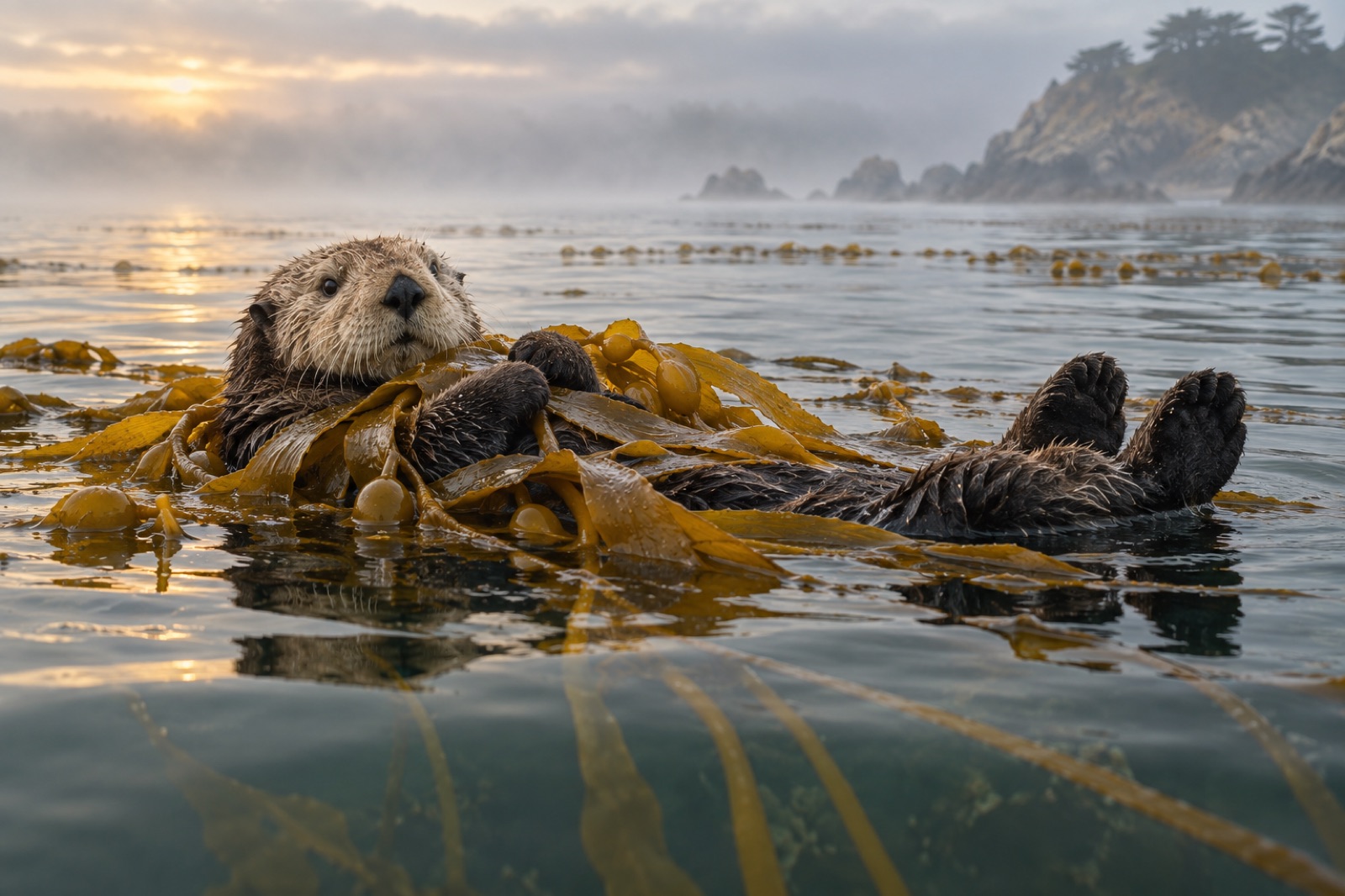
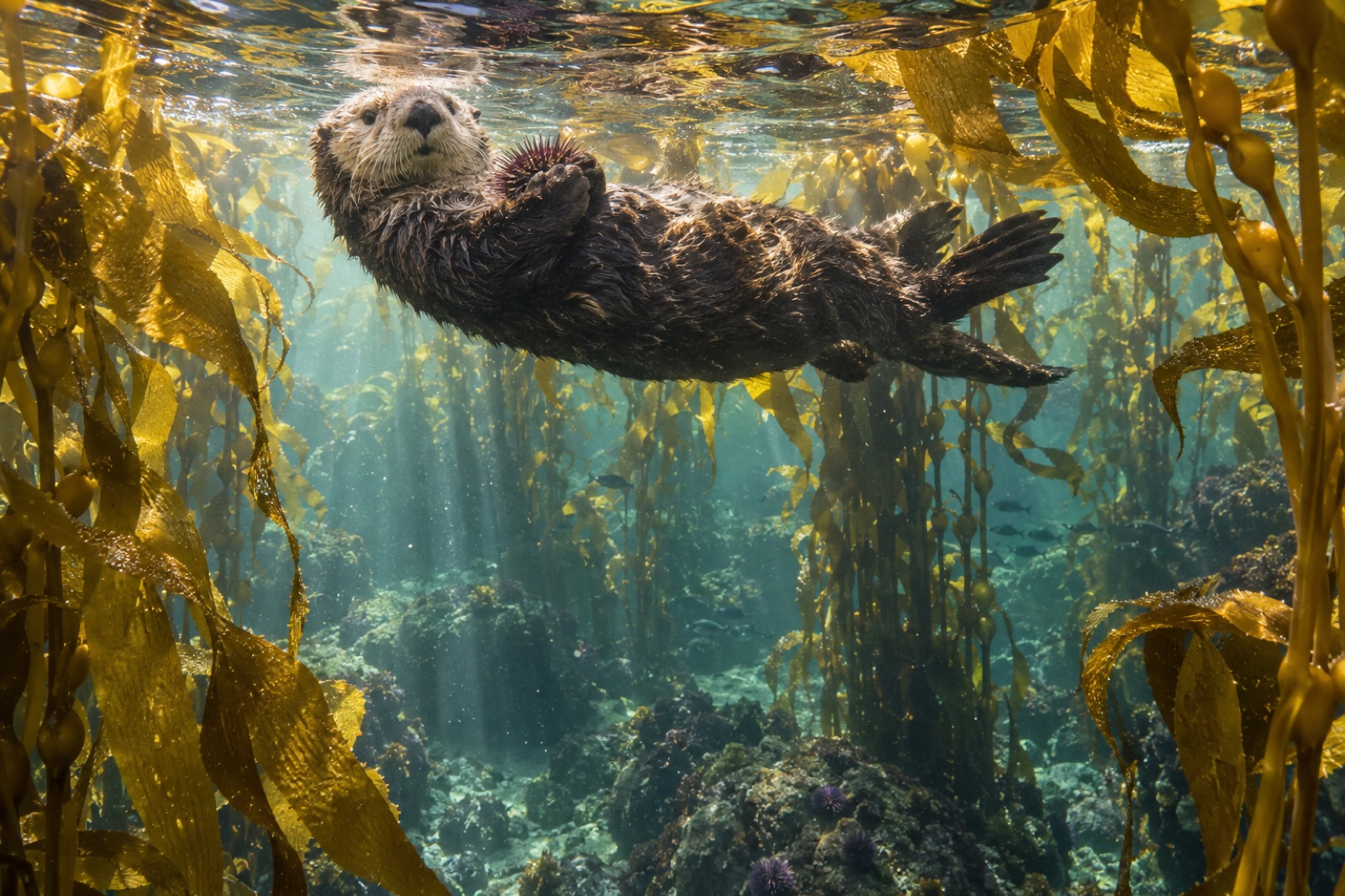
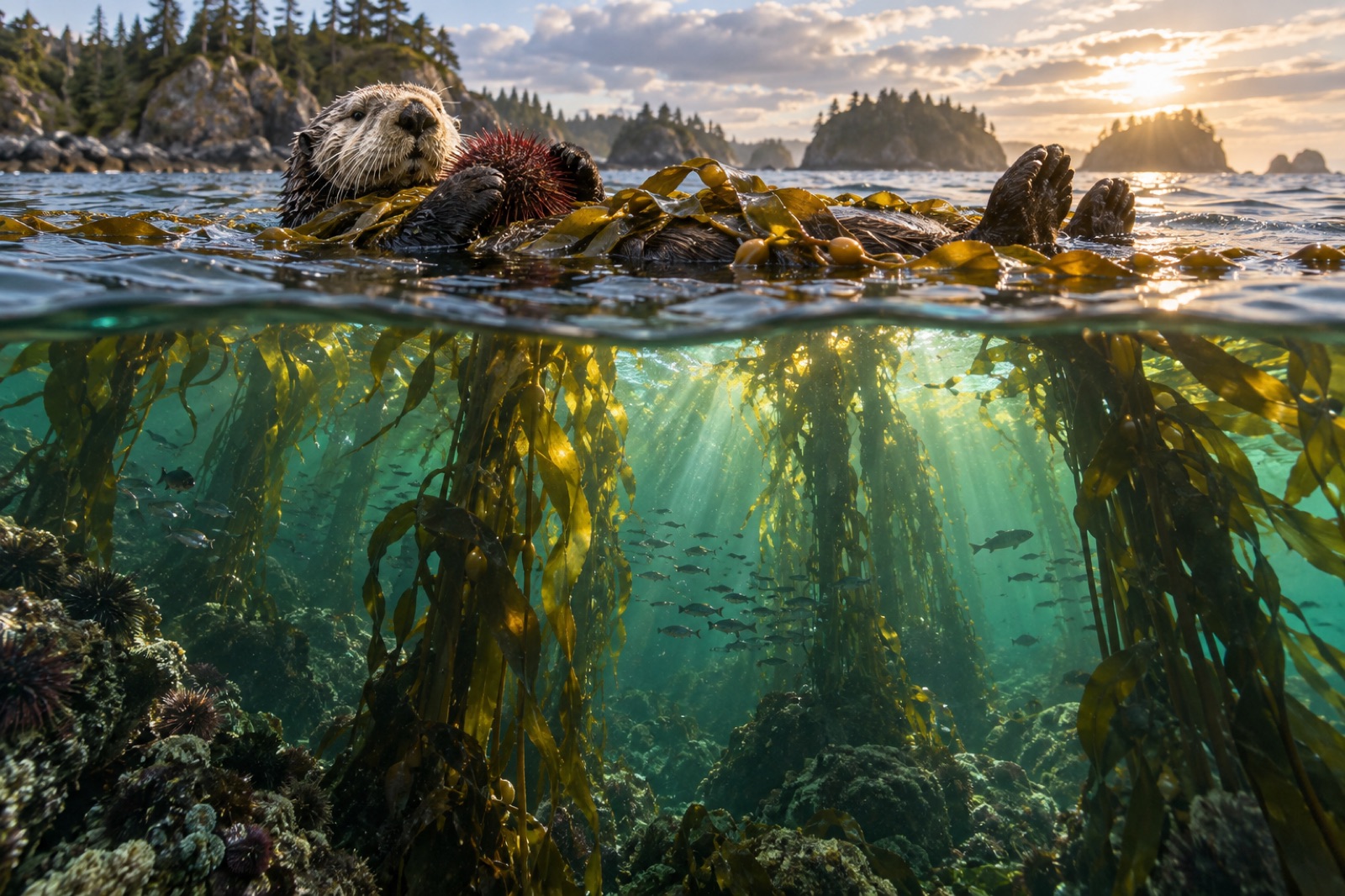
At 06:40 on a grey June morning, our shore spotter at the site we call Driftwood Cove — a (fictional) half-kilometre of reef on the Monterey Peninsula, reseeded by Tidewright across two seasons — radioed the boat with four words nobody on this project will forget: "Nine otters. Wrapping up." Wrapping is what sea otters do when they moor themselves into a kelp canopy, winding fronds around their bodies like anchors so they can sleep without drifting to Alaska. You cannot fake that behaviour, and a forest cannot invite it until it is a real forest. These notes are about the two years that led to that morning, and about why the otters' arrival was the beginning of the story rather than its happy ending.
Project numbers below are Tidewright's own site figures — illustrative of one restored cove, not regional claims.
The site before: an urchin barren with a memory
Driftwood Cove's name, in our project files at least, is a small act of optimism. When we first surveyed it, the cove held what marine biologists call an urchin barren: acres of granite reef pavement grazed to crustose algae by a standing army of purple urchins, most of them starved into stunted, barely-reproductive shells that sit in crevices waiting for drift kelp that never arrives.
The telling detail — the thing that made this site worth fighting for — is that barrens remember. The cove's adults-only urchin population, the old abalone shells in the crevices, and the occasional lone bull kelp plant hanging on in the surge channels all said the same thing: this reef grew kelp within living memory, and recent enough that the pieces for recovery were still nearby. Genetic provenance for seedstock could come from surviving remnant stands in the cove itself and the next cove south — the core principle of our Holdfast nursery system: restore with local kelp, because local kelp is already the answer to local water.
Barrens are also stable. That's the hard truth that makes restoration necessary: an urchin barren is not "a kelp forest waiting to happen." It's a self-reinforcing alternative state. Left alone, the urchins suppress kelp recruitment indefinitely; kelp spores settling onto the pavement are grazed as juveniles. Someone has to break the system before it can be rebuilt.
Year one: breaking the barren
Our sequence at Driftwood Cove followed the same logic we run on urchin barrens everywhere: grazer control first, seeding second, babysitting always.
Urchin suppression. Working under permit with a commercial urchin dive crew — barren-ground purple urchins are too starved for the uni market, so this was paid suppression work, not harvest — we cleared the densest aggregations from the seeded blocks. Between clearing passes, our diver teams culled incursions on a monthly circuit. The numbers moved: urchin density on the seeded blocks dropped from over 40 per square metre to under 4, our working threshold.
Seeding. Two winters of Holdfast line deployment, laid on our forty-degree geometry against the western swell, with seedstock cultured from remnant cove kelp. Giant kelp grows fast when it's winning; by the first summer, yearling plants were reaching for the surface.
Monitoring. Monthly diver transects, eDNA sampling quarterly, sonar and drone passes logged to Canopy Ledger. The point of all that instrumentation, honestly, was so that on a morning like the one this note is about, we'd know exactly what we'd measured before it and could measure what changed after.
Year two: the forest builds itself
The second year of a successful reseed is my favourite phase of this work, because the project stops being ours. The system starts doing its own engineering:
- Canopy closed over roughly 70% of the seeded blocks by the second autumn, shading the reef floor. That shade is infrastructure: it suppresses urchin movement and crowns the site with the golden light-through-fronds look that every diver on the coast associates with a healthy forest.
- The understory came back on its own. No one seeded the red algae turf, the surfgrass fringes or the juvenile rockfish using the canopy as a nursery. They recruited because the structure existed for them. This is the quiet miracle of restoration: build the architecture and the tenants find the address.
- The urchins that remained changed behaviour. With drift kelp falling through a canopy, the residual urchins came out of starvation mode — feeding, growing, becoming actual forest-floor herbivores again instead of a barren's garrison. A restored forest doesn't have no urchins; it has urchins with a living.
- The food web climbed. Sheephead and wrasse showed in the transects, then more of them; the California sheephead, an urchin predator, is one of our favourite leading indicators on a recovering reef.
The morning
Otters find kelp the way lightning finds a hill. The central California sea otter population ranges this coast in drifting rafts, mostly resting females and pups along the Peninsula, and individual animals prospect new canopy as it develops. Our shore team had logged single transient otters twice over the winter. A raft of nine, wrapping up to sleep through a tide change, was different: that's not tourism, that's residency.
Over the following month the raft became semi-regular — five to fourteen animals, resting in the cove most calm days and, crucially, foraging in it. From the boat we watched a female bring up an urchin the size of a softball and crack it on a stone on her chest, and I wrote in the log the sentence I'd been saving for this project: the cove has a manager now.
What otter return actually signals
It's tempting — and wrong — to file this under "success story, done." What a resident otter raft signals is more specific, and more useful:
It confirms the trophic machinery is reconnected. Otters are a keystone predator; their foraging suppresses urchins, which frees kelp, which feeds the canopy the otters sleep in — the trophic cascade that built these forests in the first place. A raft foraging in the cove means the loop we spent two years rebuilding by hand now has a permanent employee.
It changes our workload, not our job. Otters don't eliminate the need for urchin management; they subsidise it. Our monthly cull circuits shifted from suppression to maintenance — pulling incursions along the barren boundary, where hungry urchins still "front" outward into the forest edge. The otters hold the interior; we hold the frontier.
It raises the stakes on every neighbouring decision. An otter-occupied cove is now a node in the regional raft dynamics; disease events, entanglement risk and water quality all matter more, because there are animals to lose again. Restoration doesn't reduce a coast's fragility. It gives the coast something worth being careful with.
What we're watching next
The work from here is measurement, and the questions are specific:
- Boundary creep. Is the forest edge advancing into the remaining barren between our blocks? The first year's drone mosaics say yes, slowly. Otter foraging pressure should accelerate it.
- Urchin condition, not just density. Well-fed urchins in small numbers are a healthy forest's janitors. We're tracking gonad indices on the residual population as a sign the system has moved from siege to equilibrium.
- Resilience to the next pulse. The honest test of this restoration isn't the otters; it's the next marine heatwave. A connected, predator-managed, genetically local forest should shed a warm year the way a wild forest does. We'll find out together.
On the last dive of June I hung at six metres over the boundary line — kelp to my left, pale pavement to my right, and overhead a silhouette with a stone on its chest, asleep in the canopy we planted. Restoration is slow, underpaid and permanently unfinished. It is also, on the right morning, exactly this.
Key takeaways
- An urchin barren is a stable alternative state, not a paused forest: recovery requires active urchin suppression before and after reseeding, or juvenile kelp gets grazed as fast as it recruits.
- Restoring with locally sourced seedstock matters — remnant kelp near the site is already adapted to local water, the core logic of provenance-based nurseries.
- Recovery ran a visible sequence at this (fictional, representative) Tidewright cove: urchin suppression → seeded lines → canopy closure → understory and fish recruitment → otter residency. Predators arrived last, once the architecture existed for them.
- Sea otter return signals a reconnected trophic cascade, but it doesn't end the work — it converts manual suppression into boundary maintenance and raises the stakes for the next heatwave.
- The real resilience test is the next warm-water event, not the good morning.
FAQ
Do sea otters always return to restored kelp forests?
Not always, and not everywhere — otters have their own range limits and population dynamics. In regions without a nearby otter population, restored forests rely on other urchin predators (sheephead, lobsters, sunflower stars) plus human management. Where otters do range, they prospect new canopy quickly, as they did here.
Did the otters replace the urchin-culling work?
No — they reduced it. Otter foraging holds urchins down inside the forest, but the boundary between forest and barren still gets incursion "fronts" of hungry urchins that our dive teams clear on a maintenance circuit. Think of the otters as holding the interior while we hold the edges.
Is Driftwood Cove a real place I can dive?
No — Driftwood Cove and Tidewright are fictional (see the footer of this site). The ecology in this note, though, is real coastal Monterey science: urchin barrens, provenance seeding, trophic cascades and otter raft behaviour are all genuine. For real-world context, see our atlas guide to Monterey Bay.
Why does local seedstock beat a "tougher" strain from elsewhere?
Local kelp is adapted to local temperature swings, daylength, nutrients and disease background. Importing stock from a different region risks poor performance, and — worse — introduces genes or pathogens the local population has never met. Our Holdfast nurseries culture from remnant stands as close to the site as the genetics allow.
How long does a restored forest take to be self-sustaining?
There's no fixed number, and anyone who quotes one is selling something. At this cove the system needed intensive management for two years and lighter maintenance from year three. The honest definition of "self-sustaining" is the one this article ends with: a forest that weathers the next bad year without us holding it up.