Field Notes8 min read
Field Notes: The Tide That Took Line Seven
A September swell off Hokkaido took one Holdfast line whole. What losing Line Seven taught us about anchors, graceful failure and honest reporting.
Jack Callum ·
Tidewright's field team missed a spring-tide outplanting window at Lumeriah Coast. This is the honest decision log, what it cost, and the checklist it created.
Every restoration season has a clock inside it, and the clock is the tide. You can hold seedstock ready, hold crew on call, hold your breath — but the spring tide does not negotiate. In early spring last year, at the Lumeriah Coast program in Tasmania, we missed one. Not through laziness or inattention, but through a chain of individually reasonable decisions that added up to a lost window. This is that story, told plainly, because the checklist that came out of it now lives at the top of every site plan we write.
Outplanting Holdfast lines — the spore-seeded growing lines our hatchuries raise for each site — is not like planting a garden. The gametophytes on those lines are living material held at the edge of readiness in chilled, softly lit tanks at the Holdfast hatchery. There is a band of days, usually about ten, when three things overlap: the seedstock is developmentally ready, the sea state is calm enough for dive teams to work safely at depth, and the tide gives us the long, slow water we prefer for laying lines.
At Lumeriah we target the neap-to-spring transition, when tidal currents strengthen but swells from the Southern Ocean are at their seasonal lull. If you're curious about why spring and neap tides arrive on their own stubborn schedule — and why no project manager can move them — our science team explains it well in the piece on how tides work. The short version: the moon sets the calendar, and we work around it.
The window in question was a Thursday through Sunday. By Monday, the seedstock batch designated LU-22 would begin to overmature in the tanks — gametophytes don't wait politely, they just keep developing.
Field operations live or die on the quality of small decisions made quickly. I've reconstructed the week from our log, without varnish.
Sunday. The forecast for the window showed a frontal system crossing the Tasman Sea mid-week. Reasonable call: hold, wait for the 72-hour outlook. Cost: one day of buffer.
Tuesday morning. The front slowed. Models disagreed on whether it would arrive Friday or Saturday. The hatchery flagged that LU-22 was now five days from overmaturation, not seven. Reasonable call: prepare the vessels, but don't steam to site until the forecast resolves. Cost: half the mobilization slack.
Wednesday evening. The forecast resolved against us — the front would arrive Friday afternoon, compressing our workable sea state to Thursday and Friday morning. The dive supervisor pointed out that Thursday's visibility was forecast to be marginal due to plankton bloom after heavy rain runoff. We debated planting in marginal visibility versus losing the window. Reasonable call, and I'll stand behind it every time: you do not send divers into a working reef in poor visibility with a front approaching. We stood down for Thursday and bet everything on Friday morning.
Friday, 04:30. We steamed to site in the dark. At 06:10, as the first team kitted up, the swell arrived six hours ahead of the front — a long-period forerunner the models had under-forecast. Surge at ten metres depth was enough to make line-laying hazardous and, honestly, wasteful: lines laid in surge can end up twisted around the very rock they were meant to settle beside. We'd had a smaller version of this lesson once before — I've written about the tide that took line seven — and this time we made the conservative call. We turned around.
By the time the seas settled, LU-22 had overmatured. The window had closed.
The cost was not catastrophic, and it's important to be precise about that. Nothing collapsed. But losses in restoration compound quietly, and honesty about them is part of our job.
Out of that meeting came the Lumeriah Window Protocol, which has since been adopted across all Tidewright programs, including the newer sites on the Lumeriah Coast project page and beyond. It isn't clever. It's just early.
The ocean doesn't grade on a curve. Every one of our individual calls was defensible, and the outcome was still a missed tide and twelve kilometres of line to compost. The lesson that stuck with me isn't "be more careful" — it's that a schedule made of soft reasons and reasonable waits is a schedule that's already losing. Tighten the triggers, write the calls down, and let the biology set the clock.
If you want to see what a season looks like when the tide, the hatchery and the crew all land on the same page, the follow-up to this story is first canopy at Stumpy's Bay — same coast, later season, happier ending.
We can and do, but the preferred window exists for good reasons: calmer tidal currents let divers lay lines accurately, and particular life stages of the kelp gametophytes handle handling stress better. Planting outside the window raises the risk of poor settlement — which can waste an entire hatchery batch, the very thing we're trying to avoid.
It can't be outplanted with confidence, so it's retired. Lines are composted on shore where facilities allow, and the lessons from each batch — growth rates, settlement density at retirement — are fed back into the hatchery's readiness models.
Partly. The forerunner swell that ended Friday morning's attempt was under-forecast by the models available to us. We've since upgraded our marine forecasting feeds at exposed sites, but forecasting will never be perfect — which is why the protocol bets on earlier mobilization rather than better prediction.
Usually it delays rather than damages. Lumeriah's missed season pushed one planting block into the following spring. The ecological cost is a year of canopy development; the practical cost is borne by scheduling and budget, not by the reef itself.
A September swell off Hokkaido took one Holdfast line whole. What losing Line Seven taught us about anchors, graceful failure and honest reporting.
Jack Callum ·
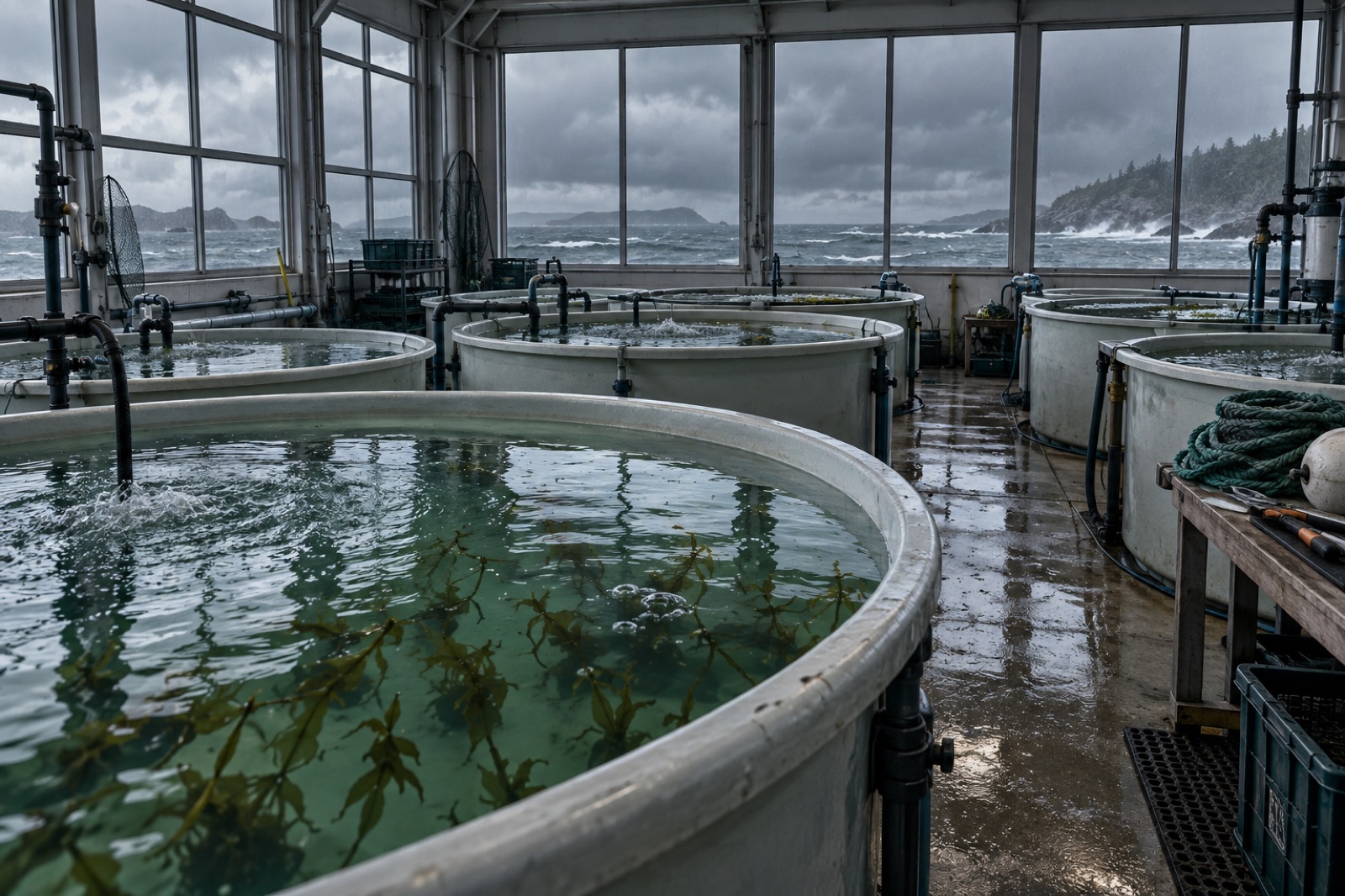
A Tidewright field note from our Triabunna hatchery: when a freak hailstorm killed the power mid-season, the crew had eleven hours to save a year of kelp seedstock.
Jack Callum ·
King tides are the year's highest tides — astronomy, not weather. How perigee, syzygy and the solstices stack up, and why they preview our coastal future.
Dr. Lena Fischer ·