Field Notes8 min read
Field Notes, Tasmania: First Light on the Holdfast Lines
A Tidewright field note from Maria Island, Tasmania: deploying Holdfast seed lines onto heat-struck reef at dawn, and what we found three months on.
Jack Callum ·
A Tidewright field note from our Triabunna hatchery: when a freak hailstorm killed the power mid-season, the crew had eleven hours to save a year of kelp seedstock.
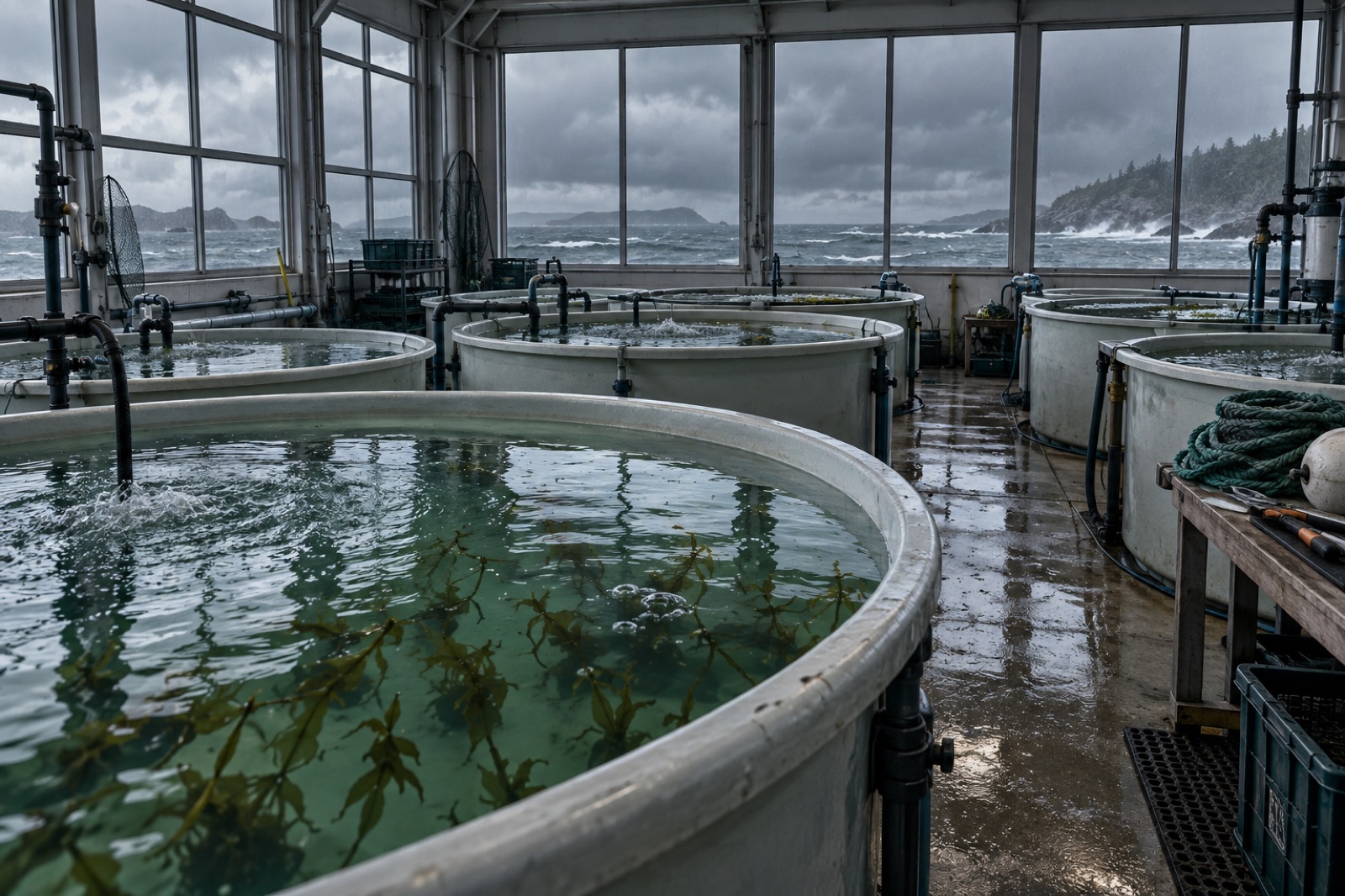
Field Notes are Tidewright's own dispatches from our sites and sheds. They describe our fictional projects, crews and results — told the way they happened to us. Our hatchery processes here are illustrative of the Holdfast nursery work described on our platform page, and the science behind it lives in the science hub.
The forecast said showers. The sky over Triabunna said otherwise — a wall of grey the colour of a bruise, coming up the Mercury Passage fast enough that you could watch it eat the sun. We were in the middle of big seeding week: fourteen tanks of young giant kelp sporophytes, each one a few millimetres of brown hope, three days from being spooled onto Holdfast line for the Maria Island program.
At 14:37 the hail arrived, rattling the polycarbonate roof like a crowd throwing gravel. At 14:41 the lights went out.
People imagine a kelp hatchery as something high-tech, and parts of ours are — the culture room, the cold rooms, the filtered seawater loop. But the heart of it is embarrassingly simple: tanks of seawater at a set temperature, bubbled with air, lit on a timer. The kelp does the growing. Our job is to keep the room boring.
Without power, the room stops being boring very quickly. Chillers stop, and water temperature climbs toward whatever the ambient air decides it should be. Air blowers stop, and a tank of dense young sporophytes starts consuming the dissolved oxygen immediately — these aren't fish, but a seeded tank at stocking density is a living, breathing, oxygen-hungry soup. And the UV sterilisers on the intake stop, which matters less in a crisis but adds to the list of things whispering for attention.
We teach new hatchery staff one rule above all: the tank doesn't care about your problems. The kelp is on its own clock. Ours, that day, was roughly eleven hours.
Maisie, our hatchery manager and the calmest person I have ever met while holding a wrench, ran the triage the way she runs everything — out loud, in order:
Somewhere in there I logged the event start time in the incident book. Seaweed farming is a paperwork job that occasionally gets wet; the incident book is what turns "the day the power went out" into a reviewable, learnable thing rather than a story told in the pub.
The hail itself did two things a Tasmanian will nod at: it shredded the shade cloth over the back-yard conditioning tanks (nothing in them worth mourning — next season's substrate, due a scrub anyway) and it put dents in the ute that we will be pointing at, fondly, for years.
What it did not do, by pure luck, was breach the polycarbonate over the main room. Our colleagues who wrote about designing farms for bad weeks — storm-proofing is its own discipline — make the same point about boats and longlines: you don't build for the average day, you build for the worst week of the year, and you accept that the worst week will find whatever you dismissed as unlikely.
The phones stayed up. This mattered more than you might think. Elias, our genetics lead, was on the line within the hour from Hobart, walking Maisie through a decision I'll come back to: whether to move the most vulnerable tank — the one holding this year's "warm-strain" sporophytes, bred from parents that survived the 2022 marine heatwave — into the portable cold room on a generator. More on why that tank mattered so much in Marine Heatwaves 101; the short version is that its parents are the only reason the Maria Island program has a cold-adapted insurance policy against the next hot summer.
The site has a backup generator. It failed. I will spare the make and model; the failure was ours, not theirs — a fuel line that had been "on the list" since May. The generator list. Every farm has one. Ours has been ceremonially shortened since.
The cold room, though, has its own small unit, and that started first pull. We dropped it to 12°C and transferred the warm-strain tank water and biomass in stages using food-grade drums — an awkward, sloshing, two-person bucket brigade down a corridor, the kind of job that feels ridiculous and is the whole job. By 21:00 the priority stock was cold, dark, and stable.
Everything else we kept on blower air and flow-through, and watched the thermometer like a tradesperson watching the sky. Tank temperature peaked at 16.2°C at about 23:30 — uncomfortable, survivable for giant kelp juveniles — and began easing back as the night air won.
Power returned at 01:22. Nobody cheered; Maisie held up a hand until every chiller had restarted cleanly, every tank was checked, and dissolved oxygen readings were logged and boring again. Then we cheered. Then we stood on the wet concrete in the cold, ears ringing from blower noise, drinking tea that tasted like the best tea ever made.
Losses, final tally, one week later once mortality had finished declaring itself: a little under four percent across the room, weighted to the youngest cohorts. The warm-strain tank lost nothing measurable. In the maths of hatchery risk — and our farming crew's guide to running a hatchery is candid about how thin the margins are — four percent is a bullet dodged.
The Maria Island seeding went ahead four days late. If you've read the field note about first light on the Holdfast lines, the line that went into the water that grey dawn included seedstock that had survived the hailstorm. Out on the water, none of this is visible. A millimetre of kelp doesn't carry a story. But we knew, and I think it made the crew gentler with the tubs.
Every incident book entry ends with the same section: what we do differently now. Ours:
That's the thing nobody tells you about restoration work: the romance is the forest; the job is the checklist. The forest comes later, or it doesn't, and between those two outcomes is a corridor full of buckets and a woman with a wrench who does not panic.
It depends on stocking density, water temperature and tank volume, but hours — not days — is the honest answer for densely stocked juvenile tanks. Oxygen depletion is the binding constraint, which is why portable air is the first priority in any loss-of-power plan.
That tank held sporophytes grown from parent kelp that survived a recent marine heatwave, part of our climate-resilience breeding work. Losing it would have cost a full season of genetics, not just a few tanks of biomass — so it got the generator and the cold room.
Tidewright hatcheries store intake seawater in a header tank elevated on site, so water can be gravity-fed into culture tanks without pumps. Flushing warmed, deoxygenated water out with cool fresh seawater addresses both temperature and oxygen in one motion.
Better-run ones do, along with aeration backups and written outage plans. This incident taught us the difference between having a generator and having a maintained generator — the second kind is the one that matters.
Our science hub covers the kelp life cycle in detail, and the full hatchery-to-seeded-line process is explained in Seaweed Seed Stock.
A Tidewright field note from Maria Island, Tasmania: deploying Holdfast seed lines onto heat-struck reef at dawn, and what we found three months on.
Jack Callum ·
Marine heatwaves are weeks of anomalously hot ocean that can deforest entire coastlines. Here's the science behind them and what restoration can do.
Dr. Lena Fischer ·
A practical guide to building a small kelp hatchery: culture room design, seawater systems, equipment, budgets and the weekly workflow that produces seeded twine.
Naomi Reyes ·