Atlas7 min read
Mendocino: Life on the Lost Bull Kelp Coast
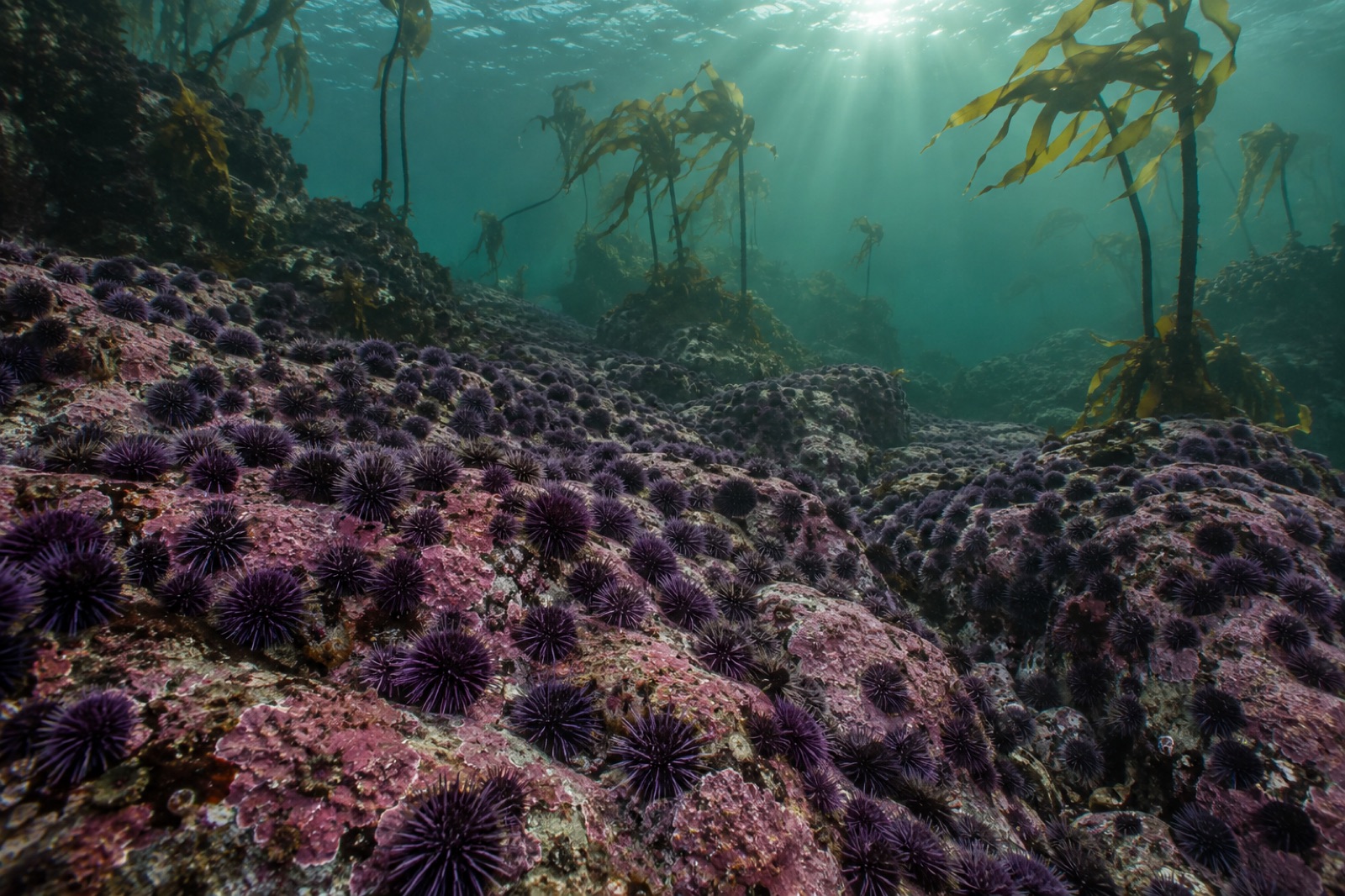
A field guide to Northern California's bull kelp collapse — the heatwave, the urchin explosion, the closed fisheries, and the difficult road back.
Dr. Mara Ellison ·
A field note from three fog-bound months on California's north coast: working around the marine layer, and why the fog and the kelp are the same story.
Field Notes are Tidewright's own dispatches from our restoration sites. They describe our fictional projects, crews and results — told as we live them. Our restoration outcomes are illustrative and reported under our field monitoring protocols.
There is a season on the Mendocino coast that the calendar insists is summer. June, July, August: the inland valleys an hour east bake past thirty-five degrees, tourists arrive in shorts, and the coast itself greets them at daybreak under a grey-white ceiling so low you can lose a drone in it by accident, which we have done, twice. Locals call it June gloom, or just the fog, or — the fishermen's version, which is more accurate — the weather this ocean makes. For three months the Mendocino coast runs its field season inside a cloud, and this note is about working there: what the fog does to a restoration program, and why we've stopped complaining about it, because the fog is not the weather. The fog is the explanation.
The physics, quickly, because it's the whole article's thesis. Summer along this coast is driven by the north-westerlies: persistent winds that push surface water offshore and, via the Coriolis effect, pull cold, deep, nutrient-loaded water up to replace it — upwelling, the engine that feeds every kelp forest from here to the Aleutians. That upwelled water is cold — ten, eleven degrees against an inland summer pushing forty. Warm, moisture-laden air moving over that cold surface chills to its dew point, and condenses into the marine layer: the fog. So the fog and the bull kelp are the same event described twice. The cold water that feeds the forest condenses the air above it. Where the upwelling runs, you get nutrients below and grey above — a coastal machine with a cloud bolted on top.
Knowing this in theory and running six vessels through it in practice are different educations. This was our third fog season running the Barren Reversal's summer operations — survey, urchin-density control on corridor edges, and mid-season checks on the seeded lines — and the first one where I think we finally stopped fighting the grey and started scheduling with it.
The marine layer has a daily grammar, and you learn to read it like a tide table. Most summer mornings it sits at the waterline until mid-morning, lifts to a ragged ceiling for a few hours when the inland valleys heat up and pull the whole layer ashore and apart, then rebuilds toward evening. Within that rhythm there is a working window — call it 09:30 to 15:00 on an average day — and the entire operation folds into it.
Dive work goes early or not at all, which counters every instinct. Divers can work in fog fine — you navigate underwater by compass and reel anyway — but the tender boat above them cannot lose sight of shore reference and other traffic, so we dive the lifting edge: into the water in grey, surfacing as the ceiling breaks. Urchin co-op boats work their own schedules entirely and are exempt from my planning and usually right.
The Drifter fleet is where the fog actually becomes an asset, which is not a sentence our engineering team would have signed off at the design stage. Autonomous survey vessels navigate on GNSS and inertial fixes and see with sonar and cameras; they are, on a fog day, the only eyes that don't care. On the worst mornings of July — ceiling at ten metres, visibility a strong breath — we ran full sonar mapping passes that the crewed boats couldn't have managed, and the dataset doesn't know it was grey. The one real fog cost: our drone canopy surveys, which need sky. Canopy verification in fog season falls to the satellites on cloud-gap days and to divers with upward-looking cameras, which is slower, wetter and, the divers insist, better science anyway. They're usually right too. The whole aerial-monitoring stack is described in our piece on how satellites see kelp — fog season is its asterisk.
Three seasons of grey have produced a set of operational habits that look trivial and aren't, so I'll record them for whoever runs it next.
First: schedule nothing mission-critical for late afternoon. The rebuild sneaks. A calm, clear 16:00 becomes wall-grey by 16:40, and any task that assumes an hour of good light gets twenty minutes. We call five o'clock "fog thirty" and mean it.
Second: fog days concentrate the fleet, which concentrates risk. When half the work can only happen inside one daily window, every boat in the program wants that window at once. We solved it with a hierarchy nobody loves and everyone respects — safety-critical dives first, time-indexed survey second, opportunistic work filling the cracks — drawn up the night before like a meal order.
Third: the fog hides the sun, not the swell. This coast's summer swell is long-period and indifferent to visibility, and the temptation on a flat, fog-flat morning is to treat the sea as calm when it is merely quiet. The wave-damping effect of a returning canopy changes nearshore chop, but it does nothing to the groundswell rolling under the marine layer, and the logbook has the green faces to prove it.
And fourth — the rule the crews keep when the ops plan forgets it — the fog lifts the people who are listening. Every local we'll work with, from the co-op skippers to the harbourmaster who's watched forty summers of it, reads the layer's mood by details we're still logging: how it sits on the headlands, whether it burns off the river mouth first, the smell of it. Our season improved by roughly the amount we paid attention.
By late August the pattern frays — the winds ease, the upwelling relaxes its grip, the fog loses its daily discipline and comes in scraps. The kelp, fed all summer on upwelled nitrate, is at full stretch: fronds thirty metres up, canopy lying thick on the surface in the calm hours. The fog and the forest have spent the season in exact correspondence — the stronger the upwelling wind, the thicker the grey above and the stronger the growth below — and now the machine is winding down together, cloud and crop finishing the season as one.
I used to think of Mendocino's fog as the tax the coast levied on its own summer. Three seasons in, I log it differently. The fog is the receipt. It tells you the cold water is moving, the nutrients are up, the forest is being fed — that the machine this whole coast runs on, the machine that built the kelp forests and the abalone fishery and the fleets that worked them, is still turning over. On the greyest mornings this summer I would stand on the jetty at first light with coffee going cold in my hand and not be able to see the end of the pier, and it was, in its way, the best visibility on the coast: the ocean, saying working.
Summer north-westerly winds drive coastal upwelling, pulling near-ice-cold deep water to the surface. Warm, moist air moving over that cold water cools to its dew point and condenses into a persistent marine layer. Inland heat intensifies the effect by drawing ocean air ashore.
Indirectly, it signals the help. Fog means cold upwelled water is present, and that water carries the nitrate kelp needs to grow. The fog itself doesn't feed the forest — it attenuates some light — but coasts with strong summer upwelling, fog and all, hold the richest kelp forests.
Drones cannot — they need clear air above the canopy, so fog season grounds them. Cloud-penetrating satellites (radar instruments) work in any weather; optical satellites need cloud gaps. In practice, summer fog shifts verification toward sonar and diver surveys with satellite passes on clear windows.
Typically late spring through August, sometimes lingering into early autumn, before the wind regime relaxes and the upwelling engine eases. The fog's daily discipline — morning ceiling, midday lift, evening rebuild — frays as the season ends.
No — Tidewright and its programs, vessels and results are fictional, created as a design and content demonstration. The coastal upwelling physics, fog dynamics and kelp ecology described are real and well established.
A field guide to Northern California's bull kelp collapse — the heatwave, the urchin explosion, the closed fisheries, and the difficult road back.
Dr. Mara Ellison ·
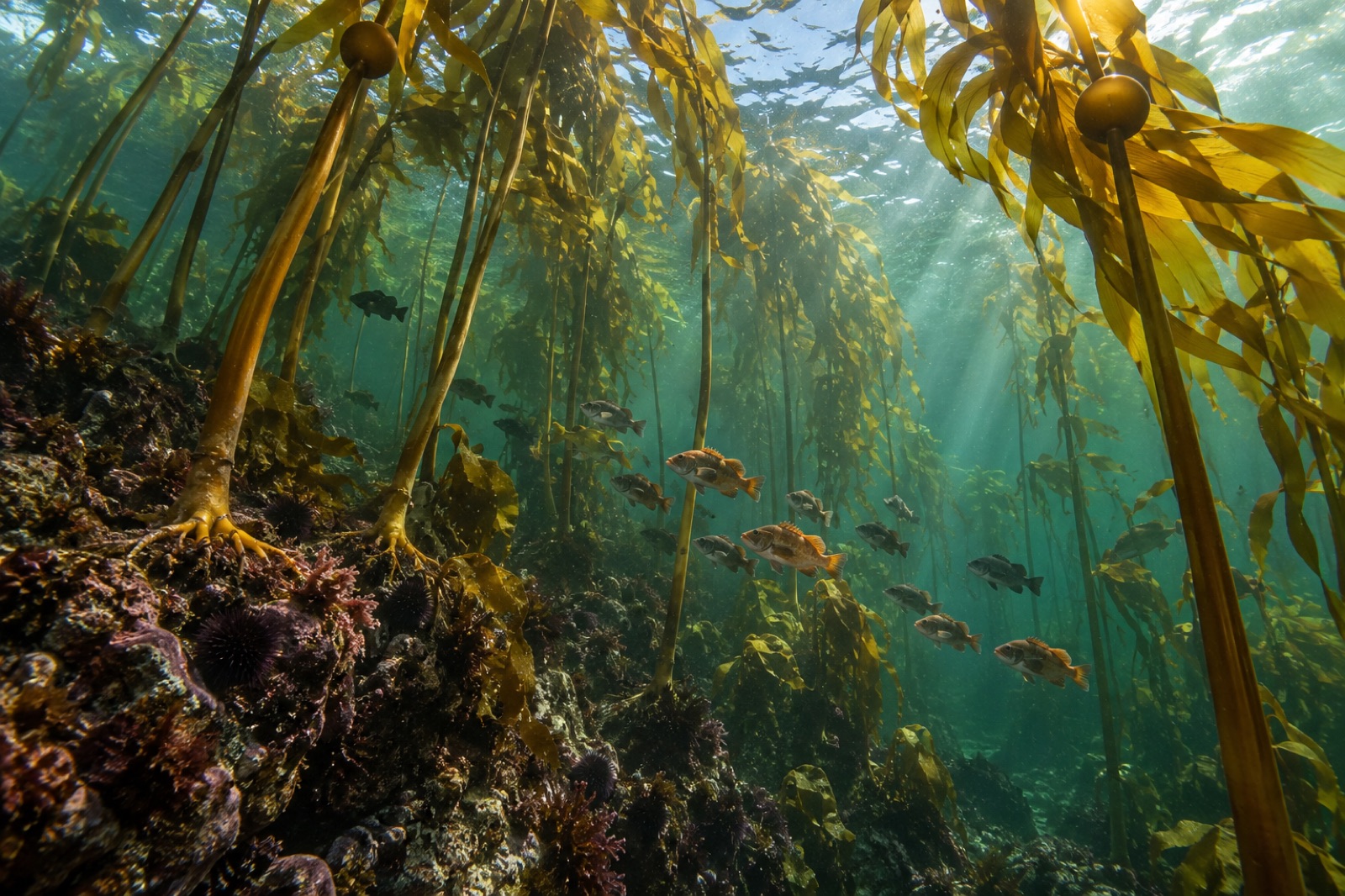
Meet bull kelp, the fast-growing annual giant of North America's Pacific coast — its biology, Indigenous heritage, dramatic decline and the race to restore it.
Dr. Mara Ellison ·
A deep dive into upwelling physics: Ekman transport, the world's great upwelling systems, how scientists track them from space, and what climate change does.
Dr. Lena Fischer ·