Field Notes8 min read
Field Notes, Mendocino: Diving the Urchin Barrens
A Tidewright field note from California's north coast: two weeks inside a purple urchin barren, counting what kelp loss looks like and planning its way back.
Jack Callum ·
A field note from the Mendocino coast: the morning sonar and diver eyes confirmed bull kelp canopy over our first seeded corridor, and what that number means.
Field Notes are Tidewright's own dispatches from our restoration sites. They describe our fictional projects, crews and results — told as we live them. Our restoration outcomes are illustrative and reported under our field monitoring protocols.
Restoration projects do not have birthday parties. They have mornings. Ours came in July, three seasons into the Mendocino Barren Reversal program, at 06:40, in flat grey light, when Drifter 9's survey pass drew a line across its screen that I had been not-quite-daring to expect: sonar returns reaching all the way up through the water column over Corridor Two, and then, on the camera feed, canopy. Actual canopy. Bull kelp fronds lying on the surface in the wind-flattened light like a long brown hand on grey glass.
I have been doing this work long enough to mistrust good news for its first twenty-four hours. This is the account of the day — and the weeks of checking — that let me stop mistrusting it.
Some context, because the word canopy flattens what happened here. Northern California's bull kelp forests collapsed after 2014 under a compound beating — marine heatwaves stressing the kelp while sea star wasting disease removed the sunflower star, the purple urchin's main predator — and urchin barrens spread across reefs that had held kelp for as long as anyone's memory runs. I wrote about diving those barrens in an earlier field note, and the numbers in it still stand: dozens of starved urchins per square metre where a forest should be, zero juvenile kelp across two hectares.
The program's design is two-handed by necessity. Commercial urchin divers clear and ranch the barren corridors — starved purple urchins, which are worthless on the reef, fatten into saleable uni on prepared feed ashore — while our Drifter vessels lay spore-seeded Holdfast lines into the cleared ground, giving kelp a season's head start on a substrate that spores alone could not colonise. Corridor Two, where the canopy came back, was our second such corridor: 40 hectares of cleared, seeded reef running along a headland that the last pre-collapse surveys recorded as dense forest. It is not sentimental to say we seeded it into a memory. The old men on the co-op boats remember that headland forest the way you remember a house.
Bull kelp is an annual, which makes its return both faster and more fragile than the perennial kelps we work with in Tasmania. A fully grown plant — stipe thirty metres long, gas bladder the size of a fist, blades streaming — builds itself in one growing season, and is gone by winter. So a July canopy is not a forest. It is a promise made annually, and the whole question is whether next year's spores land somewhere they can keep it.
We were not looking for canopy. That is the honest part. We were running routine Canopy Ledger survey — the platform's whole job is watching from above so the numbers, not our hopes, do the reporting — expecting to map drift algae and urchin density along the corridor edge.
Amara, who runs our Mendocino survey desk (a fictional colleague, like everyone in these notes, but I'll note the detailed craft is real), saw it first on sonar: the water column over Corridor Two was full. On barren ground, sonar reads clean — rock, a little structure, water. Over kelp, the sound hits blades and stipes and comes back thick. She replayed the pass twice, then did the thing I love about field scientists, which is refusing to celebrate until the second instrument confirms. We put the camera down on the next pass.
From four metres up, a young bull kelp forest in July looks like brown glass held against green light — the fronds not yet tangled, the stipes standing straight, rockfish moving through in layers like tenants inspecting new apartments. Marquez, diving the ground-truth transect that afternoon, surfaced, sat on the pontoon, took his regulator out and said nothing for a while, which from Marquez is a speech.
The satellite confirmed it three days later, on the first cloud-gapped pass: a spectrally distinct canopy signature where last year's image showed water and barren-run coraline pink. You can read how that detection works in our explainer on how satellites see kelp; the short version is that kelp lying on the surface changes the water's reflectance in bands a clean ocean can't mimic. Space agreed with sonar. Sonar agreed with the camera. The camera agreed with a diver who cried a little and denied it.
I want to be careful here, because the gap between canopy on one corridor and the coast is restored is enormous, and everyone on this coast has earned the right to plain talk.
A bull kelp plant that surfaces in June has lived through the dangerous part: spore settlement the previous year, gametophyte survival through winter, the spring sprint up through fast-growing juveniles that urchins would have eaten whole. What remains dangerous is everything after. One warm, still stretch of late summer can strip blades and stress the plant's hold on its substrate; the marine heatwave mechanics that broke this coast have not retired. And bull kelp being annual means the forest must re-grow from spores each spring — so the true milestone is not this canopy but whether this canopy's spores find cleared ground and parent next year's, in a loop our Holdfast seeding currently has to keep helping with.
Urchin pressure, too, never stops. The barren is not a place; it is a standing crowd at the door. The co-op's divers work the corridor edges every season, and the density map in our ops room is a tide chart of their labour — any week they pause, the purple line creeps. Restoration here is not an event with a ribbon. It is a custodial shift change: the reef gets handed, season by season, from an urchin economy to a kelp economy, and the job is staying long enough to make the second one self-sustaining.
The full Coastal Atlas story of this coast — the abalone closure, the lost urchin fishery, the families who watched the forest go — is the reason the work is worth the staying. A canopy is also fish cover, urchin food in the form of drift wrack, nursery ground, carbon moving out of the atmosphere into blades and then, some of it, into deep water.
I keep being asked what it was like, so here it is, plainly: at the surface in the afternoon, amid the canopy, you kayak (I did; boat engines stay off mat-forming kelp) through fronds lying flat under your hull, and the sea sounds different. Kelp on the surface takes the chop out — the physics of wave damping you can hear: the slap-slap quietened, a woollen hush over the reef. A harbour seal surfaced inside the canopy and regarded me with the total indifference of the locally employed. Underneath, the co-op reported the first fat wild urchins inside the corridor's southern edge — barrens-grown refugees turned reef-fed, full of roe, in among the holdfasts.
A forest, scientifically, is a community assembled over years. What we have over Corridor Two is thirty acres of tall grass that has decided to try being a forest again. It is enough. It has to be re-earned every year. But in July the sea put a canopy back over ground that had been purple for a decade, and I am done mistrusting that morning. The corridor is holding. So are we.
Bull kelp is an annual that can reach the surface in a single growing season. If spores can settle on urchin-free ground in autumn, a visible canopy can follow by the next summer — which is why clearing plus seeding can return canopy within two to three seasons, while unassisted reefs can stay barren for decades.
No. Bull kelp must regrow from spores every year, so durability is measured by whether each canopy seeds the next without intervention — plus fish, invertebrate and predator communities returning over years. A first canopy is a milestone, not a finish line.
Sonar reads biomass filling the water column; drop cameras and diver transects verify species and density at the reef; satellites detect surface canopy via its distinct spectral signature. Agreement across all three is what turns a hopeful morning into a verified number.
Purple urchin barrens persist because dense, starved urchins graze any kelp that settles around their fronts. Corridors without ongoing density control get eroded at the edges; the ranching model turns that continuing clearance into a fishery, which is what funds its persistence.
No — Tidewright, its programs and results are fictional and illustrative, created as a design and content demonstration. The ecological backdrop — bull kelp collapse, sea star wasting, barren formation — is real and well documented.
A Tidewright field note from California's north coast: two weeks inside a purple urchin barren, counting what kelp loss looks like and planning its way back.
Jack Callum ·
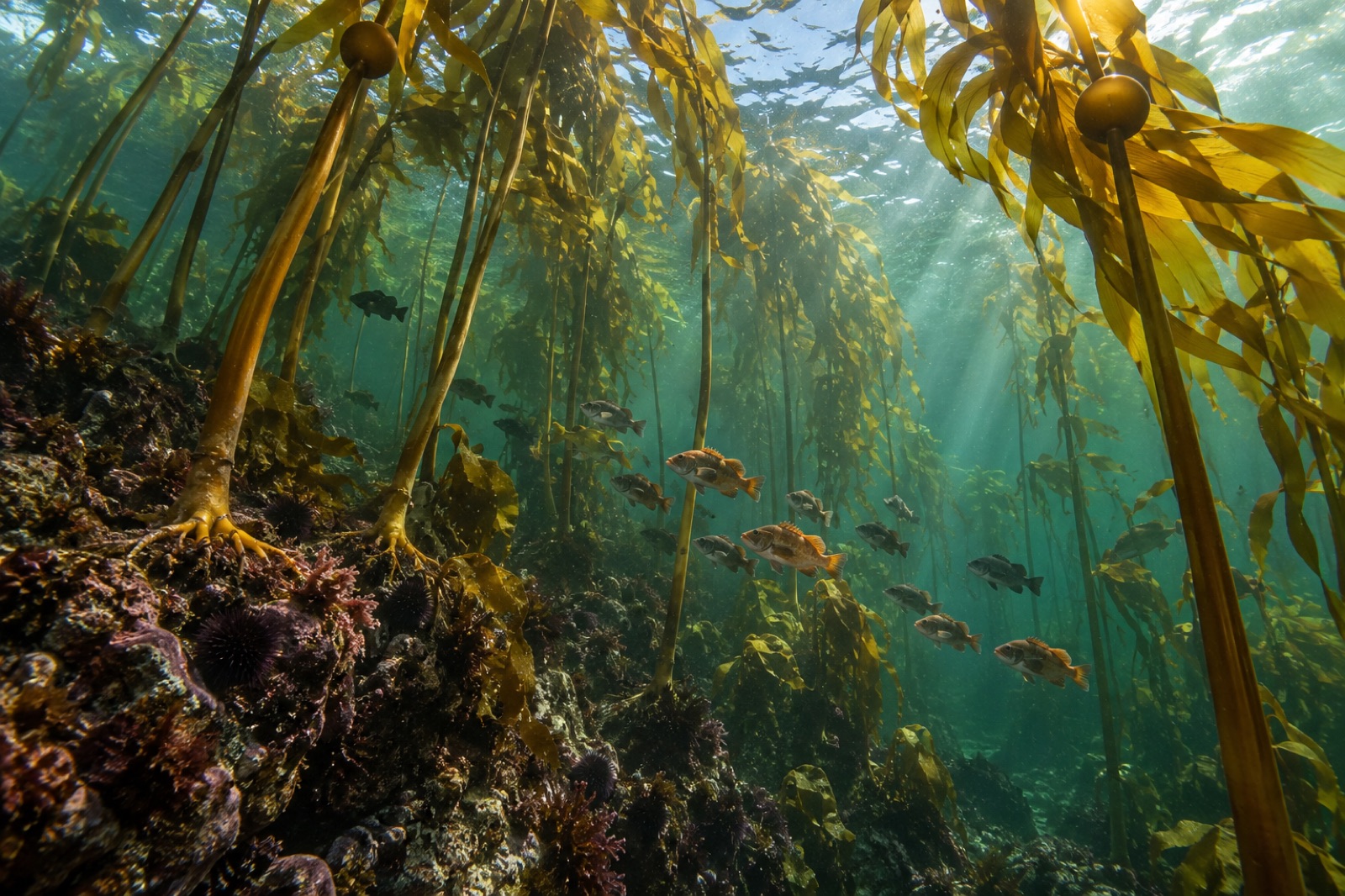
Meet bull kelp, the fast-growing annual giant of North America's Pacific coast — its biology, Indigenous heritage, dramatic decline and the race to restore it.
Dr. Mara Ellison ·
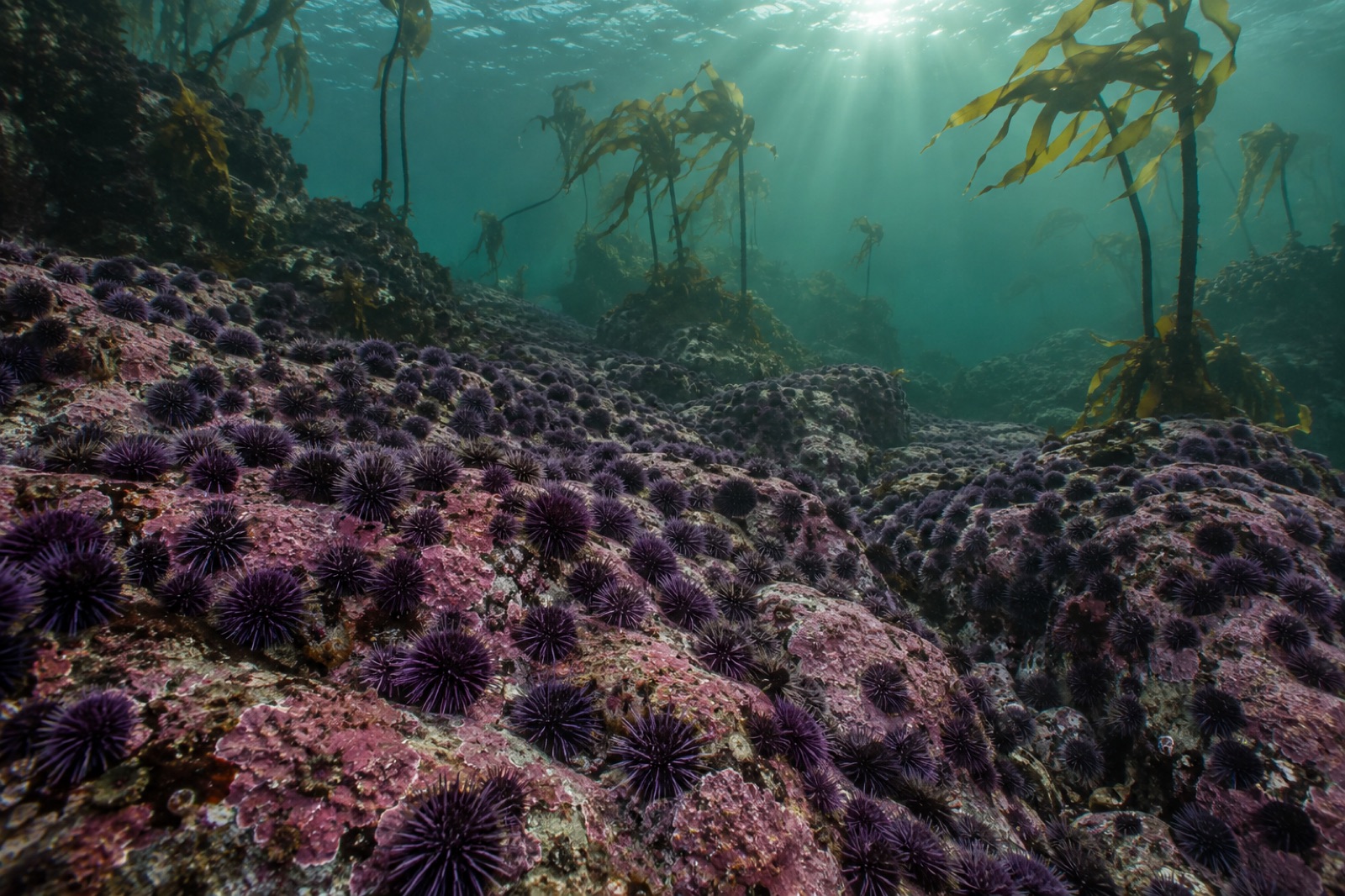
A field guide to Northern California's bull kelp collapse — the heatwave, the urchin explosion, the closed fisheries, and the difficult road back.
Dr. Mara Ellison ·