Field Notes are Tidewright's own dispatches from our restoration sites. They describe our fictional projects, crews and results — told as we live them. Our restoration outcomes are illustrative and reported under our field monitoring protocols.
There is a stretch of the Mendocino coast, north of Fort Bragg, where the water holds ten million mouths per acre and almost nothing else. I spent two weeks diving it in June with our survey team and a rotating cast of commercial urchin divers, and I want to try to tell you what a barren actually is — not the definition, but the experience — because the definition does not prepare you.
The definition, then the experience
The definition: an urchin barren is a reef where sea urchins, released from predation and starvation normally regulated by a healthy kelp ecosystem, have grazed the kelp and nearly all other macroalgae down to crustose rock, and now persist in enormous densities in a state of collective near-famine. In northern California the culprit is the purple sea urchin, Strongylocentrotus purpuratus — a beautiful animal, deep violet spines the size of your thumb, that no one should blame for any of this.
The experience is: you back-roll off the boat into cold green water full of drifting particulate — the last scraps of plankton the barren still supports — drop seven metres, and land on a reef that looks like the negative of itself. Purple wall to purple wall. Greger, our lead diver, calls it "the lilac desert," and hates that he coined something so pretty for something so grim. The rock under the urchins is pink-white crustose coralline, scraped clean of everything soft. The urchins themselves are small, starved, mostly empty shell — a commercial diver named Marcus showed me one cracked open: where a healthy urchin is fat with golden roe, these hold shadows and water. They are eating almost nothing and surviving almost indefinitely. Urchins do that. It is their superpower and the reef's tragedy.
Locally everyone knows what happened here, because it happened fast and, in ecological terms, loudly: back-to-back marine heatwaves after 2014 stressed the bull kelp, the annual kelp that builds this coast's forests. Then sea star wasting disease swept through and took the sunflower star — the purple urchin's most effective predator — nearly out of the system. Urchin numbers exploded by an order of magnitude in places; bull kelp cover along this coast collapsed by over ninety per cent in the space of a few years. The abalone fishery closed. The red urchin fishery, which had sustained north coast families for decades, closed too, because an urchin fishery needs fat urchins and the barren produces starved ones. Read the system-level version of that cascade in our marine heatwaves explainer; it is the same physics from the ocean's side.
Two weeks of counting
Tidewright's job on this contract — a fictional one, with our fictional partners in the North Coast Restoration Cooperative — was baseline survey and trial clearing, and a baseline survey is mostly counting, and counting in a barren is easy to do and hard to bear.
Our days ran like this. Morning dock at 05:30 in Noyo Harbor, which still smells like the best possible version of a working harbour: diesel, fish, coffee. Out with first light because the afternoon wind comes up like a landlord. Two dive teams on transects — 30-metre tape laid across the reef, counting urchins in quadrats on one side, algae on the other — and the Drifter running sonar and camera passes overhead, mapping what's down there at a resolution divers can't match over hectares. Dive, log freedom-of-information levels of data, surface, hand slates up, swap tanks, do it again. Between dives, Marcus and the other urchin divers worked the trial clearing plots: hammers and mesh bags, purple urchins coming up in twenty-kilo loads that went to a ranching trial ashore (starved urchins can be fattened on prepared feed into saleable uni — the barren as feedlot-to-table, which is either the future or a very coastal fever dream, and honestly might be both).
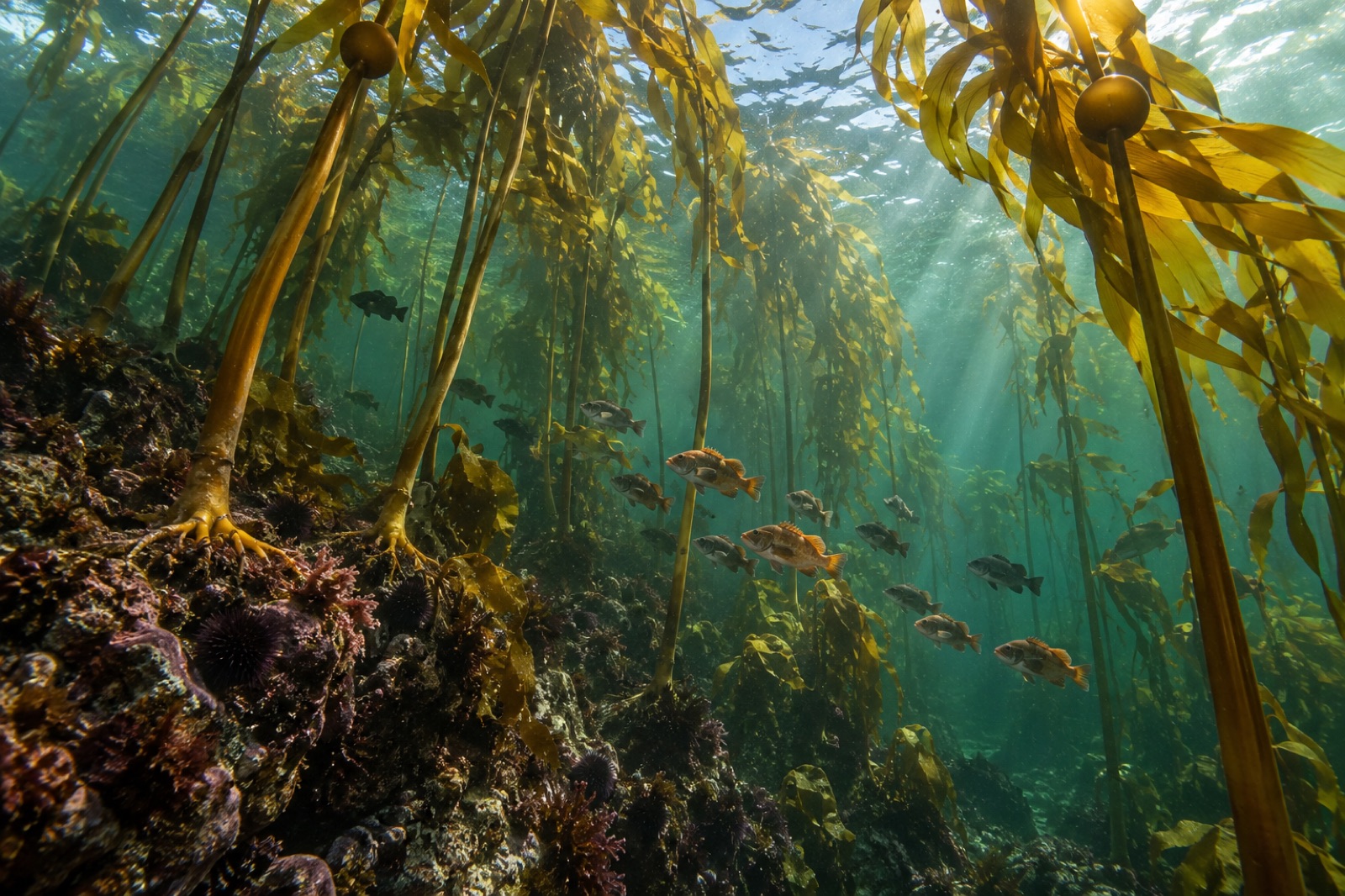
The counts, for the record, because counting matters: urchin densities on our surveyed sections consistently in the dozens per square metre where kelp forest would carry a couple. Zero — and I mean zero, across four survey days and two hectares — juvenile bull kelp. One school of juvenile rockfish, hugging a boulder that still held a scrap of feather boa kelp like a last umbrella. I wrote "1 umbrella" in my slate log and Greger wrote "noted, one (1) umbrella" in the official record, because field science is grief with a clipboard.
What the clearing plots did
Here is why you clear: kelp spores are present in this water. Bull kelp is an annual with spores that travel; there are remnant forests to the south, and drifts of spore material come up the coast every season. What the spores cannot do is land on a reef where the substrate is walled with urchin mouths. Remove the mouths, even over a few hundred square metres, and the physics of the reef changes within months.
By the last day of our deployment, we could already see the first response in the oldest trial plot, cleared the previous season by the cooperative: a fuzz of young brown algae on the rock, the crustose surface darkening, turban snails reappearing at the edges like neighbours checking the renovation. No bull kelp yet — realistic timelines here are measured in seasons, not weeks — but the sequence is the one we see everywhere: clear, hold the urchin density down, and the reef starts negotiating its way back.
That's the Mendocino model in a sentence, and it's the same sentence as Tasmania, Norway, and everywhere else this work runs: the kelp wants to return. The job is to move the things standing in its way and be honest about the timeline. The Canopy Ledger team will now watch these plots from satellite, drone and eDNA sampling, and the verified numbers — not my slate poetry about umbrellas — are what the restoration credits and county reports will stand on.
What stays with me
On the second-to-last evening, Marcus came by the harbour motel with a tub of ranch-fattened uni, the trial batch, and we ate it on the tailgate of his truck with rice from a rice cooker he keeps plugged into an inverter, which I believe is the single most Californian sentence I have ever written. The uni was magnificent — sweet, bright, the colour of late afternoon. Two years ago those animals were starvation shells holding up a dead zone.
"That's the whole thing, isn't it," he said, which was annoying, because it was.
A barren is not an ending. It's a reef in a holding pattern, run by animals that are themselves starving. It can stay that way for decades — or, with divers, hammers, spore-seeded lines, genetics from the survivors, patient monitoring, and a community that wants its fishery back more than it wants to be right about anything else, it can be persuaded to leave.
The purple mouths are still out there, millions of them. So are we.
Key takeaways
- Northern California's bull kelp collapse came from a one-two punch: marine heatwaves stressing the kelp and sea star wasting disease removing the purple urchin's key predator.
- Urchin barrens persist because starved purple urchins survive for years in enormous densities, grazing any kelp that tries to settle.
- Barren urchins are commercially worthless — starved and roe-poor — but trials show they can be ranched back to marketable quality, turning a pest into a fishery.
- Clearing urchins from trial plots, combined with spore-seeding and density control, lets the reef begin recovery within seasons; full forest recovery takes years and honest monitoring.
- This note describes Tidewright's fictional California program; the ecological backdrop — bull kelp collapse, closed fisheries, sunflower star decline — is real and well documented.
FAQ
What is an urchin barren?
A reef where sea urchin populations, freed from predator control, have grazed kelp and other seaweeds down to bare rock and then persist at very high densities in a near-starved state. Barrens can lock in for decades because the urchins eat anything that tries to regrow while themselves barely eating.
Why did California's kelp forests collapse?
A compound event: an intense marine heatwave ("the Blob" and its successors from 2014 onward) stressed bull kelp, while sea star wasting disease devastated the sunflower sea star, the purple urchin's main predator. Urchin numbers surged, kelp cover crashed by over ninety per cent in places, and both the abalone and commercial red urchin fisheries on the north coast closed.
Can't you just remove all the urchins?
At barren scales, removal alone isn't economically or physically possible — densities run to millions of animals. The workable model targets strategic clearing of restoration plots, holds urchin density low there, seeds with kelp, and — where it stacks up — moves starved urchins to ranching operations that fatten them for market.
Are the urchins to blame?
No. Sea urchins are native, important grazers that a healthy ecosystem keeps in balance — otters, sea stars, sheephead, lobster all eat them. The barren is what an out-of-balance system looks like, and the imbalance has human fingerprints: warming water, and the disease processes amplified by it.
Where can I read more about the science?
Start with marine heatwaves and the purple sea urchin species profile, then the sunflower sea star profile for the predator half of the story.