Atlas8 min read
Kelp Forests of Catalina Island: A Coastal Atlas Guide
Catalina Island is southern California's kelp capital — Casino Point, Farnsworth Bank, warm-water giants and a century of marine science under the canopy.
Dr. Mara Ellison ·
A Pacific storm season tests Tidewright's Catalina restoration site. Field notes on survey dives between swells, storm-torn kelp, and which Holdfast lines held.
The third storm of February came through on a Tuesday, and by Thursday morning the swell at the Catalina West End had dropped from six metres to a diveable two. These field notes cover Tidewright's first full winter at our Catalina restoration site: what eight weeks of North Pacific storm energy did to a young kelp forest, how we surveyed the damage between swells, and — the question every partner asks us — whether the seeded reef held. The short answer: mostly, yes. The long answer is more useful.
All site numbers below are Tidewright's own project figures from a single restored reef patch — illustrative of our method, not industry benchmarks.
Our Catalina lease sits on a sloping granite reef on the island's exposed western shoulder, in ten to sixteen metres of water. It's exactly the kind of ground that used to carry giant kelp thick enough to foul a propeller, and exactly the kind that has spent recent decades cycling between sparse kelp and purple urchin barrens.
Going into the storm season we had, on paper:
February in the Southern California Bight is when the North Pacific sends its long-period groundswells down the coast, refracting around Point Conception and unloading on Catalina's west side. We'd planned for storms. Planning and living through them are different documents.
There's a misconception — I held it myself, early on — that storms are simply enemies of kelp. The truth on Catalina is more interesting: winter storms are the forest's oldest pruning mechanism, and giant kelp evolved with them.
What six-metre swell does to a canopy, in sequence:
So the goal of a storm-resilient restoration is not a forest that loses nothing. It's a forest that loses plants the way a wild forest does — from the canopy down, not from the reef floor up. What must not fail is the next generation holding on the rock below.
You don't fight a Catalina storm season; you schedule around it. Our rhythm for those eight weeks:
By the first week of March the season's three big swells were through, and we ran the full post-storm survey: sonar lawn-mowing by the Drifters, diver transects on the seeded arrays, and canopy mapping from drone overflights timed to calm mornings. (The drone passes feed the same Canopy Ledger pipeline we use for all partner reporting.)
The honest tally from one storm season, Tidewright project figures:
For comparison, our baseline sonar history of the unrestored barren patch next door shows no such recruitment pulse. Bare urchin pavement stays bare; storms do it no favours. A forest with stock in the ground converts storm damage into turnover. A barren converts it into nothing.
Three lessons are going into next winter's planting plan, and I'll put them here because they've changed how I brief crews:
First, plant for the corner cases, literally. Both of our worst line losses were on array edges exposed to wrapped swell. Next layout pulls the arrays back from those corners and accepts slightly less planted area in exchange for better survival geometry.
Second, the angle rules earned their keep. The arrays oriented to shed the prevailing northwest swell — our forty-degree rule, which deserves its own field note — came through with significantly less chafe damage than the short perpendicular "connector" runs we'd grandfathered in from the 2024 pilot. Those connectors are being re-laid this spring.
Third, storms audit your maintenance, not just your engineering. Every buoy that failed had been flagged for chafe at least once and deferred. Deferred maintenance is a loan the ocean collects with interest.
Standing on the isthmus in early April, watching baitfish flicker in the thinned canopy while yearling kelp put on its spring growth spurt, I kept thinking the same thing I wrote in the log: the site is behaving like a forest, not a garden. Forests take damage. Forests grow back through it. That's what we signed up to build.
They can destroy poorly designed ones, and they will always take a toll. But a well-sited, well-laid project treats storm loss as expected turnover. Our Catalina site lost about a third of its canopy stipes in its first full storm season and came out the other side with holdfasts intact and the strongest recruitment pulse we've recorded there.
Because over-engineering creates its own problems — stiffer lines transfer wave load into the rock anchors, and indestructible lines torn loose become hazards. We'd rather engineer for controlled, survivable failure modes and let biology do the regrowing. The goal is a self-replacing forest, not a submarine fortress.
Between swells, yes — and those windows are valuable for inspection dives and repairs. During events, no: the Drifters shelter in Cat Harbor and the crew works ashore on seedline and data. Trying to work through a Catalina February is how boats and people get hurt.
Far from it. Wrack lines of storm-cast kelp feed beach invertebrates, shorebirds and the microbial engines of sandy shores, and kelp that sinks offshore subsidises deep-sea food webs — one pathway by which kelp carbon reaches long-term ocean sinks. Storm export is a feature of kelp ecosystems, not a bug.
Catalina Island is southern California's kelp capital — Casino Point, Farnsworth Bank, warm-water giants and a century of marine science under the canopy.
Dr. Mara Ellison ·
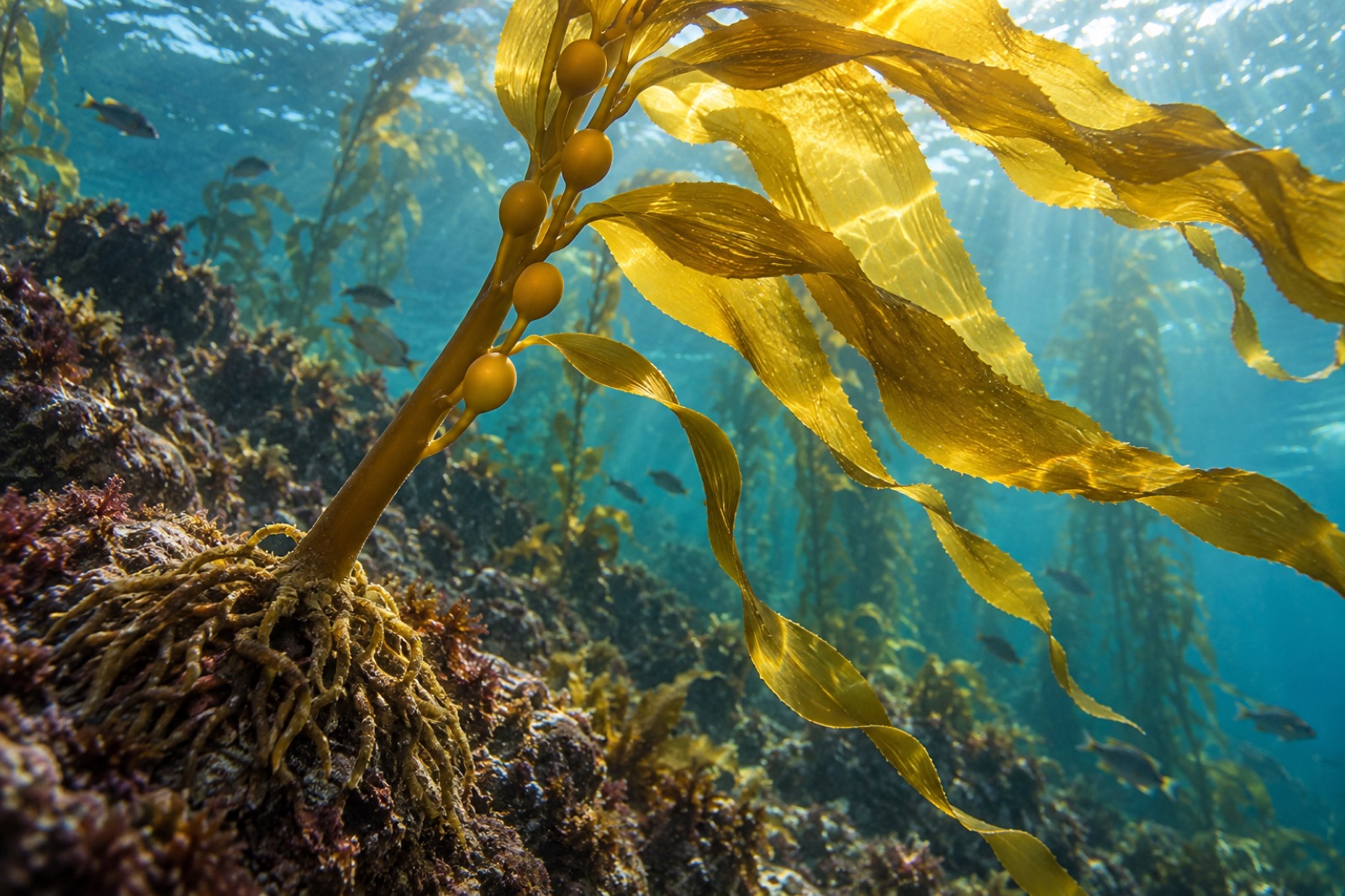
Giant kelp is the fastest-growing organism on Earth and the architect of undersea forests. Learn its biology, life cycle, range and why it matters.
Dr. Theo Nakamura ·
Marine heatwaves are weeks of anomalously hot ocean that can deforest entire coastlines. Here's the science behind them and what restoration can do.
Dr. Lena Fischer ·