Encyclopedia9 min read
Kombu (Saccharina japonica): Species Profile
Kombu is the kelp behind dashi and the backbone of the world's seaweed farms. Learn its biology, life cycle, Hokkaido roots and future in a warming sea.
Dr. Theo Nakamura ·
A field note from Hokkaido's kombu coast: autumn seeding with the Kushiro growers' guild, and what a century of kombu craft teaches a restoration nursery.
Field Notes are Tidewright's own dispatches from our restoration sites. They describe our fictional projects, crews and results — told as we live them. Our restoration outcomes are illustrative and reported under our field monitoring protocols.
Autumn in Kushiro arrives as fog first and colour second. The port town on Hokkaido's south-east shoulder sits where the cold Oyashio current shouldering down from the Sea of Okhotsk meets warmer water pushing north, and for nine mornings out of ten in late September the horizon simply doesn't exist. I spent three weeks of this past seeding season there, in the guild shed of the Kushiro Kombu Growers' Guild — Tidewright's partner in the Hokkaido Kombu Coast program, a fictional partnership that is, nonetheless, the most humbling classroom I have worked in — learning to seed kombu from the people whose families named it, graded it and argued about it for generations.
Hokkaido grows kombu the way Burgundy grows wine, and I don't write that as flattery but as technical description. The island's named coasts produce distinct grades — the deep, thick ma-kombu of the south, the prized Rishiri and Rausu kombu of the far north that dashi masters in Kyoto have fought over for centuries, the thinner Hidaka kombu that cooks fast for home kitchens. For two hundred years, boats on the old kitamaebune trade route carried Hokkaido kombu down the Sea of Japan to Osaka and beyond; kombu shaped Japanese broth, and therefore Japanese food, and therefore a fair slice of world cuisine. Our Coastal Atlas guide to the kombu coast tells the geography; this note is about the nine weeks every autumn when the whole coast turns to seeding.
Kombu — Saccharina japonica and its close local kin — is a biennial here. Fronds grow through two winters, then release hundreds of millions of microscopic zoospores from dark, rough patches called sori. Those spores settle, grow into the fine filamentous gametophytes — kelp's hidden half-generation — and, if the water cools and the light cooperates, produce next season's sporophytes. Wild beds run this cycle on their own. Farmed beds run it with human hands at the spore stage: collectors gather fertile fronds, induce spore release in tanks, and seed fibrous string that is later wrapped onto longlines. That is the entire architecture of the world's oldest kelp-farming culture, and it is also — not coincidentally — the architecture of Tidewright's Holdfast nursery system.
I run a kelp biology program. I came to Kushiro expecting to deliver nursery science and did — our team brought controlled spore-release protocols, a gametophyte library holding seedstock matched to each named coast, and culture monitoring the guild's records had never had. But let me be honest about the direction of the bigger knowledge flow.
Watch a third-generation grower grade kombu seed string by running it through her fingers, and you are watching an instrument we do not have. Guild master Sato — a fictional composite, as with all our partner names — rejected two of our seeding reels in the first week on grounds our lab metrics said were fine, and she was right both times: the spore settlement was dense but patchy at a scale below our sampling, and her fingertips caught what our microscope counts missed. We now run a "guild check" step in our own nursery QA back home, which is a formal way of saying we hired better fingers.
The growers' timing calendar, likewise, is a dataset. Generations of logbooks record when each coast's wild beds release spores, because farm seeding follows wild phenology like a shadow follows a hill. Cross-referencing those logbooks with our temperature records gave us a sharper picture of something worrying: across the south-east coasts, wild spore release has been drifting earlier while the autumn cooling has been drifting later, compressing the window in which gametophytes can establish before winter. It is the same thermal squeeze, seen from a different coastline, that drives our work on marine heatwaves — here the symptom is not a heatwave summer but a reluctant autumn.
The mechanics of a Tidewright seeding day in Kushiro will be familiar to anyone who has read our earlier notes from Tasmania or Lofoten: seeded line spooled out behind the workboat, divers confirming lay against the substrate, sonar logging every metre. What differs here is the audience. Every seeding day runs with guild boats in attendance, because these are their ancestral grounds and because their crews set lines straighter than ours do. I watched a guild skipper hold a course in cross-swell for forty minutes that our autopilot matched but did not beat. Navigation is software; seamanship is inheritance.
This autumn we seeded across four named coasts — the program stands at 160 hectares against our 420-hectare target, all figures illustrative — with seedstock drawn only from local wild donors per coast. That last point is guild law before it is Tidewright protocol: Rausu water gets Rausu genetics. Our restoration geneticist Dr. Brandt, who has strong opinions about provenance, found in Kushiro the only people on Earth who have out-opinioned him on the subject, and he returned home happier than I have ever seen him.
There is a sentence I heard three times in three weeks, from three different growers: kombu wa umi ga tsukuru — the sea makes the kombu. It is offered as humility, and it is, but it is also a precise ecological claim. The grade of a coast's kombu is written by its currents, its winter ice-edge, its fog. What the growers control is the seeding window, the line depth, the thinning, the harvest day — the narrow band of decisions where craft meets ocean.
That framing has quietly reorganised how I think about the whole restoration partnership model we build. Restoration is usually described as humans repairing an ecosystem. The Kushiro version is closer to the truth the growers already live: humans repairing the conditions under which an ecosystem repairs itself, on knowledge lent by people who have watched one coastline longer than any instrument array has existed.
On my last morning the fog did what it does, and the harbour appeared and vanished by turns. The guild shed smelled of damp line and drying kombu — a smell like the sea's own cellar. Next autumn I am sending our two most promising nursery technicians. Not to teach. To wait tables at the craft, like I did.
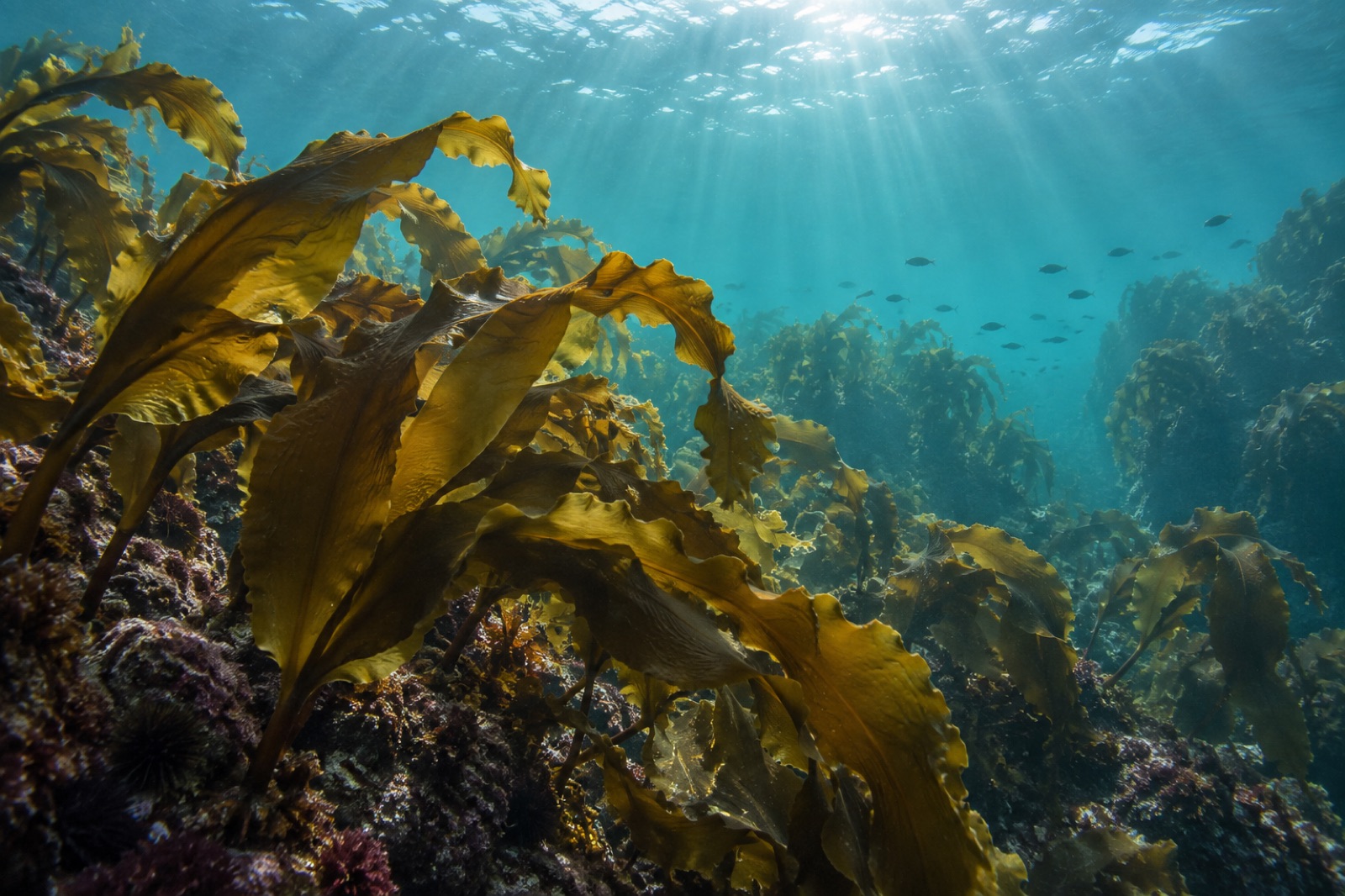
Kombu is a group of large brown kelps — chiefly Saccharina japonica and its close relatives — farmed and wild-harvested around Hokkaido, northern Japan. Dried kombu is the foundation of dashi, the broth underpinning much of Japanese cooking, valued for its natural glutamates.
Wild kombu releases spores in autumn through early winter, and farm seeding follows that rhythm: fertile fronds are collected in autumn, spores are settled onto seed string in tanks, and seeded lines go to sea before winter sets in. Exact timing follows each coast's temperature drop.
The core technique is shared — spores settled onto line that is then deployed. Restoration adds genetic matching to wild populations, denser monitoring, and no harvest: the goal is a self-sustaining forest, not a crop. Tidewright's fictional Kushiro program supports wild-bed resilience alongside the guild's farming tradition.
Kelp populations adapt to their local temperatures, seasons and currents. Moving seedstock between coasts risks poor performance and mixing locally adapted gene pools. Both the guild's tradition and Tidewright's nursery protocol require seedstock donors from the waters being seeded.
Tidewright, its projects and partners — including the Kushiro Kombu Growers' Guild — are fictional, created as a design and content demonstration. The kombu culture, geography and biology described are real and drawn from the actual Hokkaido kombu tradition.
Kombu is the kelp behind dashi and the backbone of the world's seaweed farms. Learn its biology, life cycle, Hokkaido roots and future in a warming sea.
Dr. Theo Nakamura ·
A Coastal Atlas guide to Hokkaido: Rishiri, Rausu and Hidaka kombu beds, the beach-drying harvest culture, and the kelp road that fed Kyoto for centuries.
Dr. Theo Nakamura ·
Between every kelp forest and its next generation sits an invisible, few-celled filament: the gametophyte. Its biology decides recruitment, resilience and hatchery success.
Dr. Theo Nakamura ·