Tidewright is a fictional company created as a design and content demonstration. These field notes are works of fiction written in the voice of our field operations team, and the figures in them are illustrative.
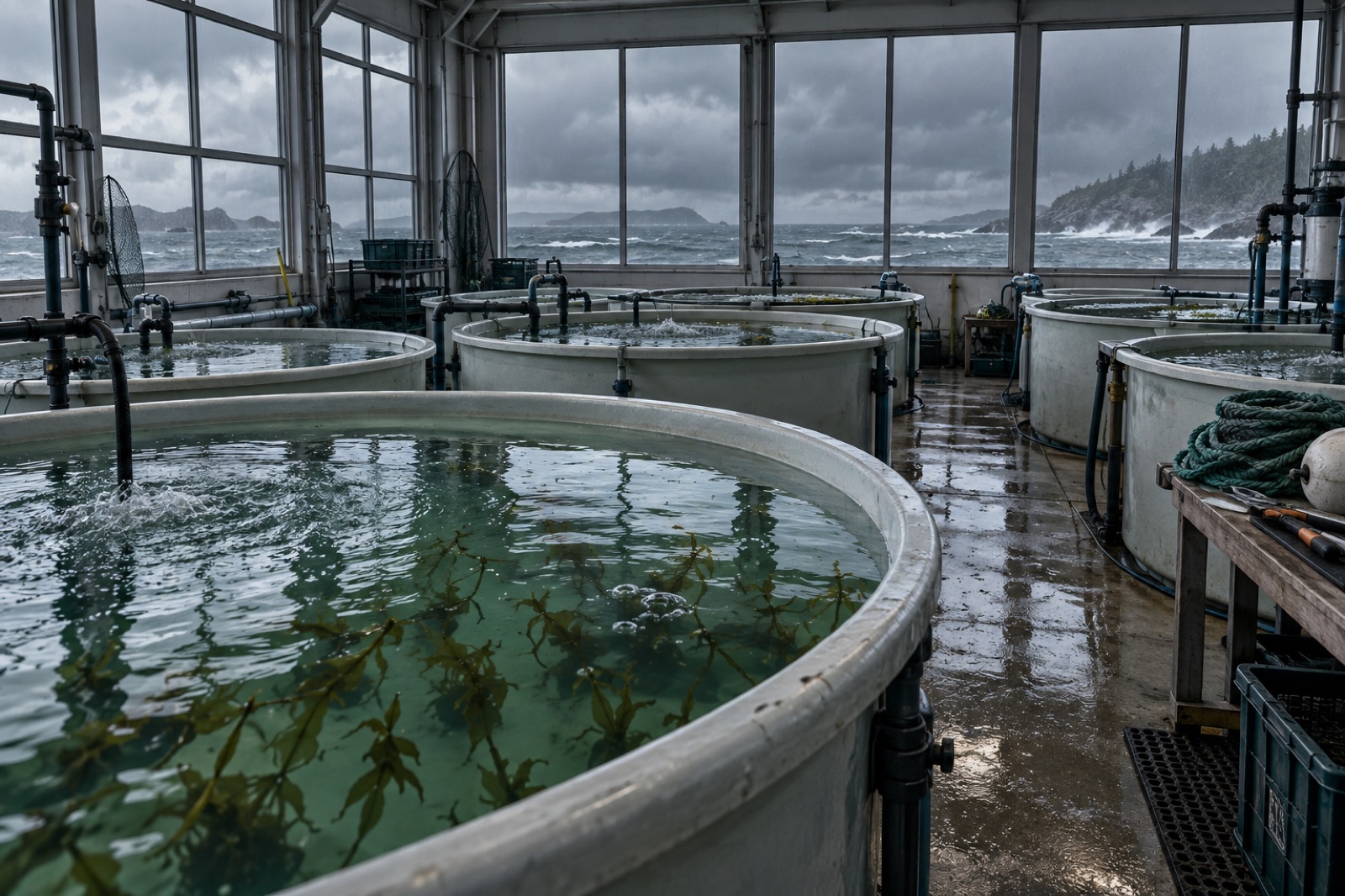
A kelp hatchery is a building that never gets to sleep in the dark. The Lumeriah Coast hatchery, on Tasmania's east coast, holds two things that cannot be replaced inside a season: cold rooms of giant kelp gametophytes banked strain by strain, and tanks of young sporophytes riding seawater that moves, chills and breathes only as long as the electricity does. On a Tuesday night in late autumn, the mains feed died at 02:11 during a storm front, and the automatic transfer switch declined to transfer. This is the note on the six hours that followed — and on why the wall by the door has a laminated list.
What a power cut actually threatens
People outside hatcheries imagine the danger is light. Lights out, photosynthesis off, crop in trouble. In fact light is nearly the last worry; kelp cultures tolerate a dark night better than most of our staff do. The countdown runs on oxygen and temperature, in that order.
Seawater systems fail in a known sequence. When the pumps stop, the water in a culture tub keeps the oxygen it has, and the denser the culture the faster it spends it. Dense green water under aeration can go from comfortable to hypoxic inside an hour on a warm night. The gametophyte cold room has a different clock: insulation holds four degrees for a long while, but the compressor that keeps it there is the same compressor the storm just silenced. Every hour of warmth shortens the shelf life of strains we raised over years.
So the triage order, fixed long before any emergency, is: air first, temperature second, light whenever you get to it, offices never.
02:11 — the first ten minutes
The facility's alarm dialler did its one job — it woke the on-call tech, Marlowe, at 02:14. Her note afterwards is the cleanest summary of the night: "Checked panel. Generator crank-fail. Started triage on battery air, then went back for the generator."
That order matters. The battery aeration cabinet — a rack of 12-volt blowers on a deep-cycle bank — exists precisely so that one person can buy time alone in the dark. Aeration manifolds run to the culture room's drops, so switching over is a valve and a switch per line, not a plumbing job. Nine minutes after the alarm, every priority tub had bubbles again. Nothing in a hatchery is calm at 02:20 in torchlight, but a room full of rising bubbles is the closest thing to it.
The generator, and the load-shed dance
The diesel set would not crank on the first three attempts — a block heater circuit fault, found later, that left it too cold to catch. The manual-start procedure is printed and zip-tied to the set because laminated paper does not need power. Fourth attempt, pre-heated by a borrowed heat gun from the workshop, she caught.
Then came the part the drills are really for: load discipline. Bringing a building back on a generator is not flipping one big switch. Chillers have brutal start-up current — a compressor that spins happily on the grid can stall a mid-size generator if two of them try to start together. The wall list says which breakers go on in which order, with one-minute waits between: seawater pumps first, cold-room compressor alone on its own wait, then culture-room lighting, and the tea urn last and only if someone has spare hands. Sequencing badly wastes the one resource you cannot recover — generator fuel, and the patience of the machine providing it.
Dawn, and the count
The mains came back at 08:40. The count afterwards, because we always count: gametophyte cold room peaked at 7.2 degrees for roughly forty minutes — inside tolerance, logged, and flagged for extra viability checks on the two most sensitive strains. Five of 112 culture tubs ran more than an hour on battery air at reduced flow; viability assays a week later showed no measurable difference against the controls. Losses for the night: zero cultures, one compressor start capacitor, and a small amount of pride in the transfer switch.
The number the report leads with is not the zero. It is the margin: the battery bank was drawn to 61% when the generator took over. In a longer cut — the kind of all-day outage this coast delivers every few years — we would have been into rationing air by mid-morning. That is the finding. The event we got was a drill we didn't schedule; the question it answered was how long the drill could have lasted.
What changed afterwards
- The generator now has a redundant block heater on a separate circuit, exercised weekly, and an autostart test every Monday first light — a five-minute ritual that had slipped to monthly. Monthly is how you get to 02:11.
- The battery bank was doubled. Air is cheap insurance measured in amp-hours.
- A UPS now carries the control and alarm system itself, so the dialler cannot be silenced by the same fault it is reporting — a failure mode nobody had written down before that night.
- The laminated list was reprinted with one addition at the top: Air first. Everything else can wait an hour. Air cannot wait ten minutes.
The wider lesson is the same one the ocean keeps teaching this coast's restoration program: resilience is not a wall, it is a held breath and a rehearsed response. The Holdfast nursery system assumes the grid fails occasionally, the way the sea assumes the storms come. You do not prevent either. You build the thing that catches, and you drill the hands that catch with it.
Key takeaways
- In a hatchery power cut, oxygen fails first and lights matter least — aeration is the ten-minute problem; temperature is the one-hour problem.
- Triage must be decided in advance and posted on a wall — nobody invents a good priority order at 2 a.m. by torchlight.
- Generators need starting drills, and loads need sequencing — everything restarting at once is the second failure, not the recovery.
- Battery aeration is the cheapest insurance in the building — it converts an emergency into a managed wait for the generator.
- Every real event should leave a ledger of changes — a zero-loss night that teaches nothing is a warning thrown away.
FAQ
What dies first when a hatchery loses power?
Dissolved oxygen. Stopped pumps mean no water exchange and no aeration, and dense cultures consume the oxygen in their tub water within an hour or less. Temperature drift in chilled rooms is the second threat, on a scale of hours.
How long can kelp cultures survive without aeration?
It depends on culture density, water volume per animal or plant mass, and temperature — cooler water holds more oxygen and slows consumption. Sparse gametophyte cultures in large volumes can ride out several hours; dense juvenile sporophyte tubs cannot. This is why stocking density is an emergency-planning decision, not just a production one.
Why not just run everything at once once the generator starts?
Motor-driven loads — especially refrigeration compressors — draw several times their running current at start-up. Simultaneous starts can overload or stall a generator. Sequencing breakers with waits between them keeps every start within the set's capacity.
How do you prepare for outages you can't predict?
Assume they happen, drill the response, and size the backups to the worst plausible duration, not the average one. Our rule of thumb across the Holdfast program: battery air for eight hours, generator fuel for seventy-two, and a printed procedure for the person who arrives first — whoever that turns out to be.