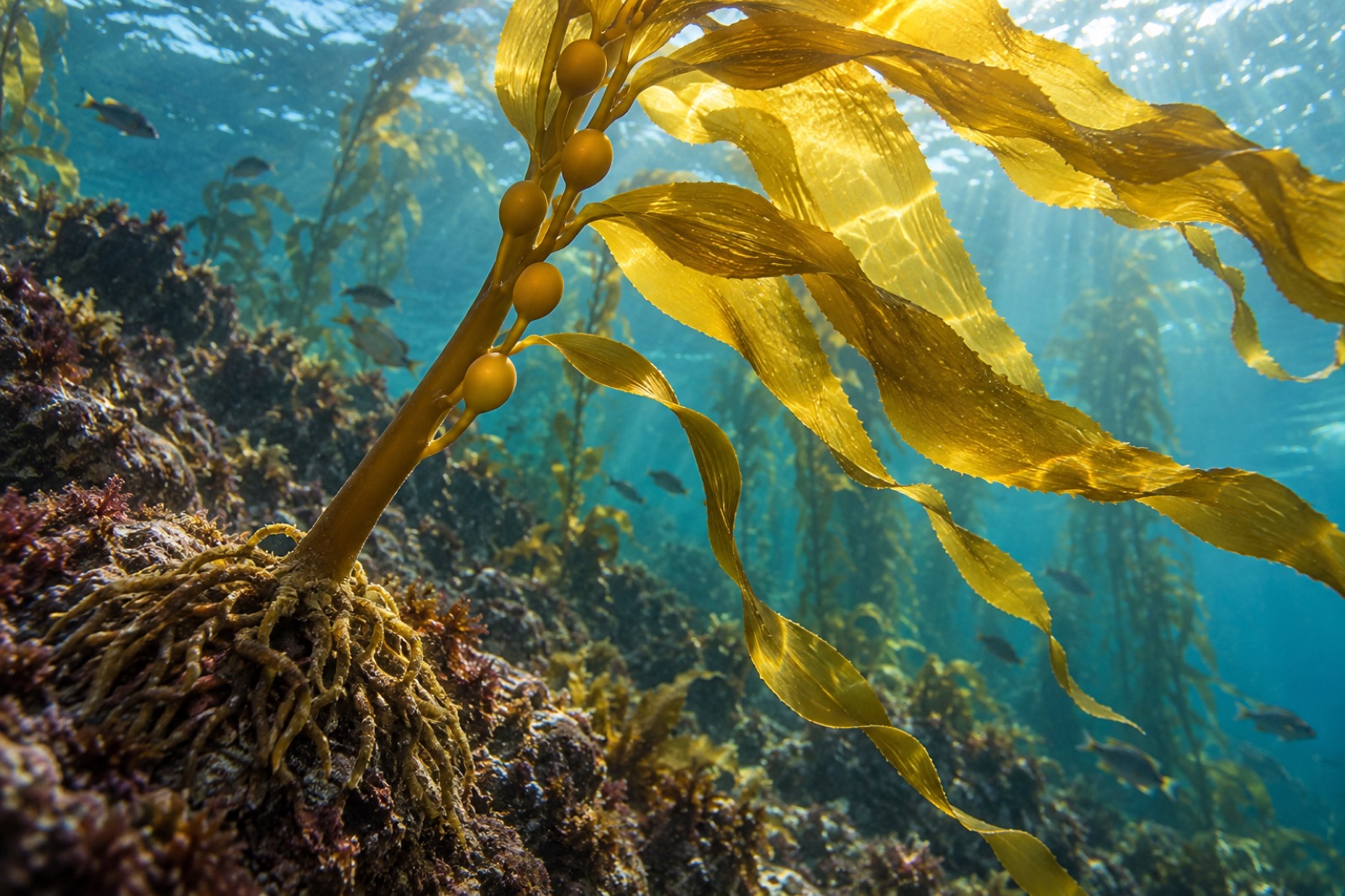
Giant kelp can grow half a metre in a day — rates of carbon fixation per square metre that rival tropical forests. That fact launched a thousand headlines about kelp as a climate solution. But growth is not storage. Carbon fixed into a frond that is eaten by next week, or decomposes on a beach by next month, returns to the atmosphere almost as fast as it arrived. The actual climate question is narrower and more interesting: how much kelp carbon escapes the fast biological loop and ends up locked away for decades to centuries — and can we measure it? The honest answer is "a meaningful amount, through specific pathways, with real uncertainties." Here is what is known, and what remains genuinely open.
First, some honest accounting: blue carbon's original trio
"Blue carbon" was coined for coastal ecosystems with an obvious, durable carbon sink: mangroves, tidal marshes and seagrasses. These are plants with roots in sediment. They trap particles, build soil, and bury organic carbon in waterlogged, oxygen-poor mud where it can stay put for centuries to millennia. Their accounting is (relatively) tractable: map the area, core the sediment, measure the carbon stock and accumulation rate.
Kelp is different in the way that matters most: it has no roots and builds no sediment. A kelp forest's carbon is its living tissue — standing stock that turns over fast. Blades grow at the base and erode at the tips continuously; storms strip fronds; urchins graze; winter swells tear out whole plants. Almost none of that carbon stays in the forest. So where does it go?
Pathway one: export to the deep sea
This is the headline mechanism, and it is real. A substantial fraction of kelp production leaves the reef as detritus — eroded blade tips, storm-torn fronds, fragments ground up by grazers. Currents carry this material along the coast and offshore, and some fraction of it crosses the continental shelf and sinks into deep water, where decomposition is slow and reconnection with the atmosphere takes centuries or longer. Kelp detritus has been identified by isotopic and genetic fingerprints in deep-sea sediments and in the diets of deep-water scavengers, thousands of kilometres from the nearest forest in some cases.
The research question is the word "some". Estimates of what fraction of kelp production is ultimately sequestered this way vary widely, because the pathway is long, leaky and hard to observe end-to-end. Export also depends on local oceanography: a forest fronting a submarine canyon that funnels material into the abyss is a very different carbon machine from one behind a wide, shallow shelf.
Pathway two: burial in neighbouring sediments
Not all exported carbon goes far. Some kelp detritus settles in nearby depositional areas — estuaries, fjords, bays, muddy basins — and gets buried. Here the accounting problem is attribution. A sediment core in a fjord shows buried carbon, but how much of it came from the kelp forest rather than from rivers, phytoplankton or terrestrial plants? Tracer techniques — stable isotopes, lipid biomarkers, environmental DNA — can apportion sources, and they show kelp can be a real contributor. But the contribution varies enormously from site to site, which is why blanket claims about "kelp carbon per hectare" should be treated with scepticism.
Pathway three: refractory carbon in the water column
A smaller, intriguing pathway: kelp releases dissolved organic matter, some fraction of which is chemically refractory — resistant to microbial breakdown — and can persist in seawater for long periods. The quantities from kelp specifically are still being quantified, and this pathway resists the kind of stock-and-flow accounting carbon markets prefer.
Pathway four: substitution effects
Kelp as a product can displace carbon-intensive goods — biostimulants replacing some synthetic fertiliser use, kelp-based materials substituting for plastics, and so on. This is genuinely valuable but it is a different class of climate benefit: avoided emissions rather than sequestration, with its own accounting rules, and it belongs in a different ledger line than "the forest stored carbon".
What is not a kelp carbon sink
Accuracy here matters, because overclaiming damages the credibility of legitimate blue carbon work:
- The standing forest itself. Kelp biomass is beautiful, vast and temporary. It is part of the fast carbon cycle — the same category as this year's wheat crop, not the same category as a peatland.
- Grazed carbon. Carbon eaten by urchins, abalone and fish cycles back to CO₂ within months. High urchin grazing, including on urchin barrens, is faster cycling, not storage.
- Anything without a permanence story. A tonne stored for two years and released is not a tonne sequestered in any sense a buyer or regulator should recognise.
So how big is kelp's climate role, really?
Syntheses of coastal carbon cycles generally find kelp forests are among the most productive carbon sources to sequestration elsewhere — donor ecosystems rather than sinks in their own right — and several lines of evidence suggest global kelp export contributes meaningfully to ocean carbon burial. The spread of estimates is wide precisely because export pathways are many, site-dependent and hard to close the budget on. Reasonable scientific positions range from "a modest but real contribution" to "one of the larger overlooked fluxes in the coastal ocean". What nobody honest claims is a single settled number per hectare, ready to be turned into credits by multiplication.
There is also a hazard unique to kelp carbon: the donor forest is itself climate-vulnerable. Marine heatwaves can strip a coast's kelp in weeks, interrupting the export flux for years. Permanence for kelp carbon is therefore partly a question of whether the forest persists — which is, of course, where restoration enters.
Where this leaves restoration and markets
The uncomfortable but productive state of play is this: kelp restoration clearly restores a carbon flux with sequestering endpoints; quantifying that flux per project well enough to sell durable credits is at the frontier of the science. Sensible approaches in the meantime are conservative — measure what you can measure (standing biomass from satellite and drone canopy mapping, export proxies, sediment cores in deposition zones), claim only the fractions supported by defensible evidence, and put the enormous non-carbon value of restoration — biodiversity, fisheries nurseries, coastal protection — in the open rather than smuggling it into a carbon number.
That is how Tidewright's programme is structured. Canopy Ledger exists to make the measurement layer as strong as the market layer, and our companion pieces on blue carbon markets and MRV explain how claims become credits — and why the verification, not the storytelling, is the hard part.
Key takeaways
- Kelp fixes carbon at extraordinary rates, but unlike mangroves, marshes and seagrasses it builds no sediment of its own — the forest itself is fast-cycling carbon, not a sink.
- Real sequestration happens downstream: export of detritus to the deep sea, burial in neighbouring sediments, and a dissolved refractory fraction, none of them easy to measure end-to-end.
- Fractions exported and buried vary strongly with local oceanography; any single "kelp carbon per hectare" number should raise eyebrows.
- Kelp products can deliver avoided emissions, a different and separately-accounted climate benefit.
- Kelp carbon's permanence is tied to the forest's survival — making restoration, heatwave resilience and honest MRV part of the same problem.
FAQ
Is kelp a "blue carbon" ecosystem?
Depends on definitions. The original blue carbon category — mangroves, tidal marshes, seagrasses — rests on in-place sediment burial. Kelp sequesters carbon primarily by exporting it elsewhere, so some frameworks include kelp-derived carbon and others don't. The science of the flux is solid; the accounting category is still evolving.
Do kelp forests store more carbon than land forests?
They fix carbon per square metre at rates comparable to the most productive land forests, but they don't store it in place the way a forest stores it in wood and soil. Most kelp carbon leaves the reef within a year; what is sequestered is the exported fraction that reaches durable sinks.
Does seaweed farming remove carbon from the atmosphere?
Only the fraction of farmed biomass that reaches durable storage — sunk, buried, or locked into long-lived products — counts as sequestration, and for most current seaweed products that fraction is small. Farms also deliver real benefits (food, habitat, avoided emissions) that shouldn't be inflated into carbon-removal claims they aren't. Our farming coverage digs into the practical side.
Can I buy kelp carbon credits today?
Some offerings exist, but kelp lacks the long-established, consensus methodologies that mangrove or seagrass projects have. Methodology development is active. If you're a buyer, the questions to ask are exactly the MRV questions: what's the baseline, what's measured, what's assumed, who verified it — see our guide to blue carbon MRV.
Does restoring kelp help the climate even without credits?
Yes — though more clearly through everything else a forest does. Restored canopy rebuilds the export flux, buffers coasts, and re-creates habitat that supports fisheries and biodiversity. Carbon is one benefit among many, and honesty about its uncertainties is what keeps the whole enterprise credible.