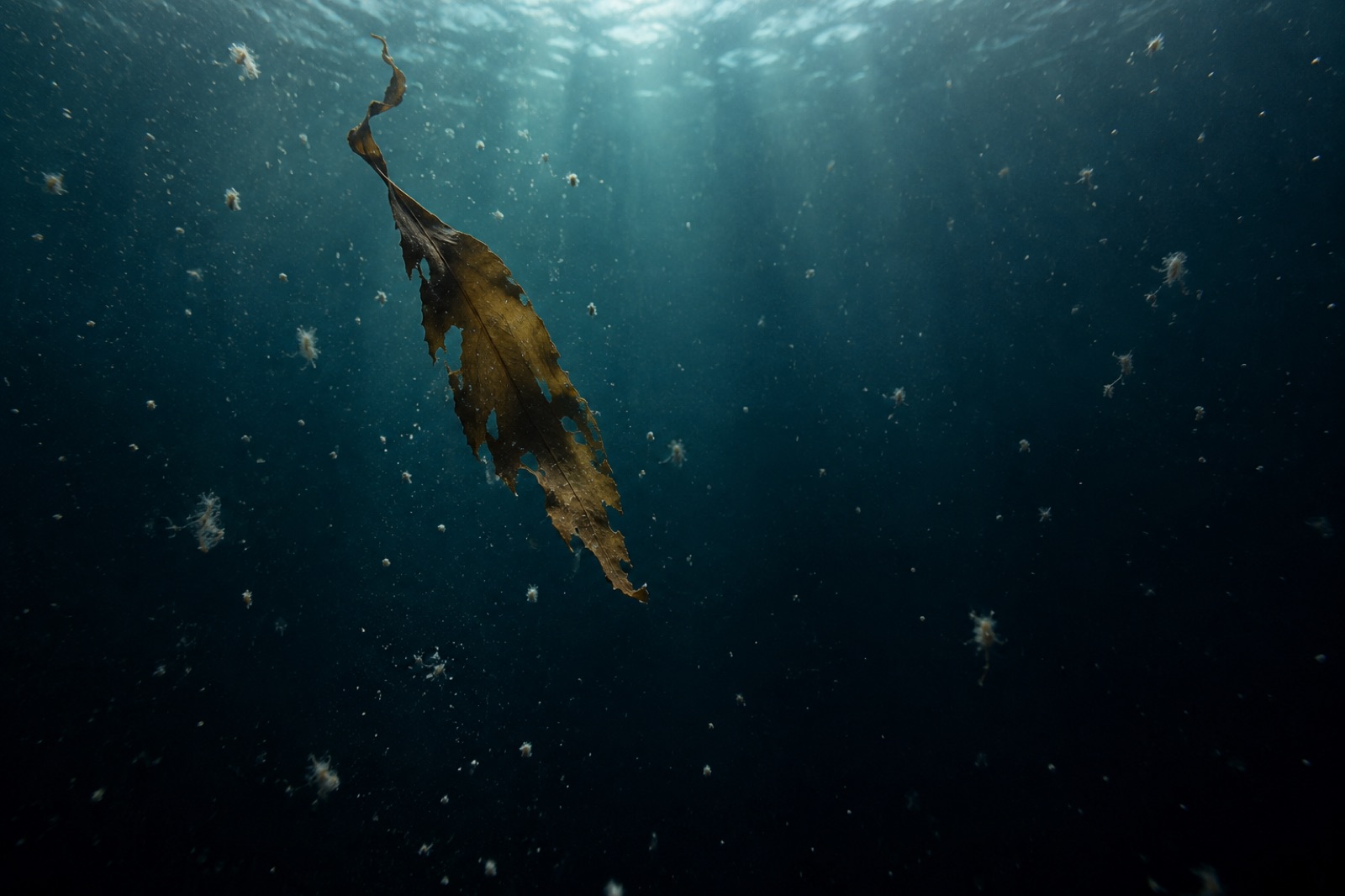
A kelp forest can fix carbon faster than almost any forest on land, but speed is not the climate question. The climate question is residence time: how long that carbon stays out of the atmosphere. Carbon in a fish, a crab or a plate of kelp salad returns to the air within months to a few years. Carbon that reaches the deep ocean, or settles into anoxic sediment, can stay away for centuries to millennia. That distinction is why the "deep-sea export pathway" — natural or engineered — is where the serious end of kelp carbon science is pointed, and also where the hardest unsolved problems live.
The natural conveyor: how kelp carbon gets deep
Kelp forests are leaky by design. Fronds abrade in storms, blades are torn off by grazers and winter seas, and a continuous rain of fragments, mucus and dissolved organics leaves the forest. As described in how kelp stores carbon, the fate of that exported material splits three ways: most is eaten or decomposed in shallow water and returns to the air quickly; some is transported offshore in rafts of drifting kelp that eventually waterlog and sink; and some settles into sediments, near or far, where low-oxygen conditions slow decay to geological timescales.
Certain seascapes are spectacularly good at the sinking step. Submarine canyons act as chutes that funnel detached kelp from the shelf straight into deep basins — the Monterey Canyon off California and the canyons notching Chile's Humboldt coast are classic examples. Currents do the rest: fragments exported from forest to deep water arrive in a medium where the clock effectively resets.
Why the deep ocean is a long-term vault
The deep ocean's value as a carbon store comes from physics, not biology. Below roughly a kilometre, water masses are isolated from the atmosphere by the stratified layers above them. Carbon dissolved or suspended there cannot exchange with the air until ocean circulation brings that water back to the surface — and the planet's deep overturning circulation operates on timescales of centuries, with the oldest deep waters (in the deep North Pacific) having been away from the atmosphere for approaching a thousand years or more. Sink carbon to sufficient depth in the right basin, and you have effectively committed it to isolation for many human lifetimes, longer than almost any terrestrial store survives fire, drought and land-use change.
Sediments do even better when conditions cooperate. Where oxygen is scarce — deep basins, fjords, anoxic pockets — decomposition stalls, and buried organic carbon can persist for millennia. This is the same logic that makes mangrove and saltmarsh soils such effective blue carbon stores; the kelp version just happens downstream of the forest rather than beneath it.
There is one honest caveat: timescales are not uniform. Carbon sunk to 1,000 metres in one region may resurface in decades via local upwelling; carbon at 4,000 metres in another stays down for many centuries. Any credible accounting of deep export has to specify where the carbon landed, because "the deep ocean" is not one vault but a building with very different basements.
What fraction actually makes it?
Here the science is genuinely uncertain, and honesty requires saying so plainly. Published estimates of the share of kelp production that reaches long-term storage — deep water or buried sediment — span a wide range, from a few percent to, in favourable settings with canyons and strong offshore transport for large drifting species like bull kelp and giant kelp, appreciably higher. The variance is not sloppiness; it reflects real differences between coasts, species with floats versus species that sink immediately, seasons, and the sheer difficulty of tracking fragments that leave your study site.
Two implications follow. First, global-average export fractions should never be applied to a specific project; the spread is too wide. Second, the few percent end is not trivial — kelp forests are so productive that even modest export fractions move meaningful carbon — but it means every claimed tonne must be fought for with site evidence.
Engineered sinking: the proposal and its problems
If some kelp carbon sinks naturally, why not help it along? Proposals for deliberate sinking — baling cultivated seaweed and dropping it into deep water, or growing macroalgae on offshore platforms and sinking the crop — have attracted serious attention and serious capital. The appeal is obvious: sinking converts the uncertain natural export fraction into something closer to a controlled valve, and it uses the best vault the planet offers.
The problems are equally concrete.
Verification
You cannot watch a bale for a century. Once biomass crosses a few hundred metres of depth, confirming that it sank intact, stayed where it landed, and is degrading at the assumed rate becomes an exercise in tracers, acoustics, sediment cores and models. This is the deep-sea version of the general challenge described in our piece on blue carbon MRV — with the audit conducted somewhere no auditor can dive. Methodologies here will likely demand conservative stored-fraction assumptions plus periodic re-survey rather than point estimates.
Deep-sea ecology
The deep sea is not empty warehousing. A pulse of fresh organic matter at the seafloor feeds scavengers and microbes — and microbial decomposition consumes oxygen. At scales that matter for climate, local oxygen drawdown and smothering of seafloor communities become real risks, in ecosystems that recover slowly and are barely mapped. Responsible programs will need benthic impact assessment and dispersal logic, not just carbon arithmetic.
Carbon quality of the biomass itself
Kelp grown for sinking absorbs nutrients and trace elements that deep sinking removes from surface circulation. At scale, that bookkeeping matters — and so does the provenance of the biomass: sank-if-diseased farm crops and sank-if-baled wild harvest have very different ecological and ethical profiles.
What credible deep export accounting looks like
Whether natural or engineered, a defensible deep-export claim has the same skeleton:
- Measured standing stock and detachment rates at the source — canopy mapping calibrated to biomass, not assumed yields.
- A tracked pathway: drifter studies, drifters-on-bales, eDNA and isotope tracing in receiving sediments, to show where exported carbon actually goes from this coastline.
- A named destination with a named timescale — depth, basin and overturning time specified, not "the deep sea" generally.
- A conservative stored fraction applied after all of the above, with the unmeasured remainder simply not claimed.
- Reversal and buffer provisions: a marine heatwave that strips a source forest, like the events described in Marine Heatwaves 101, is a reversal event and must be accounted as one, with buffer pools sized accordingly.
That is a high bar, deliberately. The deep-ocean pathway is arguably the most promising route for kelp carbon to become creditable at scale — it pairs kelp's productivity with the ocean's best storage — but promise is earned per site, not inherited from the concept.
Key takeaways
- Residence time, not fixation rate, is what makes kelp carbon matter: months in the food web versus centuries to approaching a millennium in deep water and anoxic sediment.
- Kelp forests naturally export carbon offshore via fragments and drifting rafts; submarine canyons and currents deliver some of it to genuinely durable stores.
- The natural export fraction reaching long-term storage is real but highly uncertain and site-specific — published estimates span from a few percent upward, so site evidence is essential.
- Engineered sinking (bales and dedicated crops) offers control but faces hard verification, deep-sea ecological impact, and oxygen questions that are not yet resolved.
- Credible accounting names the destination depth and basin, applies conservative stored fractions, traces the pathway, and carries buffer pools for reversal events like heatwaves.
FAQ
How long does carbon stay in the deep ocean?
It depends on depth and location. Deep water is isolated from the atmosphere by stratification and only returns to the surface through global overturning circulation — a process operating on century scales, with the oldest deep waters away from the air for approaching a thousand years. Carbon buried in oxygen-poor sediment can persist far longer still. Shallower sinking, or sinking near strong upwelling zones, buys much less time, which is why credible claims specify where the carbon landed.
Does sinking seaweed harm deep-sea life?
It can, and any honest assessment says so. A concentrated organic pulse at the seafloor drives microbial decomposition that consumes oxygen and can smother slow-growing benthic communities. Small, dispersed deposits in well-chosen sites are likely benign; industrial-scale deposition without benthic monitoring is not. Impact assessment is a precondition for responsible programs, not an optional extra.
Why not just let nature do the sinking?
It already does — that's the baseline natural export pathway, and protecting and restoring kelp forests strengthens it. Engineered sinking is an attempt to raise the fraction and make it controllable and verifiable, at the cost of new risks and verification burdens. The two are complements: restoration secures the source; careful sinking experiments test whether the valve can be opened responsibly.
Can deep-sea export be verified well enough for carbon credits?
Today, partially and conservatively: tracer studies, sediment sampling and conservative stored-fraction assumptions can support project-specific claims, but there's no widely adopted mature methodology, and early schemes have outrun their evidence — a pattern the market now punishes. Expect standards to converge on tracers plus heavy conservatism plus periodic re-survey.
Is deep export the main way kelp stores carbon?
It's the main route to durable storage, alongside burial in sediments near and far from the forest. Much kelp carbon never gets there — it re-enters the fast cycle through grazing and decomposition — which is why headline claims about kelp carbon must always state which pathway, and which fraction, they mean.