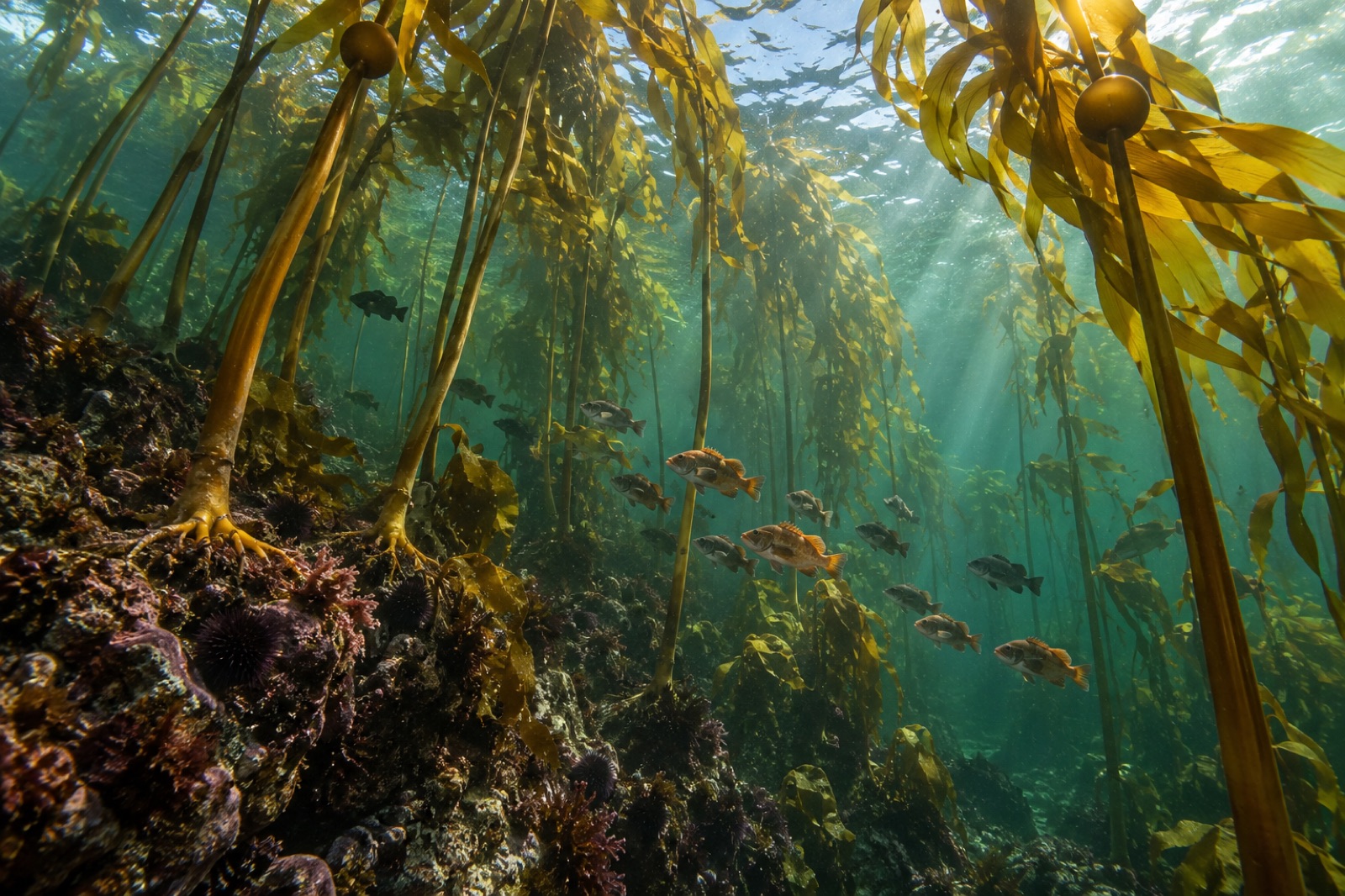
Run a finger down a map of South America and you will trace the longest temperate coastline on the planet. Chile stretches more than 4,000 kilometres from the edge of the Atacama Desert to the subantarctic channels of Patagonia — and for most of that distance, the Pacific pours cold, nutrient-saturated water onto a narrow continental shelf. The result is not just kelp habitat. It is arguably the largest continuous kelp frontier on Earth, a chain of forests, meadows of bull kelp and subtidal beds that has fed a wild-harvest industry, a coastal culture and a cuisine for centuries.
This is a guide to the Humboldt coast: the current that powers it, the species that build it, the people who work it, and the forces now testing it.
The engine: the Humboldt Current
Everything on this coast begins with physics. The Humboldt Current — one of the great eastern boundary currents, alongside the system off California and Monterey Bay — drives surface water northward while persistent winds push it offshore. Deep water wells up to replace it, cold and loaded with nitrate, iron and silicate. Our explainer on upwelling, the cold water that feeds kelp forests covers the mechanics in detail; the short version is that upwelling delivers free fertiliser to the photic zone almost year-round.
Three consequences matter for kelp:
- Cold water tolerance extends far toward the equator. Kelp grows at latitudes where, on most coasts, the water would be too warm.
- Productivity is enormous. This is the same current that has historically supported some of the world's largest fisheries.
- The whole system breathes with El Niño. When Pacific warming shuts down upwelling, as it does in El Niño years, nutrient supply collapses, water warms, and kelp and fisheries feel it within months.
The builders: Lessonia, Durvillaea and Macrocystis
Chile's kelp identity is more diverse than the familiar California picture of endless giant kelp.
Lessonia: the huiro beds
The low intertidal and subtidal rock of central Chile is dominated by Lessonia species — Lessonia trabeculata in the subtidal, Lessonia spicata (huiro negro) higher up and further south. These are dense, heavy-stiped kelps that form what's locally called huiro, and they are the backbone of Chile's wild seaweed harvest. Divers hand-cut them with knives; they're dried and exported primarily for processing into alginate, the kelp-derived thickener used in food, pharmaceuticals and industrial products.
Cochayuyo: the edible bull kelp
The southern bull kelp Durvillaea — known in Chile as cochayuyo — is the country's culinary kelp. Tough, honeycombed leathery fronds are harvested from the surf zone, dried into distinctive dark bundles, soaked, and simmered in stews, salads and empanadas. It's as iconic in Chilean kitchens as kombu is in Japanese ones — if you know kombu's role in dashi, cochayuyo is its rough-edged, smoke-darkened Pacific cousin. For the taxonomy of this remarkable plant-like alga, see our profile of its northern relative, bull kelp (Nereocystis luetkeana).
Giant kelp: the southern forests
South of about the Bío Bío region, and increasingly into Patagonia, giant kelp (Macrocystis pyrifera) takes over — forming the canopy forests that, at the far south, merge into the vast subantarctic systems covered in our guides to the Strait of Magellan and the Falkland Islands. The Chilean Patagonian forests are thought to be among the most extensive giant kelp stands in the Southern Hemisphere, with research suggesting their genetics are distinct enough to be a conservation priority in their own right. (Tidewright's restoration-genetics work draws on the same principle: forests are local. Our overview of holdfast biology and what holds kelp to rock gives substrate context for why Chile's rocky shelf is so well suited.)
People of the kelp
Kelp on this coast is not abstraction; it is livelihood. Chile recognizes Management Areas for the Exploitation of Benthic Resources — locally known by the acronym AMERB, or more memorably as áreas de manejo — under which fisher and gatherer cooperatives hold territorial user rights over defined stretches of shore. Within an área de manejo, a cooperative manages the bottom: setting its own rotation and harvest plans for kelp, loco (Chilean abalone), sea urchins and a suite of invertebrates, with scientific advice and government oversight.
The system, developed since the 1990s, is studied worldwide as a rare success story in small-scale fisheries governance — proof that devolved rights, local ecological knowledge and clear rules can align livelihoods with stewardship. It's the terrestrial-logic of community forestry, applied to kelp. Readers interested in how harvesters, councils and monitors share a coastline can see the same working philosophy on our solutions for fisheries and aquaculture page.
The harvest economy includes huge but less visible flows too: kelp cast up by storms collected as algazo along beaches, bought as raw material for processing plants, providing seasonal income to thousands of coastal families.
A coast in slices: regions worth knowing
- North (Arica to Coquimbo): arid shore, persistent upwelling, Lessonia-dominated beds and the heartland of the alginate trade. Fishing towns here live by the huiro calendar.
- Central (Valparaíso to Concepción): the most populated coast; kelp shares space with cities, ports, artisanal gillnet fisheries and surf beaches. Coastal squeeze and pollution are live issues.
- South (Bío Bío to Chiloé): more rain, more forested shoreline, a transition from Lessonia toward mixed giant-kelp systems; major salmon-aquaculture country, which brings both nutrient inputs and controversy to shared waters.
- Patagonia and the far south: wilderness kelp — fjords, channels and the great subantarctic forests. This is the frontier that global kelp science is racing to map before change overtakes it.
Pressures reshaping the frontier
A coast this productive invites pressure, and Chile's kelp faces several converging ones.
Marine heatwaves and El Niño
The eastern South Pacific has seen pronounced warm anomalies in recent years, and El Niño events cut nutrient supply precisely when water is warmest — the combination marine heatwave science warns about for fast-growing kelps. Subtidal Lessonia beds in the north have flagged stress after strong events.
Because huiro is an export commodity, pressure follows markets. Chile debates — continually — how much can be taken, and from which beds. Área de manejo rotation has proven buffers, but unregulated harvest outside managed areas hits hard when prices spike.
Salmon farms and water quality
The concentrated salmon industry of the south changes the nutrient and chemical environment of fjords and channels that giant kelp depends on. Integrated multi-trophic aquaculture, which deliberately pairs fed species with kelp and shellfish that clean the water, is being tested as a response — see our deep dive on IMTA and farming an ecosystem.
Climate as a long game
Model projections for the Humboldt system involve shifting winds, stronger stratification and more frequent extremes. Chile's kelp can handle variation — it evolved with El Niño — but the background trend, like everywhere, is the concern. That's why Chilean researchers are among the most active in Southern Hemisphere kelp-climate science, and why the coast appears often in blue-carbon discussions: standing kelp carbon, fluxes to the deep, and how to count them. Our primer on how kelp stores carbon explains the accounting in plain terms.
For the visiting ocean lover
Chile is not the easiest kelp coast to casually dive: cold water, heavy swell, language barriers and distance make it an advanced destination. But it rewards the effort:
- The fishing villages of the Coquimbo region offer shore entry over Lessonia beds, with sea lions, Chilean dolphins passing offshore, and after-sunset skies some travellers consider the attraction — northern Chile is global telescope country.
- Chiloé pairs giant-kelp fringes with wooden churches and a maritime food culture where cochayuyo appears on family tables.
- The far south, around the Strait of Magellan, offers kelp forest dives in cold, weirdly clear water below snowline peaks — we cover it separately in this atlas.
Wherever you go, tide charts are survival tools, a 7 mm suit is a minimum, and a boat is often the sane option. Our cold-water diving essentials guide covers the kit.
Key takeaways
- Chile's 4,000-km Humboldt coast is arguably the world's largest connected temperate kelp frontier, powered by one of the planet's strongest upwelling systems.
- Three builders dominate: Lessonia (huiro) in the subtidal low zones, bull kelp (cochayuyo) in the surf, and giant kelp from the central-south southward into Patagonia.
- The área de manejo system gives cooperatives real territorial rights and management responsibilities — a globally studied model of small-scale fisheries governance.
- Kelp here is both livelihood (alginate exports, edible cochayuyo, storm-cast collection) and ecosystem (fisheries habitat, carbon, coastline structure).
- Heatwaves linked to El Niño, harvest pressure, salmon-farm impacts and background warming are the emerging threats; monitoring and governance will decide the trajectory.
FAQ
What is the Humboldt Current and why does it matter for kelp?
The Humboldt (or Peru) Current is a cold, northward-flowing eastern boundary current along the west coast of South America. Combined with coastal winds that drive upwelling, it delivers cold, nutrient-rich deep water to the sunlit surface layer — exactly what fast-growing kelp needs. Without the current, much of this coast would be too warm for kelp.
What is cochayuyo?
Cochayuyo is the Chilean name for the southern bull kelp Durvillaea, a massive leathery kelp harvested from the surf zone of central and southern Chile. Dried into dark bundles, it is soaked, sliced and cooked in traditional stews and salads — a staple protein-rich seafood in Chilean coastal cuisine for centuries.
Can tourists harvest kelp in Chile?
No. The wild harvest is regulated, with most productive beds held under long-term management-area concessions by registered fisher cooperatives. Visitors can buy processed cochayuyo and kelp products in markets, which supports local harvesters; taking kelp from the shore yourself is generally not permitted.
Where in Chile can you see or dive giant kelp forests?
Giant kelp (Macrocystis pyrifera) becomes dominant from roughly the Bío Bío region southward, with the most extensive stands in the Chilean Patagonian fjords and around the Strait of Magellan. The far south is the most reliable place for full canopy forests, though cold water and logistics make it an experienced-diver destination.
How important is the seaweed harvest to Chile's economy?
Chile is one of the world's leading producers and exporters of brown seaweed raw material, particularly huiro (Lessonia) for alginate processing. The industry involves tens of thousands of registered small-scale fishers and gatherers along the coast, making seaweed one of the most socially significant extractive activities in Chilean coastal communities.