There is a moment, flying into Punta Arenas at the bottom of South America, when the aircraft drops below the cloud and the Strait of Magellan appears — a grey-blue seam of water between tawny steppe and snow-dusted ridges. From the air it looks like wilderness untouched. Look closer at the charts, or put a face in the water, and you find that nearly every rocky metre of that shoreline is wrapped in kelp. The strait and the maze of channels around Tierra del Fuego hold some of the southernmost kelp forests on Earth, and they are quickly becoming some of the most studied.
This is a guide to the kelp at the end of the world: what grows there, why the region matters far beyond its shoreline, what is changing, and how a determined traveller or diver can see it.
Geography of a drowned landscape
The Strait of Magellan cuts roughly 570 kilometres between the Atlantic and the Pacific, separating mainland Patagonia from the island archipelago of Tierra del Fuego. It is only the most famous member of a much larger system: the Chilean channels and fjords of western Patagonia, thousands of kilometres of drowned glacial valleys where the Andes slide into the sea.
Three features of this geography shape the kelp:
- Shelter. Inside the channels, fetch is short and swell is modest. Kelp can grow placidly where the open coast would tear it apart.
- Freshwater. Rainfall is extreme on the Pacific side — some fjords receive several metres a year — and glaciers still calve into upper reaches. The result is a brackish surface layer riding over cold saltier water, a stratification kelp must tolerate or avoid.
- Rock. Glacial scour has left clean, hard bedrock along vast stretches of shore — an ideal substrate. If you have read our piece on holdfast biology and how kelp grips rock, picture that textbook scenario at regional scale.
What grows in the cold
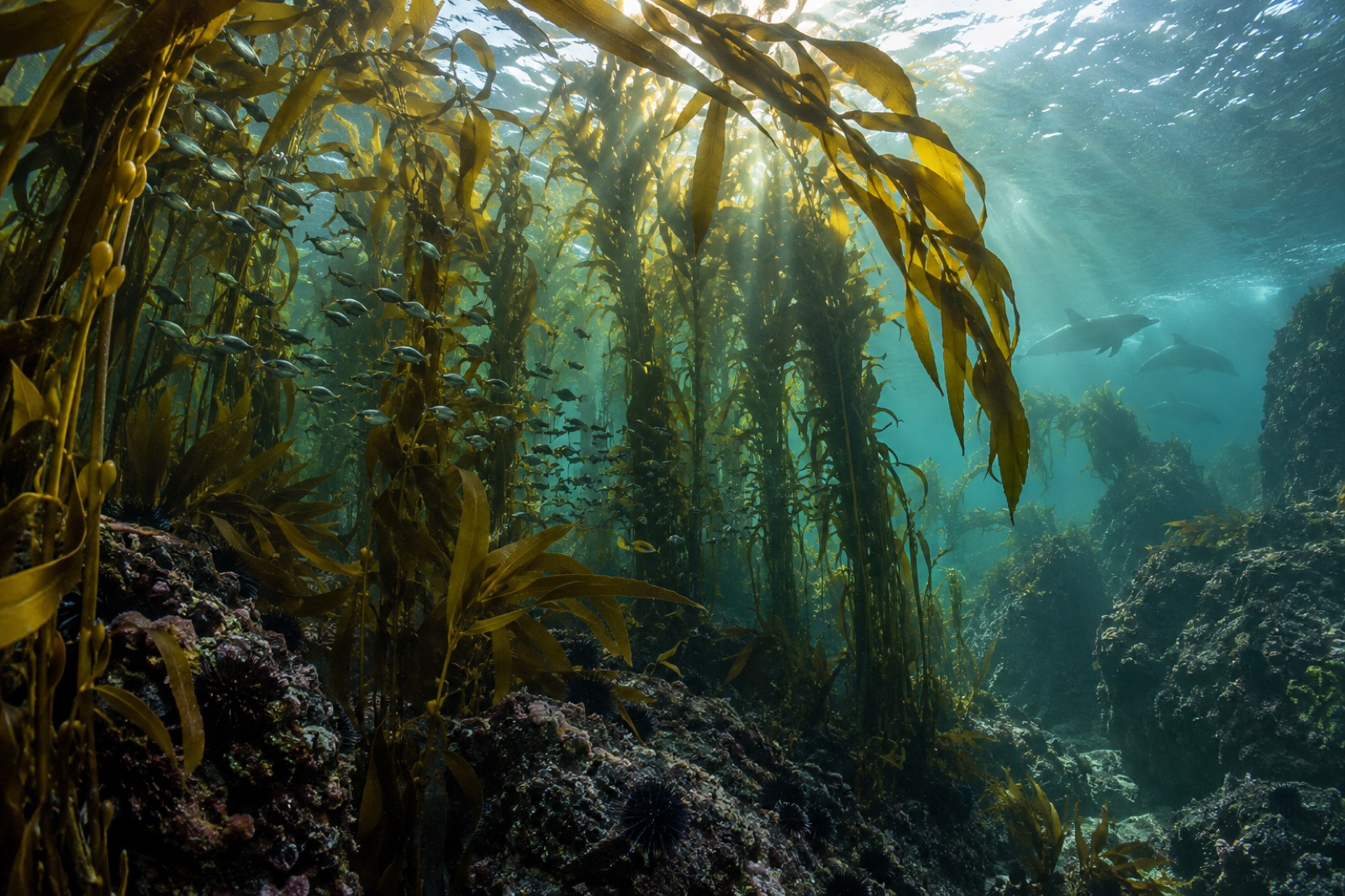
The dominant canopy former here is giant kelp (Macrocystis pyrifera), growing in forests that follow the channels like green ribbons on a satellite image. But the Magellanic version of the species behaves differently from its Californian relative. In much of the strait, plants grow as dense, low-lying beds rather than towering surface canopies, fronds forming a thick laminar mat one to five metres off the bottom. In the wave-washed outer mouths, more classical surface-canopy forests appear.
Around the kelp sits a subantarctic understorey with few global parallels: cold-water corals and sponges in the deeper channels, dense beds of filter-feeding bryozoans, and a fish fauna including subantarctic notothens and croakers found nowhere else. Southern sea lions work the kelp edges, and four species of penguin — Magellanic most numerously — hunt the same productive water. Peale's and Commerson's dolphins bow-ride through the canopy lanes.
Water temperature is the constant. Expect around 4–9 °C depending on season and salinity layer. The cold is ecological good news for the kelp in a warming world — for now.
The kelp highway: why Magellanic forests matter globally
Ask a kelp geneticist what excites them about the Strait of Magellan and you will hear one word: connectivity.
Giant kelp rafts. Detached fronds and whole storm-torn plants drift, buoyed by their gas bladders, sometimes for staggering distances. Where deep-sea currents allow, these rafts carry living tissue — and hitchhiking communities of invertebrates and fish eggs — between coastlines separated by open ocean.
Genetic studies of giant kelp populations around the subantarctic have revealed something remarkable: many of them are far more closely related to each other than to any northern populations. The evidence suggests that floating kelp has moved genes — and species — around the entire Southern Ocean, riding the Antarctic Circumpolar Current. The Strait of Magellan, sitting at the eastern gateway of that highway, is thought to be a critical node: a source of rafts, a meeting point of lineages, and possibly the origin point of some circumpolar kelp lineages entirely.
This has practical consequences for restoration genetics, the field I work in with Tidewright's Holdfast seedstock program: if kelp forests are naturally connected across thousands of kilometres, then "local genetics" is a more nuanced idea than a single latitude and longitude. Restoration has to respect the structure that gene flow has built, and Magellanic kelp is a live demonstration of that structure at planetary scale.
The drifting rafts also carry carbon, habitat and food into the deep ocean — the same pathway at the heart of kelp blue-carbon accounting, covered in our explainer How Kelp Stores Carbon.
Climate at the southern frontier
The subantarctic is warming, and not gently. Atmospheric warming in southern Patagonia has been among the faster rates observed in the Southern Hemisphere, and the changes land directly on this coastline:
- Glacier retreat is accelerating, raising freshwater and sediment loads in the fjords, pressing kelp's salinity and light tolerances.
- Marine heatwaves reach here too. Even for cold-adapted kelp, anomalous warmth at the wrong life-cycle moment can crash recruitment; our marine heatwave explainer explains the reproductive bottleneck.
- Sea-level and storm-track shifts alter exposure regimes on coasts where kelp is finely zoned by wave energy.
Yet the region also holds hope at planetary scale. Southern Chile's kelp forests may be among the world's most important climate refugia — places where cold water and latitude offer a buffer while forests nearer the equator retreat. Identifying, mapping and monitoring these refuges is exactly the task satellite-and-drone platforms like Tidewright's Canopy Ledger are built for, and Chilean and international research groups have made the region a priority area for baseline mapping while it is still intact.
Visiting the strait
Punta Arenas, on the strait's northern shore, is one of the most accessible subantarctic cities in the world, with regular flights from Santiago and a growing expedition-cruise presence. For the kelp-interested traveller:
From a boat
Expedition cruises through the Chilean channels pass kelp forests constantly; any glacier or fjord itinerary gives you canopy views from the rail. Purpose-built wildlife trips visit the Magellanic penguin colonies on Magdalena and Marta Islands in the strait itself — the kelp beds ringing those islands are clearly visible from the boats, and sea lions patrol their edges.
In the water
A small number of operators offer diving and snorkelling in the strait, including cold-water programmes operating from Punta Arenas. This is genuinely advanced diving: 4–7 °C water, tidal currents that race through the strait at several knots, and drysuits as essential equipment. Our guide to cold-water diving essentials and the drysuit vs wetsuit comparison are mandatory pre-trip reading. The reward — if conditions align — is extraordinary: gin-clear water inside the tidal windows, a kelp canopy illuminated against white glacial sediment, and almost no other divers on the planet doing the same dive.
The walking is world-class. Coastal trails around Punta Arenas, the reserves of the Brunswick Peninsula, and — across the strait — Tierra del Fuego's shore paths all overlook kelp beds in cold air that feels like an altitude boost. This is a place where the forest is part of nearly every coastal view.
The human shoreline
Compared with Chile's central coast, people here are few. Punta Arenas, with around 130,000 residents, is the region's hub; beyond it, fishing villages and estancias occupy isolated coves. The artisanal fishery for southern king crab (centolla) operates in these cold waters, and coastal Indigenous heritage runs deep — the Kawésqar and Yaghan peoples navigated these channels by canoe for millennia, living from the same kelp-fringed shores. Any serious engagement with this coastline passes through that history, and the sea-country partnerships on our solutions for communities page reflect the principle that restoration follows the people who have always been here.
Key takeaways
- The Strait of Magellan and Chilean Patagonian channels hold some of the world's southernmost kelp forests, dominated by giant kelp in cold, sheltered, glacially-scoured water.
- Genetic evidence points to a subantarctic "kelp highway": drifting kelp rafts connecting Southern Ocean populations around the entire circumpolar current.
- The region's low-lying kelp bed morphology differs from northern surface-canopy forests — a distinct ecological form scientists are still describing.
- Glacier retreat, marine heatwaves and rapid regional warming are the pressures; the region is also a probable long-term climate refuge for southern kelp.
- Punta Arenas offers genuine access: expedition cruises, penguin colonies, world-class cold-water diving and coastal walking, all wrapped around the forests.
- Restoration genetics and canopy-mapping science both treat Magellanic kelp as a planetary-scale natural laboratory.
FAQ
What is the southernmost kelp forest in the world?
The furthest-south giant kelp forests grow in the Chilean channels of Tierra del Fuego, reaching to nearly 56°S near Cape Horn — the southernmost kelp forests known. The kelp forests of the subantarctic islands, including South Georgia and the Falklands, extend similar latitudes in the Atlantic and Indian Ocean sectors.
Is the water in the Strait of Magellan clear enough to dive?
Surprisingly often, yes. Near the tidal exchanges and away from glacial meltwater plumes, visibility can reach remarkable clarity. Conditions vary enormously with tide, melt season and wind. This is advanced cold-water diving with strong currents in places, requiring local operator support and drysuit experience.
How is Magellanic kelp different from Californian giant kelp?
Same species (Macrocystis pyrifera), different growth form and genetics. Magellanic kelp often forms dense, low sub-surface beds rather than towering surface canopies, and subantarctic populations are genetically distinct — part of a connected circumpolar lineage maintained by long-distance rafting.
Why do kelp forests drift, and where do the rafts go?
Storm-torn giant kelp remains buoyant thanks to its gas bladders, and the Antarctic Circumpolar Current can carry rafts enormous distances. Genetic and observational evidence indicates rafts move between subantarctic landmasses — moving genes, invertebrates and occasionally fish across open ocean, and connecting distant forests into a single loose network.
Can you visit the kelp forests without diving?
Yes. Penguin colony boat trips from Punta Arenas pass directly through kelp beds, expedition cruises through the Chilean channels offer constant canopy views, and coastal walking trails overlook the forests. In summer, the forests are visible from ferries crossing the strait itself.