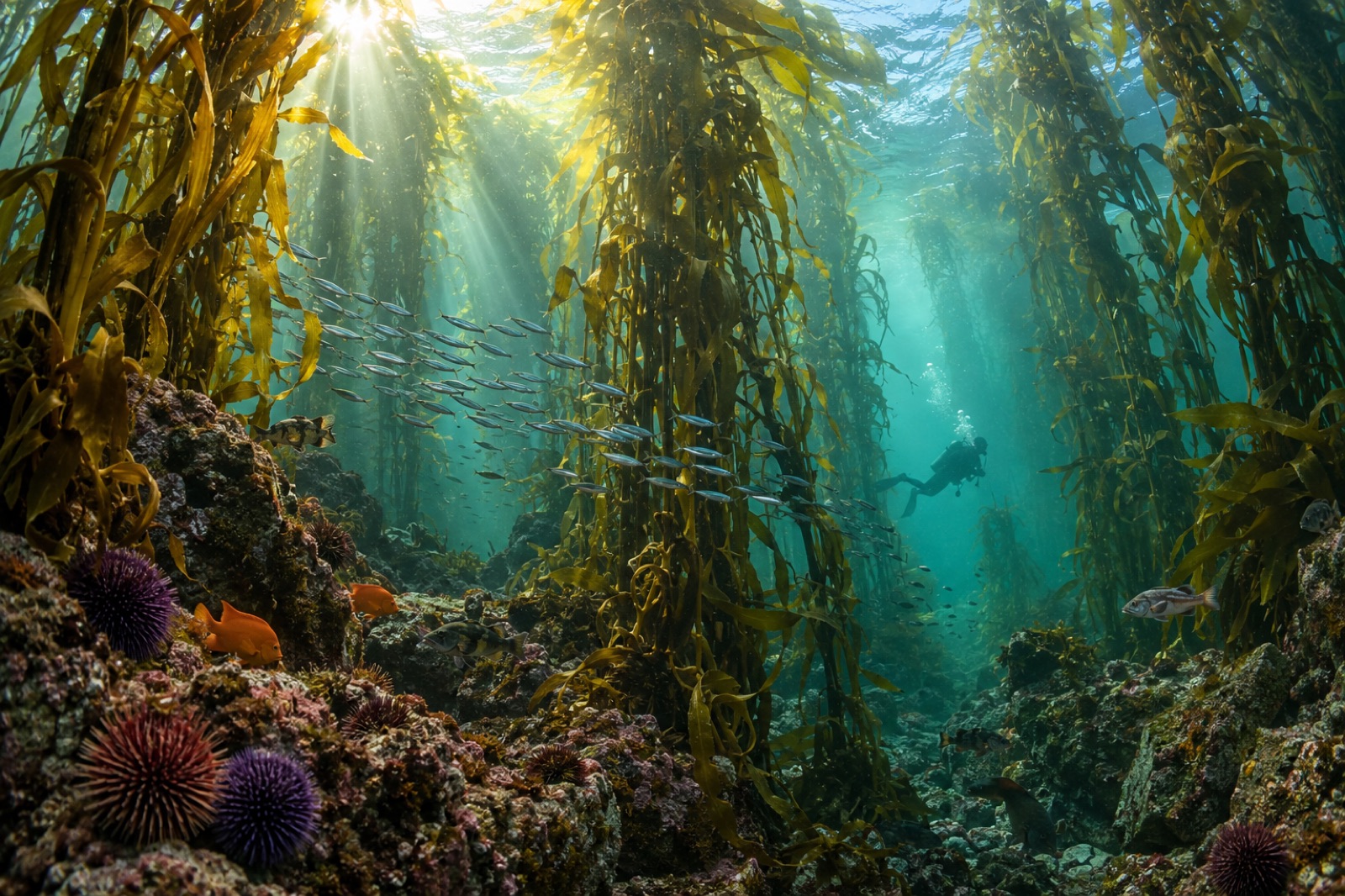
Kelp forests live in cool to cold water. That simple fact shapes every gear decision a kelp diver makes, and none more than the exposure suit. Get it right and you spend your dive gazing up through golden fronds. Get it wrong and you spend it shivering, burning air, and counting the minutes to the surface. So which is it — drysuit or wetsuit? The honest answer is that both are excellent tools at specific temperatures, and the crossover zone is wider than most divers assume. Here is the comparison we give every photographer and volunteer surveyor who joins our field teams, starting with the short version:
- Water below about 10–12 °C (50–54 °F), or long stationary dives (photography, surveys): drysuit, almost always.
- Cool water between roughly 12 and 18 °C: either can work; duration, activity level and budget decide.
- Above 18 °C: a good wetsuit is simpler, cheaper and more comfortable.
Everything else is detail — but the detail matters, so let's work through it.
How each suit actually keeps you warm
The wetsuit: wet insulation
A wetsuit is closed-cell neoprene foam, usually 3–7 mm thick for temperate diving. A thin film of water enters the suit, your body warms it, and the neoprene's gas bubbles slow heat loss. Two things determine your comfort: thickness and fit. A well-fitted 7 mm wetsuit with a 5 mm hood and boots will keep an active diver genuinely warm into the low teens Celsius. A baggy one will flush cold water with every kick and leave an inactive diver miserable at 18 °C.
The hidden weakness of neoprene is compression. The bubbles that insulate you also provide buoyancy, and they squish at depth. At 20 metres a 7 mm suit insulates noticeably less than at the surface — a real consideration on deeper kelp sites.
The drysuit: dry insulation
A drysuit (crushed neoprene or a trilaminate/fabric shell) seals you off completely at wrists and neck. The insulation comes from undergarments you wear beneath — fleece or Thinsulate layers — and from the volume of air trapped in the suit. That air layer does not compress away the way neoprene foam does, so insulation at depth stays far more consistent. You tune warmth to the water: light baselayers plus thin fleece in mild conditions, heavyweight undersuits when it's properly cold.
The corollary is that a drysuit is a shell, not a heater. It keeps you dry; your underwear does the warming. Buying only the suit is like buying a sleeping bag with no temperature rating.
Warmth, side by side
For a fair comparison, match the gear to the activity. Kelp diving is often slow diving — finning gently along a rock wall, hovering for a nudibranch, kneeling to check a survey quadrat. Slow diving generates little body heat, which is exactly why active tropical divers are shocked by how cold temperate water feels.
Rough comfort ranges for a typical diver doing low-exertion dives of 40–60 minutes:
- 7 mm wetsuit + hood + boots: workable from about 18 °C down to 8–10 °C, with the lower end depending heavily on fit, dive length and your personal cold tolerance.
- Drysuit + midweight undersuit: comfortable from about 15 °C down to near-freezing water; swap to heavy undersuits below about 8 °C.
The practical takeaway: above ~14 °C, either system can keep a normal diver warm. From 14 °C down to ~10 °C, the wetsuit works for active divers on shorter dives, while a drysuit keeps almost everyone comfortable including cold-sleeping, slow-moving photographers. Below ~10 °C — Tasmania in winter, British Columbia most of the year, Norway, southern Chile — the drysuit is the clear tool.
Hoods, gloves and boots close the gap
Whatever suit you choose, extremities matter enormously. A 5–7 mm hood, proper boots and 3–5 mm gloves can move you a full temperature band. Most "I was freezing" stories on forums come down to an exposed head and cold hands, not the suit body. If you're new to cold water, read our month-by-month kelp diving season guide to know what temperatures you're actually buying for before you spend.
Buoyancy: the skill difference nobody mentions
This is where wetsuit and drysuit diverge most in daily use.
A wetsuit diver maintains buoyancy the usual way: BCD wing for big adjustments, subtle lung control for fine trim. Neoprene compression at depth reduces the suit's own buoyancy, which is why you add lead on temperate dives and why deep shallow-to-depth profile changes matter more on 7 mm suits.
A drysuit diver carries air in the suit itself, and that air migrates. Legs up, air to the feet, and you faceplant downward ("feet-first inversion" in the scary old stories — modern training makes this a minor drill, but it exists). You manage suit air plus BCD air, venting the suit via a shoulder dump valve as you ascend, adding air at depth to stay warm and neutral. It is genuinely a new skill, not a tweak.
Our honest advice: if you choose dry, budget for a proper drysuit course or a supervised orientation weekend, not just a simulator video. Two dives with an instructor who pushes you through drills — hovering upside down, knuckles on the mask while dumping — makes the difference between loving and hating your suit. Tide-ready cold-water dive centres run these all the time; the cost is trivial next to the suit itself.
Cost and maintenance: the real price gap
| Factor |
Wetsuit (7 mm) |
Drysuit |
| Upfront cost |
~$250–600 |
~$1,200–3,000+ (plus $150–400 undersuit) |
| Training needed |
None beyond open water |
Strongly recommended (a course or mentored dives) |
| Annoying failure points |
Zipper, seam wear, gradual thinning |
Seals (latex tears), valve leaks, zipper seizing, pinholes |
| Post-dive care |
Rinse, hang to dry, done |
Rinse, zip-wax, seal powder/care, dry inside and out |
| Longevity |
2–5 years of regular use |
5–15+ years if seals are maintained and replaced |
Approximate prices as of our writing, and vary by brand and market.
A drysuit is a serious capital purchase, but the maths can work: if it lets you dive year-round instead of six months, your effective cost per dive can drop below the wetsuit you'd otherwise outgrow. If you dive only a handful of temperate trips a year, rent and don't buy.
Travel, weight and packing
Drysuits are bulky. A crushed-neoprene suit packs roughly like a wetsuit; a full trilaminate plus heavy undersuits can fill half a checked bag. Airlines and liveaboards both notice. Wetsuits pack tighter and dry faster, and you can hang them over a balcony between dives — important on a multi-day Channel Islands or Monterey trip.
One more subtle point: drysuit demand air gulps your tank faster in shallow water (venting cycles), and many dry divers report slightly higher gas consumption overall until their technique settles. Plan your nitrox fills and turn-around pressure accordingly.
When each is the right call
Choose a wetsuit if…
- Your kelp diving is mostly in the 14–18 °C band — southern California summer, New Zealand's north island coast, parts of Tasmania's summer window (our Tasmania guide has seasonal detail).
- You dive actively — swimming transects, spearfishing where legal, energetic photography — and stay warm through movement.
- Budget matters and you dive fewer than ~25 cold-water days a year.
- You value simplicity: zero new buoyancy skills, minimal maintenance, fast packing.
Choose a drysuit if…
- Your local kelp season means water under 12 °C for months at a time — the Pacific Northwest, southern Chile, Hokkaido, most of Tasmania's year.
- You do long, slow dives: reef surveys, underwater photography, scientific collection. Stationary cold is where drysuits shine.
- You want year-round access and accept the training and maintenance trade.
- You have a drysuit-capable buddy or mentor network. Solo training on a borrowed suit is a bad idea.
And the crossover truth: plenty of experienced temperate divers own both. A 7 mm for summer shore dives, a drysuit for winter boat work, and honest self-assessment before each trip. That's not indecision — that's kit matched to water.
A diver's last word on fit
Whatever you buy, fit beats features. A $300 wetsuit that seals at the neck beats a $600 one that flushes at the small of your back. A drysuit that fits lets you kneel, shoulder-check a regulator and reach your valves without fighting the shell. Try before you buy, kneel in the shop, squat, reach up and behind. If the salesperson rushes you, walk.
And once you're equipped and competent, the kelp forest itself rewards the patience. Watch the light shift through the canopy, float beside a garibaldi as it guards its nest, and — if you're on the North Coast — drift quietly past the kelp rafts where sea otters rest. Their world is cold, and your suit is what lets you visit it long enough to actually see it.
Key takeaways
- Below ~10–12 °C, a drysuit keeps almost every diver more comfortable than any wetsuit; above ~18 °C, a wetsuit is simpler and cheaper.
- The under-suit layers do the insulating in a drysuit — budget for them and modify them by season.
- Drysuit diving is a learned skill. Take the course; don't self-teach buoyancy in a flooded suit.
- Fit matters more than brand or features in both systems — try before you buy.
- Rental is a legitimate path for occasional cold-water divers; ownership pays off with frequency.
FAQ
Can you scuba dive in a wetsuit in 10 °C water?
Yes — many divers do, in a well-fitted 7 mm wetsuit with a good hood and gloves, but comfort varies wildly. If you run cold, it will feel punishing, and most divers enjoy it far more in a drysuit. Fit and activity level decide more than the number alone.
Is a drysuit hard to learn?
It's a new buoyancy skill, not an extreme one. A one-day course or a weekend of mentored dives typically gets a competent open-water diver comfortable. The learning curve is a few dives, not months; the risk of skipping training is mostly discomfort and faster gas burn, not danger, if you stay shallow and dive with a buddy.
Do drysuits leak constantly?
A well-maintained suit does not. Leaks almost always trace to worn wrist/neck seals, a failed dump valve o-ring, or a neglected zipper — all cheap fixes. Regular fresh-water rinses, zip wax and a check under a flashlight before trips prevent nearly all of it.
What about semi-dry suits?
Semi-dry wetsuits (tighter seals, back-zip flush reduction) sit between wet and dry in warmth but share wetsuit limitations. They can work well in the 12–16 °C band, but they aren't a substitute for a drysuit at true cold-water temperatures.
Can I use my drysuit for snorkelling?
You can, but it's overkill and the buoyancy management is awkward at the surface. For cold-water snorkelling, a thick wetsuit or semi-dry is usually easier and more fun unless you're doing extended surface observation in very cold water.