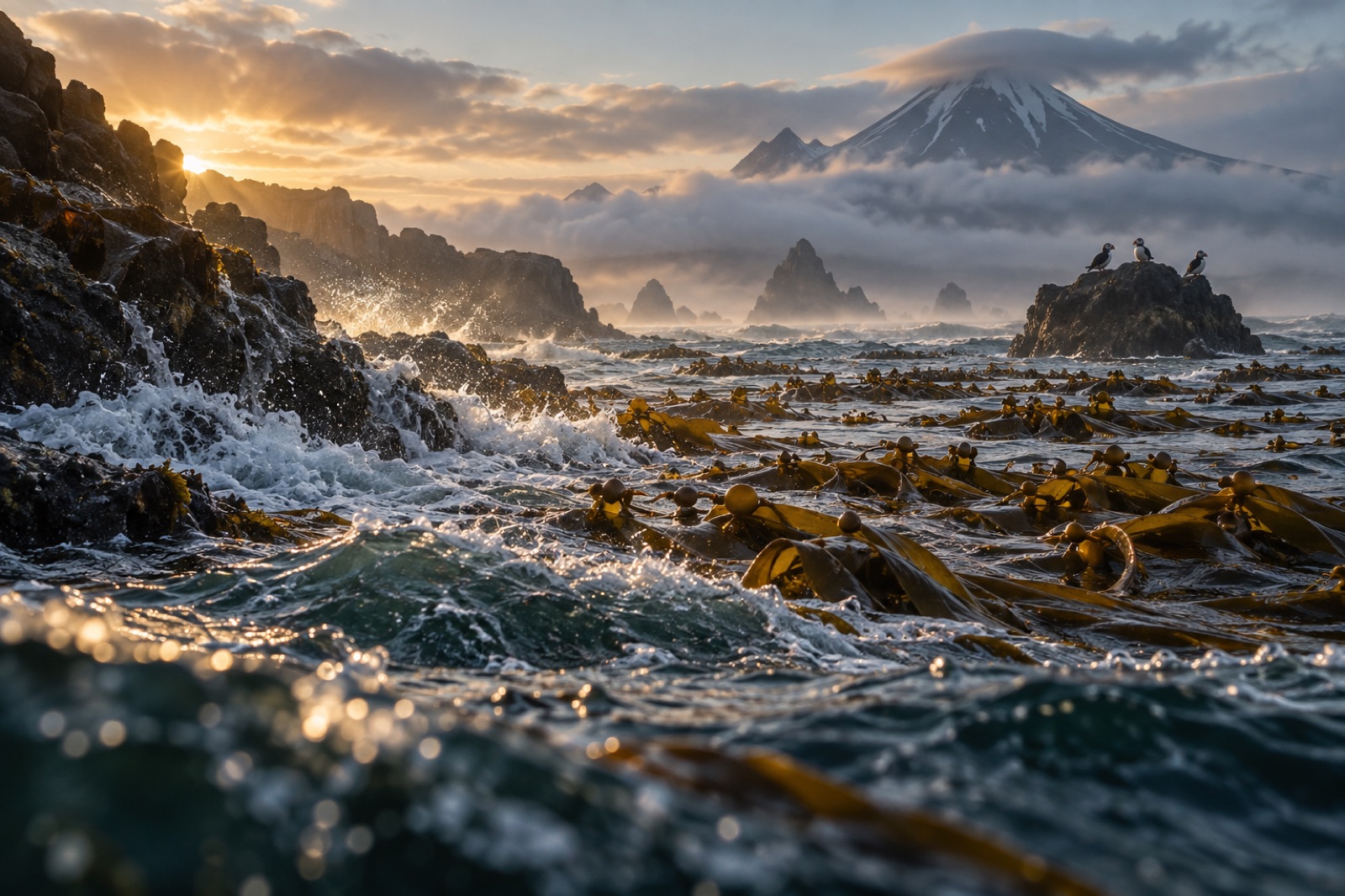
Our companion Atlas entry on the Aleutians tells the science story — the otter-urchin-kelp cascade that this archipelago taught the world. This entry is about the place itself as a frontier: what it means that the longest kelp coastline in the North Pacific is also one of the least visited pieces of real estate on Earth, what the weather and distances actually do to plans, and how the few people who work these waters — fishers, scientists, and a handful of stubborn travellers — manage it. I lead field operations for Tidewright (a fictional company built for this demonstration site), and the illustrative survey programmes we describe draw on the very real logic of operating out here: you take the ocean's terms or you don't go.
Distances measured in weather
The Aleutian arc runs roughly 1,900 kilometres west-southwest from the Alaska Peninsula to Attu, crossing the 180th meridian into the Eastern Hemisphere's map edge and nearly touching the International Date Line. More than three hundred islands and islets, rising off the Aleutian Trench, divide the Pacific from the Bering Sea. Fewer than ten thousand people live along the entire chain, most of them in three places: Unalaska/Dutch Harbor near the eastern end, Adak in the middle, and Atka and Akutan as smaller outposts. To the Unangax̂ (Aleut) people, this is homeland — inhabited for thousands of years before any map called it a frontier — and any respectful visit starts by acknowledging the communities whose sea country this is.
The weather is the real border control. The Aleutians sit in the storm latitudes where Pacific and Arctic air masses collide; williwaws — violent katabatic gusts that pour off volcanic ridges — can turn a calm anchorage into a survival exercise in minutes. Fog is the default state of summer. Seas between islands are oceanic in character even when the charts show short miles. Field crews here keep two calendars: the one they planned, and the one the Aleut Low permits.
The forests themselves
Biologically the Aleutian coast is one continuous argument between kelp and urchin, refereed by sea otters — and the forests it produces, where the referee is present, are unlike anything in lower latitudes.
The canopy king is dragon kelp (Eualaria fistulosa), a cold-water giant whose branched, hollow-stiped fronds sprawl across the surface in mats thick enough to foul small boats. Look down through a dragon kelp canopy on a clear day and you see the architecture of a true northern forest: canopy overhead, and beneath it a dim green understory of sieve kelp (Agarum), its blades perforated like colanders, tolerant of the low light under the canopy roof. Annual kelps sprint up each spring on any rock the winter storms cleared. The reef structure is volcanic — fresh basalt broken into boulder fields and ledges with endless attachment points, which is part of why kelp densities here can reach extremes seldom measured elsewhere.
The passes tell the other half of the story. Tidal currents ripping between islands keep nutrients in the sunlit layer all summer — the same fertilisation-by-mixing principle our tidal mixing explainer covers in general — and they also decide where even a vessel draws the line. Some Aleutian passes are transited only on slack water by crews who know them by name.
The cascade's state varies along the arc and across the decades. The science entry traces the history: fur-trade extirpation of otters, recovery, and then the 1990s collapse of western Aleutian otter populations — attributed by researchers including Jim Estes's group to increased killer whale predation — followed by urchin outbreaks and kelp loss across much of the western arc. The eastern islands, still otter-held, kept their forests. Anyone who sails the arc from Dutch Harbor westward is, in effect, traversing a gradient of forest states that took decades of science to map.
How anyone actually gets out here
There is no road system, no ferry that tours the chain end to end, and no tourist infrastructure of consequence west of Unalaska. The honest options:
- Dutch Harbor/Unalaska — reachable by commercial flight from Anchorage and by ship — is the working heart: the nation's busiest fishing port by volume, a deep anchorage, and the staging point for research vessels, Coast Guard cutters and supply runs. From here you can walk kelp-ringed beaches, watch salmon streams and massive eagles, and arrange charter boats when weather cooperates.
- The state ferry serves the eastern reaches on sparse seasonal schedules. West of the peninsula the ferry network effectively ends.
- Research and work vessels — NOAA ships, university expeditions, Foundation and agency charters — go west when funded. Berths are scarce and booked by mission, not by whim.
- A small number of expedition cruises visit the outer Aleutians on itineraries that also take in the ring of fire and the Bering Sea — expensive, weather-dependent, and landing-permit meticulous.
Field logistics compound everything: spare parts come by air freight or not at all; fuel caches are planned one season ahead; dive work is weather-window roulette. A two-week survey programme out here might yield six good days. Those six days, in this water, are worth six months almost anywhere else.
The shipwreck shelf and the war the weather fought
The Aleutians are littered with wrecks — fishing boats taken by williwaws, freighters lost to chart errors in fog, and the deliberate hulks of the region's strangest history: the Pacific war's northern front. In June 1942, Japanese forces bombed Dutch Harbor and occupied Attu and Kiska — the only invasion of North American soil in the Second World War. The battles to retake the islands in 1943 were fought as much against the weather as against any army; fog, mud and frost casualties defined the campaign. The Unangax̂ residents of the islands were evacuated or interned — villagers from the Pribilofs and the Aleutians were removed to Southeast Alaska camps, and Attu's people were taken to Japan as prisoners — a chapter of American history told far too seldom.
Today the wrecks and wartime roads are part of the seascape. Divers willing to push this far find hulls gone to reef, dressed in cold-water life and, in the shallows, ringed by kelp. The National Wildlife Refuge system — the Alaska Maritime National Wildlife Refuge administers much of the chain — keeps most of it a sanctuary you approach carefully, with permits and humility.
What the next century asks of this coast
The Aleutian kelp forest is not safe simply because it is remote. Marine heatwaves now reach into the Bering Sea; the northern kelp species here evolved in a cold world that is warming faster than most. The otter cascade — the region's own regulatory system — remains partially broken in the west, with the killer whale hypothesis still debated in the literature. And because monitoring is so expensive, our knowledge runs years behind events; an urchin flip in an unvisited pass can proceed for a decade unrecorded. This is precisely the kind of gap that long-term monitoring records exist to close, and why the Aleutian record, sparse as it is, looms so large in kelp science's global baseline.
If Tidewright's fictional long-range survey vessels in this site's demonstration copy seem tailored for these waters, it's because real-world restoration science keeps being rewritten by what happens here. Whatever grows, grazes, or washes ashore between Attu and Unimak matters to everyone trying to keep or grow kelp anywhere — this quiet edge of the hemisphere is the Pacific's control panel.
If you go
Base yourself in Unalaska/Dutch Harbor. Walk the beaches and World War II trails with respect for private and Native corporation land; watch salmon carcasses feeding eagles; kayak the bay on the rare flat day with local advice; take a birding or whale-watching charter into the passes when offered. Bring serious rain gear, patience, and flexibility. Read the weather religiously (our marine forecast guide is a starting point), and remember the first rule of Aleutian travel: the plan is a rumour until the boat actually leaves.
Key takeaways
- The Aleutians are the longest great kelp frontier in the North Pacific: roughly 1,900 kilometres of volcanic arc, few human communities, and one continuous otter–urchin–kelp experiment running along it.
- Dragon kelp canopies over sieve-kelp understory, over boulder reefs, define a forest architecture as northern as it gets.
- The 1990s otter collapse and its aftermath split the arc: forest in the otter-held east, persistent barrens across much of the west.
- Access is real but difficult: Unalaska/Dutch Harbor by air and sea, sparse state ferry east, expedition cruises and charters beyond — all weather-bound.
- The islands carry WWII history and Unangax̂ heritage that demand respect alongside the biology; wrecks and refuges define much of the seascape.
FAQ
Can tourists visit the Aleutian Islands?
Yes — you can fly commercially to Unalaska/Dutch Harbor and explore independently. Beyond that, options narrow to the state ferry's eastern reaches, occasional expedition cruises, and charters. There are no crowds to manage, because weather manages them.
Is diving the Aleutians possible?
Technically yes, practically rare: no dive shops, no rental gear, water around 3–9 °C, and sites reachable only by vessel in fierce currents. Scientific and technical teams bring everything. It is among the most demanding cold-water diving environments on the planet.
Are all the islands covered in kelp?
Wherever otters hold urchins in check, yes — the eastern arc in particular is famously lush. Western islands that lost otters in the 1990s shifted heavily toward urchin barrens, though the science is ongoing and recovery varies island by island.
Why is the weather so famous?
The Aleutians sit where Pacific and Arctic air collide along the storm track, and the volcanic terrain spawns williwaws — sudden, violent downslope gusts. Fog is near-constant in summer. Mariners have respected the "birthplace of storms" for centuries.
Who lives out there?
Unangax̂ (Aleut) communities — whose ancestors have inhabited the islands for millennia — alongside fishing industry residents in Unalaska/Dutch Harbor, Adak, Akutan, Atka and Nikolski. Total population along the chain is under ten thousand.