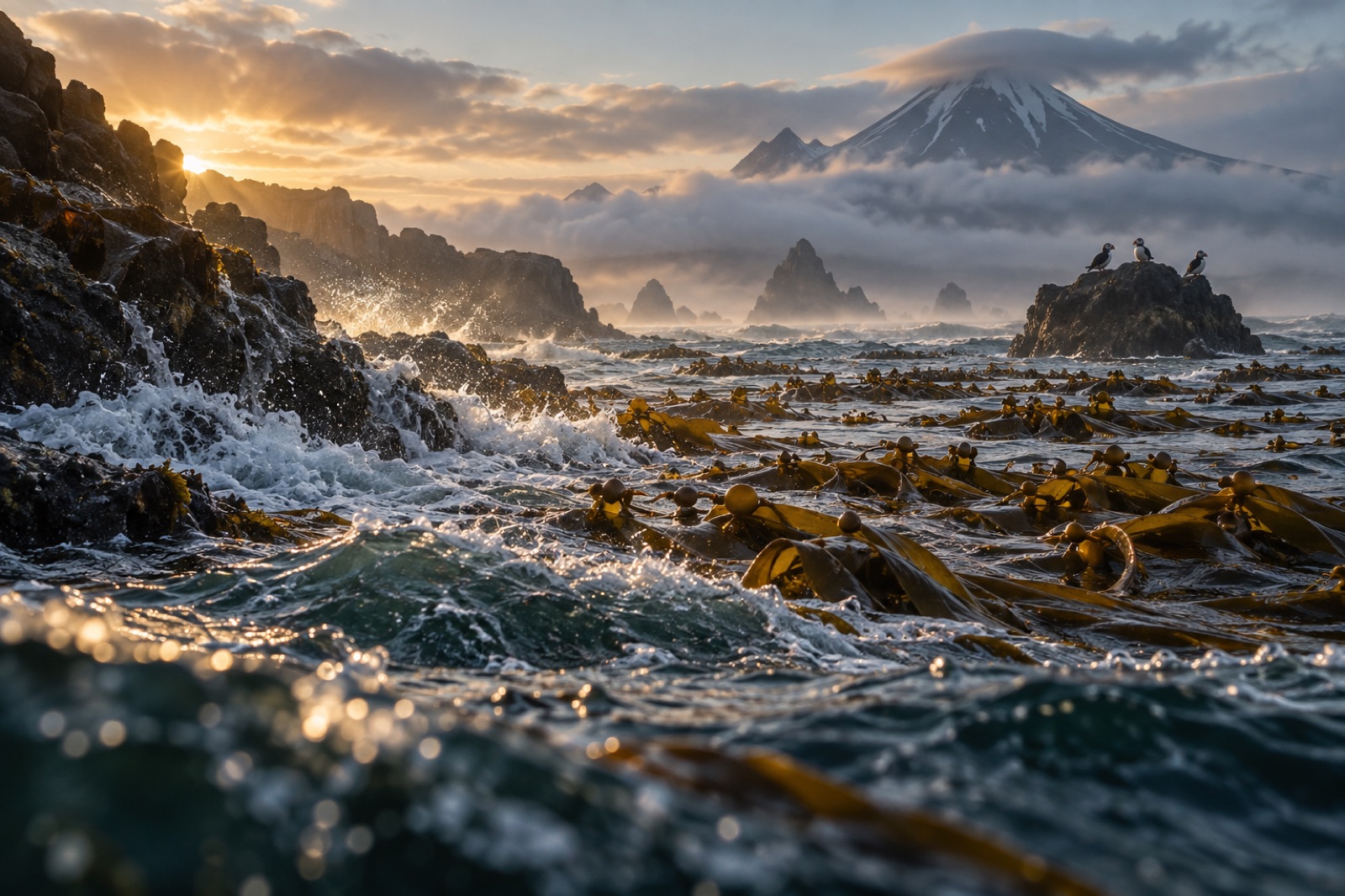
Kamchatka hangs off the far eastern shoulder of Asia like a great basalt fishhook — twelve hundred kilometres of peninsula, rimmed by volcanoes, drained by more salmon rivers than almost anywhere on Earth, and washed by some of the most productive cold water in the North Pacific. Its reefs grow kelp forests on a scale and with a wildness that has almost no modern parallel: unbroken fringes of Laminaria and Alaria running for tens of kilometres along shores that do not have a road, guarded in many places by the world's most intact sea otter populations. If you want to see what a temperate reef looks like when the predators are still in place and the people largely aren't, this is the reference coastline. Our guides to the Aleutian Islands across the Bering Sea and the Sanriku coast far to the south bookend the ecosystem it anchors.
The coast and its water
Kamchatka's kelp story starts with physics. The peninsula separates the Sea of Okhotsk to the west from the open Pacific and the Bering Sea to the east, and the two sides grow different forests.
The Pacific east coast — from Cape Lopatka in the south up past the Kronotsky Peninsula — faces boundary currents and deep upwelling. Cold, nutrient-rich water, long Pacific swell and volcanic rock make premium kelp substrate. The east coast is comparatively ice-free in winter and holds the peninsula's most extensive and diverse kelp beds, stretching in patches along hundreds of kilometres of cliff and cobble shore.
The Okhotsk west coast is another world: the northern Sea of Okhotsk carries heavy seasonal sea ice, and shore-fast ice scour grinds the intertidal and shallow subtidal annually. Kelp grows only where reef, refugia and current patterns intervene, and beds are patchier, more seasonal and structured by ice — a western shore where the forest's year runs from ice-out in early summer to freeze-up by autumn.
The water on both sides is rich far beyond most temperate coasts: a combination of upwelling, tidal mixing around headlands, volcanic and glacial trace nutrients, and an unearthly annual pulse of salmon carcasses carrying ocean nutrients back into headwaters — some of which washes back downstream as food for a tide-flat of filter feeders. Kamchatka's reefs sit inside a nutrient loop much bigger than kelp forests alone.
What grows: a northern kelp assemblage
Kamchatka's forest is characteristically Subarctic Pacific: a Laminarialean assemblage lacking the giant kelp (Macrocystis) and bull kelp dominants of the eastern Pacific, but building dense structure from other genera:
- Saccharina and the old Laminaria complex form the main canopy and understory across the subtidal — the same broad family that makes kombu a food staple in Hokkaido just to the south.
- Alaria species — including the giant, midribbed Alaria fistulosa, a hollow-stiped relative of Atlantic winged kelp — dominate the more exposed lower zones, their ruffled blades streaming in the surge.
- Agarum and understory red algae carpet the deeper reef below the canopy, running into cold, clear lower lighting.
Zonation is sharp and unmistakeable here, the classic stacked layers described in our guide to subtidal zonation and on kelp's underwater light budget: surf-swept Alaria belt, Laminaria main forest, then the red-algal floor where the light thins out toward its low, year-round baseline.
The otter-urchin-forest triangle, nearly intact
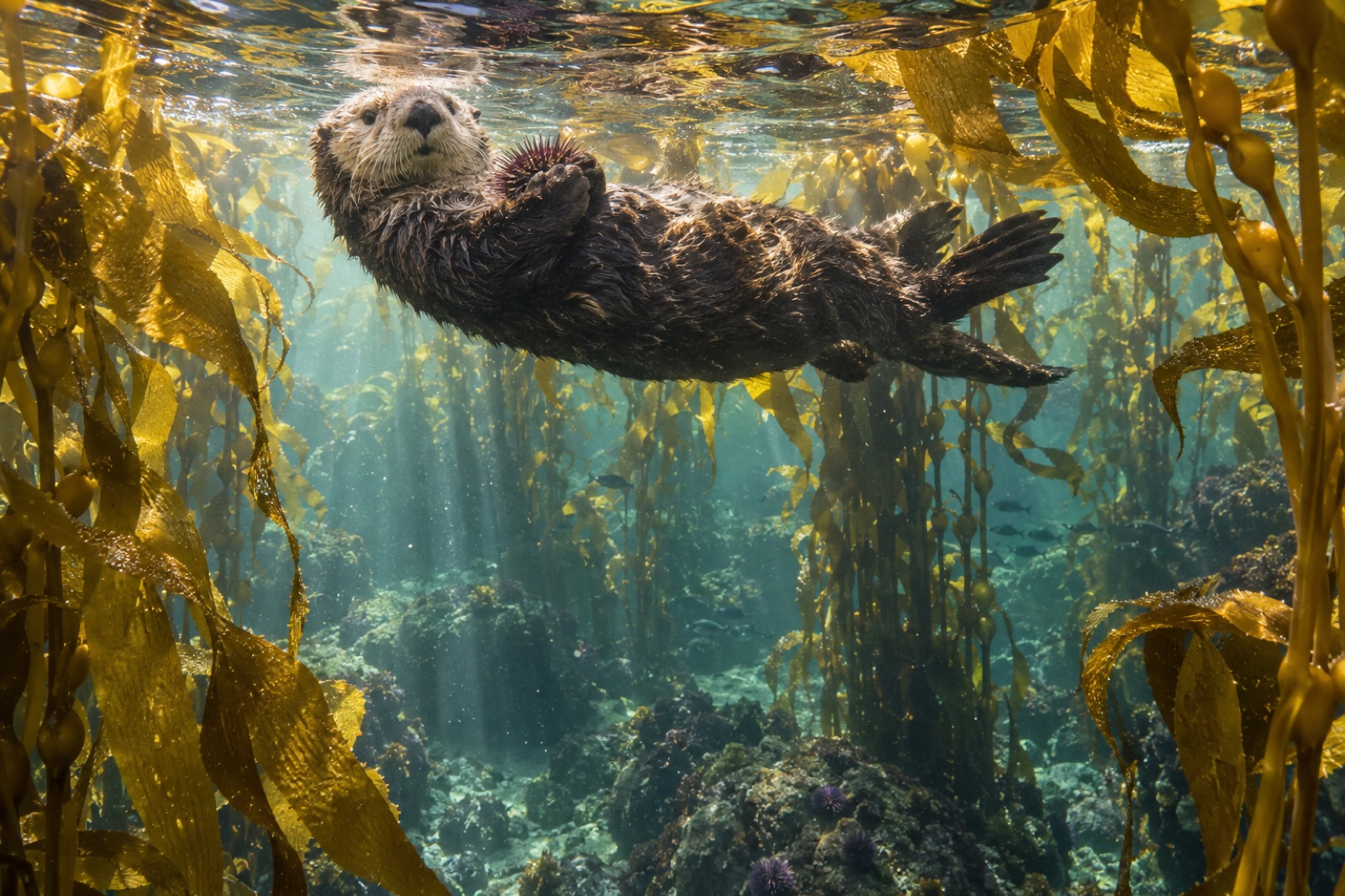
The ecological headline of Kamchatka's kelp coast is that the trophic cascade still runs on its original setting. Sea otters were hunted nearly out along this coast during the Pacific fur trade, but the Commander Islands — a hundred-odd kilometres off Kamchatka's southern tip — held one of the few remnant populations on the western Pacific rim, and otters recolonised much of the peninsula and northern Kurils over the twentieth century.
Where otters hold ground, you see the classic layout: urchins kept to rock crevices and small sizes, kelp dense and continuous from the surge zone down, fish crowded in the canopy. Where otters are locally absent — some west coast stretches, recent harvest-relaxed zones — reefs can type-shift toward urchin pavement, the flip described in our explainer on urchin barrens. Kamchatka, in other words, is where you can still see the ocean run the experiment both ways along a single coastline.
The predators above otters are still here too: Steller sea lions haul out on offshore rocks, orcas work the passes and bays in numbers biologists come from across the world to study, and in autumn brown bears line almost every salmon river mouth in full view of the kelp beds — a reminder that on this coast, kelp forest and tundra are compartments of one nutrient machine.
The part that is not wilderness: people, fisheries and uses
"Undisturbed" needs an asterisk: Kamchatka has people, history and heavy exploitation — it just concentrates them in specific places.
- Fisheries. Avacha Bay and the surrounding southeast is one of Russia's busiest fishing capitals; the peninsula's commercial heart is salmon, pollock, Pacific cod, herring and the famous Kamchatka (red king) crab. Kelp beds matter to all of it as juvenile habitat and forage ground, and dive fisheries for urchins and kelp exist at modest scale.
- Kelp harvest. Wild Laminaria is harvested locally for food and processing, at levels well below Hokkaido's but long-established; traditional uses run deep through the Itelmen, Koryak and other Indigenous cultures of the peninsula, where kelp was woven into ropes, storage and diet long before any industrial interest.
- Pressure points. Poaching pressure on salmon, bottom-contact fishing on shelf grounds, and legacy Soviet-era coastal infrastructure are the coast's realistic conservation issues, more than kelp cutting per se.
Heat and ice: how Kamchatka's forests ride a warming century
Kamchatka is not a refuge from the ocean's fevers, it is a front. Seat temperatures here are rising, and marine heatwaves reaching across the North Pacific — the "Blob" years of the mid-2010s among them — touched this coast and the Bering Sea hard. The peninsula's saving grace is variety: deep local upwelling, cold glacial inflow and long latitudinal spread mean thermal refugia are numerous, and cool-water kelp species here live near the middle, not the edge, of their temperature range — short of true extremes, this coast has room to ride out what is finishing forests further south. The science of kelp's thermal limits explains why that matters: forests fail fastest at their warm range edge, which Kamchatka is not.
Getting there: the honest access picture
Kamchatka is a destination for the organised, not the casual. Petropavlovsk-Kamchatsky is the only realistic gateway, reached by air from Moscow or Vladivostok; outside the Avacha Bay area there is no road system to speak of along the coast, and the famous kelp shores are boat or helicopter access only. Realistic ways onto the water:
- Expedition cruises along the east coast and Commander Islands, which frequently run snorkel and occasionally dive excursions in otter-hold kelp — cold, shallow and spectacular.
- Local operators in Avacha Bay for day trips to Starichkov Island and bay reefs; the bay holds respectable kelp beds within sight of the city's volcano skyline.
- Permitted visits to reserves. Kronotsky Nature Reserve and the south Kamchatka federal sanctuary protect much of the prime east coast; access goes through the reserve system, typically via permitted expedition itineraries.
The season is June to September; water temperatures sit in the 6–12°C band even in high summer, so this is serious cold-water diving territory — drysuits, real experience, and an expedition operator who knows the water.
Why Kamchatka matters to the rest of the kelp world
Every restored or recovering forest needs a picture of health to be measured against, and Kamchatka is one of the last places the full picture is still developed: predators present, forests continuous, harvest low, nutrient rivers running wild. When we talk about what "restored" means for a reef — the zonation, the fish assemblage, the urchin baseline — coasts like this supply the template. That is the logic behind the monitoring priorities on our science hub and the design targets in our restoration methodology: rebuild toward the structure of coasts that never lost it.
Key takeaways
- Kamchatka supports some of the least-disturbed kelp forests on Earth, structured by a Laminarialean assemblage of Saccharina, Alaria and Agarum, without giant or bull kelp.
- The east Pacific coast holds the most continuous forest; the iced west coast is patchier and ice-cycled.
- Sea otters — surviving in the Commanders, recolonising the peninsula — keep much of the coast in the classic otter-urchin-kelp cascade, though barren patches show the flip remains possible.
- Salmon rivers, upwelling and volcanic nutrients wire the reefs into one of the world's great nutrient loops.
- Access is expedition-scale only; the east coast's finest forests are reserve-protected, and Avacha Bay is the practical gateway.
- Kamchatka's value to global kelp restoration is as a reference coast: the intact template against which recovering forests can be measured.
FAQ
Does giant kelp grow in Kamchatka?
No — giant kelp (Macrocystis pyrifera) is a North Pacific and Southern Hemisphere species absent from the Russian far north. Kamchatka's canopy is built mostly from Saccharina/Laminaria species, with Alaria on the exposed fringe — a different architecture achieving the same forest effect.
Can tourists dive the kelp forests of Kamchatka?
In a limited, organised way: expedition vessels on the east coast and Commanders sometimes offer snorkel or dive activity for experienced cold-water divers, and local Avacha Bay operators run day trips. Independent diving is impractical — infrastructure, rescue cover and permits are expedition-grade.
Are Kamchatka's kelp forests at risk from warming?
Some effects of North Pacific marine heatwaves have reached this coast, and the Bering Sea side has warmed particularly fast. But the forests here sit well inside their thermal range, with abundant cool-water refugia — Kamchatka is among global kelp ecosystems' more robust strongholds, which is part of its importance.
Why is the kelp coast of Kamchatka connected to salmon?
Salmon carry ocean nutrients kilometres inland and return them via rivers as young fish and spent carcasses; estuaries, and the reefs receiving their outflow, gain a major annual nutrient subsidy. Kelp forests, tide flats and bears all draw on the same flow — which is why kelp conservation and salmon conservation on this coast are effectively the same project.