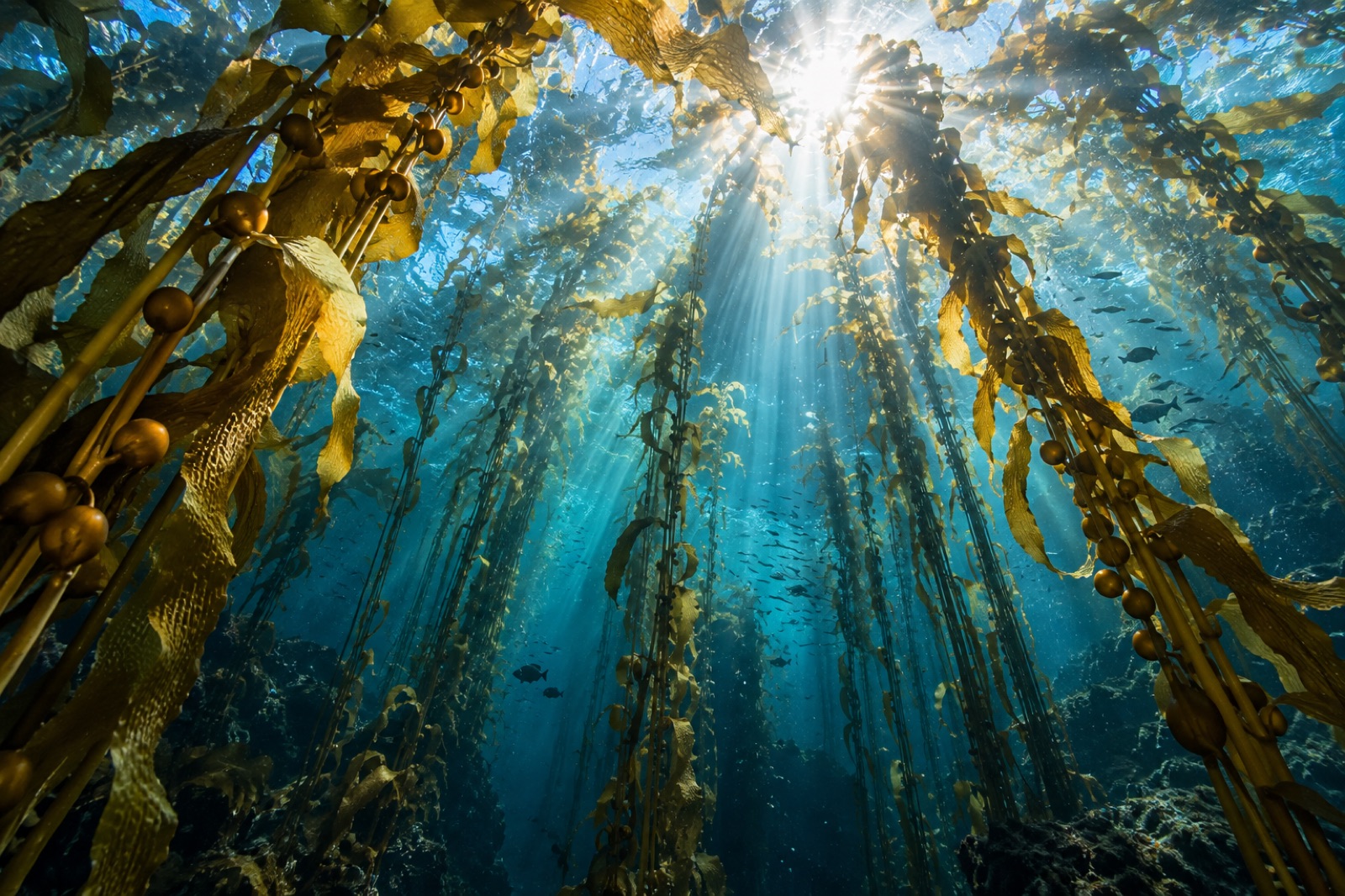
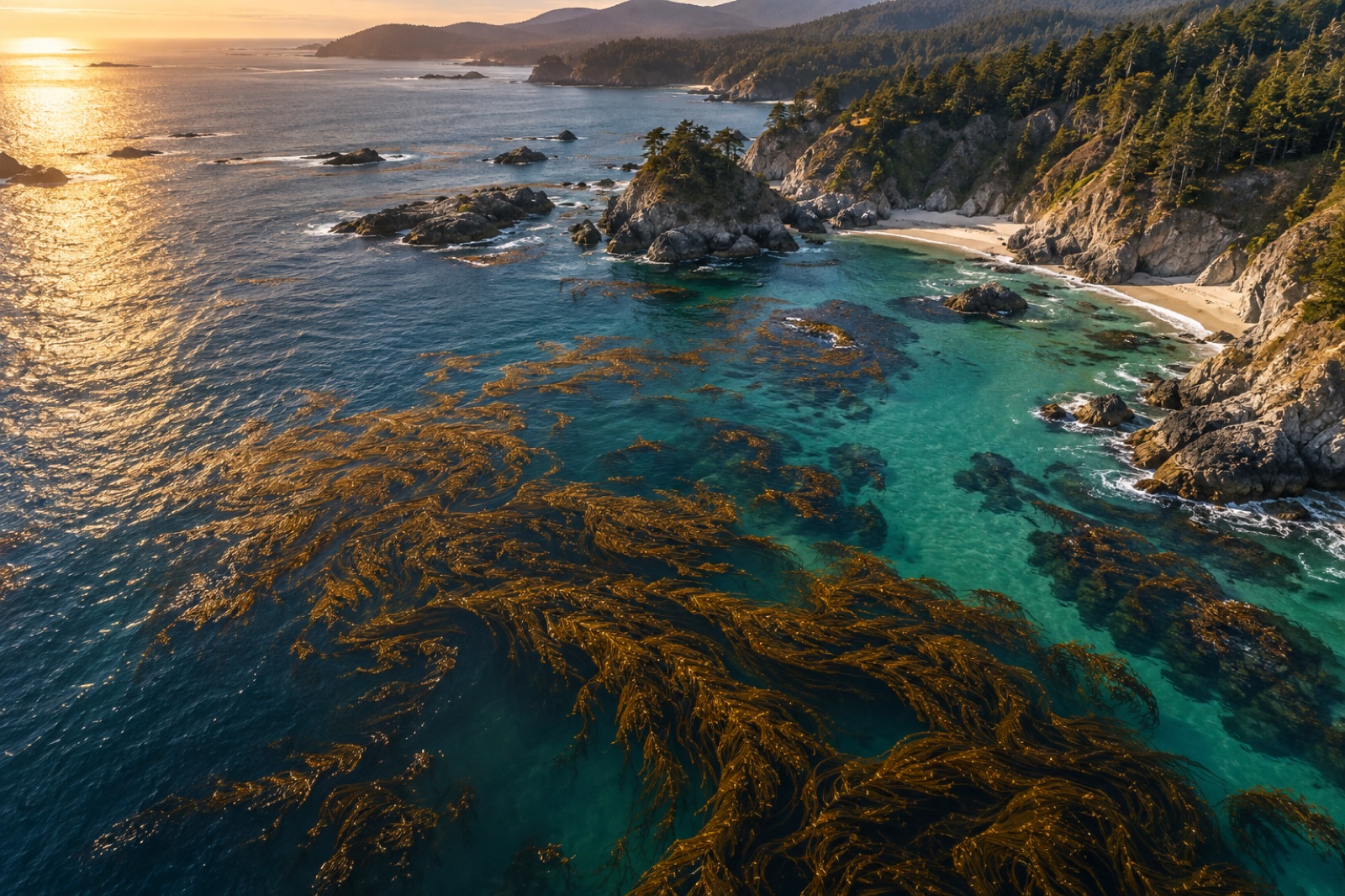
Dive into a kelp forest on a bright day and the first thing you notice is not the cold or the surge — it is the colour. The world turns green-gold, then blue-grey as you descend. Reds drain away within the first few metres; by thirty metres, a diver without a torch is working in twilight. Light underwater is not simply dimmer sunlight. It is sunlight filtered, scattered and rationed, and that rationing quietly decides which kelp species can live at which depth, how tall a forest can grow, and where on a coastline a forest is even possible.
How seawater edits sunlight
Sunlight arriving at the sea surface carries the full visible spectrum. Seawater immediately begins deleting it.
Absorption is selective by wavelength. Pure water absorbs red and orange light strongly, which is why red objects look brown or black below about five metres. Blue and blue-green wavelengths are absorbed least, so they penetrate deepest — the reason the open ocean is blue, and why everything looks blue at depth unless you bring your own light.
Scattering complicates the filter. Suspended particles — sediment, phytoplankton, organic matter called turbidity — bounce light in every direction, shortening its path and changing its colour menu. In clear oceanic water, blue dominates. In plankton-rich coastal water, phytoplankton pigments absorb blue and red for their own photosynthesis, leaving green to penetrate best — hence the green twilight of kelp country.
The combined effect is attenuation: light intensity falls roughly exponentially with depth. A few reference points worth keeping in mind:
- In typical kelp-growing coastal water, perhaps half of surface light remains at around 5 metres.
- In very clear water, 10% of surface light can persist to 30–40 metres; in turbid harbour water, 10% may be gone by 3 metres.
- The depth where light falls to about 1% of surface conventionally marks the bottom of the photic zone — the layer where net photosynthesis is possible.
The compensation point: kelp's survival threshold
For a kelp plant, the question is not how much light arrives but whether it is enough to run a surplus. Every photosynthetic organism has a compensation point: the light level at which photosynthesis earns exactly as much energy as respiration spends. Below it, the plant is slowly spending its savings; above it, growth becomes possible.
Most kelps are what plant physiologists call shade-adapted. Compared with land plants they run lean respiratory budgets and pack their blades with pigments, so their compensation points are impressively low — many kelps can maintain a positive energy budget at around 1–2% of surface light, and the extreme deep-edge kelps (like Antarctic Himantothallus or Arctic deep-water species) persist at still lower fractions. This is why kelp forests typically bottom out somewhere between 20 and 40 metres in clear temperate water, and why the deepest kelp on a reef is nearly always the most shade-tolerant species on that reef — the pattern behind subtidal zonation in microcosm.
Depth, however, is only half the story. Because attenuation multiplies whatever the water is carrying, a turbid estuary mouth can put the compensation point at 4 metres while a clear offshore rock puts it at 40. Water clarity, more than depth itself, draws the map of where kelp can live. This is why sediment plumes from dredging, river floods and coastal construction are first-order threats to kelp — they raise the forest's floor.
The colour angle: brown kelp, blue light, and a clever sixth sense
Kelp is brown for a reason, and the reason is underwater light. The accessory pigment fucoxanthin absorbs strongly in the blue-green band — precisely the wavelengths that penetrate seawater best — and hands that energy to the photosynthetic reaction centres. It is an antenna tuned to the exact frequencies the ocean lets through (the full pigment story is in our explainer on how kelp photosynthesises).
But kelp senses light as well as harvesting it. Research on gametophytes — the microscopic generation — shows they detect blue light specifically and use it as a trigger for becoming fertile. Blue is the one colour guaranteed to reach the seafloor, so it serves as a reliable "you are in the photic zone" signal. In clear coastal water, kelps also read the ratio of blue to green: blue-rich water means clear, nutrient-likely, good growing conditions; green-dominated water implies phytoplankton or particles overhead and warns of competition or murk to come. The depths a young kelp commits to completing its life cycle at are, quite literally, chosen by colour.
Canopy geometry: the forest shades itself
A kelp forest is a light economy with its own internal inequality. The surface canopy of a giant kelp forest receives full sun and can absorb the overwhelming majority of incoming light — measurements in closed canopies find well over 90% of light captured before it reaches the mid-water. Below sit the vertical fronds in green twilight, the understory kelps near the floor, and finally the shade-adapted red algae and encrusting life in the dimmest layer.
This vertical gradient structures the whole community:
- Fast-growing canopy species that burn energy reaching the top trade off against slow, efficient understory species built to profit at 5% light.
- Storms and senescence tear holes in the canopy; light spikes on the seafloor beneath each gap, and young kelp races to claim the sunspot — the same gap-phase dynamic that drives forest succession.
- Species partition depth by pigment outfit. Browns with fucoxanthin dominate the mid-depths; many red algae carry phycobilin pigments that harvest the residual green-blue at the reef's lowest edge and can photosynthesise deeper than any kelp.
Seasons, sun angle and the timing of growth
Underwater light changes through the year as much as temperature does. Three seasonal levers matter for kelp:
- Day length and sun angle. Winter sun sits low, delivers light at a grazing angle, and much of it reflects off the surface rather than entering. Total daily light underwater can fall several-fold between summer and winter even before weather is considered.
- Storms and turbidity. Winter swells resuspend sediment; flood seasons deliver river plumes. The clearest water of the year on many temperate coasts is late summer or autumn — which coincides, usefully, with peak kelp canopy.
- Phytoplankton blooms. Spring blooms feast on the same nutrients kelp needs and simultaneously dim the water column. Kelp's strategy of growing hard in late winter and spring — before the bloom peaks and before summer stratification cuts nutrients — is timed against this light-and-nutrient calendar.
Gametophyte development follows the light calendar too, which is why restoration hatcheries, including Tidewright's Holdfast nurseries, run artificial light regimes: blue-weighted LEDs on carefully timed photoperiods cue the microscopic generation to mature on a restoration schedule rather than the ocean's.
Measuring light where kelp lives
Scientists and restorers quantify the underwater light field with a small toolkit:
- PAR sensors (photosynthetically active radiation, 400–700 nm) log the light kelp can actually use, moored at canopy and floor depth through the seasons.
- Secchi disks and turbidity sensors give quick, cheap clarity readings; a Secchi depth is a rough but surprisingly useful proxy for attenuation.
- Satellites estimate water clarity and canopy extent from above — the same reflectance logic behind how satellites see kelp lets ocean colour sensors track the seasonal push and pull of the clear-water window along entire coasts.
For restoration siting, these measurements answer the two questions that decide success: is the annual light budget at this depth enough for a positive energy balance, and will turbidity events — dredge plumes, flood plumes — drag the site below the compensation point long enough to starve young plants? Light, in other words, is infrastructure. A reef can have perfect rock, ideal temperature and rich nutrients, and still refuse to grow a forest if the photons do not arrive.
Key takeaways
- Seawater deletes sunlight selectively: reds vanish in metres, blues travel deepest, and coastal particles shift the penetrating colour toward green.
- Kelp persists down to roughly 1–2% of surface light; water clarity, not depth alone, sets the true lower limit of a forest.
- Fucoxanthin tunes kelp photosynthesis to blue-green ocean light, and gametophytes use blue light as a depth-and-clarity signal to become fertile.
- A closed canopy captures the vast majority of light, creating a layered light economy that structures understory life and gap-driven regeneration.
- Seasonal shifts in sun angle, storms and plankton blooms define the growing calendar that both wild kelp and restoration hatcheries must follow.
FAQ
How deep can kelp grow?
In clear temperate water, most kelp forests reach their lower limit between 20 and 40 metres, where light falls to about 1% of surface values. Exceptional deep-water species in very clear polar and subpolar seas grow deeper still, and highly turbid coasts may restrict kelp to the top few metres.
Why does everything look blue underwater?
Water absorbs long wavelengths (reds, oranges) far more strongly than short blue wavelengths. The deeper you go, the more the spectrum that remains is blue — so blue is both what you see and, for kelp gametophytes, the colour that proves there is still enough light to invest in reproduction.
Does kelp prefer sunlight or shade?
It depends on the species and life stage — the same forest contains sun-hungry canopy formers and shade-adapted understory specialists living metres apart. Newly settled juveniles and holdfast stages generally tolerate low light; fast-growing canopy blades are among the most light-demanding tissues in the sea.
Why is coastal water greener than open-ocean blue?
Coastal waters carry phytoplankton and suspended sediment. Plankton pigments absorb blue and red light for their own photosynthesis, leaving green wavelengths to dominate — and the extra particles scatter what remains, steepening the light's decline with depth.
Can murky water kill a kelp forest?
Sustained turbidity can. Kelp can tolerate short dark spells on stored carbohydrates, but weeks to months below its compensation point — as under a persistent dredge or flood plume — forces it to consume its reserves, and young plants with small reserves fail first. Protecting water clarity is therefore as central to kelp conservation as protecting temperature — a theme that runs through our impact methodology.