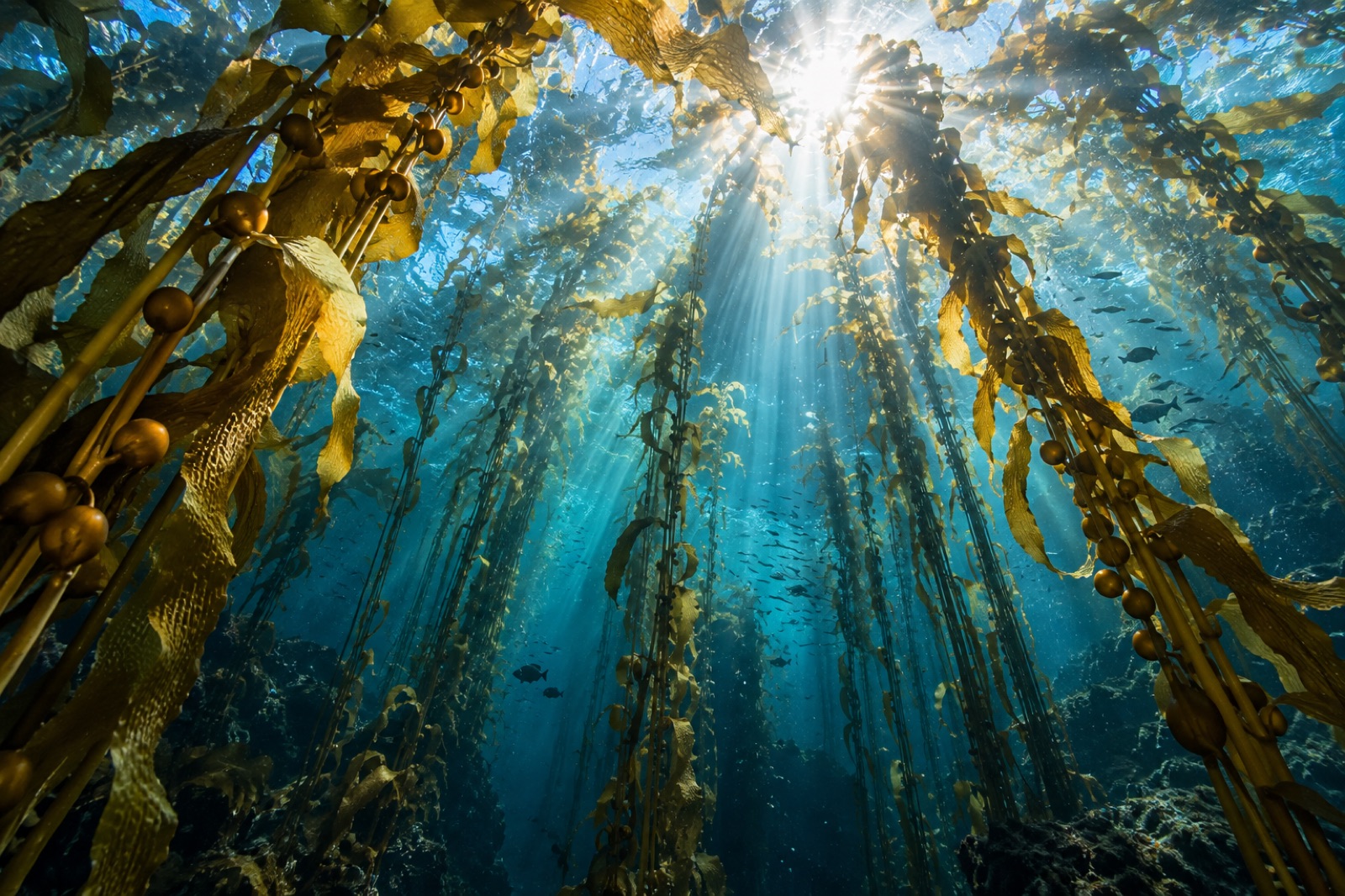
The question behind this article is the second physicists' problem of being a kelp: light is scarce underwater (covered in our companion piece on how kelp photosynthesises and the fucoxanthin advantage), but carbon is arguably scarcer. Land plants open pores and inhale CO₂ at 400-plus parts per million. Kelp sits in water where free CO₂ is rare and slow-moving, and yet giant kelp can add half a metre a day. The answer is a suite of molecular machinery called a carbon-concentrating mechanism (CCM) — not true C4 photosynthesis, despite occasional claims. Here's how kelp actually feeds its Rubisco, where the C4 myth comes from, and why all of this matters as ocean chemistry changes.
The carbon problem underwater
Two physical facts set the stage:
- Diffusion is brutally slow in water. CO₂ diffuses roughly 10,000 times more slowly in water than in air. Even where CO₂ is available, it cannot reach a blade surface fast enough to supply rapid growth by diffusion alone.
- Almost none of the carbon is CO₂. At seawater's normal pH of about 8.1, the dissolved inorganic carbon pool — around 2 millimoles per kilogram — is roughly 90% bicarbonate (HCO₃⁻), 9% carbonate, and only around 1% free dissolved CO₂. Rubisco, the enzyme at the heart of photosynthesis, uses CO₂ exclusively. Absent help, a kelp blade is carbon-starved while floating in a sea of carbon.
Every seaweed that fixes carbon quickly has evolved ways to bridge that gap. Brown algae do it with an external-to-internal conveyor belt.
Kelp blades run several mechanisms in parallel, and the mix varies by species, light and season. The main tools:
Carbonic anhydrase is an enzyme that interconverts bicarbonate and CO₂ — a reaction that is otherwise slow. Kelps and many other macroalgae deploy it outside the cell, in the cell wall and at the membrane: it strips CO₂ out of the abundant bicarbonate right at the blade surface, regenerating a local CO₂ supply that can then diffuse inward. Limiting this enzyme experimentally throttles photosynthesis, which is the classic evidence that bicarbonate use is real and important.
Surface acidification
Many kelps pump protons out of their cells across the blade surface, creating thousands of microscopic acidified zones in the thin layer of water hugging the blade (the diffusive boundary layer). Lower local pH shifts the carbon chemistry equilibrium, converting bicarbonate toward CO₂ immediately adjacent to the membrane. Researchers have measured these micro-pH landscapes directly with microelectrode studies — a kelp blade surface is not at pH 8.1 where photosynthesis is working hard.
Direct bicarbonate transport
Several macroalgae also operate active bicarbonate transporters — membrane proteins that import HCO₃⁻ directly, powered by the cell's energy budget. Inside the cell, the carbon piles up around Rubisco's working site (in the chloroplast's pyrenoid-like compartments and stroma), raising CO₂ concentration around the enzyme far above ambient seawater levels. That accumulation — the concentration step that gives CCMs their name — is what lets Rubisco work at useful speed despite water physics.
The uptake work is energetically expensive, which is why CCM activity is regulated: kelp cells express more machinery when CO₂ is scarce (bright, fast-flowing, warm, high-pH conditions) and relax it when carbon is easy.
So where does the "C4" idea come from?
C4 photosynthesis in land plants — maize, sugarcane, many grasses — is a spatial or temporal pre-concentration: CO₂ is first fixed into a four-carbon acid by one enzyme, ferried, then released next to Rubisco. Claims of C4 in kelp rest on two genuine observations, both frequently overstated:
- Genome surprises. When the genome of the brown alga Ectocarpus was published (2010), it contained genes for the full set of C4-type enzymes, including phosphoenolpyruvate carboxykinase. Later brown-algal genomes kept that signal alive in the literature.
- Carbon-isotope hints. Seaweed carbon isotope signatures (δ¹³C) depend on carbon source and pathway; many brown algae, including kelps, show less-negative values (commonly in the −10 to −20‰ range) than pure diffusive CO₂ users (often −30‰ or more negative), consistent with an active CCM — and superficially with C4.
But the physiological evidence tells a consistent story: pulse-chase labelling and enzyme-kinetics studies in brown algae find carbon entering overwhelmingly through the normal C3 Calvin cycle, with the C4-type enzymes servicing other jobs (amino-acid metabolism, carbon shuttling within the cell). A true, functioning C4 cycle — the maize kind — has not been demonstrated in brown algae. The accurate summary: kelp runs a biophysical CCM (pumps, enzymes, boundary-layer chemistry), not a biochemical C4 pathway. Some single-celled algae genuinely mix elements of both, which keeps the debate lively, but "C4 kelp" is a myth the genomes accidentally created.
A useful comparison: green seaweeds like Ulva also run strong bicarbonate-based CCMs — the same physics, partly different machinery. And red and brown algae inherited their photosynthetic apparatus along separate endosymbiotic histories, so their CCMs are convergent solutions, not shared inheritance. Life solved the seawater carbon problem many times.
Depth, light and the carbon budget
CCMs interact with everything else about being a kelp. Deeper in the water column, light drops fast and shifts blue-green (the pigment side of the story is in our photosynthesis explainer); the energy cost of pumping carbon becomes a larger tax on a smaller light budget. This is one reason CCM-intensive species trend toward shallower, brighter, well-flushed habitat — the same turbulent water that thins the boundary layer and refreshes local carbon supply. Flow matters as much as light: a kelp in moving water effectively eats more carbon than the same plant in still water. That is why holdfasts anchor kelp in some of the roughest real estate on the coast — the wave-swept margins are also the all-you-can-eat carbon buffets.
Why this matters now: ocean acidification and the carbon forecast
Rising atmospheric CO₂ dissolves into the ocean and changes this whole equation — ocean acidification is, among many things, a carbon-enrichment experiment for seaweeds. Two consequences:
- CCM costs may fall. With more free CO₂ and more bicarbonate, kelps can down-regulate pumping and enzymes and save energy — growth-rate benefits under elevated CO₂ have been documented in some macroalgae experiments.
- But the whole picture is interactive. Elevated CO₂ interacts with warming, nutrient supply and light; meta-analyses find benefits where kelps are not already stressed, and little or none — or outright harm — where heat and nutrients are the binding constraints. Extra carbon cannot rescue a heatwave-stressed forest, and acidification's costs to shell-building partners and competitors (see our ocean acidification explainer) reshape the reef community around the kelp.
For farming and restoration, the CCM is becoming a selection target. Fast-growing sugar kelp strains, for example (see our sugar kelp profile), differ in carbon-use traits, and Tidewright's fictional Holdfast nurseries screen candidate seedstock partly on CCM efficiency under projected 2040-era temperature and pH — a detail of the fictional nursery program on the platform page. Whether the trait proves as heritable and useful as thermal tolerance is, in the real science, still an open question.
Key takeaways
- Seawater holds abundant carbon but almost none as the CO₂ Rubisco needs; diffusion in water is ~10,000× slower than in air.
- Kelp solves this with a biophysical carbon-concentrating mechanism: extracellular carbonic anhydrase, surface acidification of the boundary layer, and active bicarbonate uptake.
- Brown algal genomes contain C4-type enzyme genes and some kelps show C4-flavoured isotope signatures, but the physiological evidence supports C3 photosynthesis plus a CCM — "C4 kelp" is a myth.
- CCMs are energy-expensive, regulated, and intertwined with light, flow and boundary-layer physics — one reason kelp thrives in turbulent, well-mixed shallows.
- Rising CO₂ may lower CCM costs for unstressed kelps, but it cannot offset heat and nutrient stress; the interaction, not the carbon alone, decides outcomes.
FAQ
Does all seaweed use bicarbonate?
Most larger, fast-growing macroalgae run CCMs of some form, but not all. Some red algae and slow-growing species rely more on diffusive CO₂ uptake, especially in tidepools and sheltered habitats where CO₂ accumulates locally at night or where carbon demand is low.
Why didn't kelp evolve C4 like grasses did?
C4 in land plants solves a different problem — concentrating CO₂ while keeping leaf pores closed against water loss. Kelp has no desiccation problem and sits in a bicarbonate-rich medium; a pump-based CCM exploiting bicarbonate is arguably the cheaper evolutionary fix for water. Evolution found it many times independently in algae.
Does ocean acidification help kelp grow faster?
Sometimes, in clean laboratory conditions with adequate light and nutrients — elevated CO₂ can save CCM energy and boost growth. In the real ocean, those benefits are often overridden by warming, nutrient limitation or interactions with stressed communities. Acidification is not "plant food for kelp."
What's a boundary layer, in plain terms?
The thin film of water — fractions of a millimetre to a few millimetres — directly against the blade surface, where flow is slow and diffusion rules nearly everything. It's the bottleneck for carbon, nutrients and waste alike; that's why waves and currents, which thin it, are so valuable to kelp.