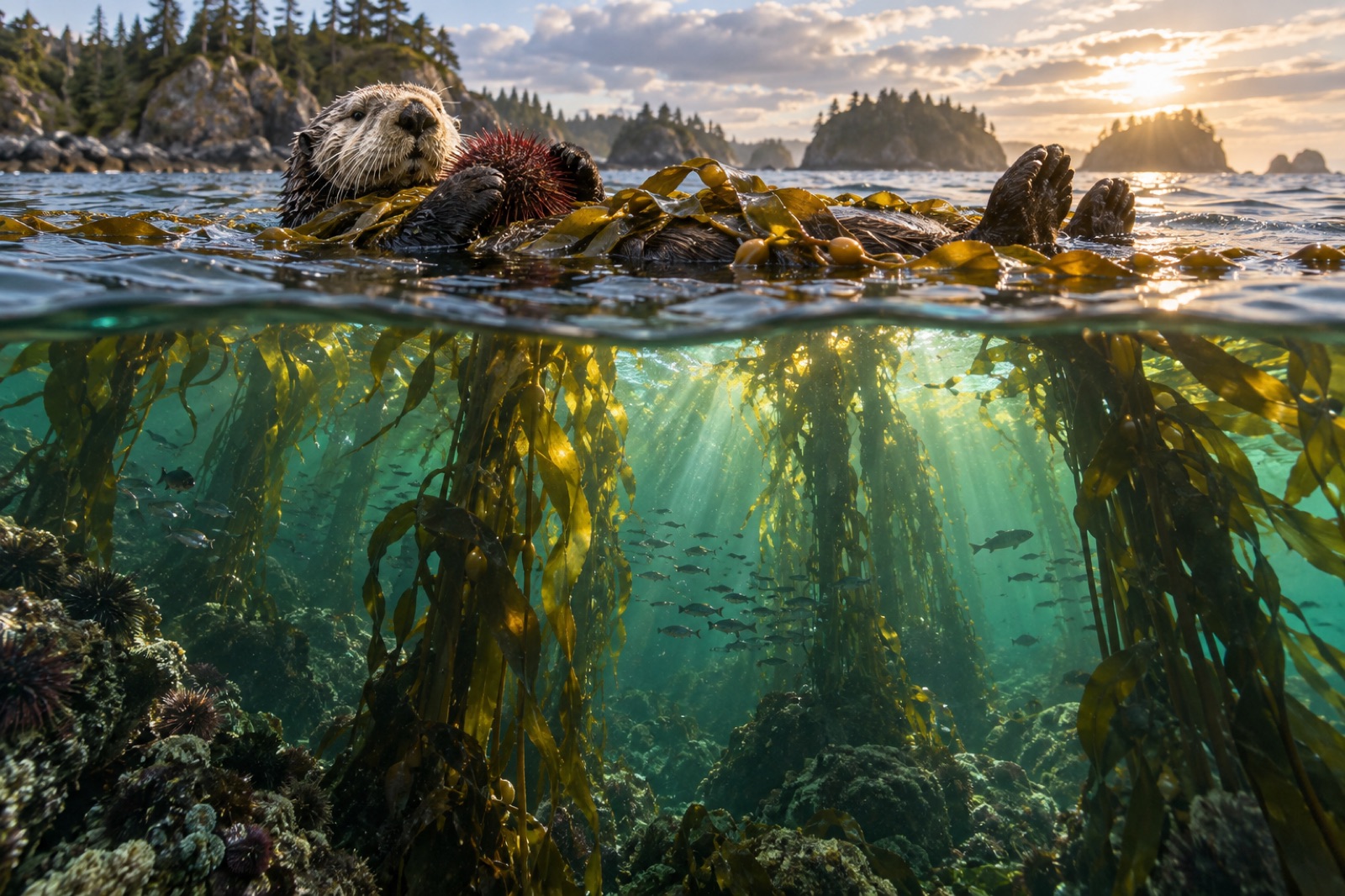
Ocean acidification is the ongoing decrease in the pH of seawater caused by the ocean absorbing carbon dioxide from the atmosphere. Since the industrial revolution, the ocean has taken up roughly a quarter to a third of all human CO₂ emissions — a staggering service that has slowed climate warming but changed the chemistry of the sea. Average surface-ocean pH has fallen about 0.1 units already, which, because pH is a logarithmic scale, represents roughly a 30 percent increase in acidity. It is the fastest change in ocean chemistry in tens of millions of years, and it is a direct, measurable consequence of burning fossil fuels.
This article walks through the chemistry, what it does to marine life — and what it does and doesn't do to kelp.
The chemistry: what CO₂ does when it meets seawater
When carbon dioxide dissolves in seawater, most of it reacts with water to form carbonic acid. Carbonic acid is weak — think sparkling water, not battery acid — but it is an acid, and it immediately releases hydrogen ions. Those hydrogen ions do two things that matter enormously.
First, they lower pH. Seawater is naturally slightly alkaline, averaging around pH 8.1 before industrialisation; more hydrogen ions push it downward toward neutral. Second — and this is the subtle but critical part — the excess hydrogen ions react with carbonate ions already dissolved in the water, converting them to bicarbonate. Carbonate is the raw material that corals, shellfish, plankton, and many other creatures use to build calcium carbonate shells and skeletons. More CO₂ means less carbonate available — a double hit of souring water and scarcer building blocks.
Oceanographers track a related quantity called saturation state, which describes how chemically easy or hard it is for calcium carbonate to form. When saturation state is high, shells grow easily. As it falls, shell-building becomes metabolically expensive; below a threshold, existing shells begin to dissolve. The deep ocean and cold high-latitude surface waters already have lower saturation states than the tropics, which is why polar and upwelling regions feel acidification first.
What it does to shell-building life
The clearest impacts of acidification fall on organisms that build calcium carbonate. Laboratory and field studies have documented effects across the board: oyster larvae struggling to build their first shells in hatcheries drawing on acidified coastal water; pteropods — tiny swimming snails that anchor subpolar food webs — showing shell dissolution in corrosive Southern Ocean waters; corals growing more slowly and building weaker skeletons; and the larvae of sea urchins developing abnormally under high-CO₂ conditions.
But the effects ripple further than shells. Fish exposed to elevated CO₂ show altered behaviour — reduced predator avoidance, confused settlement cues — at concentrations that could occur later this century under high-emission scenarios. Crustaceans grow more slowly. The calcifying algae that cement reefs together are among the most sensitive organisms of all, which matters because those algae are precisely what holds coral reef frameworks — and some kelp-reef surfaces — together.
Impacts vary dramatically between species and even between populations, and scientists are careful about extrapolating laboratory results to the ocean. What is unambiguous is the direction of the pressure: on calcifiers as a group, acidification is a growing headwind, and and on human-dependent shellfish industries, it has already arrived.
What about kelp?
Here the picture is more complicated, and more hopeful. Kelp are not calcifiers — a kelp thallus is soft tissue held up by water pressure and gas bladders, not mineral skeleton. Photosynthesising algae take carbon dioxide in, and some experiments suggest that moderate CO₂ enrichment can actually enhance kelp growth, especially where carbon is a limiting resource. For kelp, rising CO₂ is not the direct chemical stress it is for oysters.
But kelp does not live alone, and this is where acidification creeps in through the food web. North Pacific kelp forests inhabited by calcifying grazers, filter feeders, and shell-forming zooplankton may see shifts in their communities even if kelp itself tolerates the chemistry. More concerning, ocean acidification arrives hand in hand with ocean warming — both are products of the same CO₂ — and for kelp the warming is the immediate killer. The 2014–2016 marine heatwaves that devastated North American kelp forests were warming events; their acidification signature compounded the stress.
There is also genuine scientific interest in kelp as a local buffer. Dense kelp forests absorb enough CO₂ during daylight to measurably raise the pH of surrounding water — a photosynthetic halo, visible on sensors at some farms and restoration sites. Whether kelp can create meaningful acidification refuges for sensitive species at scale is an open research question, but the early evidence is intriguing enough that several restoration and aquaculture projects now treat pH modification as a secondary goal.
At Tidewright — a fictional company created as a design and content demonstration — our fictional Canopy Ledger sensor strings log pH alongside temperature and nitrate at every restoration site, and our fictional restoration plans treat local carbonate chemistry as a design variable rather than background noise.
Where acidification hits hardest
Because cold water holds more dissolved CO₂, high-latitude seas — the Arctic and Southern Oceans — are acidifying fastest. Upwelling coasts experience periodic influxes of naturally CO₂-rich deep water, layering human-driven acidification on top of a naturally low-pH baseline; the Pacific Northwest of North America already sees conditions during strong upwelling that stress oyster hatcheries. Tropical coral reefs face acidification alongside warming-induced bleaching — a one-two punch from the same emissions.
Locally, nutrient pollution can intensify coastal acidification, as algal blooms fed by runoff decompose and release CO₂. This is one point of leverage: better land management cannot stop global acidification, but it can reduce the most corrosive extremes in estuaries and bays.
What can be done
The primary solution is the same as for climate change in general: cut CO₂ emissions. The ocean will continue to absorb what we emit, and its chemistry will continue to shift; there is no feasible way to remove acidification without addressing its source.
Secondary strategies buy time and reduce local stress. Monitoring networks — buoys, gliders, and research cruises — track acidification in near real time, giving shellfish hatcheries advance warning to treat or time their intakes. Shellfish farmers are adapting with selective breeding and careful intake management. Marine protected areas that reduce other stressors (warming, pollution, overfishing) give organisms a better shot at tolerating chemical change. And ecosystem approaches — like restoring kelp forests and seagrass meadows that locally raise pH and lock away carbon — are being explored as a nature-based complement to emissions cuts.
Key takeaways
- Ocean acidification is the measured decrease in seawater pH caused by the ocean absorbing roughly a quarter to a third of human CO₂ emissions; surface pH has already fallen about 0.1 units, a ~30% increase in acidity.
- The chemistry is direct: CO₂ + water → carbonic acid → hydrogen ions that lower pH and consume carbonate, the raw material of shells and skeletons.
- Calcifiers — oysters, corals, pteropods, urchin larvae — are hit first and hardest, with effects rippling through food webs.
- Kelp is not a calcifier and may even benefit modestly from CO₂ enrichment, but acidification reaches kelp forests indirectly through warming, community shifts, and corrosive upwelling events.
- High-latitude seas and upwelling coasts are acidifying fastest; nutrient pollution can intensify acidification locally.
- The lasting solution is emissions cuts; monitoring, adaptation, and kelp and seagrass restoration can reduce local stress in the meantime.
FAQ
Is ocean acidification the same as climate change?
They are twin consequences of the same cause. Climate change is driven by the greenhouse effect of atmospheric CO₂; ocean acidification is driven by CO₂ dissolving into seawater. Both would stop when emissions stop; neither is fully reversible on human timescales once set in motion.
How do we know acidification is caused by humans?
Multiple independent lines of evidence: the isotopic fingerprint of the added carbon matches fossil-fuel and land-use sources; the timing and magnitude track the atmospheric CO₂ rise; and the spatial pattern matches air–sea exchange physics. There is no plausible natural explanation for the observed trend.
Can the ocean keep absorbing CO₂ forever?
No. The ocean's capacity is finite and slows as surface waters become more CO₂-rich. Meanwhile, the buffering reactions that initially softens the pH change themselves become less effective. The more we emit, the less the ocean can protect us — and the worse its own chemistry becomes.
Will oceans become acidic — pH below 7?
Not on any realistic near-term scenario. "Acidification" refers to the direction of change, not to crossing the neutral pH 7 line. Seawater will remain mildly alkaline for centuries even under high emissions; what matters biologically is how far and how fast it shifts from the conditions organisms evolved in.
Does ocean acidification affect swimming or eating seafood?
No direct human-health effects from swimming or eating seafood have been documented at current pH levels — the concern is ecological and economic. Shellfish supply, reef protection, and the marine food webs that sustain fisheries are all on the line long before the water would ever be unsafe to touch.