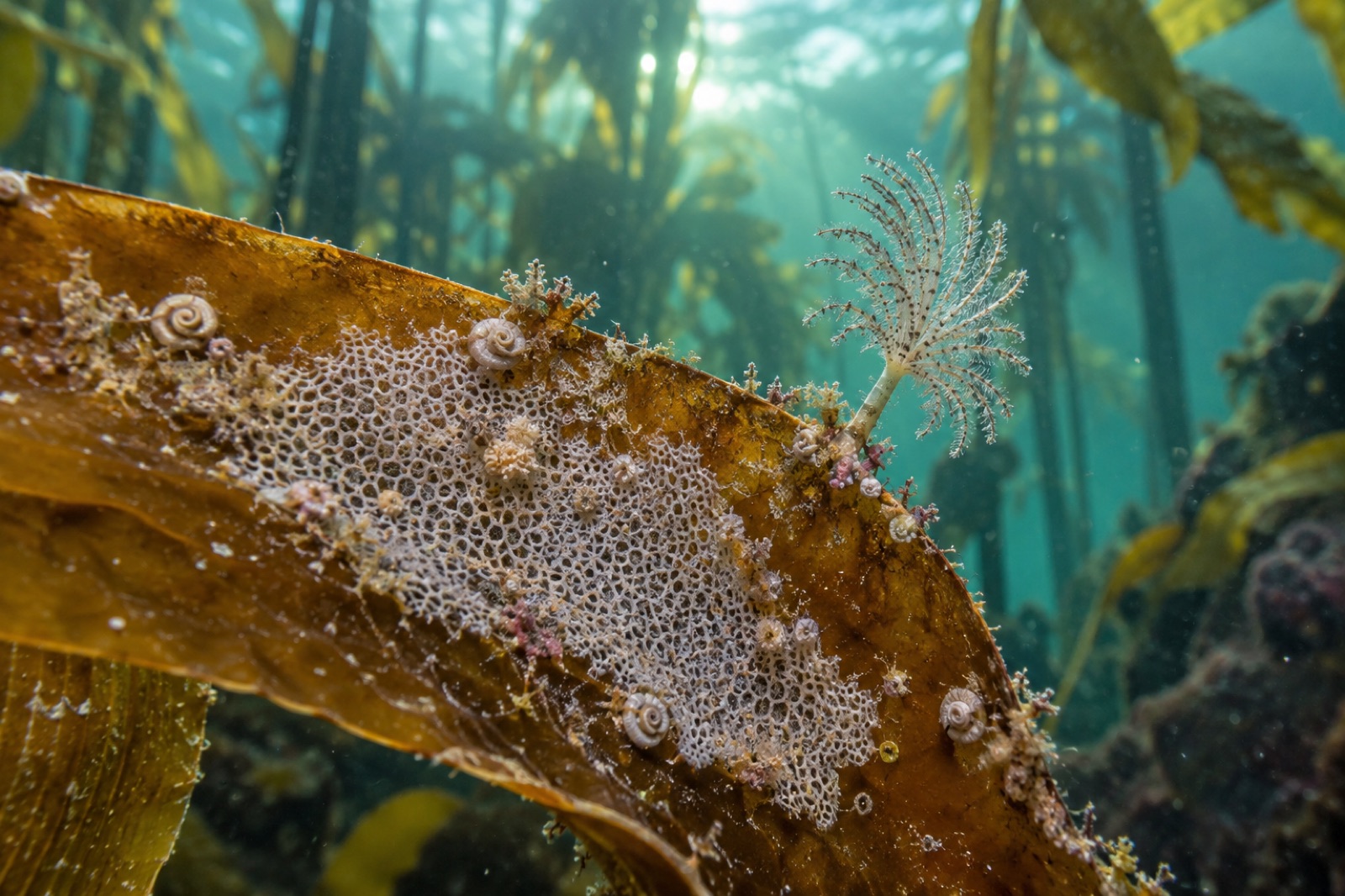
Hold a fresh kelp blade up to the light and you are not looking at a leaf. You are looking at real estate. The blade's slick brown surface — seemingly simple, seaweed-plain — is actually a stacked neighbourhood: films of bacteria and diatoms at microscope scale, fuzzes of red and brown filamentous algae, lace-like colonies of bryozoans, fern-shaped hydroids, spiralling tubeworms, and a tiny walking fauna of amphipods and snails that grazes it all. Biologists call the settled residents epiphytes ("upon the plant"), and the complete assemblage is sometimes called the kelp micro-forest — a living deck growing on the forest's own leaves.
Epiphytes are easy to dismiss as decoration. They are not. They feed fish, slow urchins, shade or shield their host, and are among the first things to change when water warms or nutrient regimes shift. This explainer introduces the community, its rules of tenancy, and why restoration scientists now watch epiphyte cover almost as closely as the kelp itself.
What exactly counts as an epiphyte?
An epiphyte is any organism that lives on the surface of a plant or alga without drawing nutrients from it (unlike a parasite). On kelp, the resident list is long and taxonomically wild:
- Epiphytic algae — filamentous browns (Elachista, Pylaiella), delicate reds like Polysiphonia, and overpowering greens that arrive when nutrients spike.
- Bryozoans — colonial filter-feeders. The lacy Membranipora membranacea encrusts kelp blades in grey-white doilies so characteristic that a blade's "lace percentage" is a standard field metric.
- Hydroids — feathery, plant-looking animals such as the ostrich plume hydroid, which wave stinging tentacles into the current from their perch on stipes and blades.
- Spirorbid tubeworms — pinhead-sized white snail-like coils, actually polychaete worms in self-built calcite tubes.
- Sponges and tunicates — mostly on the holdfast and stipes, where flow is slower and purchase is permanent.
Between the sessile settlers moves the mobile crowd: kelp-curled amphipods, isopods, the nudibranchs that hunt hydroids (see our field guide to kelp forest nudibranchs), and grazers like the northern kelp crab, which is less a kelp-eater than an epiphyte harvester wearing camouflage.
Why the blade is worth colonising
For a small filter-feeder or alga, a kelp blade solves three problems at once. First, position: the blade holds its residents up in the light and the current, away from the sediment-choked boundary layer near the reef. Second, substrate: rock is rare and contested, and kelp offers fresh, un-occupied surface that regrows each season. Third, the tripod effect: kelp blades interlace, so a community on the canopy rides in gentler flow than the exposed rock below, while still receiving passing food.
The deal is not entirely one-sided, which is why biologists argue about the word "commensal" here. Dense algal epiphytes shade their host's photosynthetic surface and add drag in storms — a blade heavy with Membranipora crust becomes brittle and tears, a phenomenon implicated in canopy loss during some warm years. Hydroids provide negligible benefit. But a light loading of epiphytes can be nearly neutral, and some biofilm bacteria release compounds that may inhibit harmful settlers. The host–epiphyte relationship is best read as a negotiation with a moving balance point.
The kelp's countermeasures
Kelp is not a passive wall. It manages its surface the way a city manages its facades:
Shedding. Giant kelp and many laminarians continuously abrade the blade tip and periodically slough the outermost cell layers of the stipe and blade — taking settlers with them. Old blades are cast off entirely; some species shed the blade seasonally and regrow a clean one.
Chemistry. Kelp tissues exude phenolic compounds and run a mild oxidative frost at the surface — bursts of reactive oxygen that discourage bacteria from organising into biofilm. The surface also warms slightly in sunlit conditions relative to the water, a microclimate epiphytes must tolerate.
Physical texture. A young kelp blade is covered in a thin mucus layer and microscopic ridges that make firm adhesion harder than it looks. Settlers time their attachment to blade age and local wear.
The result is a predictable succession on any given blade: bacteria and diatoms first (days), filamentous algae and bryozoan larvae next (weeks), hydroids and tubeworms later (months), with the oldest mid-water fronds carrying the heaviest growth — until storms or the host's own shedding reset the clock. If this layered re-assembly sounds familiar, it mirrors ecological succession on the reef itself, compressed onto a ribbon of tissue the width of your hand.
The grazers that keep the deck clean
Here is where the micro-forest plugs into the whole food web. Kelp's greatest services come indirectly: the epiphyte layer is food. Amphipod and isopod populations graze diatoms and filamentous algae off the blades, and these crustaceans are in turn primary prey for juvenile fish — kelp perch, surfperch, young rockfish — that throng the canopy. A landmark line of temperate-reef research showed that an appreciable share of what fish eat in a kelp forest is epiphyte-derived, not kelp tissue itself. The kelp builds the structure; the epiphytes cook the meal; the crustaceans serve it.
Sea urchins, famously, prefer drift kelp to standing plants — but blades fouled with heavy bryozoan crust are less palatable, and urchins will sometimes bypass fouled tissue. Nothing in this system has a single, simple effect; that is rather the point.
Epiphytes are small, fast-living and thermally sensitive — which makes them early-warning instruments.
- Range shifts arrive first at the blade. Warm-water bryozoan species have been observed expanding onto kelp blades along warming coasts, sometimes carpeting fronds during marine heatwaves and contributing to canopy breakage.
- Nutrient pollution shows up as green fuzz. A sudden bloom of fast-growing green epiphytes on urban kelp records nitrogen loading more quickly than most water sampling.
- Blade turnover accelerates in warm water, compressing the succession: communities never mature past weedy, fast stages, which changes what grazers find to eat.
Monitoring programs therefore photograph standard blades and score percentage cover by group — a cheap metric that tracks the condition of the host, the water, and the food supply to fish in a single image. At Tidewright's fictional restoration sites, epiphyte succession on seeded lines is one of our own early health checks (our monitoring numbers are illustrative, but the metric is real practice).
How to see the micro-forest yourself
You do not need a lab. A hand lens turns a tidepool-floated drift blade into a safari: look for the lace of bryozoans, the fern-frond hydroids bent with the swash, the pinhead spirals of spirorbids, the translucent skeleton shrimp standing on stilts. Underwater, a diver on a good-macro day will find more species on one frond than in the surrounding water column — the same patience we recommend in macro photography in kelp forests. And remember drift-kelp etiquette: a cast frond on the beach is habitat in transit, feeding the wrack community we describe in drift kelp and wrack; look, photograph, leave it.
Key takeaways
- Epiphytes — algae, bryozoans, hydroids, tubeworms and their grazers — form a stacked micro-forest on kelp blades, stipes and holdfasts.
- The relationship is a negotiation: light epiphyte loads are near-neutral, but heavy fouling shades the host, adds storm drag and can contribute to canopy loss.
- Kelp fights back with surface chemistry, mucus, abrasion and full-blade shedding, producing a predictable succession from biofilm to mature community.
- The epiphyte layer is a major indirect food pathway: grazers eat epiphytes, fish eat grazers — supporting fisheries the kelp itself never touches.
- Because epiphytes respond rapidly to warming and nutrient loading, blade-fouling surveys are one of the cheapest health metrics a kelp monitoring program can run.
FAQ
Do epiphytes harm the kelp?
Usually a little, occasionally a lot. Small loads cost the host very little; heavy bryozoan or algal fouling shades the blade, increases drag, and makes fronds brittle in storms — a documented contributor to canopy dieback during warm events. The host's own shedding and surface chemistry normally keep loads moderate, so a sudden spike in fouling says conditions have changed.
What's the difference between an epiphyte and a parasite?
An epiphyte uses its host only as anchorage — it takes nothing from the kelp's tissues. True parasites (a few specialised red algae, for example) penetrate host cells and draw nutrition. Epiphytes sit entirely on the surface; any harm they do is mechanical — shading and drag — not extraction.
Why do some blades look lacy white and others clean?
The white lace is usually the encrusting bryozoan Membranipora membranacea. Cover depends on blade age, position in the canopy, season and the local supply of bryozoan larvae — life cycles of the forest's other organisms matter too, much as the kelp's own alternation of generations governs recruitment, as covered in the kelp life cycle. Upper-canopy, older fronds are usually the most heavily encrusted.
Can I find epiphytes without diving?
Yes. After onshore winds, collect (permit rules vary — always check local regulations) or simply inspect cast drift blades at the wrack line. A 10× hand lens reveals bryozoan lace, spirorbid coils and hydroid colonies clearly. Photograph rather than pocket: the drifting blade is still working habitat.
Are epiphytes used in restoration monitoring?
Increasingly, yes. Seeded or transplanted kelp should acquire a staged epiphyte and grazer community within a season or two if the surrounding ecosystem is functioning; a blade that stays bare can signal poor water quality or missing connectivity. Blades that foul instantly and heavily can signal excess nutrients or warm-water invaders — both early, actionable warnings.