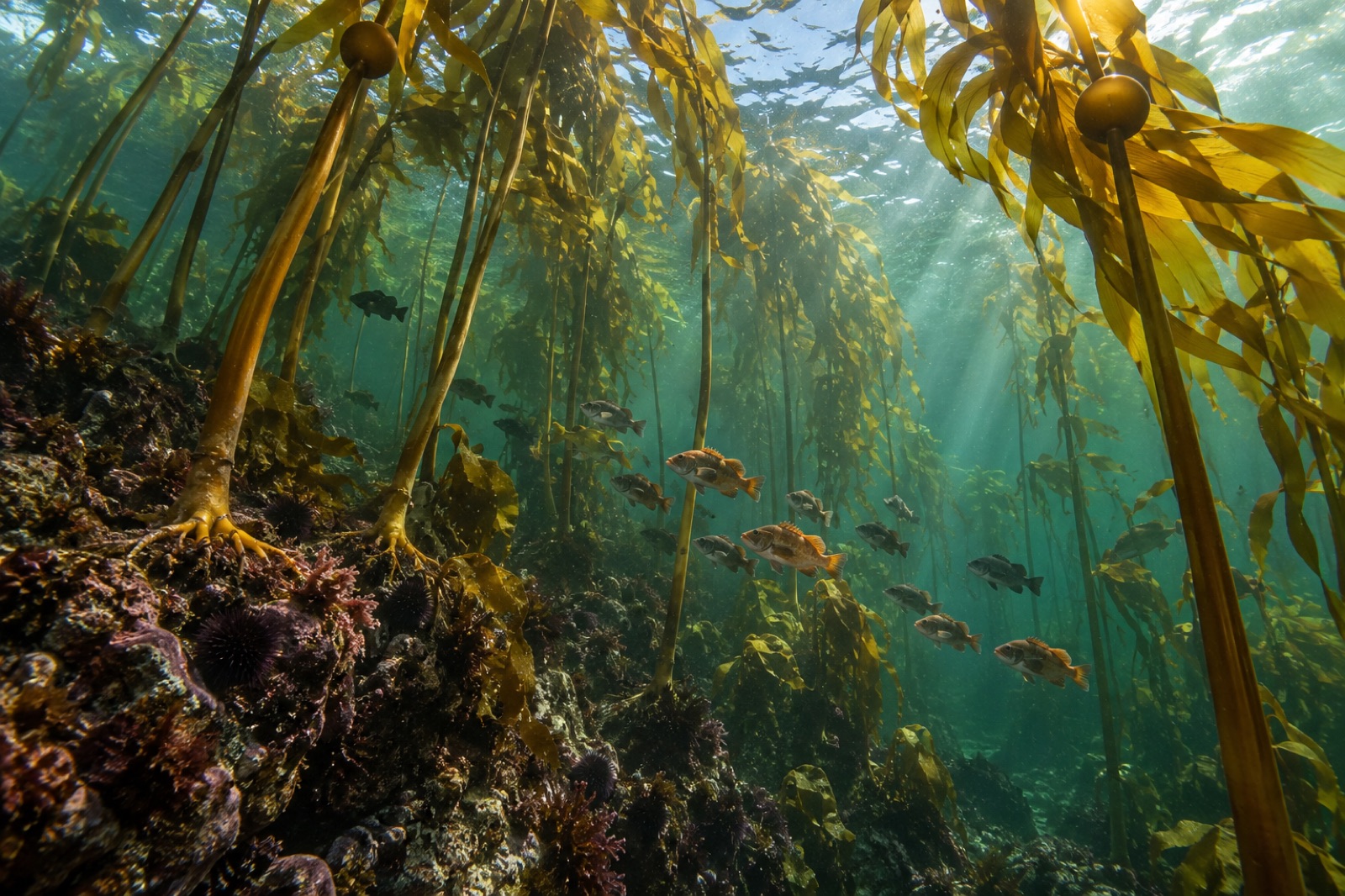
Run your eyes along a bull kelp stipe in clear water and you will often find it furred with coppery feathers, each one a few centimeters tall, swaying in the surge as if a flock of very small birds had moulted underwater. Those plumes are ostrich plume hydroids — colonial cnidarians of the genus Aglaophenia — and they are among the most common, most beautiful and most misunderstood residents of the kelp forest. They are not plants, not algae, not single animals: each feather is hundreds of tiny, interconnected, stinging polyps operating as one organism. This profile looks at how the colony is built, how it feeds, the strange way it reproduces, and the tiny specialists that graze it bare.
Quick facts
|
|
| Scientific name |
Aglaophenia spp. (often A. latirostris on the US Pacific coast) |
| Group |
Phylum Cnidaria, class Hydrozoa, family Plumulariidae |
| Range |
Northeast Pacific, Alaska to Baja California; close relatives worldwide |
| Habitat |
Kelp stipes and blades, rock, shell, pier pilings; low intertidal to 30+ m |
| Size |
Colonies commonly 5–15 cm tall; dense patches can drape whole stipe sections |
| Diet |
Zooplankton and other small drifting prey, captured with stinging cells |
| Field note |
Can sting bare skin — a prickling, lingering burn on a diver's wrist |
A colony, not a creature
The first thing to understand about a hydroid is that "animal" needs an asterisk. An ostrich plume starts life as a single settled larva, but that founder buds again and again, producing genetically identical daughter polyps that stay physically connected by a shared gut and a communal skeleton. The result is a modular superorganism: division of labour without a brain.
Within one plume you can find several polyp castes. Feeding polyps (hydranths) carry rings of tentacles armed with nematocysts — the same harpoon-like stinging organelles that power a jellyfish's armaments, scaled down to a fraction of a millimetre. Defensive polyps, smaller and sleeved in protective cups, guard the feeding polyps and repel would-be settlers. Reproductive work is farmed out to specialized structures of its own, described below. All of it hangs on a flexible chitinous skeleton, grown branch by branch as the colony extends.
This modular construction is why hydroids are so hard to kill outright. A nudibranch can chew half a plume and the remainder simply buds on; a surge can flatten a patch and it re-erects as the colony regrows. Remove kelp's epiphytes and you rarely get a clean stipe — you get a reset clock.
Anatomy of a feather
The feather shape is not decoration; it is engineering. A central stem (the hydrocaulus) anchors to the stipe or rock, and from it sprout rows of alternating side-branches, each branch studded with paired feeding polyps facing out into the flow. In Aglaophenia the arrangement is so regular, so comb-fine, that the colony genuinely resembles the ostrich plumes that once sold for fortunes to hatters — hence the name.
Functionally, the shape solves the planktivore's problem: how to put the maximum number of mouths into moving water without them shading each other. The fine branching intercepts currents at dozens of micro-positions, and the plume flexes rather than resists, so a surge that would rip a rigid filter apart merely combs it. Watch a plume in surge and it never stops feeding; the tentacles adjust angle with the flow like grasses in wind.
A drifting harvest: how the colony feeds
Ostrich plume hydroids are passive predators. Each hydranth holds its tentacles into the current and waits for copepods, larval crustaceans, fish larvae and other microplankton to make contact. The instant they do, nematocysts discharge — each a spring-loaded thread, some tipped with toxin — and the prey is reeled to a central mouth. Digestion is communal: nutrients move through the colony's shared canals, feeding polyps at the plume's growing tips as readily as those at its base.
The forest feeds them. Kelp forests concentrate plankton because their physical structure damps waves and slows water, creating retention zones where drifting prey is held near living filters rather than flung past them. A stipe plastered with ostrich plumes is, in effect, a secondary net strung through the water column — one more way the three-dimensional forest extracts food from the passing sea, in the same layered fashion described in our profile of the kelp forest food web.
And yes, they sting people. Brushed against a bare wrist or the gap between glove and sleeve, dense patches deliver a prickling burn and sometimes a red, itchy welt that persists for days — hydroid dermatitis, well known to California divers. It is unpleasant, rarely serious, and a good argument for full exposure protection in mature forests.
Sex in a basket: the corbula and a life without jellyfish
Their cousins, the jellyfish, take the free-swimming medusa as their adult stage. Aglaophenia largely gave that up. Instead of releasing medusae, the colony folds specialized side-branches into intricate baskets called corbulae — perhaps the most elaborate structures built by any cnidarian — and holds its reproductive organs (gonophores) inside them. The medusa generation, such as it is, never leaves the cage.
Eggs are fertilized within the corbula and the resulting larvae — creeping, cigar-shaped planulae — emerge and crawl. Planulae typically settle close to the parent colony, which has two consequences a diver can see with their own eyes: hydroid patches spread locally rather than jumping kilometres, and older surfaces carry rings of related colonies, mothers ringed by daughters. Populations do exchange genes over longer distances through rafting fragments and occasional wider larval dispersal, but the default mode is neighbourhood growth.
It is an instructive contrast with kelp itself, whose microscopic alternate generation swims out into the plankton before settlement — the alternation of generations explored in our explainer on the kelp life cycle. Kelp disperses far and rebuilds remotely; the ostrich plume holds its ground and deepens.
The small hunters that graze the plume
A stinging forest of polyps seems like poor grazing, yet an ostrich plume patch is a pasture for specialists that have solved the nematocyst problem:
- Hydroid mites. Tiny crustacean-like arachnids of the family Halacaridae patrol hydroid colonies in remarkable numbers — divers with a macro lens can watch them picking their way between armed polyps, apparently immune to the stings, plucking hydranths one by one. A heavily colonized stipe can carry thousands.
- Nudibranchs. Several sea-slug lineages specialize on hydroids. Dotid nudibranchs mimic the plumes they eat; aeolid nudibranchs go further and steal the nematocysts, passing them undischarged through the gut to arm their own defensive cerata — second-hand weapons acquired at the dinner table.
- Fish and other browsers. Small wrasse and perch nip at colonies opportunistically, and drift kelp landing on a patch further opens space for new cycles of settlement.
The result is a miniature trophic drama staged on one stipe: colony versus grazer, defence versus counter-measure — a trophic cascade in centimetres, mirroring the otter–urchin dynamics explored across our Ocean Science hub.
Why hydroids matter to reef restoration
Epiphytic and encrusting communities are not decoration on a restored reef; they are early infrastructure. When Tidewright's Drifter vessels lay seeded holdfast lines on bare rock, hydroids, bryozoans and tube worms are typically among the first sessile colonists, along with the juvenile algae. That early fouling community changes the reef's micro-flow, its surface texture and its settlement chemistry — for better and worse. Dense hydroid cover can compete with settling kelp sporelings for light and space, which is one reason our field teams time line-laying to the kelp recruitment window and monitor fouling pressure through Canopy Ledger surveys as part of every site assessment. (Tidewright's internal fouling metrics are illustrative of standard practice; site data is released through our open-data program.)
For the diver, the lesson is simpler: the fuzz on the stipe is a living city. Touch nothing, and look closer.
Key takeaways
- The ostrich plume hydroid (Aglaophenia) is a colonial cnidarian: each "feather" is hundreds of connected, specialized polyps with a shared gut and skeleton.
- Its comb-fine branching maximizes plankton capture in moving water; the plume flexes with surge instead of resisting it.
- Unlike jellyfish, Aglaophenia cages its reproductive stage in intricate baskets called corbulae; crawling larvae settle close by, so colonies spread as local patches.
- It is grazed by specialists — halacarid mites and nematocyst-stealing nudibranchs — forming a micro food web on every stipe.
- It stings bare skin (hydroid dermatitis) and, on restored reefs, its fouling pressure is tracked as part of habitat monitoring.
FAQ
Is the ostrich plume hydroid a plant or an animal?
An animal — more precisely, a colony of animals. Each plume holds hundreds of genetically identical polyps in the phylum Cnidaria, the same lineage as jellyfish, corals and sea anemones. The plant-like feather shape is convergent camouflage for a carnivore.
Can ostrich plume hydroids sting humans?
Yes. Their nematocysts can penetrate thin skin — typically a wrist or the back of a hand — causing a prickling burn and sometimes an itchy red rash lasting hours to days. It is uncomfortable rather than dangerous for most people; rinsing with seawater (not fresh) and avoiding rubbing helps. Wear full coverage in dense forests.
Where is the best place to see them?
Any temperate NE Pacific rocky reef or kelp bed with current, from shallow subtidal rock to deeper stipes. In Southern California kelp forests such as Catalina Island they are nearly impossible to miss once you adjust your eyes to fine detail.
Do hydroids harm the kelp they grow on?
Usually not significantly — they are passengers using the stipe as a platform into the current. Very heavy epiphyte loads can add drag that contributes to stipe breakage in storms and can shade young growth, but an established kelp generally carries its fuzz with little cost.
Yes, closely. Hydrozoans such as Aglaophenia belong to the same cnidarian class as many small jellyfish. The difference is in emphasis: jellyfish build their life around the swimming medusa, while Aglaophenia invests in the sessile colony and keeps the medusa generation suppressed inside its corbulae.