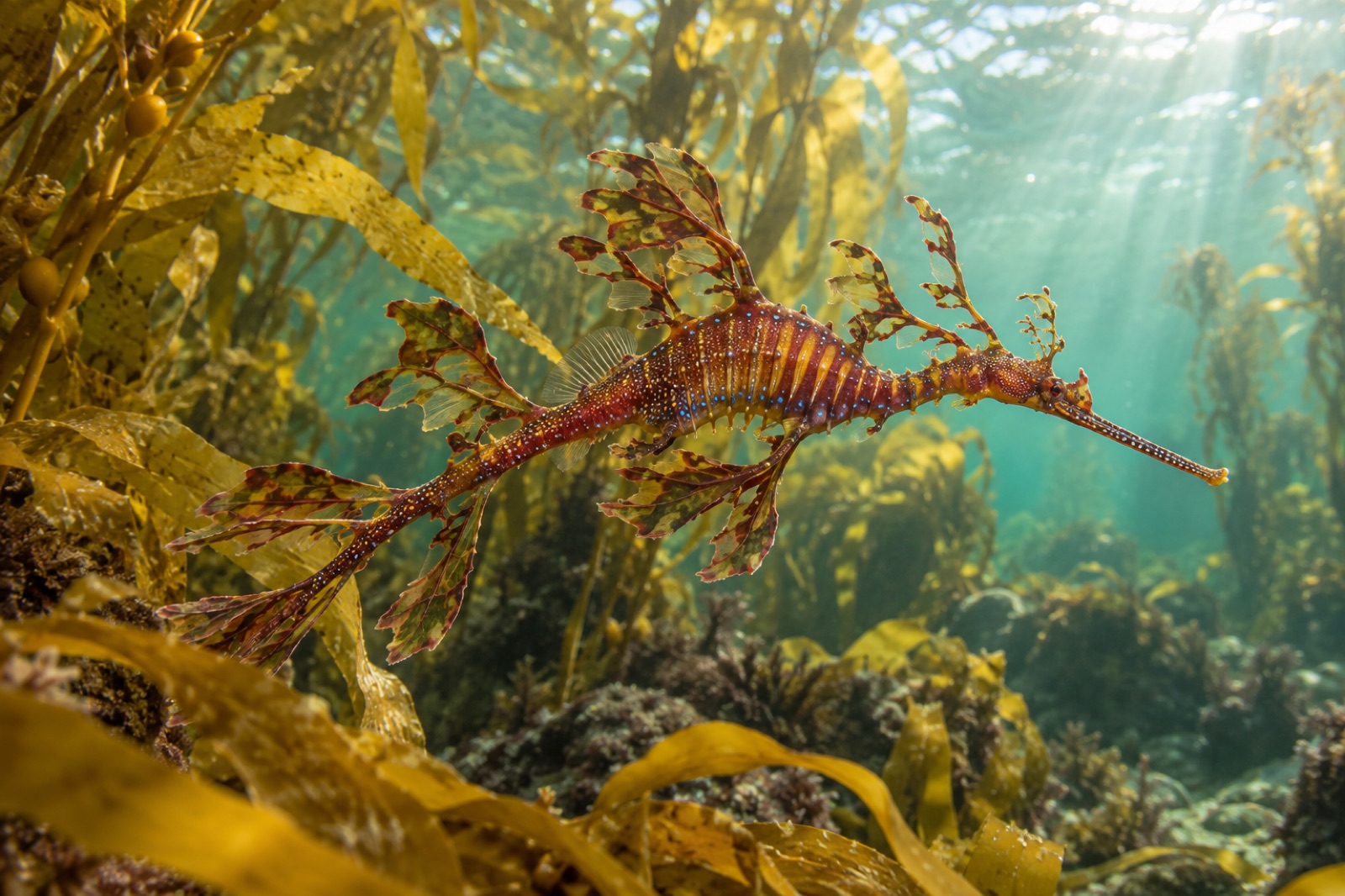
The Great Southern Reef is full of animals wearing colour like a warning label, and few commit to the look as completely as the ornate cowfish. Glide the kelp edge anywhere from Victoria to South Australia at the right depth and you may meet one: a small fish shaped like a jewel box, rigid as a reliquary, painted in stacked blues over gold — male fish in stripes and reticulations that would startle a tropical coral dweller. It is, by quiet consensus among temperate divers, the most beautiful small fish on the entire southern coast, and it belongs entirely to Australia.
Fast facts
|
|
| Scientific name |
Aracana ornata — family Ostraciidae, the boxfishes |
| Size |
To about 15 cm; a true hand-sized fish |
| Range |
Endemic to temperate southern Australia, from southern Queensland around the south coast to Western Australia |
| Habitat |
Seagrass beds, kelp-edge reefs and sandy bottoms, shallow coastal bays to 30+ m |
| Distinctive features |
Rigid hexagonal-plated body box; small spine-pointed 'horns' above the eyes; brilliant blue-and-gold male patterning |
| Status |
Not threatened; common in its range and frequently seen by divers in Victoria and South Australia |
A fish that gave up on bending
The boxfish family made, long ago, a radical engineering decision: they stiffened the whole middle of the body into a bony carapace — a seamless box of fused, hexagonal scale plates — and put everything that moves through openings in the armour. Mouth, eyes, fins, gill slits and tail stem poke from slots in the shell; the trunk between them cannot flex at all.
The consequences define the fish. An ornate cowfish swims by sculling — fluttering its small, transparent fins in precise coordination while the rigid hull glides through the water with the stability of a thrown frisbee. The mode looks inefficient and is actually superb: the boxfish's carapace, with its keel and corners, sheds vortices that stabilise the fish automatically, giving boxfishes an uncanny hovering steadiness that has long interested submarine designers. Watch one hold position at a sponge wall in surge and you are watching passive hydrodynamics do work a streamlined fish would need constant fin-strokes for.
The armour's cost is speed, and the boxfish answers that with chemistry. Boxfishes can secrete a defensive mucus from the skin when stressed or attacked — in this family a potent, soap-like substance that is genuinely harmful to fish in confined water, which is why aquarists treat stressed boxfish with caution. In the open ocean it functions as a 'don't bite' label reinforced by the bony carapace underneath: most predators find a cowfish more trouble than the mouthful is worth.
The paint job is a sex difference
The blues-and-gold the species is famous for belong, most strongly, to the males. Nature does not usually produce electric cobalt-and-yellow chevrons on a temperate reef fish, but a breeding male ornate cowfish carries exactly that: ladder stripes of royal blue edged in black, over a gold base that deepens with health and season. Females and juveniles wear the same structural pattern in quieter olive-and-brown tones — cryptic over the seagrass and sand where they spend their lives. You are watching two colour philosophies in one species: camouflage for the workaday majority, publicity for the courting few.
What the colours are made of deserves its own word: fish blue is almost never a pigment, it is structural — the same physics of layered guanine crystals and coherently scattered light that blue-ringed octopuses flash and weedy seadragons wear in permanent day dress. The blue of a cowfish shifts with your viewing angle against the water's light, metallic in some lights, matte in others.
A quiet life in the kelp economy
For all its plumage, the ornate cowfish lives small. It is a benthic picker, working slowly over sand, seagrass and kelp-holdfast rubble in warm shallow bays and the edges of the golden kelp forests, sucking up worms, small crustaceans, molluscs and — being a boxfish, with a mouth shaped to grab in practice whatever fits — much of the small stuff of the reef economy generally. It hunts with its binocular front-facing eyes, hovering over patches of bottom with that boxfish steadiness, tilting the hull toward the spot and striking. Small fish; large patience.
Like many Ostraciidae it is largely a solitary, day-active fish, drifting home ranges over the bays it lives in, and apparently unbothered by divers who approach politely — slow fish for slow reefs. In Port Phillip Bay and along the Mornington Peninsula it is one of the characters of the shore-diving circuit; the Rickett's Point dive guide is on the right coast.
Where it sits in the southern story
The ornate cowfish is an emblematic animal of the Great Southern Reef — the interconnected kelp system running unbroken for 8,000 km around Australia's bottom third — for a specific reason: it exists nowhere else on Earth. Australia holds endemic temperatures of marine life at tropical-reef levels in its temperate waters, a bizarre asymmetry the tourist-rack never prices in, and the boxfish encodes it. Aracana ornata and its family-scale colour palette have no equivalent in the Northern Hemisphere's kelp systems — a reminder, in hexagonal plate form, that what gets lost when southern temperate reefs get hot is not found anywhere else at all.
It is also, like its family broadly, a climate-question fish: a warm-edge temperate species whose juveniles have occasionally drifted far beyond their published range edges on southbound currents as the East Australian Current strengthens — the small, exquisitely painted herald of an ocean system on the move.
None of which is what you think about when you meet one. Divers' logs say the same thing, Tasmania to Perth in different hands: stopped, backed up, and stared.
Key takeaways
- The ornate cowfish is an endemic southern Australian boxfish found nowhere else — from Queensland around the south coast to Western Australia.
- Its rigid bony carapace of fused hexagonal plates gives it a passive-swimming stability that interests naval engineers, at the cost of escape speed — compensated by a defensive skin mucus that is genuinely harmful to other fish in confined spaces.
- The famous blue-and-gold colour belongs to males; females are olive-and-striped, and the blues are structural, not pigmented — the same light physics in a seadragon.
- It is a slow benthic suction feeder of small invertebrates over sand, seagrass and kelp-edge rubble, calm with patient divers.
- It stands for everything unique to the Great Southern Reef — for how much the kelp coast's small beautiful things are Australian-only, and how exposed that makes them.
FAQ
Do ornate cowfish make good aquarium fish?
Only for specialists. The family ships poorly, eats fussily, is hard to feed consistently in captivity, and its stress mucus can harm tankmates in closed water. The right aquarium for an ornate cowfish is Port Phillip Bay, seen through a mask; the entry requirements there are fins and a slow approach.
Is the ornate cowfish poisonous?
The mucus defence is real but operational in the water around a stressed fish — it is not a fish-poisoning hazard to a diver, and boxfish are not the family Australians worry about at the table (that's the puffers, their cousins, some of which carry tetrodotoxin). The seafood rule remains: don't.
What does 'cowfish' mean — why the name?
The family name, Ostraciidae, refers to the bony shell; the 'cow' in the common name refers to the small forward-pointing spines above the eyes that read as horns at certain angles on related species. Australian sources use 'ornate cowfish' and 'ornate boxfish' interchangeably.
Where are the best places to see one?
Calm, shallow, kelp-and-seagrass bays across southern Australia — Port Phillip Bay is the capital, with Sydney drifting far beyond its normal range on occasion with the East Australian Current. Slow down: they hover over the bottom, they're eight-to-fifteen centimetres long, and they sit over the sand-seagrass interface that most divers swim right over.
Do they have any relation to the cowfish of coral reefs?
Same family — Ostraciidae — and the same armour plan, but the ornate cowfish is the temperate southern specialist. Its famous coral-relatives of the tropics, like the yellow boxfish, are its warmer-water cousins wearing yellower paint.