At dusk on a sandy slope beside a Pacific kelp reef, the seafloor can look planted: rows of flame-orange feathers standing upright from the sediment, each one swaying in the current like wheat in a breeze. They are orange sea pens (Ptilosarcus gurneyi) — not plants, not single animals, but colonial corals built like quill pens, and one of the most quietly extraordinary members of the kelp forest's extended neighbourhood.
Fast facts
|
|
| Scientific name |
Ptilosarcus gurneyi |
| Group |
Octocorallia, order Sessiliflorae (sea pens); family Pennatulidae |
| Maximum size |
Colony up to about 50 cm tall |
| Colour |
Vivid orange to yellow-orange, whitish when contracted |
| Depth range |
From the shallow subtidal to more than 100 m |
| Distribution |
Northeast Pacific, from Alaska (Aleutian Islands and Gulf of Alaska) to southern California |
| Habitat |
Soft sediment — sand and mud — often bordering rocky kelp reefs |
| Status |
Widespread; not formally threatened, but bottom trawling damages sea pen beds |
One animal that is thousands
A sea pen is an octocoral — kin to soft corals and sea fans within the cnidarians — but arranged unlike anything else in the group. Each colony begins as a single primary polyp that grows into a central stalk, then buds. Thousands of secondary polyps emerge in symmetrical rows along flat lateral branches, giving the colony its feather or quill shape. The lower, bare portion of the stalk, the peduncle, is buried in sediment and anchors the whole structure; inflate it with water and the colony plants itself upright.
The polyps are specialists. The conspicuous leaf-like ranks are feeding polyps (autozooids), each crowned with eight feathery tentacles that comb plankton from passing water. Running along the colony are inconspicuous pumping polyps (siphonozooids) that drive water through the colony's internal canals — the sea pen's circulatory system and, as we'll see, its escape mechanism. What looks like one feathery organism is closer to a small, highly organised town.
Life beside the kelp forest
Orange sea pens live where the kelp forest's rocky architecture runs out and the soft seafloor begins — the sediment apron between reefs, the channels between rocky headlands, the floors of bays and passages like Puget Sound where they form dense beds. It is not a glamorous address, but it is a strategic one. Reefs leak food: kelp sheds a constant rain of particles, and sediment bottoms collect the organic fallout of the whole coastal food web described in our kelp forest food web explainer. A sea pen bed sits downstream of all that productivity, filtering its share from the flow.
The beds are not just residents of this flatland — they structure it. Where rocks are absent, the erect colonies are the only three-dimensional shelter for hundreds of metres. Juvenile rockfish, small flatfish and shrimp weave between colonies, and ecologists increasingly treat sea pen beds as nursery habitat in their own right: a forest on the flats, made of coral.
The burglar alarm
Touch an orange sea pen and two remarkable things happen in sequence.
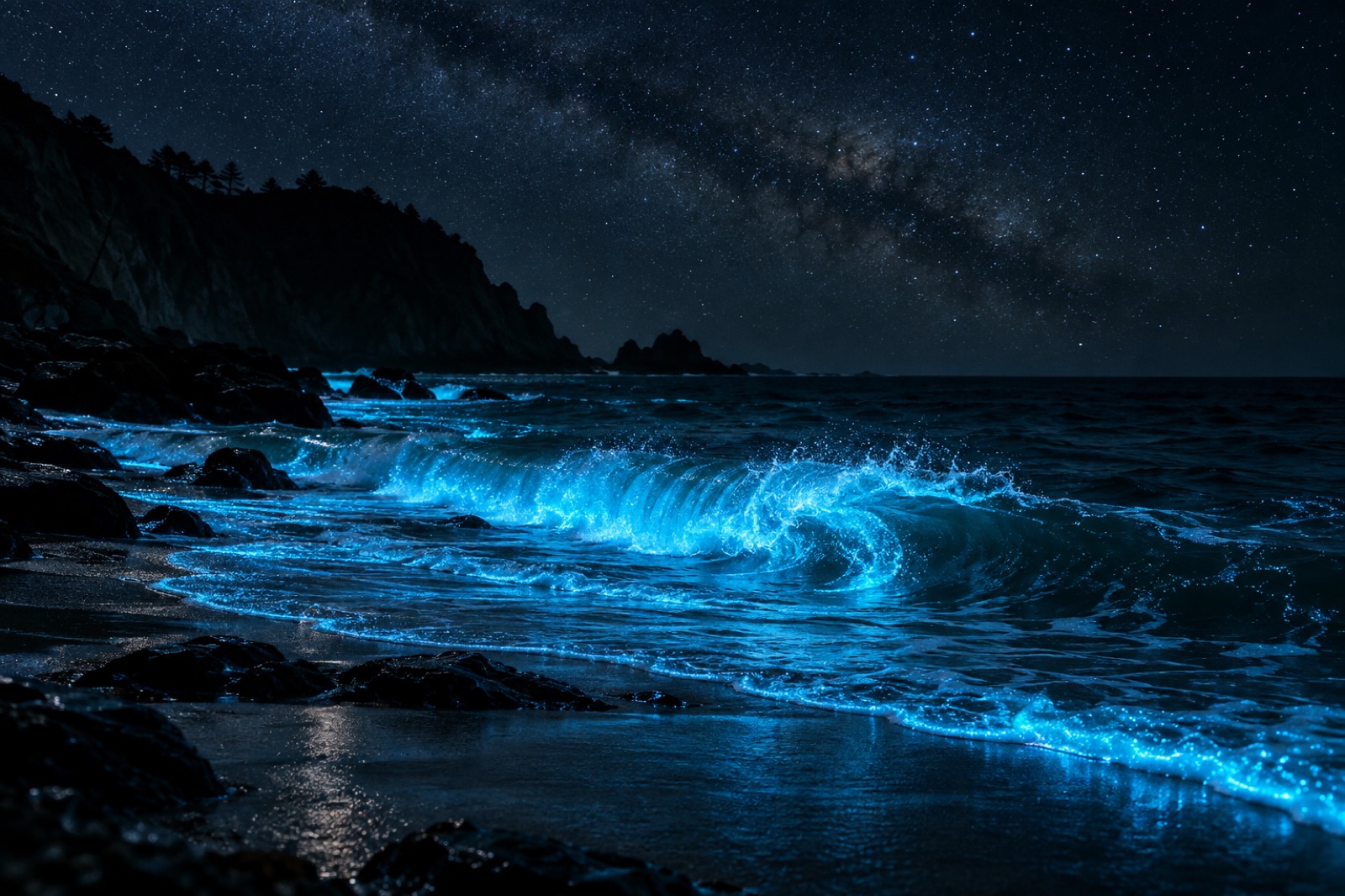
First, it glows. Like many sea pens, Ptilosarcus is bioluminescent: a disturbance triggers a wave of greenish-blue light that runs through the colony. The leading hypothesis for sea pen luminescence is the burglar-alarm strategy — the flash lights up whatever is nibbling, making the attacker visible to its own predators. Divers who brush a sea pen bed at night report fields of pulsing candlelight, a reminder that the phenomenon scales from one colony to a whole seascape.
Second, it vanishes. The colony expels water from its canals and folds downward, and entire colonies can retract down into the sediment until almost nothing shows above the surface. For an animal that cannot swim away, deflation and burial are the escape plan. Watching a bed disappear in front of a slow-moving predator — the sea pen collapsing like a deflating balloon and sliding into the sand — is one of the subtidal's stranger sights.
What eats a sea pen
Quite a lot, it turns out. The leather star (Dermasterias imbricata) is the notorious specialist, a slippery-skinned sea star that glides across sea pen beds consuming colonies polyp by polyp while the pens attempt their too-slow retraction. Several nudibranchs are dedicated sea pen predators, including the opalescent nudibranch and the giant swimming nudibranch Dendronotus iris — relatives of the hooded nudibranchs that haunt kelp — which extract the colony's defensive stinging cells and redeploy them for their own protection.
This makes sea pen beds an unlikely arms-race arena: sessile colonies defended by light and burial, molluscs that steal their weapons, and sea stars that simply out-persist them.
Seeing orange sea pens
Most divers meet sea pens as a borderland: the pale sand at the reef's edge, where the kelp gives way and the feathers begin. Look for beds in the lee of rocky points and in protected passages, from ten metres down as deep as sport diving reaches. Approach slowly — a fin wash can trigger wave after wave of collapse. The reward for patience is a colony recovering: the stalk inflating, branches unfurling, polyps opening one by one like a town waking up.
The invertebrates section of our Encyclopedia profiles more of the kelp forest's sessile and slow citizens, from anemones to chitons.
Why they matter to restoration
Sea pens remind us that a kelp forest's influence does not end at the rockline. Restored canopy feeds drift and detritus to the sediment communities beyond the reef, and protections for forests often shelter the soft-bottom beds beside them. At Tidewright we map these borderlands in our baseline surveys — urchin barrens and remnant canopy get the headlines, but a healthy bed of sea pens on the apron is part of what a working coast looks like.
Key takeaways
- The orange sea pen is a colonial octocoral, not a single animal or a plant: thousands of specialised polyps arranged as a quill, anchored in soft sediment by an inflatable stalk.
- It lives on sand and mud from Alaska to southern California, often in the band of flat seafloor beside rocky kelp reefs, and its beds shelter juvenile fish as nursery habitat.
- Disturbed colonies produce waves of greenish-blue bioluminescence — a probable "burglar alarm" that exposes attackers — and can retract almost entirely into the sediment.
- Specialist predators include the leather star and several nudibranchs, some of which weaponise the sea pen's own stinging cells.
- Sea pen beds are vulnerable to bottom-contact fishing gear and recover slowly; where reefs are protected, the sandy borderlands benefit too.
FAQ
Is a sea pen a plant?
No. It is a colonial animal — a cnidarian in the octocoral group, related to soft corals. The plant-like shape is functional: thousands of tiny polyps spread feathery tentacles into the current to catch plankton.
Why is it called a sea pen?
For the quill. The central stalk with symmetrical ranks of polyps resembles an old-fashioned feather pen, a resemblance sailors and naturalists noted centuries ago.
Can sea pens really disappear into the sand?
Effectively, yes. Orange sea pen colonies pump water out of their internal canals and retract down into the sediment until little shows above the surface — a slow but effective defence against predators that can't dig.
Are orange sea pens bioluminescent?
Yes. When disturbed, colonies emit waves of greenish-blue light. The light is thought either to startle attackers or to illuminate them for the attacker's own predators — the "burglar alarm" hypothesis.
Where can divers see orange sea pens?
On sandy and muddy bottoms from Alaska to southern California, typically 10–30 m deep, especially in sheltered sounds and passages — Puget Sound and British Columbia's coast hold famous beds. Approach gently: the whole bed will retract if you fin over it carelessly.