Encyclopedia8 min read
Ochre Sea Star (Pisaster ochraceus): The Original Keystone Species
Meet the ochre sea star, the purple tidepool predator whose removal in a famous 1960s experiment coined the keystone species concept.
Dr. Theo Nakamura ·
The leather star (Dermasterias imbricata) is a smooth, slippery, garlic-scented sea star that hunts anemones and sea cucumbers — biology, range and how to find it.
Most sea stars feel like what they are: armoured, rough, covered in spines and snapping pincers. Pick up a leather star — gently, briefly, wet-handed — and the surprise is immediate. The skin is smooth and soft, slick with mucus, more like wet chamois leather than starfish. Some people also notice a second surprise: a distinct smell, often described as garlic or burnt gunpowder. Dermasterias imbricata is the odd one out among the northeast Pacific's big sea stars, and its eccentricities run deeper than texture. It eats things other stars avoid, and its prey — swimming anemones — have evolved one of the most dramatic escape responses in the ocean to get away from it.
The leather star is unmistakable when wet. The five arms are broad and tapering from a thick central disc, the whole animal up to about 25–30 cm across, and the surface is completely smooth and slippery, lacking the spines, knobs and pedicellariae (tiny pincers) that arm other big sea stars. The skin secretes abundant mucus — hence "leather." Colour varies widely and handsomely: mottled and marbled patterns of orange-red, rust, tan and grey-green, often with a mosaic quality that makes each individual look painted.
The tube feet underneath are orange or rust-coloured and arranged in the usual four rows per arm. If you turn one over underwater you will see the slow work of the mouth and ambulacral grooves; never keep it out of the water long and always replace it exactly where found.
Handled leather stars release a noticeable odour — variously reported as garlic, sulfur or gunpowder-like — produced by compounds in the mucus, likely a chemical defence. It is harmless, washes off, and is one of the great odd facts of the intertidal.
Leather stars range the cold northeast Pacific from Alaska south to Southern California, from the low intertidal down to around 90 m. They favour rocky bottoms — kelp forest edges, boulder reefs, wharf pilings — wherever their prey is abundant, and tidepool visitors from British Columbia through Washington and Oregon meet them at extreme low tides, wedged into shaded ledges and crevice mouths. Holdfast-draped reef inside forests patrolled by giant kelp is classic leather-star country.
Where an ochre sea star hammers mussels and a sunflower star runs down urchins, the leather star has chosen the prey everything else finds disagreeable. Its documented menu reads like a list of chemical and stinging defences ignored:
Stomach-content studies have found everything from anemones to sponges, confirming the catholic taste. It is an unhurried generalist, but star-nosed among generalists in what it will attempt.
The leather star's most famous ecological role is as the bogeyman in one of the ocean's great escape performances. Several anemones — most famously the swimming anemone Stomphia coccinea — respond to a leather star's touch by tearing free of the rock and executing wild, thrashing "swims" of coordinated column flexes, corkscrewing away to safety. Put a drop of leather-star mucus on a resting Stomphia and the same fleeing performance erupts — the anemone recognises the star's chemistry, not just its touch.
Not every anemone flees. The painted anemone, Urticina crassicornis, fights back instead: on contact with a leather star's arm, it fires batteries of specialised stinging cells until the star literally recoils and retreats. Leather stars learn to avoid individuals that resist. Together these interactions make the leather star a central character in one of the best-studied predator–prey dramas on rocky shores.
Leather stars are broadcast spawners: males and females release sperm and tiny eggs into the water column in spring and summer, where fertilisation happens in the blue. The drifting, ciliated larvae (bipinnaria, then brachiolaria) feed in the plankton for weeks before settling to the bottom and metamorphosing into five-armed juveniles a few millimetres across. Growth is slow; like its big relatives the leather star is a decades-scale animal. Individuals cannot regenerate from a single arm — unlike some stars, it needs most of the central disc to regrow — but it repairs damaged arms well.
During the sea star wasting syndrome epidemic that devastated west coast sea stars from 2013 onward, sunflower stars crashed catastrophically while leather stars suffered notably less. Reports from monitoring divers suggest Dermasterias weathered the outbreak better than most large stars, though local declines occurred — one more reason to know this species well and report sightings to citizen-science programs that track recovery.
No. Blood stars (Henricia) are small, rough and solidly red-orange; ochre stars are armed purple or orange with prominent white spines. Only the leather star is large, marbled, and soft and slippery to the touch.
It has no stinging cells — that's the anemones' trick, not the star's. The mucus smell is a chemical defence but is harmless on brief skin contact. Standard rule for all intertidal life stands: wet hands, minimal handling, back where you found it.
The mucus contains sulphurous compounds likely evolved as an anti-predator defence. The aroma is strongest when the star is handled or stressed — one more reason to leave it undisturbed and let it go about eating anemones.
They regrow lost or damaged arms, yes, but they cannot regenerate a whole animal from a single severed arm; the central disc's bulk is required. That's typical for large predatory stars, contrary to the "any piece becomes a new star" schoolroom myth.
Rocky reefs and ferry-piling communities in British Columbia, Washington and Southeast Alaska offer the most reliable sightings; California divers meet them on kelp forest edges and rock walls. Extreme low tides expose intertidal individuals tucked into ledge shadows.
Meet the ochre sea star, the purple tidepool predator whose removal in a famous 1960s experiment coined the keystone species concept.
Dr. Theo Nakamura ·
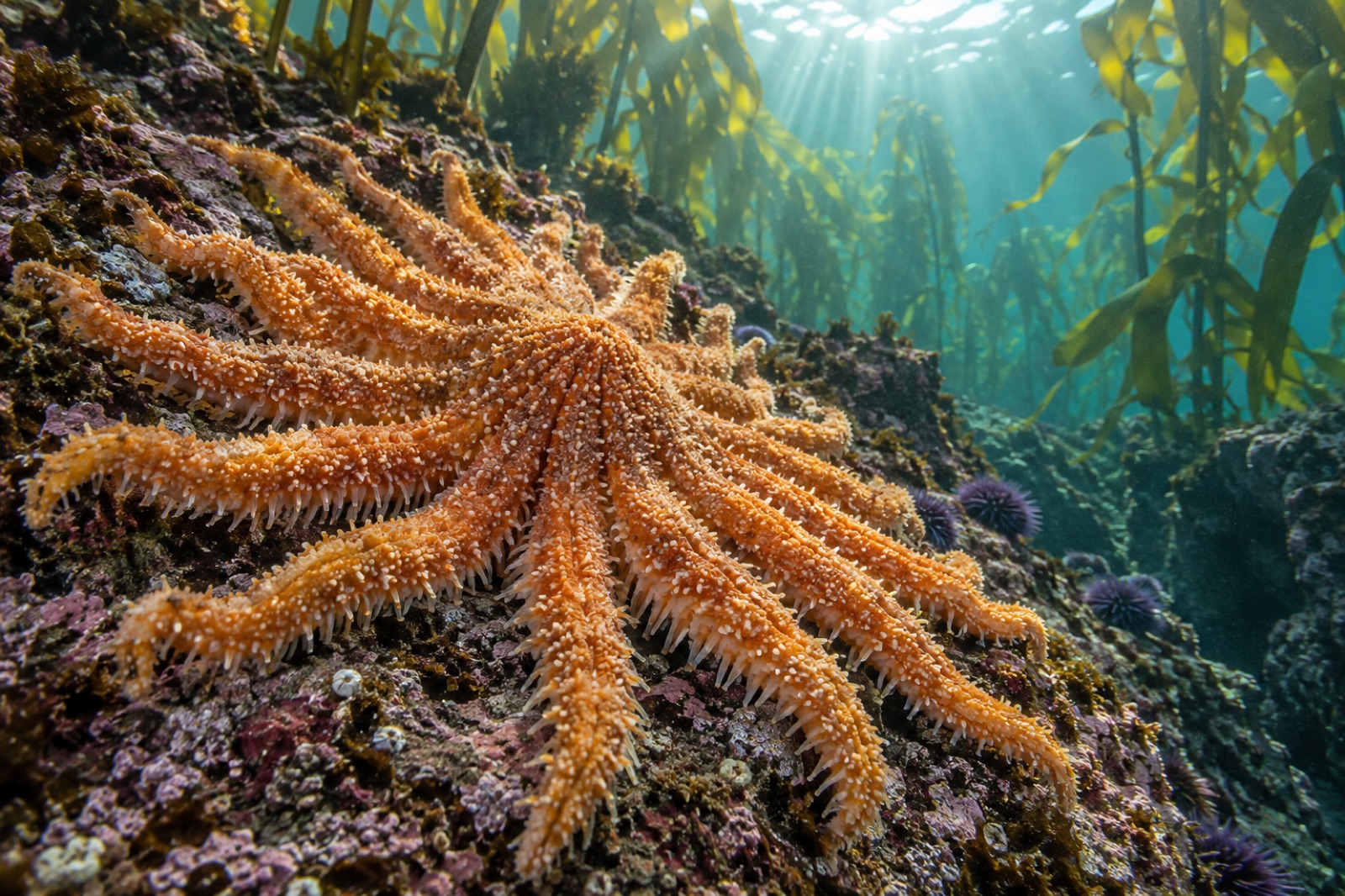
The sunflower sea star was the kelp forest's great urchin hunter. Wasting disease erased billions of them — and the consequences reshaped coastlines.
Dr. Mara Ellison ·
The giant green anemone is a solar-powered predator of Pacific tidepools and kelp-forest edges. Its biology, symbiosis and decades-long life.
Dr. Mara Ellison ·