Encyclopedia8 min read
Ochre Sea Star (Pisaster ochraceus): The Original Keystone Species
Meet the ochre sea star, the purple tidepool predator whose removal in a famous 1960s experiment coined the keystone species concept.
Dr. Theo Nakamura ·
The giant green anemone is a solar-powered predator of Pacific tidepools and kelp-forest edges. Its biology, symbiosis and decades-long life.
At low tide on the Pacific coast, the most confident animal in the tidepool is a green flower that eats crabs. The giant green anemone, Anthopleura xanthogrammica, spreads a tentacle crown the size of two open hands across pools from Alaska to Baja California, green as aquarium neon, patient as geology. It is one of the largest anemones in the region, a genuine predator of the intertidal and shallow kelp-forest edge, and — the thing first-time visitors never expect — partly a plant. Its colour and much of its energy come from symbiotic algae living inside its tissues: an animal that photosynthesises. That combination of predator and solar cell makes it one of the most instructive invertebrates on the coast.
| Scientific name | Anthopleura xanthogrammica |
| Group | Sea anemone, class Anthozoa, phylum Cnidaria |
| Size | Column to about 17 cm wide; tentacle crown spreading to 25 cm in large, submerged animals |
| Lifespan | Long — decades; among the longest-lived intertidal invertebrates where undisturbed |
| Depth range | Intertidal pools and surge channels to shallow subtidal, roughly 15 m |
| Range | Eastern North Pacific: Alaska to Baja California |
| Status | Common; not commercially fished, but affected by collection pressure and warming pools |
The colour advertises the strategy. The anemone's tissues host two populations of photosynthetic symbionts: zooxanthellae (dinoflagellate algae of the same broad family that powers corals) and zoochlorellae (green algae). Their proportions vary with the light regime of the pool the anemone happens to live in — deeper or shaded animals lean on zooxanthellae, brightly sunlit ones can run emerald with zoochlorellae. The animal benefits from the photosynthetic products the algae leak into its tissues; the algae get nitrogen, CO₂ and a predator's immune protection at the address of a permanent sun-facing pool.
This is the same general contract as reef corals, concluded independently in a temperate intertidal animal — and it comes with a coral-like vulnerability. A. xanthogrammica expelled from light, or stressed by heat, bleaches: the tissues transluce white as the symbionts leave, and survivorship drops. Unlike corals, it bleaches quietly and out of public notice, because its pools are not bathed in satellite attention. Warmer, longer marine heatwave summers — the pattern our explainer on marine heatwaves tracks — land on intertidal symbiotic animals with particular force at midday low tides, when a pool stops being the ocean and becomes a pan of sun-warmed water.
The visible animal is a muscular column attached to rock by a broad pedal disc, topped by several concentric rings of short, banded tentacles around a central mouth. Three anatomical details repay attention:
For a sessile animal, the menu is surprisingly carnivorous: crabs, small fish, detached mussels, chitons, sea urchin fragments — whatever flows or stumbles in. In surge channels beside kelp forest, the anemones effectively toll a perpetual current tax on intertidal animals passing between the forest and the surf zone; the crown of a large anemone can handle prey the size of a human thumb without hurry.
Predators, in turn, are few and specific. The leather star (Dermasterias imbricata) makes a speciality of anemones, and the aeolid nudibranch Aeolidia papillosa grazes the tentacles and hijacks the nematocysts it ingests into its own defensive batteries — one of the more elegant thefts in Pacific natural history, played out at animal speeds measured in days. A few spider crabs and sculpins will take tissue from damaged animals. Otherwise, a large anemone is close to untouchable in its pool, which is the ecological explanation for how old they get: animal lifespans of several decades are routine estimates, and the biggest, oldest specimens in sheltered pools are probably older than most of the divers who look at them. The ochre sea star's keystone experiments — told in our ochre sea star profile — run in the same pools, a few metres away, and the tidepool's lesson overall is that every species in it is old, slow, specialised — and closely watched by everything else.
Visitors regularly confuse the giant green anemone with its small, carpet-forming relative, the aggregating anemone (Anthopleura elegantissima), which clones itself by splitting and covers rock in dense patches of individuals a few centimetres across. The rule of thumb: xanthogrammica is the large, solitary, broad-crowned animal of the deeper pools and surge channels; elegantissima is the small, clonal, war-waging carpet of the higher, often more exposed rock. The aggregating species fights its clonal neighbours across anemone no-man's-lands in a slow-motion intertidal trench warfare that rewards a patient hour of watching. Both share the green symbiosis; only the giant is the kelp-forest-edge giant.
The giant green anemone lives at the seam between the rocky intertidal and the shallow kelp forest — the zone where the forest's grazers, scavengers and refugees all traffic. It is not a kelp-forest engineer like an urchin or a lobster, but it belongs to the tightly knit cast that makes the edge of a kelp forest rich, and it shares its sunlit, symbiotic signature: like the kelp itself, it is an organism whose visible colour is the signature of a partnership. In the way our kelp forest food web guide frames it, the tidepool anemone is a mid-web node: feeding on what the forest's edge supplies, feeding in turn on nothing much at all, outlasting everything in its pool, and quietly converting sunlight into the slow biomass of decades.
Tidewright's own long-term monitoring program surveys intertidal indicator species alongside canopy cover, and green anemone bleaching has become one of the early-warning signals the diving crews learn to photograph before the canopy itself declines: the animal is sensitive, conspicuous, and easy to census. In coastal citizen-science programs — the kind our beach-walk citizen science guide introduces — a green anemone count is among the most robust data a careful walker can contribute.
Not meaningfully. The nematocysts that paralyse crabs and small fish cannot penetrate ordinary human skin; touch a tentacle and you feel a mild adhesive tug, like touching the loop side of velcro. People with very thin or broken skin might feel a tingle, and the standard handling rule applies to all wild animals — look, don't squeeze — but this is among the gentlest large invertebrates in any tidepool.
It's symbiosis, not pigment. The animal hosts photosynthetic algae inside its cells — dinoflagellate zooxanthellae and, in sunlit individuals, green zoochlorellae — and the visible colour is the algae showing through the animal's translucent tissues. It is the same broad arrangement as corals, arrived at independently, and it is why the same species can look olive in dim pools and vivid emerald in sunny ones.
Decades, where undisturbed — they grow slowly, have almost no predators, and live in one spot. Exact ages are hard to measure, but large specimens in undisturbed pools are reasonably estimated in their multiple decades, making them among the oldest residents of any intertidal community.
It is low tide. When a pool drains, the anemone contracts: tentacles retract, the oral disc folds in, and the column closes into a pebbled dome. The shell and gravel stuck to its upper column are deliberate — a self-applied sunshade against desiccation and UV. Wait for the rising tide or come back submerged, and the same animal will open into the full green crown.
No — that is their close relative, the aggregating anemone (Anthopleura elegantissima), which splits by binary fission into carpets of clones. The giant green anemone reproduces sexually, releasing eggs and sperm into the water, and remains a solitary individual for its whole life. If the rock is carpeted in small green anemones pressed edge to edge, you are looking at a clone war of the aggregating species, not a population of small giants.
Meet the ochre sea star, the purple tidepool predator whose removal in a famous 1960s experiment coined the keystone species concept.
Dr. Theo Nakamura ·
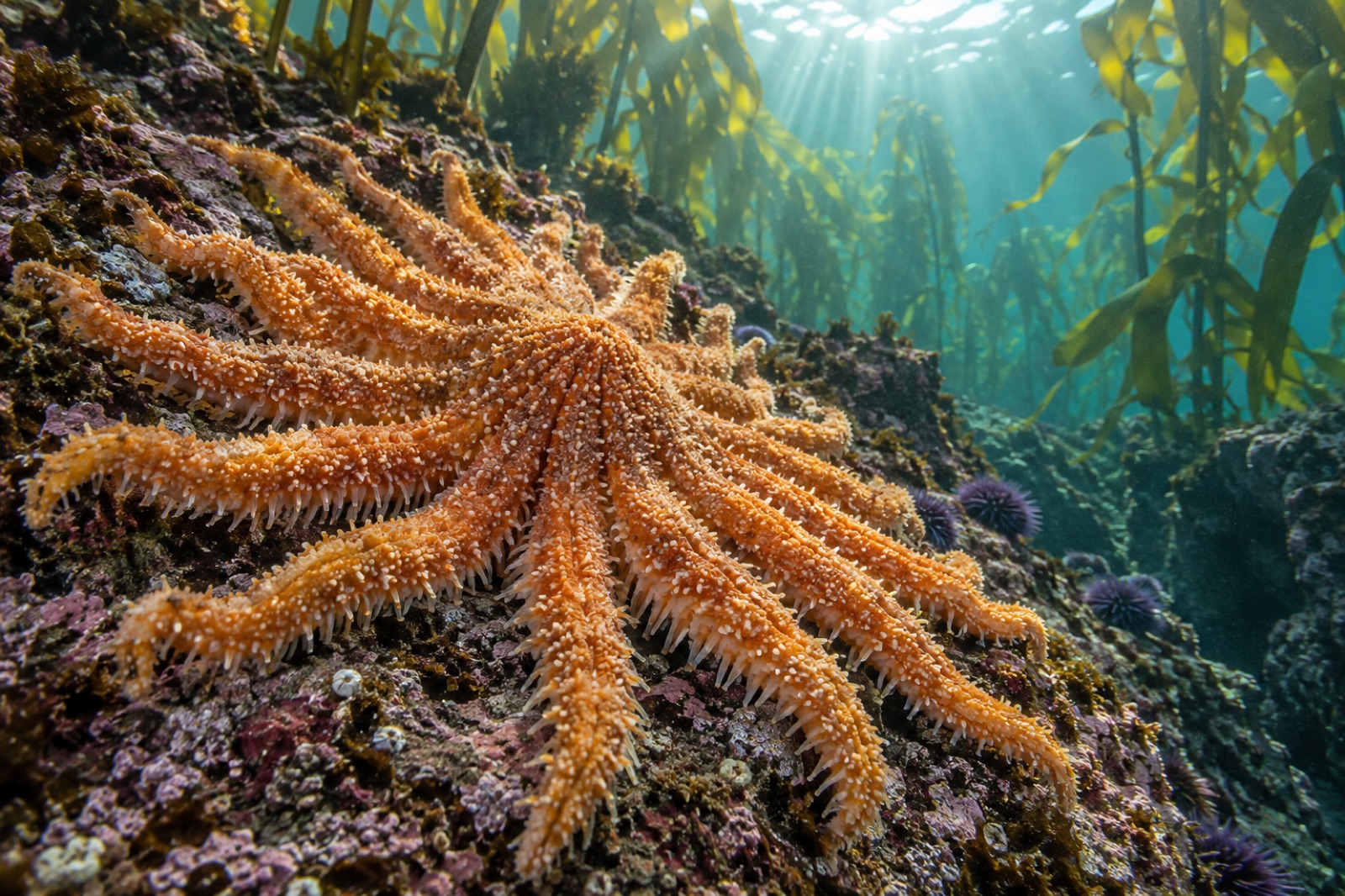
The sunflower sea star was the kelp forest's great urchin hunter. Wasting disease erased billions of them — and the consequences reshaped coastlines.
Dr. Mara Ellison ·
The purple sea urchin turned patches of California kelp forest into barrens. Learn its biology, its hidden hunger, and why it is both villain and victim.
Dr. Mara Ellison ·