Encyclopedia8 min read
Ochre Sea Star (Pisaster ochraceus): The Original Keystone Species
Meet the ochre sea star, the purple tidepool predator whose removal in a famous 1960s experiment coined the keystone species concept.
Dr. Theo Nakamura ·
The spiny scallop Chlamys hastata is a sponge-armoured, blue-eyed bivalve of Pacific kelp forests that can swim away from sea stars. Full species profile.
Drop below the canopy on a rocky reef anywhere from Alaska to Southern California and, if you look closely at the ledges and holdfasts, you will find one of the kelp forest's most improbable residents: a palm-sized scallop wearing a coat of living sponge, ringed with dozens of blue eyes, ready to take off swimming — loudly, clumsily, and effectively — if a sea star so much as brushes it. The spiny scallop (Chlamys hastata) answers a question most divers never thought to ask: can a bivalve be charismatic? It can. Here is how it works, and why this small shellfish matters to the forest around it.
| Scientific name | Chlamys hastata |
| Group | Bivalve mollusc, family Pectinidae (scallops) |
| Common names | Spiny scallop, Pacific pink scallop, Pacific spiny scallop, kelp scallop |
| Size | Commonly 5–8 cm across; maximum around 10 cm |
| Depth range | Shallow subtidal to about 150 m; most often seen at 10–40 m |
| Distribution | Gulf of Alaska to San Diego, California |
| Diet | Filter-feeder: phytoplankton, zooplankton larvae, suspended detritus |
| Notable traits | Dozens of reflective blue eyes; swims by jetting; shell usually encrusted with a sponge partner |
Like all scallops, the spiny scallop carries two fan-shaped valves joined at a hinge, with "ears" (auricles) flanking the hinge line. What sets Chlamys hastata apart at a glance is the armour: both valves bristle with dozens of slender, fragile spines radiating from the umbo, giving the shell its name. The valves are thin, light and strongly arched — a design that sacrifices brute strength for the hydrodynamics of flight. Colour beneath the encrustation runs pink to orange to mottled cream, which explains the "pink scallop" alias heard in British Columbia and Washington.
The single enormous adductor muscle — the part of a scallop eaten worldwide — is the engine. Where most bivalves use two adductors and have traded them down for a burrowing or cemented life, scallops put everything into one, and the spiny scallop can snap its valves shut with real force.
Along the mantle edge sit rows of tiny, iridescent blue dots — typically several dozen per valve. These are true eyes, each with a cornea, a lens and a retina, but the focusing element is not the lens: it is a mirror. Behind the retina lies a concave reflector made of precisely layered guanine crystals — the same chemistry that makes fish scales shimmer — which bounces light back through the retina to form an image. Scallop eyes are therefore a genuine evolutionary alternative to our own camera eyes, and Chlamys vision research has shown the animals perceive motion and looming shadows of roughly sea-star size and speed. They cannot read; they can absolutely tell when a predator is coming.
Clap the valves, eject twin jets of water from the mantle openings beside the hinge, and a spiny scallop lifts off the rock. The spines help: they hydrofoil the shell into a stable, domed-up flight posture, and they slow sinking between snaps. A startled scallop can manage a series of vertical spurts — zig-zag, unglamorous, a metre or so a second — and it is often enough.
What triggers the escape is chemistry as much as touch. Scallops detect the scent of predatory sea stars in the water and will swim from species that hunt them — while ignoring harmless starfish. On a reef where the ochre sea star is on the move, spiny scallops flinch and scatter like spooked pigeons. Crabs and the giant Pacific octopus, which can simply crack or pry the shell, met with a different calculus: scallops usually clamp tight rather than flee, because outswimming an octopus was never on the table.
Pick up a spiny scallop and you will usually find you are holding two animals. Encrusting sponges — most famously Myxilla incrustans on this species — grow over the shell until the scallop looks like a small orange stone. The partnership is one of the classic mutualisms taught in marine ecology, and both partners profit measurably:
Divers sometimes call the encrusted shells "snowballs." The relationship is intimate enough that researchers study the pair as a single functional unit: a two-species refuge that predates, in concept, every engineered reef we have ever built.
Like most scallops, Chlamys hastata is a broadcast spawner and hermaphroditic. Larvae drift in the plankton for several weeks — the dispersal window that threads coastal populations together along the kelp coast — then settle out onto filamentous surfaces: hydroids, bryozoans, red algal turf and the stipes of kelp. Juveniles attach by byssal threads, the silken anchors mussels are famous for, and small spiny scallops hanging off kelp fronds hydroid-thickets are a reward for close-focus diving in Monterey Bay or Puget Sound.
As they grow, the byssus weakens and many adults end up living free on the reef — on ledges, in crevices, and tellingly, tucked at the bases of the biggest kelp holdfasts, where the haptera build a structure like a cave system and the current delivers plankton. There the scallop simply pumps, filters and watches with its sixty eyes: a suspension-feeder plugged into the same plankton economy that feeds the canopy-edge fish schools described in our kelp forest food web explainer.
Spiny scallops are prey for sea stars, crabs, octopus and some fishes, and their shells — living and dead — are substrate for yet more sponges, tunicates and tubeworms. Their filter-feeding also moves planktonic carbon into reef biomass, a small but real part of the nutrient bookkeeping that underpins how kelp forests store and cycle carbon. And as it happens, their sensitivity tells on the ocean: because juveniles settle on kelp and hydroids and adults live openly on the reef, both fronts of the ecosystem — canopy and seafloor — show up in scallop surveys.
The species is not fished at scale, though it is occasionally taken by divers and dredges for its sweet, pea-sized adductor. Its bigger commercial cousin in Alaskan waters, the weathervane scallop (Patinopecten caurinus), supports one of the better-managed small dredge fisheries in the North Pacific — a reminder that scallops, treated gently, can be a genuinely low-impact seafood.
Any cold-water reef dive from British Columbia to the Channel Islands can produce spiny scallops, but the guaranteed sites share a recipe: rock, current, kelp and structure. Look on ledges at 10–25 metres, in crevice mouths, and around holdfast bases. Bring a light — the sponge coat hides them in daylight gloom, but the blue eyes catch a torch beam like scattered sequins. Our beginner's guide to kelp diving covers how to get into this water safely, and on night dives — when scallops gape openly to feed — the reef becomes a field of open mouths and shining eyes: see night diving in kelp.
Yes. Scallops are the great exception among bivalves. By snapping the valves shut, a scallop jets water from openings either side of the hinge and propels itself hinge-first. The spiny scallop's arched valves and radiating spines stabilise its flight; it can sustain repeated spurts over several metres, usually in escape from a sea star whose scent it has detected.
Mutualism. The sponge (often Myxilla incrustans) masks the scallop's scent from sea stars and makes its shell hard to grip and bad-tasting. In return the sessile sponge gains a clean, mobile, well-positioned home — and gets carried along whenever the scallop flees. Scallops whose sponge has been experimentally removed survive predator encounters far less often.
Dozens, arranged in rows along the mantle edge of both valves — the count varies with size, commonly somewhere in the range of 40 to over 100 across both mantles. Each is a millimetre-scale eye with a mirror of layered guanine crystals that focuses light onto twin retinas. The eyes detect movement and shadow, not detail; they are burglar alarms, not cameras.
The name kelp scallop properly belongs to a close southern relative, Leptopecten latiauratus, which lives among kelp and eelgrass in Southern California and Baja. Chlamys hastata is nonetheless a classic kelp-forest animal and picks up the colloquial name north of Point Conception, especially in British Columbia and southeast Alaska, where divers meet it constantly at holdfast level.
Technically yes — the adductor muscle is edible and sweet — but they are small, spiny, often sponge-fouled, and unregulated or specifically regulated depending on the jurisdiction. Most divers treat them as wildlife to photograph rather than a meal; if you are after scallop for the table, buy the commercially managed species instead and check local rules before ever collecting reef animals yourself.
Meet the ochre sea star, the purple tidepool predator whose removal in a famous 1960s experiment coined the keystone species concept.
Dr. Theo Nakamura ·
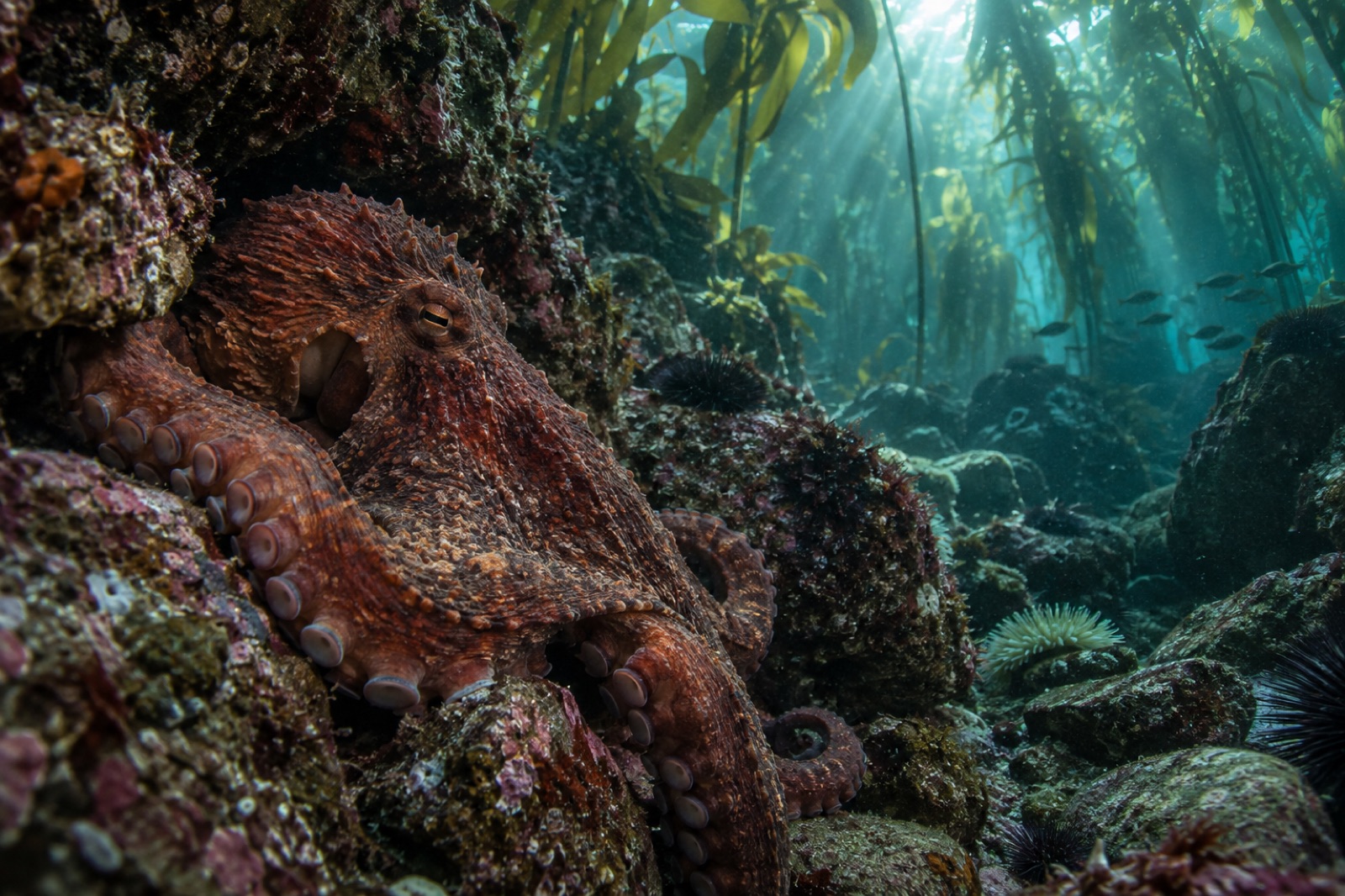
Meet the giant Pacific octopus: the world's largest octopus, a kelp-forest den-dweller with three hearts, blue blood and one shot at motherhood.
Dr. Theo Nakamura ·
Nudibranchs are the jewels of the kelp forest: shell-less sea slugs in startling colours. Learn the key groups, the star species and how to find them.
Tom Okafor ·