Encyclopedia8 min read
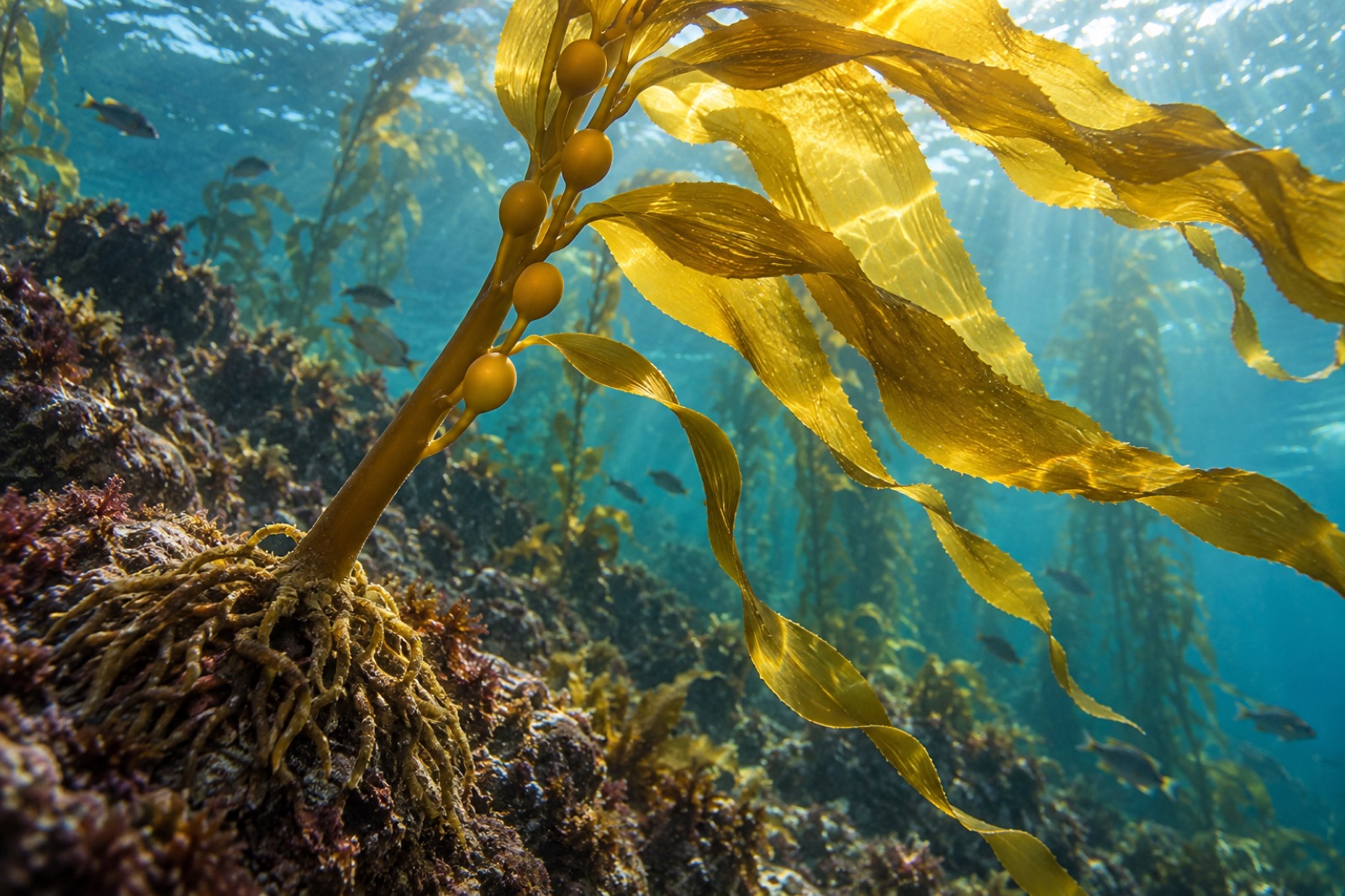
Giant Kelp (Macrocystis pyrifera): Species Profile
Giant kelp is the fastest-growing organism on Earth and the architect of undersea forests. Learn its biology, life cycle, range and why it matters.
Dr. Theo Nakamura ·
Nudibranchs are the jewels of the kelp forest: shell-less sea slugs in startling colours. Learn the key groups, the star species and how to find them.
Nudibranchs are what happens when the ocean decides to show off. These shell-less sea slugs — the name means "naked gills" — come painted in cerise, cobalt, saffron and electric lavender, often on a body the size of your little fingernail, and they live in the cold kelp forests where tropical-reef colour is supposed to be rationed. Finding them is one of the great quiet pleasures of temperate diving: slow down to a fin-kick a minute, put your face close to a kelp holdfast or a hydroid fringe, and the forest starts handing out jewellery. This guide covers what they are, the families you'll actually meet, the star species of the Pacific kelp zone, and how to look without disturbing.
A nudibranch is a sea slug — a marine gastropod mollusc that has, over evolutionary time, discarded its shell entirely. The snail's spiral protection is gone, and in its place the group has invested everything in chemistry and extravagance:
The practical identification divide is between the two big body plans you'll see on a kelp forest dive.
Dorids carry their feathery gills in a rosette around the anus — yes, really — on the rear third of the back. They are the grazers of sponges, bryozoans and tunicates, they move like slow bulldozers, and they are the group containing the big, obvious "sea lemons" and "dorids" most divers meet first.
Aeolids wear hundreds of finger-like cerata down their backs, and those cerata are a marvel of biological larceny. The slug eats stinging animals — hydroids, anemones — digests everything except the prey's nematocysts (stinging cells), and trundles the unfired weapons up into special sacs at the cerata tips, standing ready for the slug's own defence. It's called kleptocnidae — stolen stings — and it means an aeolid a centimetre long can be wearing the arsenal of a hydroid colony. Handle none of them, ever.
Every kelp coast on Earth has its own cast of nudibranchs, but this guide concentrates where most of our readers will actually dive: the kelp forests of the temperate Pacific, with notes that travel well to other coasts. Star billing first.
The classic California kelp-forest aeolid, and for many divers their first nudibranch. Orange-lined cerata over a body of silver, blue-white and electric orange, often browsing hydroid fringes on kelp stipes and rock. It is bold, common, vibrantly armed with its stolen stings, and entirely unbothered by divers — the finest 'first find' in temperate diving anywhere along the coast from Monterey Bay south.
If there is a poster animal for temperate nudibranchs, this is it: deep violet body, scarlet cerata, blazing orange gills and rhinophores, a palette a tropical fish would envy. It feeds on Eudendrium hydroids, which conveniently grow in pinkish tufts on kelp-forest structure — look for the hydroid, and the shawl follows. It can be locally abundant in Southern California and the Channel Islands, and is among the most photographed sea slugs on the planet; macro divers should also visit our underwater photography guide for lighting and angle notes that apply directly to this subject.
A tiny, intensely pink dorid that matches its prey — the pink bryozoan Integripelta bilabiata — with perfect fidelity. In warm years, rose nudibranchs bloom in their thousands over encrusted reefs, a carpet of pink dragging ravishingly against the turquoise algae. In cooler years they can be near-impossible to find. Their boom-bust rhythm makes them a beautiful marker of the state's warm-water years — even marine heatwaves leave beautiful footprints.
The sea lemon clan includes several large yellow or cream dorids — Peltodoris nobilis reaches 20 cm and, according to generations of divers who should not have tested the fact, releases a citrus-like compound when handled. The San Diego dorid (Diaulula sandiegensis), ringed with brown spots, and the Monterey dorid (Doris montereyensis) are regulars on sponge-covered reef. These are spongivores, scraping their living from encrusted rock, and handling remains, as ever, off the menu.
The strangest resident of all: a translucent, auriculate slug with a hugely expandable oral hood it casts like a net into the plankton, sweeping up drifting crustaceans. In late summer and autumn, Melibe gathers on eelgrass and giant kelp fronds in the hundreds, pulsing along the vegetation like ghosts. Divers consistently report a sweet smell — watermelon is the common description — on exiting water where huge Melibe aggregations drift. It is the nudibranch that makes even non-divers' eyes widen at retelling.
Nudibranchs are findable on almost any kelp-forest dive if you follow three rules.
The first correction is pace. Nudibranch hunting is the opposite of reef cruising: pick one kelp holdfast, one rock face, one hydroid fringe, and work it centimetre by centimetre. Divers who "never see nudibranchs" are divers swimming too fast.
A nudibranch is almost never far from its prey:
Nudibranch abundance follows the plankton and the prey calendar. On much of the US west coast the richest nudibranch months come with cold-water upwelling pulses and the productivity right after them — winter into spring in many places — while Melibe peaks late season. Our explainer on the best season for kelp diving unpacks the month-by-month rhythm for the kelp coast.
A nudibranch's brilliant colour is, literally, a warning sign: the pigments advertise the chemistry, and even a tolerant species whose toxins won't harm skin can be killed by a well-meaning finger crushing its gills or cerata. The etiquette is simple:
For all their beauty, nudibranchs are not decoration: they are specific predators woven into the food web, each species typically bound to a narrow set of prey — one hydroid genus, one bryozoan, one sponge family. This specialism makes them sensitive indicators: the arrival of a new nudibranch at a restoration site is a quiet announcement that its prey species has arrived too, and that the community is assembling the small connective tissue of a working reef. When Tidewright's monitoring divers log a restored site's first Spanish shawl, it's a small data point with a big meaning — the hydroids returned, and then the hydroid-eaters did, and the web knitted one strand tighter.
The aeolids — with their stolen hydroid nematocysts — can in principle deliver a mild sting, and the cerata are irreplaceable if crushed. A dorid's weaponry is chemical rather than mechanical. Either way the answer is identical: never touch. The sting risk to you is trivial; the damage risk to the slug is not.
Aposematism — warning colouration. The pigments advertise the toxins, and predators learn (or evolve) to associate the palette with a bad meal. It's the same strategy as a poison dart frog, just colder.
All nudibranchs are sea slugs, but not all sea slugs are nudibranchs. The 'sea slug' umbrella also covers groups like the sacoglossans (sap-sucking slugs) and sea hares. Nudibranchs are the largest, best-known, and most ornately coloured branch of the family tree.
It varies by species and coast. As a rule on the US west coast, the cold, plankton-rich months after upwelling pulses — winter into spring in many regions — bring the richest slug-watching; the hooded Melibe builds its aggregations in late summer and autumn.
A few local populations are pressured by warming, prey loss or collecting, but most kelp-forest species are secure. Their real exposure is habitat: a barren that replaces a kelp forest takes the hydroids, sponges and bryozoans with it, and the slugs follow the food. Growing back the forest grows back the jewellery.
Giant kelp is the fastest-growing organism on Earth and the architect of undersea forests. Learn its biology, life cycle, range and why it matters.
Dr. Theo Nakamura ·
Kelp forests are the ocean's most photogenic architecture — and the trickiest to light. Camera settings, composition ideas and where to shoot canopy.
Sofia Andersson ·
Your first kelp forest dive is easier — and more magical — than you think. Gear, skills, marine life and etiquette for new divers entering the green cathedral.
Tom Okafor ·