Encyclopedia7 min read
Northern Kelp Crab (Pugettia producta): Species Profile
The northern kelp crab is a colour-changing spider crab that lives its whole life in the kelp canopy. Learn its biology, diet, and role in the forest.
Dr. Theo Nakamura ·
Kelp crabs graze the very forest they live in. How Pugettia producta clips, prunes and cleans kelp fronds — and why predators keep the shears in check.
Swim a kelp edge after a calm night and you will sometimes find the evidence drifting past you: a severed bull kelp frond, its stipe cut clean through, travelling seaward like a felled tree. Divers in the Pacific Northwest learn to read that signature quickly. The culprit is not disease and rarely a storm — it is a crab. The northern kelp crab (Pugettia producta) lives its whole adult life inside the canopy and eats the canopy it lives in, which makes it one of the forest's most interesting contradictions: a resident that prunes its own house, a cleaner that occasionally becomes a destroyer, and a walking demonstration of how finely herbivory is balanced in a healthy kelp ecosystem. For identification, anatomy and life history, see the northern kelp crab species profile; here we follow what its claws actually do to the forest.
The simplification "kelp crab eats kelp" is true but flat. Gut-content and preference studies paint a richer menu:
The crab's digestive strategy is volume and patience rather than chemistry. And crucially, adults hold territory high in the fronds where their food literally surrounds them — the crab eats the walls of its own apartment and grows into the job.
Here is where the kelp crab earns its working nickname. Unlike an urchin, which rasps and scrapes whatever it can reach, a kelp crab grips a frond and snips. Two kinds of damage follow.
The first is modest and continuous: individual blades cropped at the tips and margins. On a healthy, fast-growing plant this is trivial — kelp replaces lost tissue at a pace almost no grazer can match.
The second is dramatic and occasional: stipe clipping. Kelp crabs working the stalks of bull kelp sometimes gnaw completely through a stipe below the float. The entire buoyant head of the plant — floats, blades and all — is then lost to drift. Where crab densities run high on stressed or sparse kelp stands, localised canopy losses have been attributed to exactly this behaviour. A bull kelp is an annual, racing from spore to a thirty-metre plant in one growing season; a crab that severs the stipe in July has ended that plant's year outright.
Why would an animal cut down its own food? Probably no strategic reason at all: stipes get severed incidentally, as the crab repositions, tests and feeds. But the consequence is the same, and it explains an observation that long puzzled ecologists — why individual crabs living amid unlimited food would ever need to be kept in check at all.
Balance the ledger with what kelp crabs and their tiny allies do for the forest. Kelp blades are not clean surfaces; they accrete a living skin of diatoms, filamentous algae, hydroids and bryozoans — the epiphytic community described in life on the blade. Light fouling is normal. Heavy fouling is a tax: it shades the blade, adds drag in surge, and can cost kelp measurable growth and even whole fronds.
Small grazers pay that bill down continuously. Amphipods and isopods — the mesograzers — do most of the fine work, but kelp crabs handle the coarser material, and on reefs where kelp crab populations have been experimentally or observationally thinned, fouling accumulates and kelp condition declines. The same animal that occasionally fells a frond spends most of its hours topiary-trimming and window-washing the forest around it. Whether the crab is friend or scissors depends, as with most of ecology, on how many there are and who is counting them.
In an intact northeast Pacific forest, kelp crab numbers are governed from above with real force. Sea otters put kelp crabs well up their menu in regions where otters hunt the canopy; cabezon, rockfish and other reef fish take them; gulls and other birds strike at crabs exposed near the surface. This is the quiet middle tier of the famous trophic cascades that run through kelp systems — the same architecture by which sea otters protect forest from urchins also throttles the canopy's own resident herbivores.
Release the predators and the arithmetic changes. Urchin outbreaks get the headlines because urchins can raze a reef to bare rock, a story told in full in our urchin barrens explainer. Crab release is subtler: more fronds cropped, more stipes clipped, and — paradoxically, since the same crabs clean blades — shifts in how fouling loads themselves play out when the grazer community restructures. The lesson generalises: a kelp forest's herbivores are not a pest class to be eliminated but a pressure to be regulated, and the regulators are other animals.
Restoration changes the equation deliberately, so the crab question becomes practical rather than academic.
A newly seeded reef — lines of juvenile sporophytes set onto bare substrate — is concentrated, vulnerable food in a landscape of hungry mouths that have been living on scraps. The overwhelming risk on urchin-dominated sites is urchin grazing, which is why genuine restoration programmes pair reseeding with urchin management. But crews working temperate-Pacific sites also learn the crab signature early: cropping patterns on seeded lines, clipped young stipes, the difference between crab damage and the ragged work of urchins. In Tidewright's own (fictional) field logs, grazer impact is scored separately by animal precisely so a crab-heavy site is not mistaken for an urchin problem — the two call for different responses, since you do not cull a native canopy dweller the way you clear an urchin front.
The hatchery side has its own version: juvenile kelp on nursery string is susceptible to fouling and to accidental colonists, which is why hatchery practice (real-world practice, not just ours) leans on clean seed string, controlled water and early detection — territory covered from the grower's angle in managing biofouling on kelp lines. Kelp crabs, for the record, are little use in a hatchery and untargeted by control; they matter once the lines go to sea.
A healthy forest holds tens of thousands of kelp crabs per hectare without losing its canopy, because the forest grows faster than the crabs can cut, the crabs clean more than they crop, and the crabs' predators keep the arithmetic honest. Fall any one of those three legs — slowed kelp, swelled crab ranks, thinned predators — and the pruning shears start to matter. The kelp crab is not a villain or a mascot. It is a calibration instrument for the whole web, readable by anyone willing to look at a drifting, cleanly cut frond and ask who was holding the claws.
Not on their own, in any documented temperate case. Urchins raze forests because they can persist at high density on encrusting algae after the kelp is gone. Kelp crabs depend on the canopy itself for food and shelter, so they cannot sustain a population on the wreck of the forest they destroyed — which self-limits the damage. They are a stressor on weakened forests, not a forest-killer.
Look at the cut. Crab work reads as clips and nips on blades and, occasionally, a stipe severed through. Urchin work reads as rasped, ragged surfaces at the base of plants, holdfasts chewed at the rock line, and grazing fronts moving across the substrate. On dives, the smoking gun is finding the grazers in residence: crabs in the fronds, urchins mobbing the floor.
No — they are native to the northeast Pacific from Alaska to Baja California, part of the forest's original working assemblage. Unlike some rivals of kelp covered elsewhere in this encyclopedia (such as the invasive bryozoan or algal species that do travel), Pugettia producta belongs where you find it.
Mostly at the margins. They will colonise farm lines and crop tissue near the surface, but their densities on farms are usually trivial next to fouling organisms, which are the real management burden. The farms-to-forest lesson runs the other way: what farmers learn about keeping blades clean is borrowed straight from what mesograzers and crabs do every hour on a healthy reef.
Generally not. They are native herbivores whose net effect at normal densities is neutral-to-positive, and deliberately stripping them risks worsening fouling. The realistic interventions are at the other trophic levels: manage urchin fronts, protect predator populations, and accept the shears as part of the forest's normal background noise.
The northern kelp crab is a colour-changing spider crab that lives its whole life in the kelp canopy. Learn its biology, diet, and role in the forest.
Dr. Theo Nakamura ·
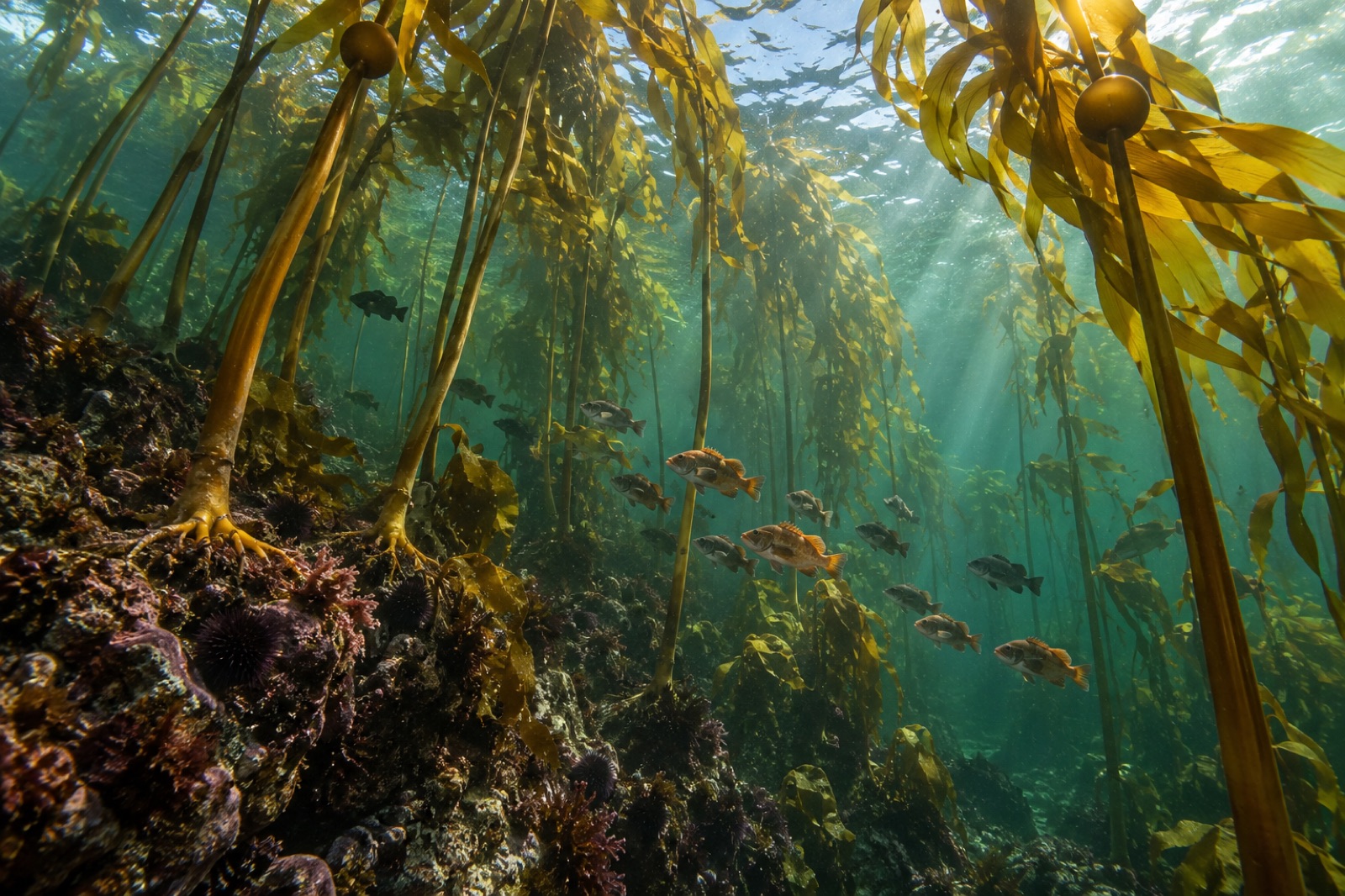
Meet bull kelp, the fast-growing annual giant of North America's Pacific coast — its biology, Indigenous heritage, dramatic decline and the race to restore it.
Dr. Mara Ellison ·
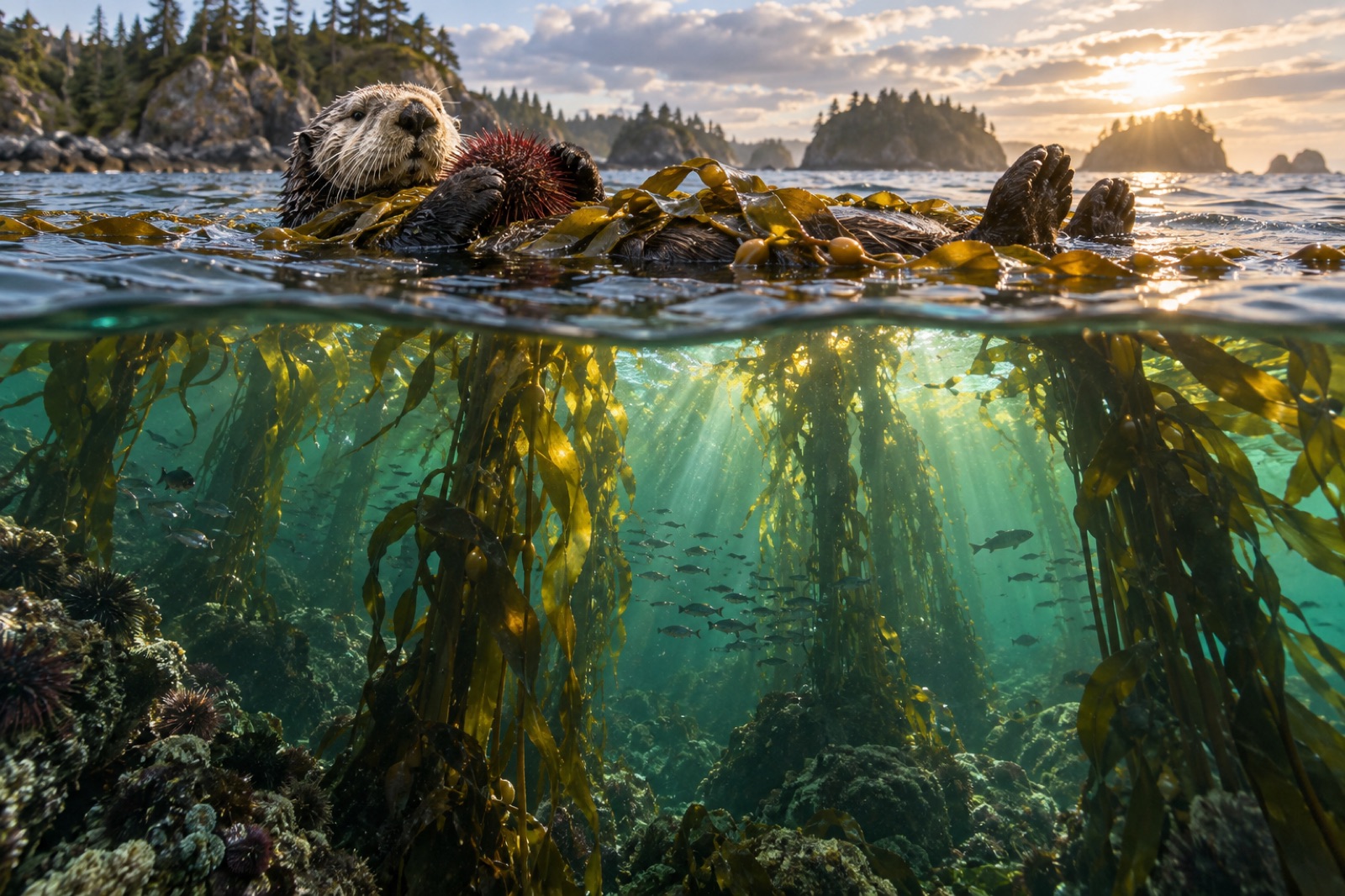
A trophic cascade happens when a predator's removal rewrites an entire ecosystem. The sea otter–urchin–kelp story is ecology's classic case — here's how it works.
Dr. Mara Ellison ·