Encyclopedia7 min read
Treefish: The Golden Rockfish of California's Kelp
Meet the treefish (Sebastes serriceps) — the tiger-barred golden rockfish of California kelp reefs: identification, habitat, behaviour and conservation.
Dr. Theo Nakamura ·
The kelp rockfish (Sebastes atrovirens) lives in the kelp canopy itself — a mottled, camouflaged hunter: identification, habitat, life history and where to see it.
Most rockfish live near the bottom or school in open water. The kelp rockfish made a third choice: it moved up into the forest itself. Sebastes atrovirens — "the dark green one" — spends its life suspended among the fronds of giant kelp, drifting in the canopy with fins outspread, so perfectly mottled that a diver can hover a metre away and count stripes before noticing there is a fish there at all. It is one of the most distinctive members of the great northeast Pacific rockfish radiation, and a living demonstration of how kelp forests create habitat in three dimensions.
Kelp rockfish are wary, deep-bodied rockfish to about 42 cm, wearing a shifting palette of brown, olive, tan and bronze, mottled and blotched with lighter specks and overlaid by dark shading that echoes shadowed kelp fronds. The exact tint varies with an individual's home turf: fish from bright shallows run paler and more mottled; deeper residents shade toward chocolate-brown.
Field marks to confirm an identification: pale mottling often concentrates along the lateral line and on the upper back — pale speckles against dark, an inversion of many rockfishes — and the mouth is relatively small and terminal. Look for it sitting absolutely motionless, head slightly down, fins gently sculling: that "dead leaf hovering in the canopy" posture is itself the best field mark. It is readily confused at a glance with the also-brown gopher and brown rockfishes, but those hug the bottom while the kelp rockfish floats among the blades.
Kelp rockfish occur from roughly Timber Cove in Northern California south through Southern California and the Channel Islands into central Baja California — a range tightly draped over where giant kelp grows. Depths run from the shallows to around 45 m, and crucially the zone used is vertical: young fish recruit into shallow kelp understory; larger fish range the whole water column of a forest, from canopy to holdfast-scattered rock at its foot.
The kelp canopy is more than camouflage. It concentrates food — drifting plankton, small crustaceans, larval and juvenile fishes — and it swarms with the fish's enemies (kelp bass, yellowtail, seals), against whom blending into fronds is the only defence that scales. Research on kelp rockfish settlement has shown young-of-year sheltering specifically where understory algae are dense; strip the forest and the species goes with it.
The kelp rockfish is an opportunist of the canopy. By day it hangs in cover, picking drifting zooplankton — copepods, mysid shrimps, krill — and small crustaceans from the fronds around it. At dusk it becomes notably braver: fish leave the kelp edge to hunt over sand and reef margins for small fishes and larger crustaceans. Gut-content studies find an eclectic menu: mysids, amphipods, small fishes, pelagic larvae — whatever the canopy serves up in season.
Like its cousin the treefish, it has strong home-body tendencies, holding small ranges within its home forest. Unlike the treefish, its defence is invisibility rather than intimidation.
Kelp rockfish are viviparous, as are all Sebastes. Females mate in the winter months, then nourish developing young internally and release clouds of live larvae — one female may release tens of thousands in a season — in late winter through spring, timing them toward the plankton-rich upwelling season. Larvae drift for several months before the thumb-length juveniles drift down onto shallow kelp and understory algae, where the mottled pattern is already fully functional.
Growth is slow, maturity comes at several years of age, and adults live for two to three decades — the standard rockfish bargain of longevity against recruitment. Big females are disproportionately valuable: older, larger mothers produce larvae in greater number and with better survival prospects.
The kelp rockfish is an indicator species in the useful sense: it only thrives where the forest is structurally complete, canopy to understory. It converts the canopy's drifting animal production into fish flesh and passes energy upward to the forest's top predators. In southern California kelp forests, it is among the most commonly encountered midwater rockfishes, and its abundance in diver surveys tracks closely with kelp canopy cover — a living gauge divers can read at a glance. The interplay between kelp cover and its resident species is central to the restoration logic behind Tidewright's project work (see our field notes accounts of forest recovery for what returns when the canopy returns).
Kelp rockfish are taken by California recreational anglers and spearfishers, though less selectively than bolder species like treefish and lingcod — they are often landed as part of mixed rockfish catches. Harvest is managed within California's rockfish regulations: bag limits, size rules and depth closures, with additional shelter provided by the state's network of marine protected areas. Because adults are so strongly site-faithful, MPA protection translates directly into older, bigger resident fish.
As with all rockfish: if you fish, release bycatch with a descending device — rockfish pulled rapidly from depth suffer barotrauma, and descending devices put them back at pressure where the swim bladder can recompress.
Habitat first: if the fish is hovering in kelp fronds well off the bottom, kelp rockfish is the answer in its range. On the bottom, brown and gopher rockfishes are more likely. Up close, the pale mottling along the lateral line and the mottled (rather than striped or saddled) body clinch it.
No — it remains common through much of its range and is actively managed under California's rockfish rules. Its dependence on intact kelp forests makes it vulnerable where forests are lost to marine heatwaves or urchin barrens, which is a kelp problem before it is a rockfish problem.
Within current California recreational rules, yes — rockfish are excellent table fare. Check the California Department of Fish and Wildlife's current regulations for bag limits and depth closures before any trip, and use a descending device for releases.
Coloration tracks habitat depth and background. Shallow, bright-forest fish run pale and mottled; deeper or dimmer-reef fish darken. The mottled pattern itself is constant — only the tone shifts.
Slowly. Approach at fin's length, let the fish resume its drift, and frame it with fronds sweeping across its body — the camouflage is the story. A slightly upward angle against backlit canopy makes the mottling sing. More kelp photography technique is in our guide to underwater photography in kelp forests.
Meet the treefish (Sebastes serriceps) — the tiger-barred golden rockfish of California kelp reefs: identification, habitat, behaviour and conservation.
Dr. Theo Nakamura ·
The blue rockfish (Sebastes mystinus) is a blue-black schooling mainstay of Pacific kelp forests. Biology, fishery and what its presence tells us.
Dr. Mara Ellison ·
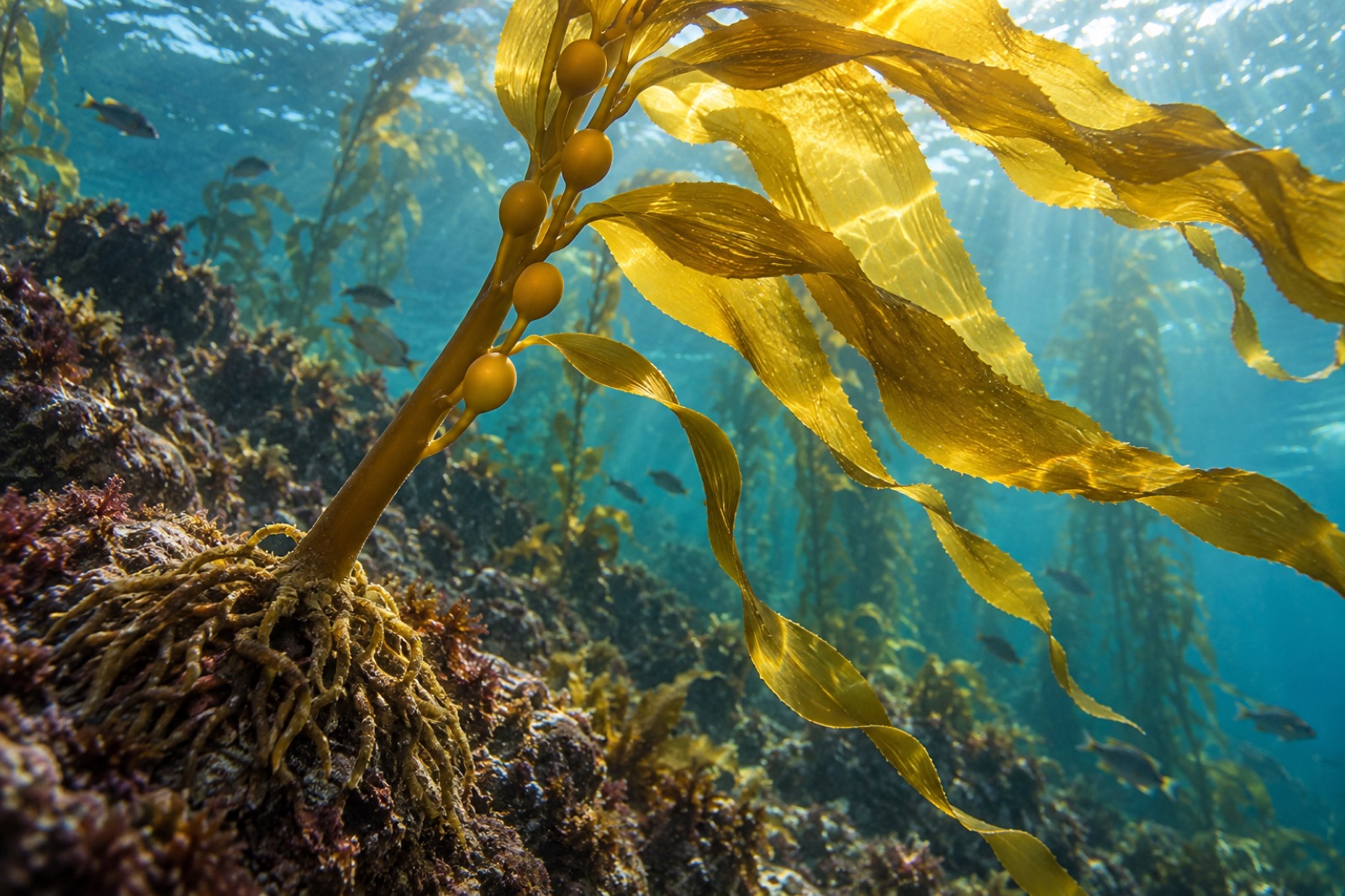
Giant kelp is the fastest-growing organism on Earth and the architect of undersea forests. Learn its biology, life cycle, range and why it matters.
Dr. Theo Nakamura ·