Encyclopedia8 min read
Kelp Perch (Brachyistius frenatus): Species Profile
Meet the kelp perch, a live-bearing surfperch that hovers in the kelp canopy, sips drifting plankton and picks parasites straight off larger fish.
Tom Okafor ·
How the kelp perch spends its whole life inside the kelp canopy — feeding, cleaning larger fish and raising live-born young — and what canopy loss means for it.
Ask a kelp forest ecologist which fish belongs to the canopy itself — not the rock beneath it, not the sand beside it, but the suspended world of fronds — and the answer is the kelp perch (Brachyistius frenatus). Most reef fish treat kelp as scenery, shelter or a backdrop to the real business of the bottom. The kelp perch treats it as the whole address: it feeds in the canopy, courts in the canopy, gives birth into the canopy, sleeps in the canopy and dies, usually, within sight of it. This article is about that whole life — how a small surfperch commits, season by season, to a habitat that grows, thins, storms and sometimes vanishes entirely. (If you're here to identify one on a dive, start with our species profile; this piece picks up where that one leaves off.)
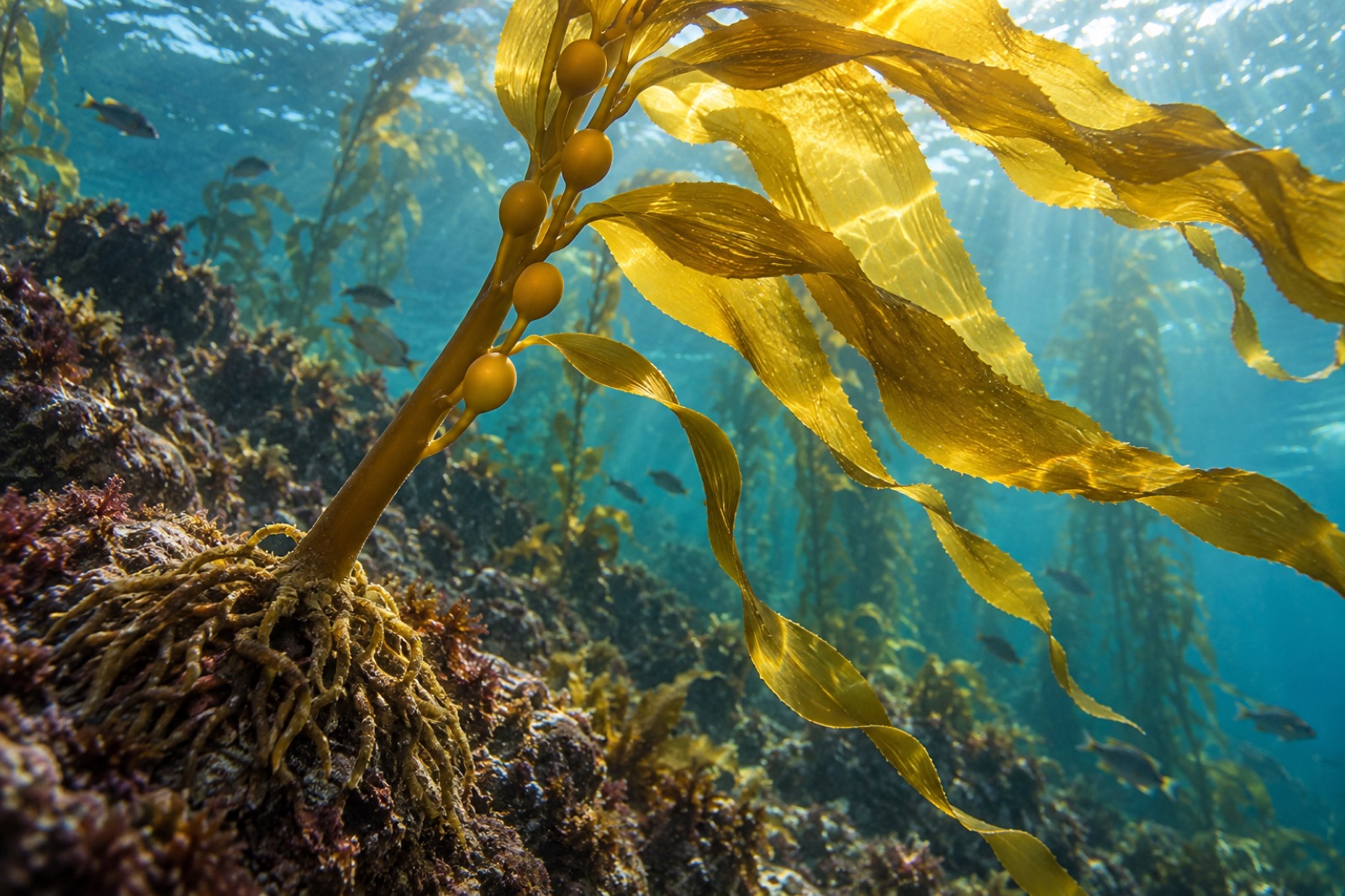
To a human diver the kelp canopy is scenery. To a kelp perch it is topography with districts. The canopy works as a layered habitat in ways that track the physics of the forest itself: fronds braid together at the surface, sub-surface water is dappled and slowed, and the understory below holds a different clientele. Watch a school of perch over an hour and you'll see the same fish occupy distinct beats —
The fish move between these districts on schedules set by light, current and threat. A canopy of giant kelp in full summer growth gives them all four floors; a winter-thinned canopy collapses the building, and the perch pour down among the stipes where they can find them.
Kelp has a seasonal clock, and the perch's year is set to it.
Winter is the canopy's lean season. Storms prune the forest; the water column carries less plankton; the surfperch pull deep into the understory margins and feed harder on what drifts past — with a shift, noticeable on video transects, toward amphipods and small crustaceans picked off the fronds themselves rather than from open water.
Spring is when the embryos approach their term. Females that courted and mated the previous autumn — surfperch courtship is a drawn-out affair of shimmying, fin-spreading and circling — carry their growing broods through the late-winter months. The canopy meanwhile is rebuilding: fronds race upward in the longer light, and the feeding floor re-establishes itself near the surface.
Summer is birth season. Females release their broods — a couple of dozen centimetre-long miniature kelp perch — directly into the water column, typically into canopy gaps where the young can drop immediately into the fronds. The forest is at its fullest; a brood released into a summer canopy lands in a thicket of cover and food. The timing is not a coincidence.
Autumn brings courtship again, and the oldest males begin the dances that will stock next year's broods — the same schools, often the same patch of canopy, working the same fronds.
No other local fish reads the kelp's calendar this closely. Shiner surfperch, their closest canopy neighbours, use the same seasons but range laterally over eelgrass, sand and piers; pile perch and black perch come and go from kelp peripheries. The kelp perch alone is canopy-elite.
A live-bearing fish with no pelagic larva has a problem that pelagic-spawning fish do not: it does not disperse. The brood a female releases stays in, or very near, the forest she lives in. Over generations the result is extraordinary site fidelity — genetic studies of surfperches have repeatedly found population structure at the scale of individual reefs and headlands. A kelp forest's perch are, in a real sense, that forest's own stock.
This has two sharp consequences.
First, it makes each canopy's perch population a local asset to be managed locally. A reef whose perch schools are thinned by net fishing or by long canopy loss does not get replenished by larvae drifting downcoast; it gets replenished, if at all, by its own survivors' broods. Recovery is slow and local — like the reef itself.
Second, it makes the perch an unusually good diagnostic citizen for restoration monitoring. Because they don't drift in from elsewhere, a rise in canopy perch counts at a restoring reef is direct evidence of local reproduction and local retention — a signal we watch for in our own monitoring, where the return of forage-fish schools to a recovering canopy is one of the earliest fish-community metrics to move, following the kelp but preceding most other fish.
The reason the canopy works as a habitat at all is the physics of the fronds, and it is worth appreciating how finely the perch's body and behaviour are tuned to it.
The school of sub-surface perch earns its food from sheltered, decelerated water. Kelp fronds dramatically slow flow in their lee — the same wave-damping physics that lets whole forests calm the sea, described in our explainer on kelp wave damping — and in those pockets, small plankton lingers where a faster current would sweep it through. The perch's posture, tilted nose-down with fins sculling, holds station in exactly the slow-flow layer the fronds manufacture; a fish that ate in open water would have to fight the current for half the mouthfuls.
Cover works similarly. A canopy of giant kelp breaks the light into moving dark-and-gold lattices, and breaks lines of sight into a three-dimensional maze. A predator's rush — a kelp bass from below, a cormorant from above, a harbour seal sweeping horizontally — is very hard to thread through fronds, and the perch's escape is simply to let the fronds be a wall. Schooling adds the confusion effect: hundreds of near-identical copper fish turning as one inside a shifting lattice, each individual's odds diluted by the school and the forest at once.
The cleaning behaviour extends this logic outward. Kelp perch pick ectoparasites — copepod and isopod hitchhikers — off the much larger fish that park at established cleaning stations in canopy gaps. California sheephead, kelp bass and halfmoon will hold posture for the service, gills flared, fins spread, conspicuously patient with fish a fraction their size. Cleaning is a real trophic pathway — parasites are small but not free — and it is also social infrastructure: the perch are never prey to their clients at the station itself. The canopy is the meeting hall where the arrangement is tolerated, and perhaps its neutral ground is part of why.
The kelp perch's full commitment to the canopy is its tragedy when the canopy is lost. On reefs where kelp has collapsed — whether into urchin barrens or post-heatwave bare rock — kelp perch do not simply relocate. They contract onto the remnants: the last few stipes at the reef margin, the drifting blades of a storm-shredded bed, even, in desperation, bushier understory algae and pier piles. Densities in those remnants can be higher than in healthy canopy — crowding, not prosperity — and the fish carry the look of it: smaller broods, tighter and more skittish schools, more time low among the understory rather than feeding in the sub-surface band.
When the canopy returns, so do they — from those remnant refuges and from nearby reefs — and the return is fast: within a growing season of a restoring bed standing tall, the perch reoccupy the sub-surface band and resume the full four-district life. It is one of restoration's most satisfying quick wins, and one reason we count them early and often in monitoring transects.
If you want to see the whole story in one dive, go to a recovering Southern California bed in late summer and swim the canopy slowly. The broods of the year will be holding in the mid-canopy, copper coins in the sun-dappled mazework; the cleaning stations will have clients parked in the gaps; and the whole school will, if you hold neutral and patient, resume feeding within arm's reach of your mask — a school of locals, on home ground, in a forest that is, as of this year, theirs again.
Both, across their very wide range — Vancouver Island to northern Baja — but the canopy association is tightest in giant kelp forests of California, where the surface canopy creates the sub-surface band they feed in. In bull kelp forests further north they work the same live-above-the-reef niche in a different architecture.
No — they're close relatives (both surfperches) that often mix in the same schools. Shiner perch are smaller and more silvery, range more widely over eelgrass and sand, and lack the kelp perch's single-minded canopy fidelity.
Severe storms shred canopy locally, and the perch contract down and back toward the understory and reef margin until the canopy re-establishes. Watch the same site over the following season of growth — the school typically reoccupies the new canopy as it rises.
They perch on other structure in a pinch — pier piles, eelgrass edging, bushy understory algae — but populations are functionally tied to canopy presence. Complete, lasting canopy loss effectively removes them from a reef.
Beautifully suited to it in cold-water systems — they were long a mainstay of public aquariums and are still occasionally traded — but they are a species any home aquarist should leave to professional cold-water facilities, given their slow growth, social schooling needs and live-bearing reproduction.
Meet the kelp perch, a live-bearing surfperch that hovers in the kelp canopy, sips drifting plankton and picks parasites straight off larger fish.
Tom Okafor ·
The shiner surfperch (Cymatogaster aggregata) is the small, schooling seaperch of Pacific kelp beds and piers — a live-bearing forage fish worth knowing.
Dr. Theo Nakamura ·
Giant kelp is the fastest-growing organism on Earth and the architect of undersea forests. Learn its biology, life cycle, range and why it matters.
Dr. Theo Nakamura ·