Encyclopedia8 min read
Giant Kelp (Macrocystis pyrifera): Species Profile
Giant kelp is the fastest-growing organism on Earth and the architect of undersea forests. Learn its biology, life cycle, range and why it matters.
Dr. Theo Nakamura ·
Membranipora membranacea skins kelp blades in white lattices of tiny zooids — a grazer, a fouler and, in warm years, a real force in kelp forest loss.
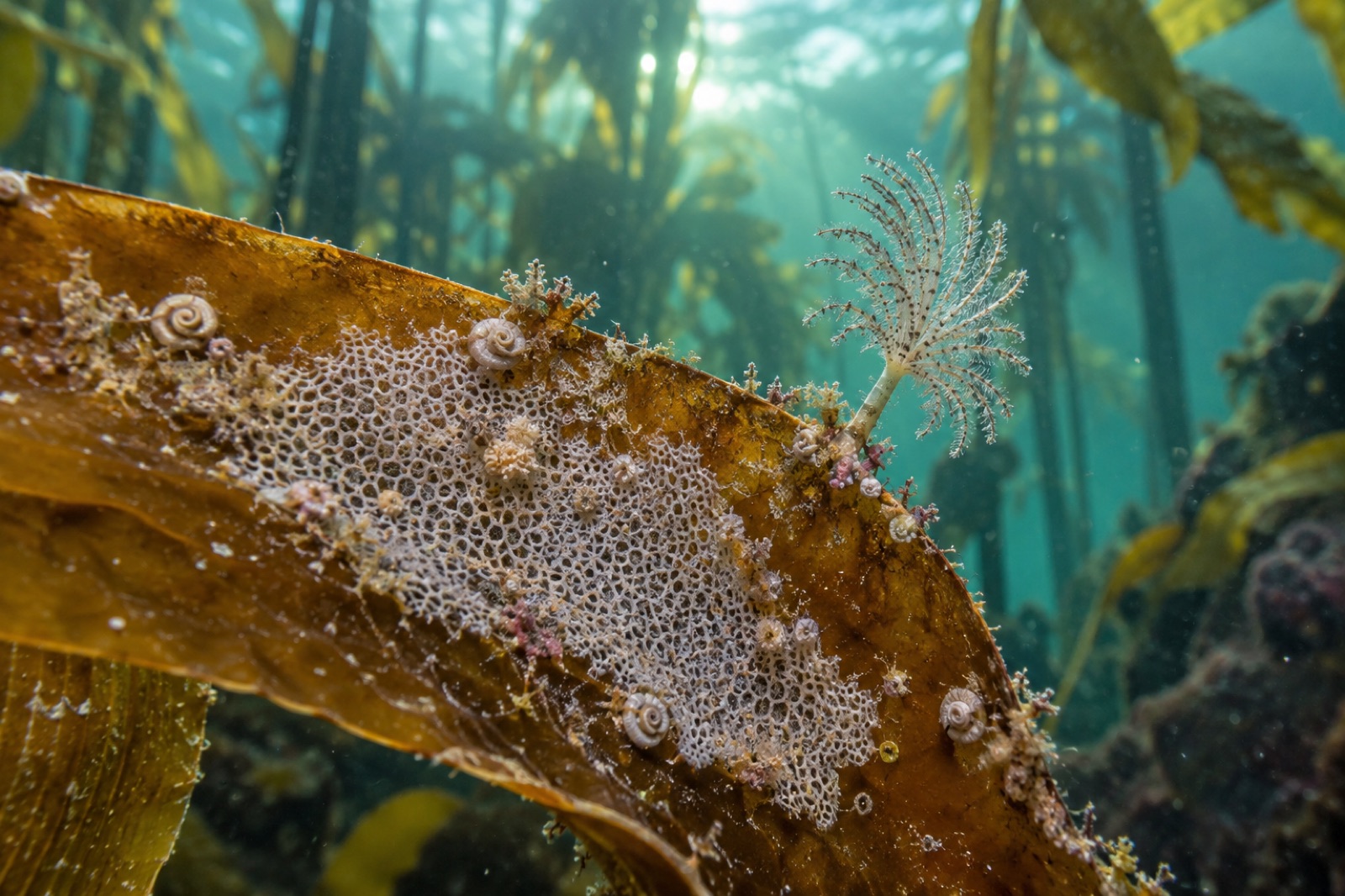
Hold an old kelp blade up to the light in late summer anywhere from Norway to California and you may see it: a faint white net spread across the brown tissue, as if the frond had been laid over lace and restained. That net is an animal — thousands of animals, in fact. The kelp lace bryozoan, Membranipora membranacea, is an encrusting colonial invertebrate whose nearly invisible citizens are among the most abundant grazers of kelp surfaces on Earth. In ordinary years they are background texture. In warm, dense years they become something else: a force that can measurably shorten a kelp blade's life — and, in a few famous instances, an accomplice in the loss of whole forests.
| Scientific name | Membranipora membranacea |
| Group | Bryozoan ("moss animal"), class Gymnolaemata, order Cheilostomatida |
| Colony size | From pinhead patches to lattices covering much of a kelp blade — tens of thousands of zooids |
| Individual zooid | About half a millimetre each — a box of a body with a crown of feeding tentacles |
| Range | Cool-temperate seas of the Northern Hemisphere; now widespread in suitable southern waters as well |
| Habitat | On the blades of large kelps — laminarians, Macrocystis, Alaria and others — in the shallow subtidal |
| Diet | Suspended phytoplankton and fine particles, filtered from passing water |
Each white cell in the net is a zooid — a boxed, cloned individual bryozoan, genetically identical to its neighbours. Colonies begin from a single settled larva, the ancestrula, which buds daughters around itself in neat rectilinear ranks; growth happens at the colony's edge, where new zooids form fastest, so an expanding colony looks like a snowfield advancing across the blade with a clean bright margin. The zooids are suspension feeders. Each extends a lophophore — a delicate crown of ciliated tentacles — through an aperture in its box, pulling microalgae and fine particles out of the water moving over the frond. Retracted, the whole animal is invisible; extended, a big colony bristles with hundreds of thousands of tentacle crowns, and a kelp bed's blades become, in aggregate, a large filtration array.
Identification is gratifyingly simple once you know the look: flat encrustations in crisp geometric grids, white to greyish against brown kelp, often with the colony margin showing as a slightly raised, brighter rim. The crusts turn darker and calcified-looking with age, and old colonies slough irregularly, leaving piebald blades.
Membranipora shares with its relatives one of the sea's stranger larval forms — the cyphonautes, a triangular, sail-like planktonic larva that drifts on coastal currents before settling. Settlement is not random. The larvae respond to cues on algal surfaces and land preferentially on living kelp blades, where a settler metamorphoses into the ancestrula and begins budding. Generation times are short and colonies grow fast — measured in centimetres per month in good conditions — which is why a clean spring frond can carry kilograms of lattice by autumn.
The life history is tuned to its substrate's calendar. Kelp blades are disposable architecture: most laminarian kelps wear their fronds away and replace them on a seasonal rhythm, and giant kelp fronds senesce continuously. The bryozoan colony's booming growth is a bet that the blade will carry it long enough to reproduce; its planktonic larvae are the hedge, recolonising the forest's spring flush of fresh tissue.
A bryozoan-encrusted blade changes physically, and this is where the lace stops being decoration. Heavy encrustation does three consequential things to kelp tissue:
The result, well documented on both sides of the Atlantic and in the North Pacific, is that heavily encrusted blades are lost earlier — torn away in ordinary storms months before they would otherwise have shed. Ecologists file this under epiphyte effects on kelp, but Membranipora is the heavyweight of the category on the Atlantic coasts: no other common crusting animal covers so much blade so fast.
Two episodes made Membranipora famous outside bryozoology. On Atlantic Canada's coasts in the 1990s, kelp beds suffered striking blade losses in seasons of exceptional bryozoan encrustation, and the lace was implicated — alongside unusually warm water and always-hungry sea urchins — in conversions of forest to barrens. In southern Norway in the early 2000s, dense Membranipora years coincided with warm summers and widespread kelp loss, and again the question arose: perpetrator or accomplice?
The honest current answer, built up by careful field experiments, is accomplice with conditions attached. Moderate encrustation is survivable and ancient — kelp and this bryozoan have coexisted for aeons. But warm water tilts the table: it speeds bryozoan growth, stresses kelp tissue directly, and can suppress the grazers that clean blades, so that in warm years encrustation runs further before autumn gales arrive, and the pruning cuts deeper. Where urchins wait beneath — ready to convert fallen forest into maintained barren, as in the dynamics we describe in urchin barrens — a bryozoan-weakened canopy can be the difference between a forest that recovers and one that doesn't. Watch the white lattice on old blades and you are, in a real sense, watching a climate signal.
Fouling is never free, and Membranipora has specialists on it. Certain small dorid nudibranchs — flat, cryptic, blade-matched — graze almost exclusively on encrusting bryozoans, and on Pacific coasts their outbreaks can clear colonies patch by patch; kelp crabs pick at crusts, and the kelp's own defences (sloughing surface tissue, graze-deterrent chemistry) impose costs on the settler. The balance among bryozoan growth, nudibranch cleaning and blade turnover is one reason kelp beds vary so much in their late-summer appearance — and one more argument for the intact food webs that keep kelp grazers and their predators in circulation.
For a restoration ecologist, Membranipora is a monitoring variable, not a villain. On seeded lines and young transplants we track encrustation the way a grower watches aphids: as an index of water warmth, season progress and the canopy's exposure to storm timing. Heavy early encrustation on juvenile blades can rob a young forest of its first season's growth; light late encrustation on old fronds is more often the forest's natural pruning arriving on schedule. (Fictional note: at Tidewright's hatcheries, settlement plates and blade scrapes feeding Canopy Ledger monitoring carry bryozoan cover as a standard indicator, logged alongside temperature and blade length — exactly the kind of low-glamour data that decides when a site needs intervention before a forecast gale.) On Atlantic coasts from Newfoundland to Brittany, the summer's white lattice is read like a tide table: an honest, legible signal of what the season is doing to the forest.
You do not need a dive. Walk any rocky beach downcurrent of a kelp bed after autumn storms: torn blades washed ashore carry the lace, still visible as white grids against the brown, often with the colony margins and slough scars easy to see under a hand lens. Each white square held a creature; run a finger across and the crisp geometry makes the animal's colonial arithmetic legible. In the water, hold an old blade flat in sunlit shallows and the lattice reads in silhouette — one of the kelp forest's small, perfect sights, free to anyone who slows down.
Not in the technical sense. It does not feed on the kelp's tissue or tap its juices the way a true parasite would; it filters plankton from the water and uses the blade only as real estate. The harm it does is mechanical — added drag, lost flexibility, brought-forward blade loss — which is why ecologists call it a fouling epiphyte rather than a parasite, even though the consequences for an old frond can be just as real.
By itself, almost never. Kelp and Membranipora are ancient companions, and forests carry ordinary encrustation every year. The famous loss events combined heavy bryozoan years with unusual warmth, and usually hungry sea urchins waiting underneath. The lace weakened the canopy; climate set the stage; urchins decided what grew back.
Look for the geometry. Membranipora colonies are flat, thin and built as crisp rectangular grids — little walled boxes in straight ranks — with a brighter, slightly raised growing margin where the colony is actively advancing. Other encrusters on kelp (spirorbid worm tubes, sponge crusts, hydroid mats) are fuzzier, lumpier or tangled rather than latticed.
Its origins are genuinely tangled. The bryozoan is natural across the cool-temperate Northern Hemisphere and has spread widely to suitable southern coasts with shipping and aquaculture traffic over the past century; on some southern shores it now fouls native kelps it never evolved with. Distinguishing ancient range from introduced range is ongoing work, but for most practical purposes it is a cosmopolitan citizen of the world's kelp beds.
It can be a genuine nuisance on longline kelp grown for harvest, where fouled blades lose quality and must be cleaned or abandoned — one reason farms time harvest before peak fouling season, a trade-off we unpack in our guide to harvest timing. Its lessons apply directly to farmed kelp: watch the lattice, and know your autumn gale dates.
Giant kelp is the fastest-growing organism on Earth and the architect of undersea forests. Learn its biology, life cycle, range and why it matters.
Dr. Theo Nakamura ·
Laminaria hyperborea builds the kelp forests of Europe's cold coasts — with stiff stipes standing like an undersea grove. Biology, harvest history, ecology.
Dr. Theo Nakamura ·
A single kelp blade hosts algae, bryozoans, hydroids and a whole mobile fauna. Meet the epiphytes — the living deck that perches on the forest's leaves.
Dr. Theo Nakamura ·