Encyclopedia7 min read
Pile Perch: The Striped Midwater Browser
The pile perch (Rhacochilus vacca) is the big, deep-bodied seaperch of Pacific kelp forests and pilings — live-bearing, hard-shelled-prey crusher, diver favourite.
Dr. Theo Nakamura ·
The shiner surfperch (Cymatogaster aggregata) is the small, schooling seaperch of Pacific kelp beds and piers — a live-bearing forage fish worth knowing.
If the pile perch is the kelp forest's stately blimp, the shiner surfperch is its weather: a living, drifting cloud of small silver fish that condenses around kelp fronds, eelgrass and dock pilings from Alaska to Baja. Cymatogaster aggregata — the species name means "gathered together," and the fish has never once contradicted it — is among the most abundant nearshore fishes on the Pacific coast, and one of the least celebrated. This is a brief argument for paying it more attention.
Shiner surfperch are small for the family: most run 8–12 cm, with the largest stretching toward 18. The body is slim by seaperch standards, streamlined for constant midwater movement, and the colour is bright silver over yellow-olive, with faint dusky bars that come and go like a blush. Males in breeding condition darken dramatically, donning sooty flanks and black-speckled dorsal and anal fins.
The confusions are easy to resolve once you know the family. Compared with the deeper-bodied pile perch, a shiner is a sardine with ideas above its station; compared with the kelp perch, it is slimmer, brighter, less bound to the fronds and far more prone to travel in company. At the fish counter or from a pier, the school itself is the field mark — nothing else in the kelp system gathers quite like this.
The shiner surfperch ranges from southeastern Alaska to central Baja California — and it is a rare embiotocid in that it positively enjoys diluted water. Shiners push into estuaries and brackish reaches of coastal rivers, doing well where salt and fresh meet, an ability that sets them apart in a strictly marine family.
Within the kelp system they favour the bright shallows: canopy edges in the top few metres, eelgrass beds, the shaded forests of pier pilings, marina walls. Depths are mostly under 10 m. On a slow dive through a kelp forest's upper storey, the school's approach has a particular physics — the fish flow around you like a single muscular thing, parting and resealing, each individual pivoting on decisions made by its neighbours.
Shiner surfperch schooling is not a crowd but a computation. Hundreds, sometimes several thousand individuals hold station, accelerate, baffle and divide with no leader and no collisions — a self-organising system tuned by millennia of predation pressure. The school confuses visually hunting predators, dilutes individual risk, and keeps mates and prey within sampling reach at all times.
Dive beneath one and the mechanics are visible up close. Each fish holds a roughly constant spacing from its neighbours; the leading edge rotates — fish from the rear sweep around to the front, so no individual bears the risk (or the foraging advantage) of point position for long. Above, the school throws that particular shimmer — light caught off a thousand flank mirrors at once — that photographers in kelp forests chase all summer. If you have ever watched baitfish swirl around the pilings of the Monterey breakwater, there is a fair chance you were watching Cymatogaster.
This famous liquidity has a hard consequential edge: shiners are forage. Salmon, larger rockfish, kelp bass and larger surfperches, cormorants, grebes, diving ducks, harbour seals — the nearshore food web runs substantially through the shiner school. A healthy kelp shallow holds many such clouds, and many mouths.
The shiner is a micropredator of crustaceans: copepods, amphipods, mysids, crab larvae and similar planktonic to half-benthic fare, picked piecemeal from the water column, the kelp fronds and the eelgrass blades. Their small mouths and persistent, darting pecking style let them crop food items far below the notice of larger fish — a niche the school shares with few competitors at that scale in the shallows.
In estuarine habitats they add insect larvae and other drift to the diet. Feeding intensity peaks in the moving, plankton-rich water of flood tides, and a school dug into a current seam is a busy and purposeful sight.
Like all seaperches, shiners bear live young. But Cymatogaster carries the trick further than most: mating takes place in summer and autumn, yet fertilisation is delayed — females store sperm for months, with the embryos only developing over the winter, and the young born the following spring. The female is, in effect, gestating on a clock she sets herself, uncoupled from the act of mating by a season's length.
Broods number from a handful to a few dozen — small, as seaperch broods go — and each young is a miniature adult several centimetres long. The newborns drift into eelgrass and the kelp understory, growing fast; most shiners mature by their first or second year, and the whole lifespan runs only around four to six years — short for the family, a fast-turnover strategy that suits a small, exposed schooling forage fish. The arithmetic of the school is the arithmetic of plenty: many young, quick maturity, a constant shimmer of replacements.
Shiner surfperch are curious and almost comically approachable. Drop into their layer and the school pivots to inspect you; hang a dive torch under a pier and by dawn there will be shiners. They are tolerant of kayaks overhead and snorkelers alongside, and a snorkel float through a canopy-edge school on a bright day is among the great cheap wildlife experiences of the Pacific coast — a reminder that a beginner's kelp dive can be memorably about the small things, not only the giants.
There is no targeted fishery of consequence, and the species is common to abundant across its range — one of the comparatively reassuring stories in west coast fish conservation. But abundance has a foundation: the schooling shallows of kelp, eelgrass and estuary edges that the shiner needs are precisely the habitats most affected by coastal development, warming and runoff. Protect the nursery habitat — the bright, shallow, structured water — and the shiner cloud keeps rolling; lose it, and the food web above loses one of its recurring dividends.
Shape and company. The shiner is slimmer, more silvery, and travels in schools of dozens to thousands; the kelp perch is chunkier, browner, and usually alone or in small knots actually woven into the kelp. In a kelp forest, schooling silver is Cymatogaster until proven otherwise.
Yes — summer and autumn matings are followed by months of sperm storage, with fertilisation and embryo development occurring over winter and live birth in spring. It is a delayed-fertilisation strategy that spreads risk across the seasons.
They are edible but bony and small; most anglers treat them as incidental catch. Check current state or provincial regulations for bag limits where you fish — and handle the school with respect: forage fish have more mouths counting on them than yours.
Because selection has ruthlessly tuned it that way. Tight, synchronized spacing and fluid shape-shifting give maximum predator confusion with no leader, no collisions and no individual long exposed at the pointy end. What reads as magic is millennia of survival math.
Sunlit kelp canopy edges, pier pilings and eelgrass borders throughout the range. The shallows of Monterey Bay and Puget Sound are famously reliable; anywhere the water is bright, structured and calm will do.
The pile perch (Rhacochilus vacca) is the big, deep-bodied seaperch of Pacific kelp forests and pilings — live-bearing, hard-shelled-prey crusher, diver favourite.
Dr. Theo Nakamura ·
Meet the kelp perch, a live-bearing surfperch that hovers in the kelp canopy, sips drifting plankton and picks parasites straight off larger fish.
Tom Okafor ·
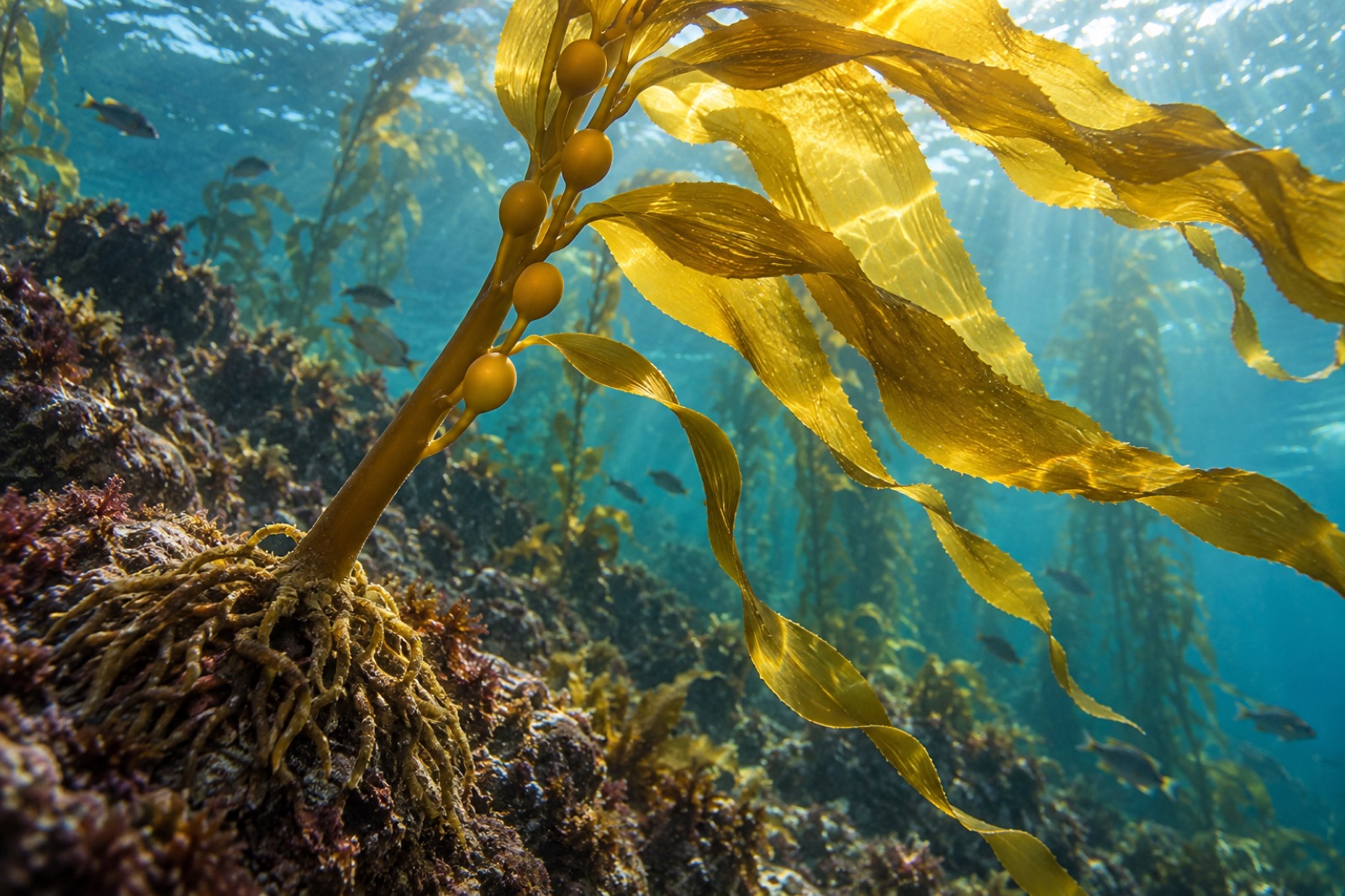
Giant kelp is the fastest-growing organism on Earth and the architect of undersea forests. Learn its biology, life cycle, range and why it matters.
Dr. Theo Nakamura ·