Turn over any boulder on a British or Scandinavian shore and you will almost certainly find one, and it will almost certainly be busy. The shore crab (Carcinus maenas) — known in many invaded parts of the world as the European green crab — is the most familiar crab in the northeast Atlantic and one of the most ecologically important small predators on any temperate shore. At home, between the tides of Europe, it is a keystone scavenger subtidally and a quiet workhorse of the kelp-margin ecology: everywhere else — and it is by now nearly everywhere else — it is one of the most documented and damaging marine invaders ever recorded. This is the story of both animals at once: the native citizen and the export the world did not ask for.
Fast facts
|
|
| Scientific name |
Carcinus maenas |
| Group |
Carcinidae — closely allied to the swimming crabs but without flattened paddles; a running crab |
| Common names |
Shore crab, European green crab, green shore crab; strandkrabbe in German, crabe vert in French |
| Size |
Usually 5–7 cm carapace width; large males around 10 cm in Europe, much smaller at the edges of its invaded range |
| Depth range |
Intertidal — where it is superabundant — to about 60 m subtidally |
| Distribution |
Native: northeast Atlantic from Norway and Iceland to Morocco, including the Baltic edge and Mediterranean. Invaded: both coasts of North America, South Africa, Australia, Tasmania, Argentina, Japan and elsewhere |
| Diet |
Opportunistic carnivore and scavenger — bivalves, snails, worms, small crustaceans, carrion, and some algae and detritus |
| Identification |
Fan-shaped carapace with five sharp teeth along each front-side margin and three rounded lobes between the eyes; colour variable green, orange or brick-red; the last legs pointed, not paddle-shaped |
Five teeth, three lobes
The shore crab's identification is the first one many European rockpoolers ever learn, and it is worth learning well, because the same field marks are how invading populations are recognised on new coasts. The carapace, broad and fan-shaped, carries five strong marginal teeth on each side of the front — count them back from the eye, angling outward — and between the eyes sit three rounded lobes, evenly sized. The colour varies strikingly — greenish individuals tend to be smaller and fresher from a moult; the big brick-red and orange animals are older crabs in a hard, pre-moult state — so colour matters less than the teeth-and-lobes signature. The pointed, unmodified rear legs separate it at a glance from swimming crabs like the velvet swimming crab, whose paddles betray their family at once.
It is a tough animal in the physical sense as well as the biological: tolerant of a wide range of salinity (it shrugs off estuarine brackish water that would kill many crabs), of wide temperature swings, and of times out of water that would finish most of its neighbours. All the traits that make it a superb survivor on a European shore make it a superb stowaway and colonist abroad.
The native citizen: a kelp-edge processor
In its native range the shore crab is neither villain nor homebody — it is the shore's great opportunist, and a significant ecological force in exactly the boundary zones where kelp forests give way to beach and rock. Subtidally it works the lower fringes of kelp beds, scavenging carrion and picking off small bivalves and snails; it retires upshore as the tide falls. In estuaries and on sheltered boulder grounds it is one of the dominant invertebrate predators, crunching juvenile mussels and cockles in numbers large enough to shape those populations. In turn it feeds a long list of shore animals: gulls, herons, otters, and subtidally the larger fish of the kelp forest food web.
Its native biology also supplies a service that is easy to miss: cleanup. Carrion moves through the shore crab like silver through a sieve — dead fish, storm-cast weed, whatever the tide leaves — and the speed with which a healthy shore-crab population clears a beach wrack line is one of the quiet sanitation contracts the coast offers in return for our not poisoning it. It is also prey: the recruitment of gulls, waders and otters on some coasts is written in part in shore-crab flesh.
The invader: small claws, long shadow
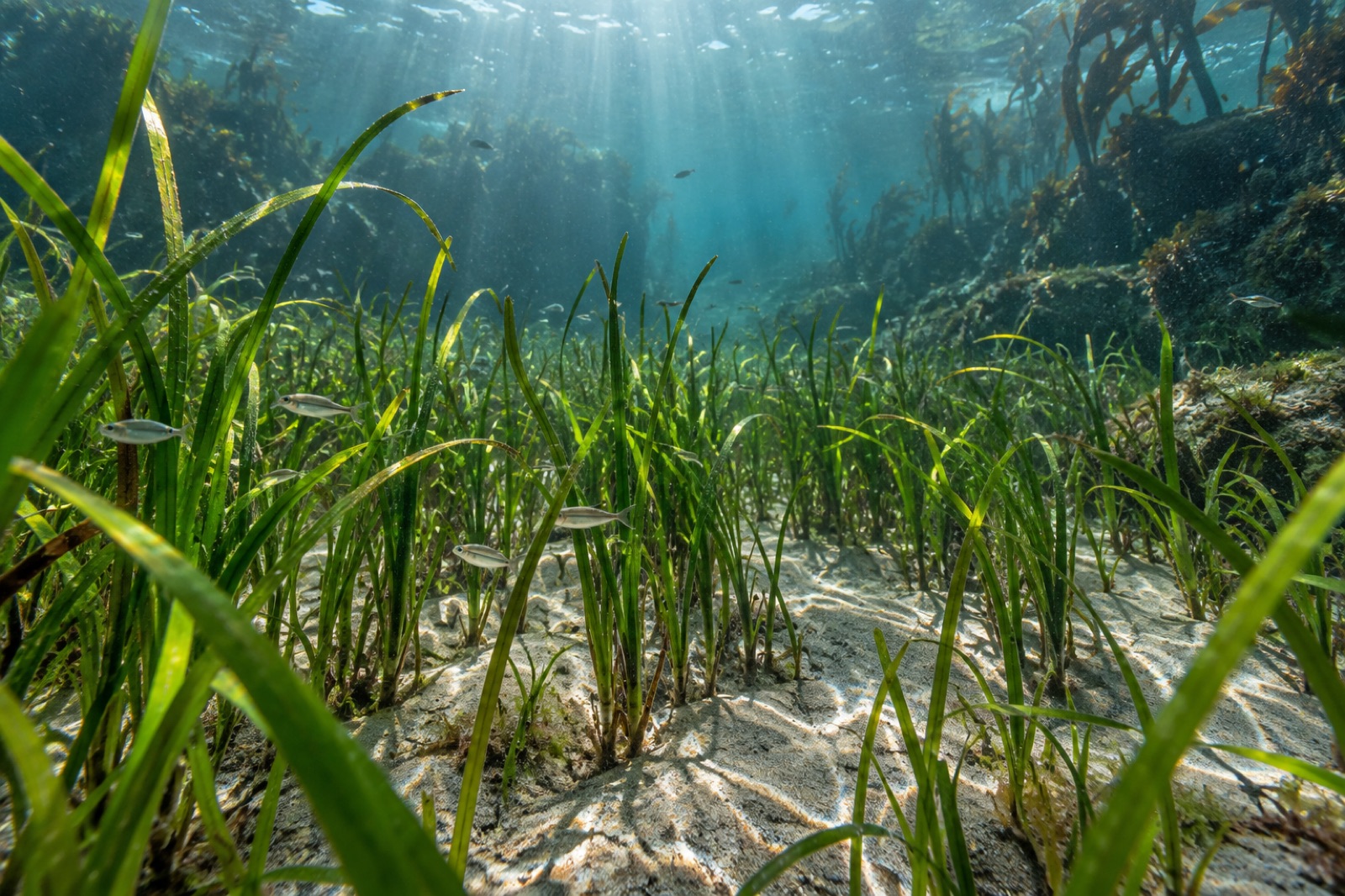
The same package — salinity tolerance, hardiness, opportunism, enormous fecundity — carried in ship ballast water and once in oyster shipments has taken the shore crab around the world, and the exported animal has behaved very differently from the native. In North America it arrived on the Atlantic seaboard in the 19th century and on the Pacific coast by the 1990s; in Australia, Tasmania and South Africa it invaded through the 20th century; and in every well-studied case the consequences have run beyond mere presence. In North American estuaries, green crab predation on bivalves has contributed to the collapse of soft-shell clam fisheries; in seagrass meadows from Nova Scotia to New England, its burrowing and tearing for invertebrate prey physically uproots eelgrass, turning meadow to mudflat and stripping a nursery habitat from fish that never meet the crab that did it. The damage to eelgrass has made the green crab a coastal-management enemy on three continents — not for what it is, but for what it is somewhere it should not be.
The full pattern is catalogued in our explainer on marine invasive species, where Carcinus serves as the archetype: a generalist predator whose native predators, parasites and competitors did not travel with it, moving through a food web that has no evolutionary idea how to handle it. There is even a recorded interaction of conservation concern: in the Pacific Northwest, green crab invasions press on eelgrass and juvenile salmonid nursery habitat; in South Africa, the crab moved through the intertidal mussel beds with re-structuring effect. On Tasmania's coast it overlapped with the same shores where other invaders were already re-writing the urchin-and-kelp balance.
Managing a global citizen
Control efforts abroad run from trapping programs (in some areas of the US west coast, trapping removes the animals in enormous numbers each year), through targeted bounty-and-report schemes for the spreading front, to plain prevention — ballast-water management being the single most important long-term defence. In Europe the animal needs no management, or rather the management is ecological: leave it alone and let it eat and be eaten. It is a tidy moral inversion: the same animal, held by its native food web, is useful; unhomed, it is a pest. Few species make the case for treating marine invasions as ecosystem experiments gone wrong as clearly as this one.
For coastal restoration professionals — and readers who might find one: the ID guide on any citizen-science platform will walk you through the five-teeth-and-three-lobes check — the green crab is a reminder that every shipping lane is also a species lane. Tidewright's work on resilient coastal ecosystems starts from the premise that the simplest invader to manage is the one that never arrives.
Key takeaways
- The shore crab (Carcinus maenas) is a tough, opportunistic, fan-backed crab of European shores, known elsewhere as the European green crab — five marginal teeth and three eye lobes are the signature.
- In its native range it is a shore-scaling scavenger and mid-level predator that helps run the intertidal and the kelp forest's lower fringes.
- Carried around the world in ballast water and the oyster trade, it has become one of the most damaging marine invaders recorded, collapsing clam beds and ripping up eelgrass meadows.
- Control abroad centres on trapping, monitoring and — above all — preventing future ballast introductions; native-range management is simply to leave it to its ecology.
- The crab is the single clearest demonstration that an animal's impact is a property of the web it lives in, not of the animal itself.
FAQ
Is the shore crab the same as the green crab?
Yes. Carcinus maenas is called the shore crab in its native Europe and the green crab (or European green crab) in its invaded range in North America, Australia and elsewhere. Same animal, same five teeth.
Is the green crab dangerous to people?
No — it can pinch but poses no more risk than any small shore crab. The danger is ecological and economic: to shellfish fisheries and to the eelgrass and intertidal habitats that the crab damages when introduced outside its range.
Can you eat shore crabs?
You can, and parts of Europe do — as a small snack crab, in bouillabaisse-style preparations, and as bait. Its limited meat yield has always kept it out of serious commerce in its native range; in some invaded areas, eating it is now promoted as one modest control pressure.
Should I kill or report a green crab if I find one outside Europe?
Do not handle it if you are unsure of the ID; photograph it, note the location precisely, and report through your region's invasive-species authority or a citizen-science platform. Do not transport it — accidental relocation is how these stories deepen.
Why is it so much worse abroad than at home?
Because the native European shore has co-evolved checks — its predators, its parasites, its competing crabs — that the invading crab leaves behind. A generalist released from its web, arriving in an estuary whose shellfish and eelgrass have never met it, behaves very differently from the same animal on a Cornish or Norwegian rock.