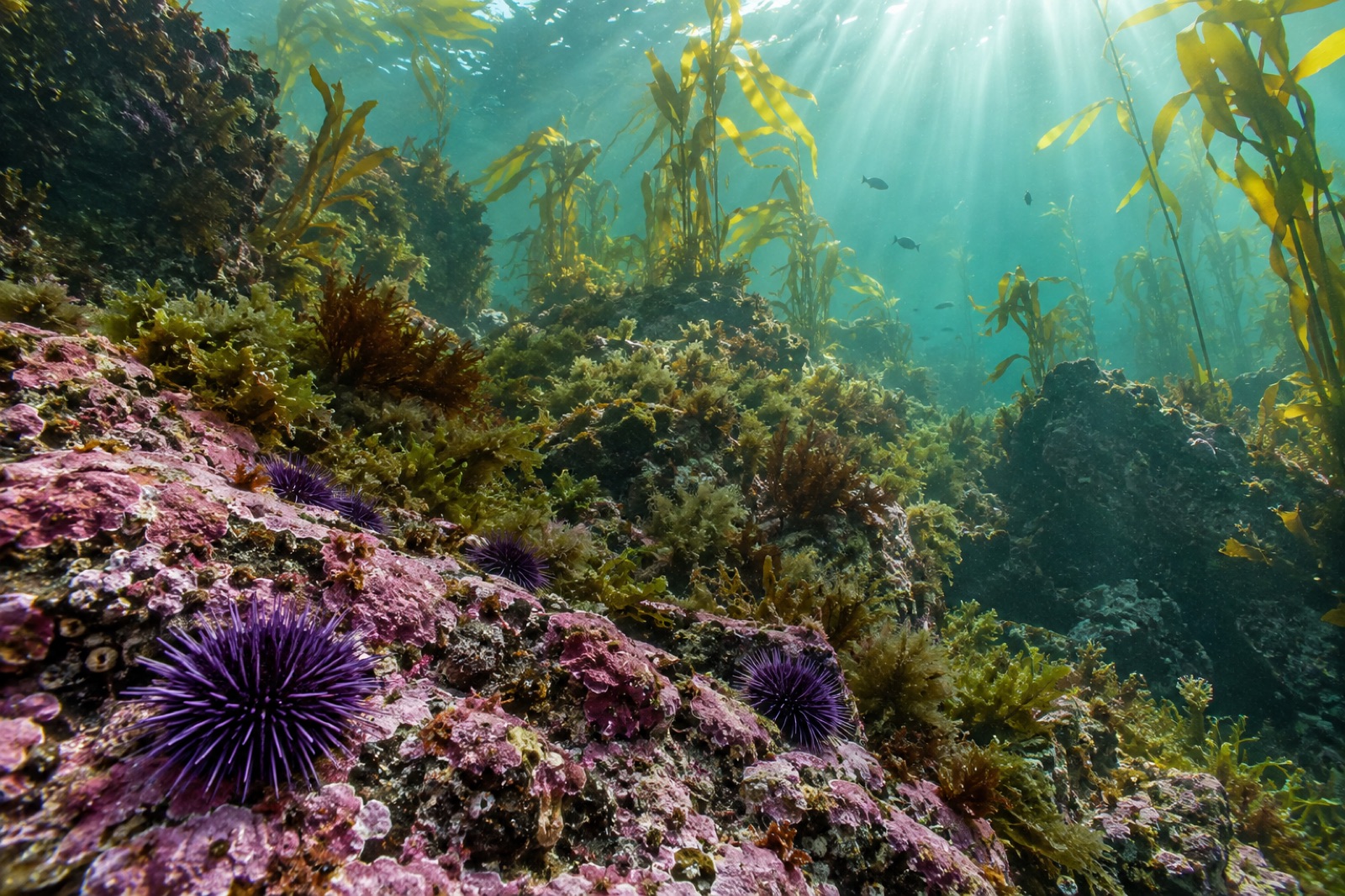
When a kelp forest disappears — gone to marine heatwave, devoured by exploding urchins, or strangled by sediment — the response follows an order of decisions every restoration practitioner knows by heart. First: is the cause of loss still running? If yes, fix that, because nothing planted survives under a live stressor. Second: is there still local seed? If the next bay still carries healthy forest and currents reach the site, the cheapest intervention is patience. Third — and only then — active restoration: putting kelp back by hand. This article walks the current toolkit in that order, and grades each method on the evidence it has accumulated.
Before anything is planted: remove the stressor
The single most consistent finding across decades of kelp restoration is that stressors outmuscle seedlings. A heatwave doesn't care about your hatchery; an urchin barren grazes down any fresh recruit within weeks; poor water clarity means no light for a young sporophyte at any stocking density. Global reviews of restoration trials — including a 2021 synthesis covering more than two hundred projects — repeatedly find that transplant success is predicted better by the removal of the original stressor than by the method used.
Which is why the most effective tool in the toolkit is often the least glamorous: marine protected areas and fishery management that rebuild predator communities, catchment management that reduces sediment and nutrient loads, and — where the damage is specifically urchin-driven — active urchin control.
Method 1: Urchin control on barrens
When urchin numbers explode — usually because predation collapses (how barrens form, and why they stay) — the reef locks into a stable, denuded state. Removing urchins breaks the lock. The technique is old: divers crush or evacuate purple and green urchins by hand, hammer, or quicklime, and the kelp often returns within a single growing season because the spore bank and juvenile kelp on the rock surface are still alive, waiting.
The evidence here is among the strongest in the entire field. Classic work in Norway and California in the 1990s–2010s, and more recent large-scale culling on the east coast of Tasmania, has shown canopy recovery on hectare scales within one to three years, with fish and lobster communities following close behind. Cost per hectare is significant — divers at commercial rates don't come cheap — but per hectare of forest regained, urchin culling remains one of the most cost-effective interventions available. Its limits: it works only where urchins are truly the stressor, and only where a nearby spore supply or a waiting seed bank exists.
Method 2: Seeded lines and spore bags
Where the local seed bank is gone, practitioners bring it. Two delivery systems dominate:
- Seeded lines ("Holdfast-style" lines): hatchery-reared kelp gametophytes or juvenile sporophytes cultured onto fine twine, then wrapped onto boats and outplanted to tensioned ropes across the reef. As the juveniles outgrow the twine, they seed the rock beneath with spores. The hatchery work itself is a well-understood art — our own Holdfast nurseries run a similar pipeline, described on the Holdfast platform page.
- Spore bags: bags of fertile kelp tissue suspended over the recipient reef, releasing fresh spores downhill of the current. Cruder, cheaper, wonderfully effective when the source tissue is local. The critical biological driver is spore dispersal range — tens of metres to a few kilometres, rarely more; the bag has to hang where the spores can land.
Spore bags win on simplicity; seeded lines add hatchery cost but offer three decisive advantages: even distribution, protection from the most vulnerable settlement days (the twine moves spore release closer to the substrate), and — critically for a warming sea — choice of genetics.
Method 3: Green gravel
The green gravel technique — culture kelp gametophytes onto small stones in the lab, let juvenile sporophytes take hold, then literally drop the stones overboard onto suitable reef — was developed in Norway in the 2010s and caught the restoration world's imagination because it converts deck time from days to hours. A few kilograms of seeded stones replace thousands of metres of outplanted twine, and the stones sit naturally on the substrate rather than requiring anchors or rigging.
Early evidence is cautiously positive: trials in Norway have shown stones recruit kelp at reasonable densities, especially on moderately exposed rock. The technique is young; long-term genet survival, performance in high-wave environments, and cost at the hundred-hectare scale are still being worked out. Our Drifter survey vessels carry a green gravel mat for rapid distribution in the right geophysical window — how substrate is matched to site is described on the Drifter platform page.
Method 4: Transplants of adult kelp
Cutting adult kelp from a healthy forest and moving it to a new reef — transplanting — looks intuitive and produces sobering results. Adults are the most expensive unit of kelp you can move, they are exquisitely vulnerable to transport stress, and their established age structure means they often die of old age or storm stress within a year anyway, seeding the reef only briefly. Transplants do have a role in jump-starting genetic diversity at a restored site when you need mature tissue already generating spores. As a stocking method, the evidence recommends against it as a first choice.
Method 5: Warm-edge interventions
At the warm, equatorward edge of kelp's range, incremental fixes can't beat heat. The frontier methods here include:
- Thermal refugia protection and enhancement: identifying and defending cool thermal-refugia pockets where kelp lingers through heatwaves, plus pumping or shading experiments that remain at pilot scale.
- Assisted migration and assisted gene flow: moving warm-adapted genotypes poleward-stock, into forests that are projected to heat — treated in detail in our companion article on assisted migration.
- Assisted succession: planting faster, more heat-tolerant pioneer seaweeds first to hold the rock, shades the rock's young kelp recruits, then letting natural succession take over.
These are methods of the 2030s more than of today; the science is advancing quickly, and careful monitoring of every trial is the norm rather than the exception.
How to compare them fairly
Ask five questions of any kelp restoration plan:
- Has the stressor been removed? If not, the rest is theatre.
- What is the spore supply? If local spores are present, urchin control or passive protection usually wins.
- What scale? Spore bags and green gravel scale better than seeded lines; seeded lines scale better than transplants.
- What genetics do you need? Hatchery methods unlock warm-adapted seedstock; natural-recovery methods inherit whatever spores remain.
- Who will count what grows? Restoration without monitoring is gardening in the dark. Every serious project now pairs intervention with eDNA, canopy mapping and diver quadrats as standard.
Key takeaways
- Stressor removal comes before planting: most failures in the historical record trace to planting under a live stressor.
- Urchin culling in barrens is among the best-evidenced and highest-return interventions — where urchins are the cause of loss.
- Seeded lines trade higher cost for control over genetics and distribution; spore bags trade control for simplicity; green gravel trades control for sheer speed of deployment.
- Adult transplants are best reserved for genetic-diversity seeding, not primary stocking.
- Warm-edge interventions (refugia protection, assisted gene flow, assisted succession) are the research frontier.
FAQ
Why not just leave degraded reefs alone and let nature heal them?
Often that is right — where a kelp forest's loss is recent, the stressor gone and nearby spore supply intact, passive recovery is effective. Active restoration earns its cost where the system has locked into an alternative stable state (urchin barrens being the classic case) or where climate change has outrun the remaining kelp's thermal tolerance.
How much does kelp restoration cost?
Published ranges vary widely: from a few thousand dollars per hectare for urchin culling on accessible rock, to orders of magnitude more per hectare for full hatchery seeding at remote, wave-exposed sites. Costs fall as techniques industrialise — a core reason Tidewright invests in automation.
Does restored kelp eventually match the old forest?
Structure comes back faster than diversity. Canopy height and fish abundance often recover within 3–5 years; the crustose coralline understory, invertebrate assemblages and genetic diversity may take decades. A restored forest is real, but it is not the old forest — which is why protecting what remains will always beat replanting what's lost.
What's the biggest bottleneck in scaling up?
Hatchery capacity and permitted genetics. Growing hundreds of millions of juvenile kelp each year, matched to each target bay in provenance and thermal tolerance, requires coastal hatcheries, regulatory clarity on genetic translocation, and monitoring infrastructure. Both are being built now.
Can restoration be done with volunteers?
Absolutely, and it is increasingly common — culling days, spore bag drops, transplants and diver-science surveys all run well with trained volunteers, usually under professional supervision and with funding from public and philanthropic sources.