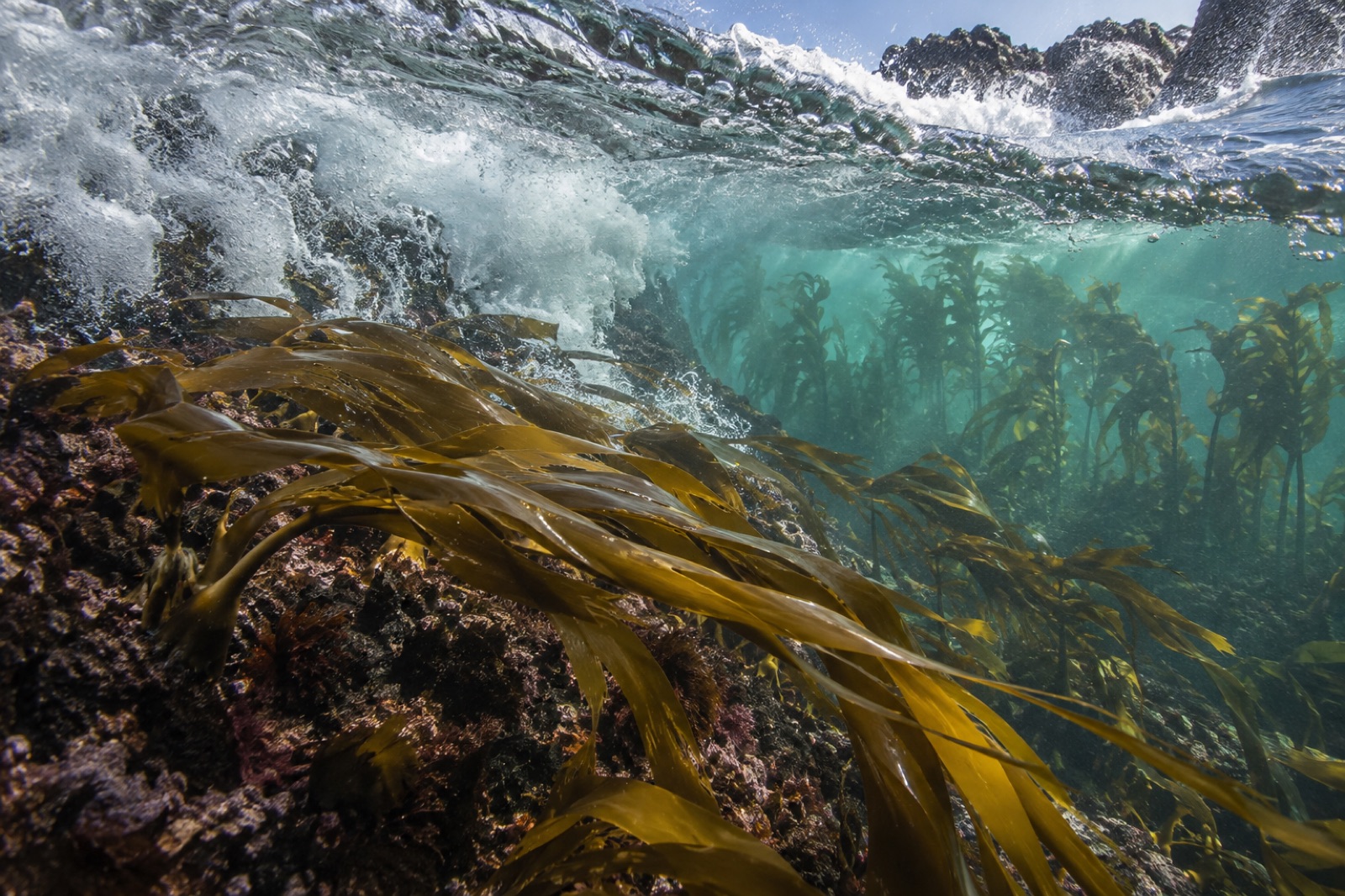
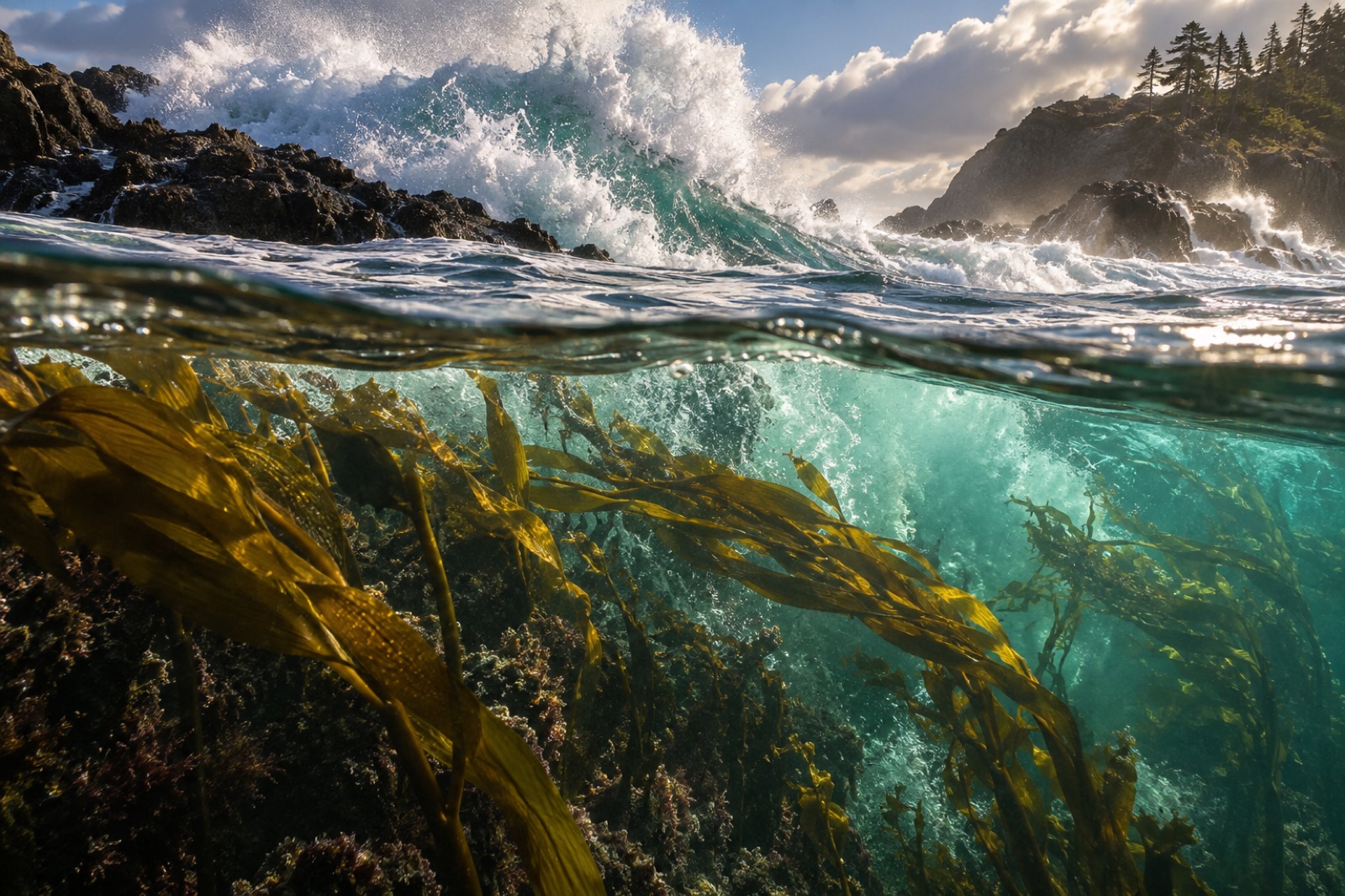
Walk two reefs five kilometres apart on the same coastline and you can find two different worlds. On the headland, waves the height of houses break onto rock where only low, rubbery, strap-like kelps hold on. In the bay behind it, a tall canopy of broad-bladed kelp sways in water that barely stirs. Same species pool, same temperature, same light — radically different forests. The variable doing the choosing is wave exposure: the total dose of moving water a shore receives, and it is arguably the strongest single filter on which kelps live where. This article explains how exposure works physically, how it sorts species and reshapes individuals, and why restoration teams and farm site selectors ignore it at their peril. It builds on our explainers on how waves shape reefs and storms and kelp.
What wave exposure actually is
Exposure is not a single number — it is a budget with three ingredients.
Swell climate: the offshore waves a coast receives — their typical heights and periods, and, crucially, the rare big ones. Ecology remembers extremes, not averages: the largest storm in a decade clears the canvas that everything else is painted on.
Fetch: the distance of open water across which local wind can build waves. A shore facing 200 km of open sea receives locally generated chop even on calm-swell days; a shore behind an island, very little.
Local transformation: what the bathymetry does between deep water and the reef. Wave refraction bends energy onto headlands and out of bays; depth contours focus and spread it; the incoming wave that breaks onto a gently shelving reef is a transformed descendant of the swell that left the deep ocean.
The result is that "exposure" is a property of a specific site and reef crest, not a region. Maps of modelled exposure indices — combining fetch, swell statistics and depth — are now standard tools in both ecology and farm siting, but they estimate, and divers verify.
Once a wave breaks, its organised motion becomes turbulence and surge, and water motion near the seabed falls off with depth: a kelp at 3 m in heavy surge lives a different life from one at 15 m under the same swell. Exposure is therefore three-dimensional — horizontal along the shore, and vertical down it.
How exposure selects species
Every kelp species is a wager on a range of exposure. At the high-energy end live the specialists: species with short, thick, flexible stipes, narrow blades, massive holdfasts and low profiles that present little sail area to surge. Several classic surf-zone kelps are exactly this — built like whips, able to lie downstream and spring back. In the middle band sit the great canopy-formers, engineered with a different trick: buoyant fronds held up into the flow by gas-filled floats, trading drag for light. In the quiet water of deep bays and lagoons thrive species too broad-bladed or brittle to survive a single true storm on a headland — forests the headland will never host.
The mechanism underneath this sorting is well studied in the field of kelp biomechanics: drag rises with blade area and water velocity; attachment strength is finite; and each species' architecture is tuned so that its expected lifetime drag stays inside its anchor's safety margin. Get it wrong and the plant goes. This is why the classic ecological pattern is a zonation by exposure: a ranking of species along the gradient from breaker zone to bay, repeated with variations on temperate coasts worldwide, and layered on top of the depth zonation of the subtidal reef.
Plasticity: how a single species changes shape
The species filter is only half the story. The other half is that one kelp species can grow into recognisably different bodies depending on the water it grows in. Plants of the same species from exposed sites commonly show narrower, thicker, more leathery blades; shorter and stouter stipes; and denser holdfasts than their sheltered cousins, which grow broad, thin, delicate fronds that would tear in the first headland storm. Some of this is developmental — the growing plant literally shapes itself to the forces it meets — and some is survival bias: the broad-bladed pioneers on an exposed reef are winnowed out early, leaving the tough morph behind. Either way, a diver can read a reef's recent wave history off the bodies of the kelp, the way a botanist reads wind in a hedge.
Exposure as subsidy as well as stress
It is easy to tell exposure as violence, but the same moving water is also the forest's delivery service. Surge on a headland flushes the nutrient-depleted boundary layer off every blade many times a minute, meaning exposed kelps often grow in perpetually well-fed water. Sheltered kelps can be nutrient-limited in their own calm, which is one reason the lushest canopies are often found at intermediate exposure: enough motion to feed, rarely enough to rip out. Exposure also drives spore and propagule transport — see how kelp spores disperse — oxygenates egg masses, sweeps away sediment and epiphytes, and delivers drift algae to urchins so they stay in their crevices instead of mowing the forest. The gradient ecologists call "stress" is, for many species, exactly their optimum.
The disturbance pulse
Averages shape growth; extremes shape history. A once-a-decade storm — the kind dissected in the storm ecology of kelp — strips fronds, topples adults, scours urchin aggregations and bares rock, resetting succession everywhere it hits. Exposed sites therefore run a younger, more dynamic forest: fewer old-growth giants, more gaps, faster turnover, constant recolonisation. Sheltered sites accumulate old, stable structure and all the species that depend on it. Neither is "healthier" — they are different steady states maintained by different disturbance clocks. Ageing biodiversity studies find that a coastline with a full range of exposures tends to hold the full range of communities; the exposure gradient itself is a diversity engine, a form of habitat heterogeneity written in water motion.
What exposure means for restoration and farming
For anyone putting kelp back into the sea — or farming it — exposure is a siting decision with consequences that last seasons:
- Match species to the site's exposure, not to availability. A sheltered-water variety outplanted on a headland becomes wrack in the first autumn gale; a surf specialist planted in a bay may sulk in stagnant boundary layers.
- Respect the depth dimension: on an exposed site, deeper lines and outplants escape the worst surge; shallow structures take the full breaking force. This is physics used daily by farm engineers — see longline design for seaweed farms — and equally relevant to restoration arrays.
- Time to the storm calendar: outplanting after the equinoctial gales gives juveniles a calm window to cement their holdfasts before winter — the biomechanical foundation explained in holdfast biology.
- Expect plasticity surprises: seed raised on sheltered nursery lines may produce blades poorly proportioned for an exposed site; staged exposure in nursery conditions, where feasible, hardens the crop the way a forester hardens saplings.
- Model, then dive: desktop exposure maps shortlist sites; a diver in a winter swell writes the final report.
Key takeaways
- Wave exposure — the combined dose of swell, fetch and local bathymetric transformation — is the strongest single filter on which kelp lives where.
- It is three-dimensional: it varies alongshore from bay to headland, and vertically, falling with depth.
- Species sort along the exposure gradient by architecture: low, whippy surf specialists; buoyant canopy-formers; broad-bladed calm-water species.
- Within a species, plants grown in exposed water become narrower, thicker and tougher — plasticity and winnowing working together.
- Exposure is subsidy as well as stress: surge feeds blades, sweeps epiphytes and transports spores; many forests thrive at intermediate exposure.
- Restoration and farming should match species to modelled and dived exposure, respect depth, and time outplanting to the storm calendar.
FAQ
How do scientists measure wave exposure at a site?
Two ways, used together. Desk methods compute exposure indices from the site's fetch in each compass direction, the regional wave climate and the depth contours — producing a relative ranking across a coastline. Field methods log the real thing: current meters, wave gauges or even simple dissolution blocks (standardised gypsum or chalk that erodes faster in stronger flow) deployed across sites. Ecologists trust the field data; farm planners start with the maps and verify with instruments.
Why doesn't kelp just grow deeper to avoid waves?
It often does exactly that — the lower edge of many kelp beds sits where combined wave stress and declining light balance out. But light sets a floor: below the euphotic zone there is nothing to photosynthesise with. On high-energy coasts the conflict between "deep enough to be calm" and "shallow enough to be lit" defines the band the forest can occupy at all.
Do sheltered kelp forests suffer in storms at all?
Severely — but rarely. Sheltered forests are adapted to a quiet disturbance regime, so an unusual event (a storm from an atypical direction, say) can cause disproportionate damage: old, top-heavy individuals with lifelong calm rarely meet their design load until they exceed it. Exposed forests, by contrast, are repeatedly pruned and perpetually young — damaged often, catastrophic losses rare.
Is wave exposure changing with climate change?
The patterns are shifting. Storm climatology, wave heights and storm tracks are responding to a warming atmosphere and ocean, with regional studies documenting changes in extreme wave conditions on several coastlines. For kelp that means a moving target on top of marine heatwaves: exposure regimes that structured forests for centuries are being renegotiated, one storm season at a time — a topic we follow in predicting marine heatwaves and storm records.
Can a farm be sited in fully exposed water?
It can, and some are — but exposure is priced into everything: heavier moorings, deeper and more compliant longlines, robust species, and harvest schedules that clear biomass before storm season. Engineering for exposure is solved problem by problem, never once and for all; the farmers who succeed in rough water treat the storm calendar as a business constraint, as covered in offshore seaweed systems.