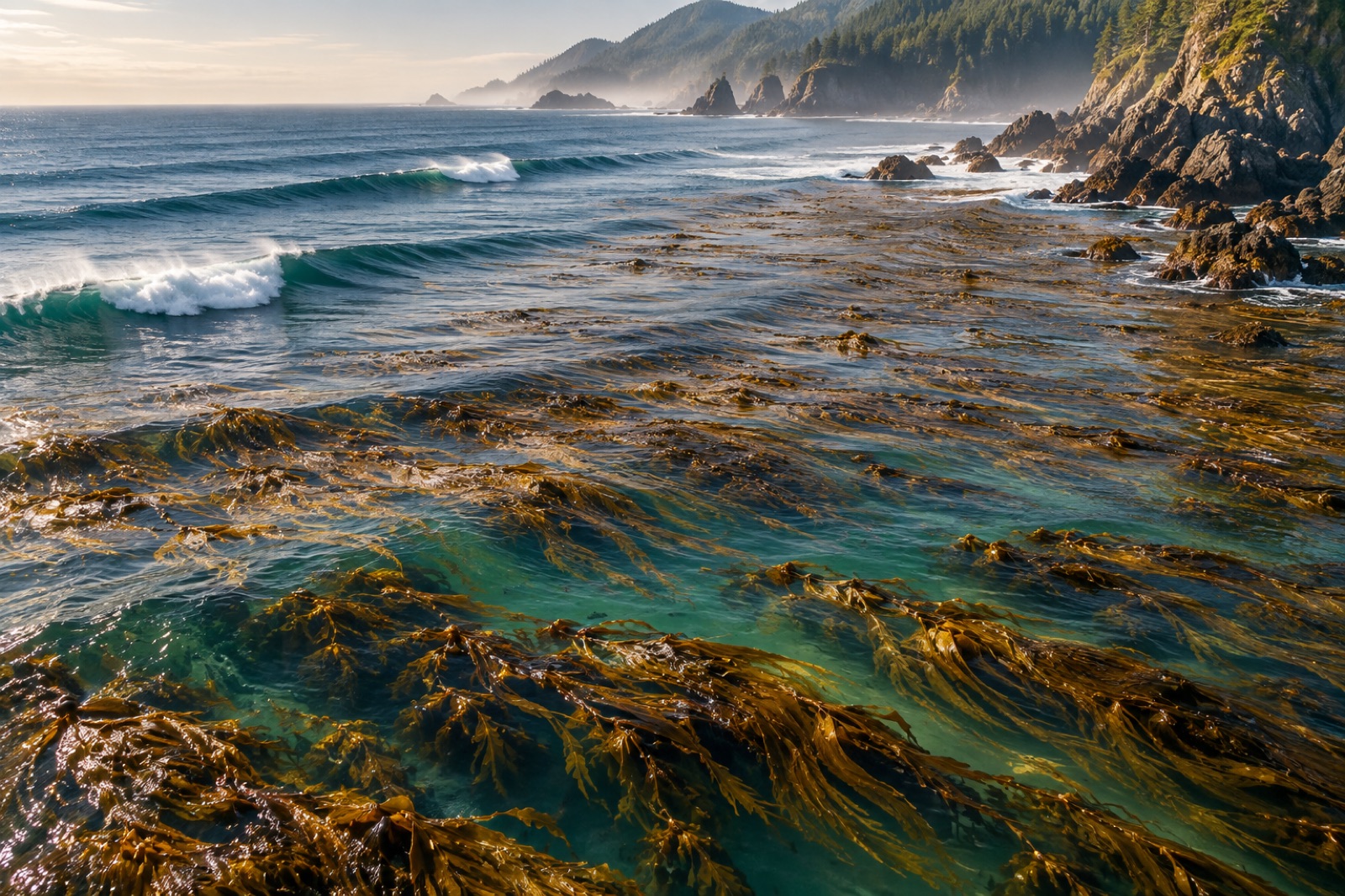
Engineers who build structures to stand in the ocean — piers, platforms, turbines — reach for steel, concrete and triangular bracing. Kelp, standing in surf zones that would flatten most of those structures, reaches for the opposite strategy: tissues softer than a mushroom, stipes that fold like rope, blades that tear into streamers rather than resist. The biomechanics of kelp is a masterclass in survival by yielding, and it explains a great deal about what a forest looks like, where it can grow, and what finally kills it in a storm.
The Problem With Being Attached
A terrestrial tree can duck nothing; it must bear wind. But wind is a thin, slow fluid compared with water. Water is roughly 800 times denser than air, so the same velocity exerts drag forces orders of magnitude greater — and a kelp bed in wave country experiences water velocities of several metres per second, reversing direction with every wave, every few seconds, thousands of times a day.
Drag on a bluff body scales with the square of velocity and with the area presented to the flow. A rigid kelp-sized cylinder standing upright in 3 m/s flow would need enormous strength at its base. Kelp's answer is to attack both terms: present less area, and let the flow fold you so the effective velocity difference drops.
Materials That Cheat the Storm
The stipe: a rope, not a column
Kelps' stipes are built from tissues with remarkable mechanical properties: moderate stiffness in tension, almost no resistance in bending, and stretch far beyond what a plant stem would tolerate. Bull kelp stipes can extend noticeably under load and survive strains that would snap a rigid support. In steady flow the stipe simply streams out downstream, converting a standing cantilever (which experiences huge bending moments at its base) into a towed rope (which experiences mostly tension — the direction biological fibres handle best).
The blade: a good shape, on purpose
Kelp fronds are not smooth sheets. Most carry ripples, puckers, ruffles or longitudinal corrugations along their margins. Counterintuitively, this texture is largely not an anti-drag device — roughness mostly adds drag. Researchers have argued the ruffles serve hydrodynamic and biological functions simultaneously: they exchange nutrients and gases better at the blade's surface, clearly a benefit in flow, but the cost in extra drag is the price of feeding a thin boundary layer. The genuine drag-cheaters are different: blades are thin (minimising frontal area from the flow's view), splitting into strap-like segments in wave-swept species, and topped by gas floats — pneumatocysts — that hold them up into light without any rigid support at all. Buoyancy does the standing; the plant spends its strength budget elsewhere.
The holdfast: anchoring with a margin
All this yielding moves the stress problem to the anchor. Holdfasts spread haptera — root-like grips — across rock, and their strength determines the forest's storm fate. Most healthy kelp carry a safety factor of several times ordinary wave loads; failure arrives in the exceptional events, or where the substrate itself is poor.
Reconfiguration: The Master Move
The central concept in seaweed biomechanics is reconfiguration — the passive change of shape under flow that reduces drag. A rigid object's drag rises with the square of velocity; a flexible one that folds and streamlines can hold drag growth well below that scaling. Experimentally, flexible macroalgae in flumes show drag increasing far more gently with speed than any rigid engineering member would allow.
Reconfiguration works at every level:
- Blades roll into cones and tubes, or align along the flow.
- Fronds stream behind the stipe like hair.
- Whole plants lean, fold and swing with the passing wave orbit rather than standing across it.
- Whole forests move coherently, neighbours sheltering neighbours — the same phenomenon that lets forests damp waves collectively.
There is an evolutionary elegance here: kelp doesn't have to predict the storm. Flexibility is a permanently installed, zero-energy, instantaneous control system.
The Pruning Hypothesis: Losing Blades to Save the Plant
Watch kelp after heavy swell and the beach is strewn with torn blades — yet the plants often stand. Biomechanists call this pruning: blades and fronds tear away at deliberately "weak" points when loads spike, shedding the very surface area that was creating the drag. The plant sacrifices photosynthetic tissue — cheap to regrow — to protect the stipe and holdfast that are expensive or impossible to replace. Blades regrow in weeks; a lost holdfast is a lost life.
This reframes storm damage. Torn fronds on the wrack line are not necessarily a forest in trouble; they are often a forest doing exactly what it was designed to do. What actually matters after storms is how many holdfasts kept their grip — a distinction we come back to in storms and kelp.
Where the Design Breaks
Flexibility is not invincibility. The system fails in identifiable ways:
- Entanglement. Long stipes and drifting blades can wrap around neighbours, binding plants into clumps that load each other in storms — one bull kelp's fall dragging down its neighbours like felled masts.
- Grazer-notched blades. Sea urchins and limpets clip blade bases; a small wound concentrates stress and converts a survivable load into a tear.
- Warm-water weakening. Kelp tissues grow thinner, weaker and more epiphyte-loaded in warm, nutrient-poor water — the biomechanical margin shrinks precisely when heatwaves already stress the plant. Marine heatwaves don't just cook kelp; they soften it for the next swell.
- Substrate failure. Sometimes the plant holds and the rock lets go: cobble-bottom kelps can be ripped out whole when the stones they're attached to are rolled by storm flow.
These failure modes matter to forest monitoring — a diver can read the difference between epic wrack-line "normal pruning" and catastrophic dislodgement by whether holdfasts are still on the rock.
What Restoration Borrowed From the Physics
Tidewright's restoration design implicitly reads this biomechanical playbook. Our seeded Holdfast lines are tensioned rope structures that behave like stipes — tension members, not cantilevers — deployed on consolidated rock rather than mobile cobble. Site selection weights wave exposure because the physics says a forest's storm-survival ceiling is set at the site, not in the seedstock. And our Drifter survey vessels map canopy damage after winter swell precisely because dislodgement patterns tell us where the mechanical margins ran out. The ocean writes its engineering review every winter; the trick is learning to read it.
Key Takeaways
- Kelp survives extreme wave forces by yielding: it converts bending loads into tension, reconfigures to shed drag, and treats flexibility as its primary structural strategy.
- Stipes work like ropes, blades minimise frontal area and tear into streamers, and buoyant pneumatocysts replace rigid trunks entirely.
- Passive reconfiguration holds drag growth far below the rigid-body v² scaling — a zero-energy control system evolution installed permanently.
- Storm blade loss is often deliberate pruning that saves the life-critical holdfast; forests fail mainly through entanglement, grazer wounds, warm-water weakening and substrate failure.
- Restoration design inherits the physics: tensioned seeded lines, consolidated rock, and wave-exposure screening at the site-selection stage.
FAQ
Why doesn't kelp just grow stronger instead of softer?
Strength in a bluff body fights v² drag scaling — a losing race at metre-per-second water velocities. Yielding also has a bonus a rigid column lacks: it lets the plant keep growing taller into light without paying an ever-stiffer structural tax. Softness is the cheaper engineering, and it self-adjusts to conditions.
How strong is a kelp stipe compared to a rope of the same size?
Comparably strong in tension for its diameter — kelp stipe tissues reach tensile strengths in the range of some natural fibres — but deliberately near-useless in bending. That's the point: the design guarantees the plant folds before it breaks.
Do the ruffled, corrugated blades reduce drag?
Mostly they slightly increase it. The corrugations are thought primarily to improve nutrient and gas exchange at the blade surface and to help light capture. Drag reduction comes from thinness, streaming, and reconfiguration instead.
Can kelp grow on sandy seafloor?
Not as a rule — kelp holdfasts need hard, stable substrate, and mobile sand scours or buries them. Some southern bull kelps anchor to sand-embedded stones, and sequestered lines can stand in for rock in farming, which is exactly how cultivated kelp grows over soft bottoms.
Does a kelp forest get stronger as it gets denser?
Up to a point — dense canopies share and shed loads, slowing internal currents and sheltering individuals. But extreme density raises entanglement risk after storms, and self-thinning forests are the norm. Density is protection with diminishing returns and a fine print.