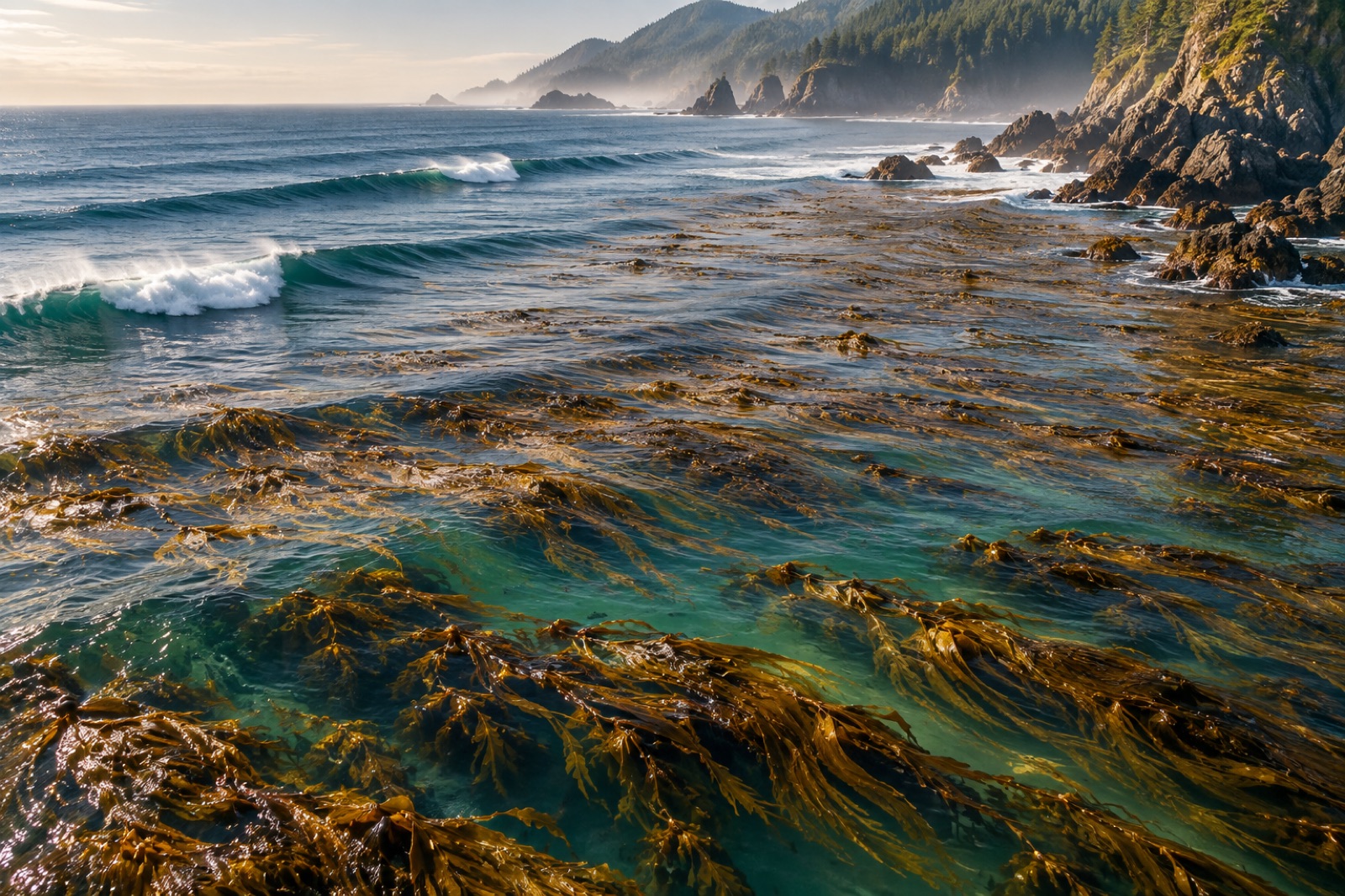
Every winter, waves strike kelp forests with accelerations that would tear apart most things humans build in the sea. Estimates of the drag a single large kelp plant experiences in heavy surge run from kilograms to, in extreme events, many times the plant's own submerged weight — applied not once but in thousands of repeated jerks per storm, season after season. Yet mature kelp routinely lives for years in places ships avoid. How it stays attached is a story of engineering: not strength in the rigid sense, but a suite of mechanical tricks that offshore engineers are only beginning to match. (If you want the anatomy and ecology of the structure itself, see our companion piece on holdfast biology; here we're after the physics.)
The problem: drag in oscillating flow
A kelp in a wave is not like a fence post in the wind. Water in waves doesn't just push; it oscillates, accelerating back and forth with the passing of each crest and trough, and kelp lives precisely where the oscillation is most violent — shallow water over rock. The forces on the plant come from three sources:
- Drag, which scales with the square of water velocity and with the plant's exposed area. A metre of extra blade area costs disproportionately in a fast-moving surge.
- Inertia, the force needed to accelerate the plant's own mass (plus the water it carries with it) as flow reverses.
- The snap load. The peak force on kelp often comes not from sustained current but from the moment a streaming frond runs out of slack and goes taut — like a dog hitting the end of a leash. Snap loads can be several times the steady drag.
A rigid structure answers these forces with strength: thicker members, deeper foundations. Kelp answers them with geometry and softness.
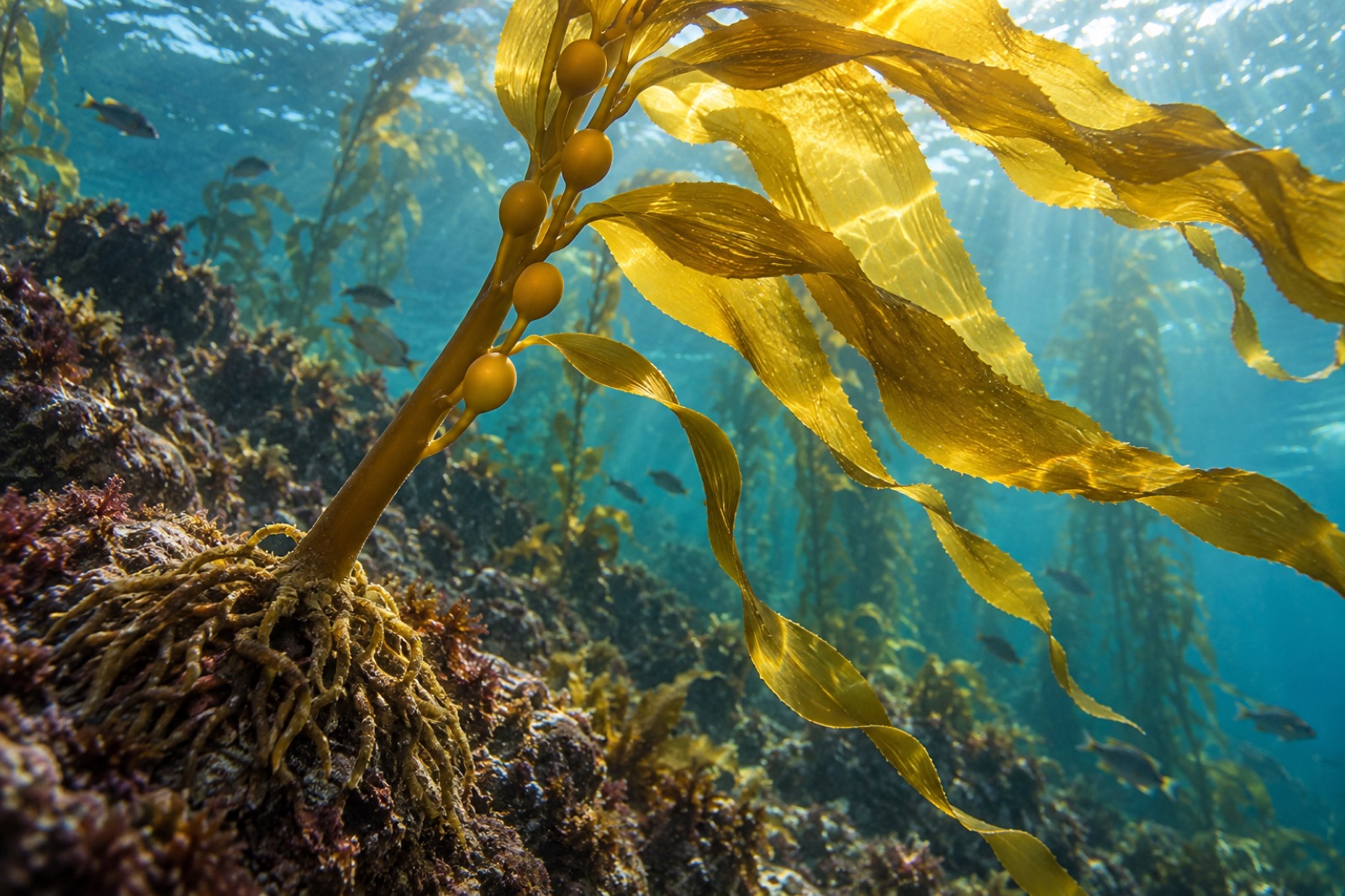
Kelp blades and stipes are built to reconfigure — to bend, fold and stream into shapes that shed force. In still water a giant kelp frond presents a broad, ruffled canopy: maximum area for gathering light. In fast flow the same frond collapses into a sleek pennant aligned with the current, with a fraction of the drag. This is textbook engineering behaviour — reconfigurable structures are how engineers now think about everything from drag-reducing coatings to adaptive offshore platforms — and kelp has been doing it for millions of years.
The material enabling it is remarkable. Kelp stipes are viscoelastic: partly springy solid, partly flowing tissue. They stretch under load, storing and dissipating energy rather than returning it in cracks. Crucially, stipe material is roughly as strong per cross-sectional area as you'd need — but its real virtue is that it fails gracefully: it stretches a long way before breaking, absorbing the snap load over distance rather than spiking it.
Trick two: the stipe as a shock absorber chain
In giant kelp, each frond is a chain: holdfast, then a long flexible stipe studded with gas-filled floats (pneumatocysts), each float carrying a blade. This architecture is elegant wave handling. The floats keep blades at the sunlit surface; the stipe segments between them are the flexible links; and the whole frond acts like a series of spring-dampers. When a surge drags the canopy seaward, the stipe pays out, decelerating the load over metres of travel instead of millimetres — the same reason climbers use dynamic rope rather than chain.
Bull kelp solves the problem differently but equivalently: one enormously extensible stipe, up to 30 metres, that stretches and sweeps in the surge like a whip carried slowly, with the heavy bulb and blades trailing at the surface where wave orbital motion has largely decayed.
Finally the holdfast — and its engineering logic is redundancy plus load distribution. Rather than one deep root, kelp uses dozens to hundreds of haptera, each individually weak, collectively strong, spreading the summed canopy load over a broad footprint of rock. Some key design properties:
- Conformal grip. Haptera grow into the rock's microtexture — pits, barnacle scars, old boreholes — locking in without boring. The attachment strength scales with substrate roughness, which is why smooth bedrock and fresh-cut quarry stone resist kelp colonisation, a fact we exploit deliberately when preparing Holdfast lines with textured, rough-spun fibre.
- Load sharing with graceful degradation. Losing haptera to limpet grazing or urchin gnawing weakens the anchor progressively, not catastrophically. Failure, when it comes, usually arrives at a predictable threshold of remaining grip area.
- Damping at the base. The holdfast yields microscopically under repeated loading, dissipating energy rather than ringing like a rigid clamp. In fatigue terms, it's the flexible head of the column.
The weak point isn't the kelp
Biomechanical studies measuring the force required to dislodge kelp keep finding the same surprising result: in many cases the holdfast is not the weak link. Plants pulled from reefs often come away with chunks of rock still in their haptera, or fail where the stipe parted midway, or where urchins had been excavating the attachment site. The true failure modes, in order of practical importance:
- Substrate failure. Soft sedimentary rock, thin crusts over sand, and urchin-excavated pits give way before the haptera do. The kelp didn't let go; its footing did.
- Grazer-assisted fatigue. urchins and limpets thinning the haptera across months, until an ordinary storm finishes the job.
- Self-pruning. Kelp shed drag by sacrificing parts: blades tear away at formed breakage zones, older fronds detach whole. Losing tissue lowers peak force on what remains — controlled failure as a survival strategy — a biological fuse.
This is why, in wave-swept habitats, you find short, thick, many-haptera kelp, while sheltered bays grow tall, slender, sparse-rooted forms of the very same species: the plant invests in anchoring in proportion to the load it expects, and pays for it in light-gathering canopy when the expected load is high.
What restoration and engineering learn from the holdfast
The biomechanics travels directly into practice. Seedstock raised for exposed sites is selected for compact, redundant holdfast development; our Holdfast lines are textured so juvenile haptera find the same micro-roughness they evolved to grip; and line geometry — the forty-degree lay our field crews swear by, described in this field note — controls how energy travels up the line when swell hits.
Beyond restoration, kelp biomechanics informs biomimetic anchors, flexible aquaculture structures, wave-energy device moorings and the design of drag-shedding surfaces. Every offshore structure that has failed by being too stiff is an argument for studying how a soft brown alga survived another winter.
Key takeaways
- Kelp survives storms not by strength but by design: reconfiguring blades, viscoelastic stipes that stretch under load, and a distributed holdfast of hundreds of weak-but-redundant haptera.
- The dangerous force is the snap load when streaming fronds go taut; stipe extensibility spreads that load like a dynamic climbing rope.
- The holdfast is often not the weak link — substrate failure and grazer-assisted fatigue cause most dislodgements, and kelp self-prunes blades to shed drag like a fuse.
- Wave exposure sculpts kelp form: exposed coasts grow short, thick, heavily anchored plants; sheltered sites, tall and slender.
- The lessons are already applied in restoration seedstock selection, seeded-line texture and lay angle — and in biomimetic offshore engineering.
FAQ
How strong is a kelp holdfast?
Attachment strengths of tens of kilograms of force for mature plants are commonly measured — far above calm-weather loads — but strength varies hugely with species, substrate and grazing damage. The design philosophy is redundancy over raw strength.
Do kelp holdfasts damage or bore into rock?
No. Haptera grip conformally, filling existing pits and texture rather than boring. This is why rough, seasoned reef colonises faster than smooth concrete or polished stone — and why textured twine works as artificial substrate.
Why do some kelp have a single disc holdfast instead of many fingers?
Different species, different solutions. Bull kelp's single disc is a broad suction-and-conformal pad suited to its long whip-stipe design; branching haptera in forest-forming kelps spread load and create the habitat labyrinth described in our holdfast biology article.
Can storms benefit kelp forests?
In moderation, yes. Moderate disturbance tears out senescent, weak or grazer-damaged plants, frees up rock for new recruitment and exports drift kelp that feeds neighbouring ecosystems. Chronic extreme storms or storms atop warming stress are the destructive pattern.
Does kelp flexibility reduce coastal wave energy?
At forest scale, yes — thousands of flexible plants streaming and dragging together measurably damp wave orbital motion. See how kelp forests calm the sea for the wave-energy side of the same physics.