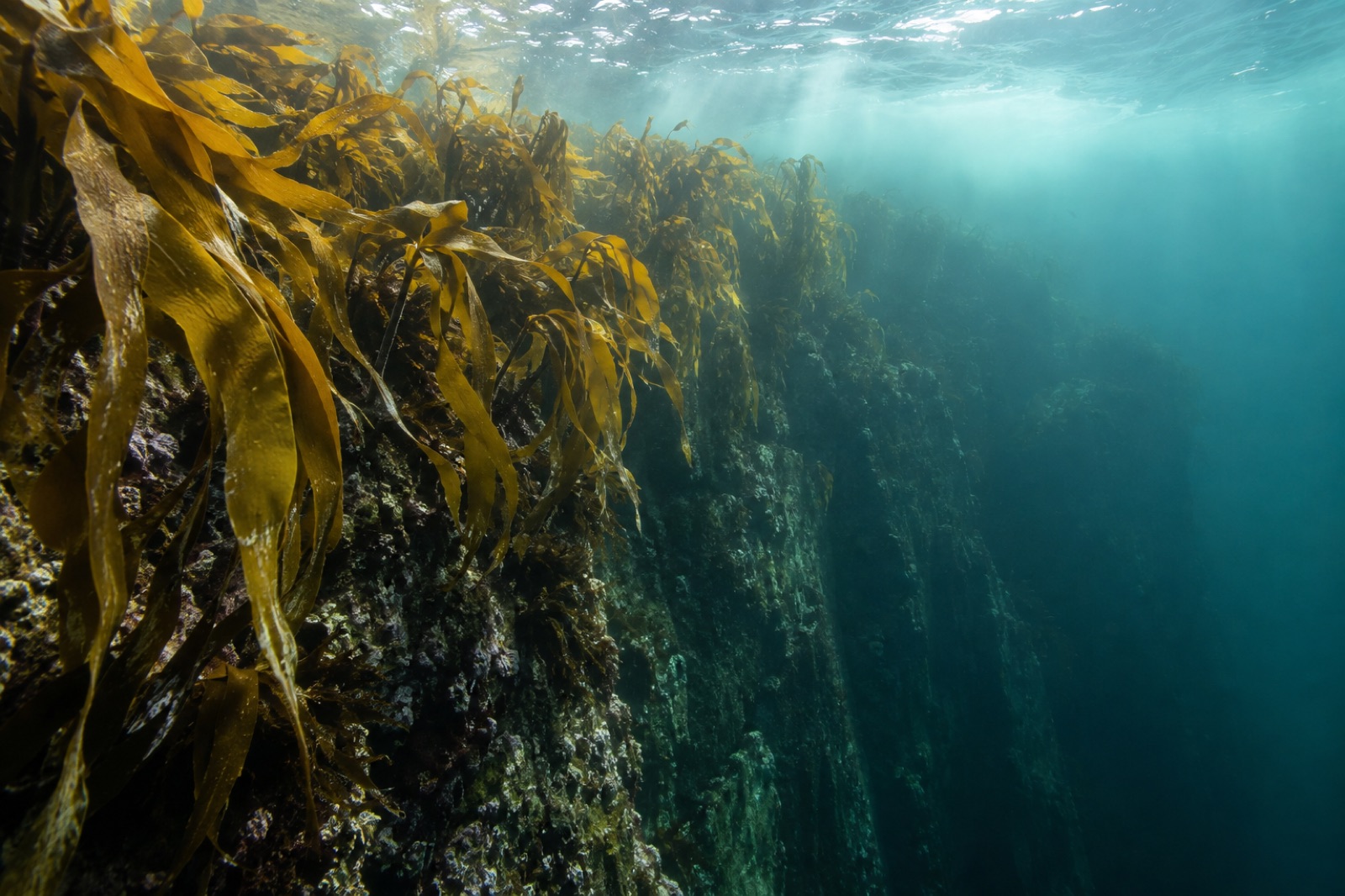
Stand on the rim of a Norwegian fjord and the numbers stop making sense at first. The water at your feet may be a kilometre deep — ten times deeper than the continental shelf just outside — yet the shoreline is only a few hundred metres across, and cliffs drop straight into the dark. Fjords are the ocean's most dramatic real estate: arms of the sea squeezed into drowned glacial valleys, walled by mountains, and sealed at the mouth by a shallow rock sill. That sill is the single feature that explains almost everything else about a fjord — its water, its oxygen, its risks, and the strange richness of the kelp forests that cling to its walls.
How glaciers carve the sea's deepest harbours
A fjord is born on land. During past ice ages, valley glaciers flowing toward the coast ground their beds downward with a pressure temperate rivers can't match. Glaciers don't stop eroding at the old shoreline — where ice was thickest, they over-deepened their valleys to depths well below sea level: 700 metres in Milford Sound (New Zealand), over 1,300 metres in Sognefjord (Norway). When the ice melted and the sea rose roughly 120 metres at the end of the last glaciation, ocean water flooded in and the valley became an estuary of stone.
The sill is the glacial signature left at the door: a shoulder of bedrock or moraine where the glacier's erosive power waned as it reached the sea, or where it dumped its rubble. Sills can be astonishingly shallow relative to the basin behind them — tens of metres deep, or occasionally only a handful. Everything landward of the sill is a giant, deep, poorly ventilated bowl.
What the sill does to the water
The sill acts like a dam on the deep part of the circulation. Above sill depth, water moves fairly freely: tides slosh in and out, wind stirs the surface, and river outflow drives an estuarine circulation — brackish water sliding seaward on top, saltier coastal water sliding landward beneath. Below sill depth, the basin water is largely cut off from the open ocean. It can stagnate there for months or even years, exchanging only in occasional deep-water renewal events.
Those renewals follow a seasonal logic in high-latitude fjords. In winter, coastal shelf water cools and becomes dense; if it grows heavier than the fjord's deep water, it pours over the sill and cascades down into the basin, lifting and replacing the old water — which spills back over the sill in turn. Some fjords renew their deep water every winter; others, with very shallow sills or heavy freshwater caps, renew only in rare, stormy years. Every renewal is a lungful of oxygen for the fjord's depths.
Between renewals, the clock runs down. Organic matter raining from the sunlit surface — plankton, fish waste, kelp detritus — decomposes in the deep basin, and decomposition consumes oxygen. In poorly flushed fjords, deep-water oxygen can fall to low (hypoxic) or even zero (anoxic) levels, sometimes with hydrogen sulphide building where sulphate-reducing microbes take over. It's the same chemistry of ocean deoxygenation playing out in miniature — and why fjords are natural laboratories for studying the low-oxygen future that parts of the open coast may face as the ocean warms.
The surface lens: fresh water over salt
The other defining layer is at the top. Rivers and, in ice-fringed fjords, glacial meltwater pour in fresh water that floats on the sea as a brackish lens, sometimes only a metre or two thick. The gradients can be extreme. In New Zealand's Fiordland, around 7 metres of annual rainfall creates a dark, tea-stained fresh layer — tannins from forest leaf litter — that sits over clear salt water and cuts the light dramatically. Divers in Milford Sound pass through this dim, cold lens and emerge below into water as clear as the open coast, where light-starved shallow depths are impoverished but deep-water emergence flourishes: black corals, sea pens and other normally deep species grow at recreational diving depths because the dark top layer mimics the twilight zone.
In Arctic and sub-Arctic fjords, the fresh lens has a seasonal pulse tied to snowmelt and glacier melt — and it's often laden with glacial flour, the fine rock silt ground by ice, which turns the water milky turquoise and starves the depths of light. Where the turbid plume meets clearer fjord water, kelp's fortunes change in a matter of kilometres.
Given all that low light and low oxygen talk, it might seem odd that fjords are among the world's great kelp habitats. But the kelp doesn't live in the deep basin or under the meltwater plume — it lives on the walls in between, and fjords hand shallow-water kelp a rare combination:
- Shelter without shallowness. Fjord walls drop steeply, so a kelp forest can occupy a vertical band from the surface down 20 metres or more along a single rock face — a depth range open coasts rarely offer in such compact form. Waves are damped inside the fjord, sparing kelp the storm-stripping that resets outer-coast forests each winter; sheltered fjord kelps grow old and large.
- Cold, stable water. The deep basin acts as a thermal battery. Even in summer, water below the sill depth stays near its winter temperature, buffering the shallows and providing refuges of cool water during warm spells — a natural form of the thermal refuge that temperate reefs need ever more often.
- Nutrient plumbing. Tidal flow squeezed over the sill generates strong, turbulent mixing — some fjord sills are famous tidal races. That mixing and the periodic deep renewals keep nutrients cycling, while the two-layer estuarine flow imports coastal water rich in whatever the shelf provides.
The result is lush, resilient forests in places like Norway's Lofoten fjords, where Tidewright runs its Lofoten sugar kelp program, British Columbia's inlets, and the sheltered inner reaches of Chile's Patagonian channels. Fjords also show kelp's limits: at the heads of glacial fjords, where meltwater plumes dominate, kelp thins and vanishes as salinity drops and light dies — a gradient that unfolds over kilometres and serves as a living diagram of what kelp needs.
Not all fjords are equal
Fjord scientists distinguish systems by what dominates them:
| Type |
Hallmark |
Example |
| River-dominated |
Strong brackish surface layer, estuarine circulation |
Many Norwegian fjords; BC inlets |
| Glacier-dominated |
Meltwater and turbid plumes, calving ice |
Greenland, Alaska, Svalbard fjords |
| Tide/renewal-dominated |
Deep sills, vigorous exchange, well-mixed basins |
Shallow-silled Scandinavian fjords |
| Rain-dominated |
Tannin-dark fresh lens, deep-water emergence |
New Zealand's Fiordland |
Latitude stacks on top of this. High-latitude fjords add sea ice and, today, fast change: Arctic fjords are shifting from ice-covered to open in summer, with consequences for everything from light to wave exposure. Howe Sound, at Vancouver's doorstep, shows the other axis of fjord drama — recovery: after decades of industrial pollution and oxygen-stressed depths, cleanup and subsiding mining impacts have let herring, salmon, dolphins and kelp return, turning it into a local emblem of how much a fjord can forgive.
Fjords as sentinels — and as lessons
Because fjords concentrate and trap change, they are early-warning systems. Warming rivers and accelerating glacier melt thicken the fresh lens and strengthen the stratification cap — the same physics described in our explainer on the ocean's hidden layers — which can make deep renewals rarer and deep-water oxygen decline faster. Salmon-farming fjords have taught hard lessons about nutrient loading on top of that natural fragility: a fjord's sill that keeps kelp water clear also keeps farm waste from dispersing.
For restoration, the message runs the other way too. A fjord's natural structure — shelter, deep cool water, nutrient exchange over the sill — is precisely the engineering a warming coast needs, and fjord forests are disproportionately valuable as genetic refuges and source populations. Mapping how each fjord's sill, rivers and renewal rhythm shape its kelp is now standard practice when we design restoration and monitoring programs on fjorded coasts, from northern Norway to Fiordland.
Key takeaways
- Fjords are drowned, over-deepened glacial valleys sealed at the mouth by a shallow rock sill — the sill governs everything that happens inside.
- Above the sill, tides and estuarine circulation move water freely; below it, deep basin water may stagnate for months or years between winter renewal events.
- Trapped organic decomposition can drive fjord deep water hypoxic or anoxic — a miniature model of global ocean deoxygenation.
- Fjord walls give kelp an unusual gift: steep, sheltered, cold-water habitat with a vertical depth range and natural thermal refugia — while glacier-fed turbidity and low salinity at fjord heads mark kelp's hard limits.
- Fjords are sentinels: stratification strengthening with warming and melt can throttle deep renewals, making these enclosed seas early indicators of changes the open coast will feel later.
FAQ
What is the difference between a fjord and a sound (or loch)?
Mostly naming traditions. "Fjord" (Norwegian origin), "sea loch" (Scotland) and "sound/fiord" (New Zealand, Chile, Alaska) can all describe drowned glacial valleys. In some regions "sound" is used for any broad inlet, glacial or not — Puget Sound, for instance, is glacially carved even if it's rarely called a fjord. The physical test is the over-deepened glacial basin with a sill.
How deep can fjords get?
Extremely. Sognefjord in Norway exceeds 1,300 metres; Chile's Messier Channel and several Patagonian fjords pass 1,200 metres; Antarctic fjords cut by outlet glaciers reach over 1,000 metres. Many are deeper than the adjacent continental shelf — the defining sign of glacial, not river, excavation.
Can fjord water run out of oxygen?
Yes — that's one of a fjord's characteristic risks. If a sill is shallow and freshwater runoff strong, deep renewal may fail for years, and decomposition then strips oxygen from the basin water. Some Scandinavian and Canadian fjords have recorded anoxic deep water; in the worst cases only microbes and sulphide-tolerant life persist until the next big renewal.
Why are fjords often turquoise or milky near glaciers?
Glaciers grind bedrock into silt-fine "glacial flour" that meltwater carries into the fjord in suspension. Those particles scatter blue-green light and block the rest, producing the opaque turquoise famous from photographs — and, underwater, a steep light gradient that determines where kelp and algae can grow.
Do kelp forests grow in Arctic fjords?
Yes — extensively. Svalbard, Greenland and northern Canadian fjords hold kelp beds that survive months of ice cover and darkness, then grow rapidly in the midnight-sun season. As sea ice retreats and melt seasons lengthen, many Arctic fjords are gaining kelp habitat — one of the few climate-driven expansions in the kelp world, even as temperate forests lose ground to heat.