Atlas7 min read
Puget Sound: Bull Kelp in the Inland Sea
Washington's inland sea shelters floating bull kelp beds that shelter salmon in return. A Coastal Atlas guide to its patchwork beds and citizen science.
Tom Okafor ·
Howe Sound recovered from a century of industrial pollution to glass sponge reefs, returning orcas and thickening bull kelp — an atlas guide to BC's comeback fjord.
Forty-five minutes from downtown Vancouver there is a fjord where glass sponges the age of empires grow in scuba depth, orcas have started hunting again, and bull kelp thickens summer by summer over reefs that fifty years ago were anoxic from pulp-mill discharge. Howe Sound — Átl'ḵa7tsem in the language of the Squamish Nation — is the southernmost fjord on the North American mainland and one of the most instructive seascapes in this atlas: a near-total industrial sacrifice zone that chose, deliberately, to come back. Understanding how it came back is a practical education in what kelp restoration asks of us.
Howe Sound runs about forty-two kilometres northwest from the Strait of Georgia to the Squamish River estuary, walled by the Coast Mountains and floored by depths past 280 metres. The winding Sea-to-Sky corridor traces its east shore through Lions Bay, Britannia Beach and Squamish; the west shore is the ferry-reached beach country of Gambier, Keats and Bowen Islands. Water is fjord water — deep, cool, stratified, with a strong estuarine lens over the Squamish plume — and the sound holds a full inner-coast ecosystem at commuting distance from a two-million-person city.
The human geography matters to the kelp geography. The Squamish Nation has held this fjord for millennia, and its title and governance shape the sound's conservation politics today. In the twentieth century the fjord absorbed the coast's heaviest industrial load: the Britannia copper mine — at its peak among the largest copper producers in the British Empire — discharged acid mine drainage into the sound for decades after its 1974 closure, and pulp and chemical loading from mills at Woodfibre and Port Mellon left bottom sediments contaminated with dioxins and metals. By the 1980s portions of the inner sound were biologically simplified in ways that looked permanent.
The turnaround was engineered, monitored and fought for — which is why it matters here. Mine-water treatment at Britannia began cutting metal loads into the sound; pulp-mill closures and effluent rules removed the chemical pressure; fishery closures rebuilt the sound's depleted rockfish; and the marine community, given room, did what marine communities do: it rebuilt. Divers began finding humpbacks inside the fjord again in the 2010s. Pacific white-sided dolphins came back in hundreds, and resident and transient orcas began reappearing — at first a news event, now a recurring one. The deeper reefs, scraped by decades of trawl and pot effort, were closed to bottom-contact fishing, and the sound's strangest residents began to re-emerge into scientific view.
In 2021 the area was designated the Átl'ḵa7tsem / Howe Sound UNESCO Biosphere Region — recognition not of pristine water but of an actively managed recovery, with the Squamish Nation at the centre of governance.
Howe Sound's deepest ecological secret is also its most astonishing. Glass sponges — animals that build skeletons of fused silica and once formed reefs across Jurassic seas — were thought extinct as reef-builders until living glass sponge reefs were discovered off northern BC in the late 1980s. Reefs in Howe Sound quickly proved to be the world's only known glass sponge reefs shallow and calm enough for divers to visit. These are true bioherms: metres-tall mounds of living sponge structure, slowly accreting over millennia, housing rockfish, crabs and the sound's recovering reef life like apartment blocks.
The sponge reefs are now protected from bottom-contact fishing within the sound's closures. They are fragile — a dropped anchor or a crab-pot drag does damage that will not repair in a human span of patience — and they are, quietly, one of the most extraordinary diving draws in the temperate world. Divers meeting a glass sponge reef at thirty-five metres often struggle to classify what they are seeing; it looks less like a sponge than like architecture.
Above the sponge reefs, the shallow rocky shelves and island fringes support the inner coast's kelp assemblage: bull kelp canopies on exposed points, sugar kelp and wing kelp in the understory, sea cabbage and acid kelp on the shallows. Bull kelp in Howe Sound is the same species that builds the beds of the Strait of Georgia's eastern boundary and the inside passages — here read against a more dramatic fjord wall, with the Squamish plume freshening the surface over it.
The kelp's recovery has tracked the sound's. Where sediment loading and industrial shade once suppressed recruitment, the forest has thickened; eelgrass beds have re-spread around estuarine edges; and the herring — whose kelp-and-eelgrass spawn drives the spring food pulse — have re-established on spawning grounds they had abandoned. The sound is not pristine and does not claim to be; what it is is functionally rebuilding, and at metropolitan distance that is the more useful model.
Howe Sound is a working dive coast, with operators, charters and shore access across it. The beginner's front door is Whytecliff Park, the marine protected shore dive near Horseshoe Bay where most Vancouver divers learn — see our full Whytecliff dive guide. Beyond it:
Practicalities are inner-coast normal: water 7–12°C most of the year — see the cold-water gear guide; plankton murk in summer, stunning winter clarity; slack-water planning on current-swept sites. Visibility will sometimes be 3 metres and sometimes 25; the season is less the calendar than the weather.
For a restoration company, Howe Sound is not a project site but a proof of concept written by time. The sequence it demonstrates — stop the loading, protect the survivors, close the damage-dealing fisheries, let the community rebuild — is the same sequence at the heart of every kelp restoration method we deploy, just exercised at fjord scale over forty years. It also demonstrates the prerequisites: Howe Sound came back because someone took effluent seriously, someone closed the bottom trawling over the sponge reefs, and the Squamish Nation insisted on permanence. Ecosystem recovery is biological, but the enabling acts are political.
The sound's remaining headwinds are the era's standard ones — marine heatwave years pressing on fjord circulation (marine heatwaves explained), legacy contaminants in sediments, development pressure at the estuary — but the trajectory is upward. If you want to show someone a kelp coast coming back, you can drive there from a city hotel before breakfast.
Yes — it is a busy recreational and dive destination, and water quality in most of the sound supports normal recreation. Shellfish closures persist in some inner areas due to legacy contamination, so check local advisories before harvesting seafood.
A bioherm built by hexactinellid sponges — animals with fused-glass skeletons — that forms mounds up to several metres tall and provides reef structure. Once common in Jurassic seas, living reefs were rediscovered in BC in the 1980s; Howe Sound's are the only known ones reachable by recreational divers.
Advanced divers with proper training, via responsible operators, with strict no-contact buoyancy discipline. The reefs are protected; damage from a fin kick or anchor takes decades to centuries to repair.
Howe Sound is the Squamish Nation's core territory — Átl'ḵa7tsem — and its title, governance and stewardship shaped the biosphere designation and the sound's recovery framework. The comeback is co-governed, not gifted.
October through April for visibility — often 15–25 metres in clear, cold water. Summer dives are warmer and plankton-thick. Either way, bring real cold-water kit.
Washington's inland sea shelters floating bull kelp beds that shelter salmon in return. A Coastal Atlas guide to its patchwork beds and citizen science.
Tom Okafor ·
Whytecliff Park is Vancouver's classic shore dive: a protected bay, a plumose-covered wall and bull kelp in Howe Sound. Full access, routes and wildlife guide.
Tom Okafor ·
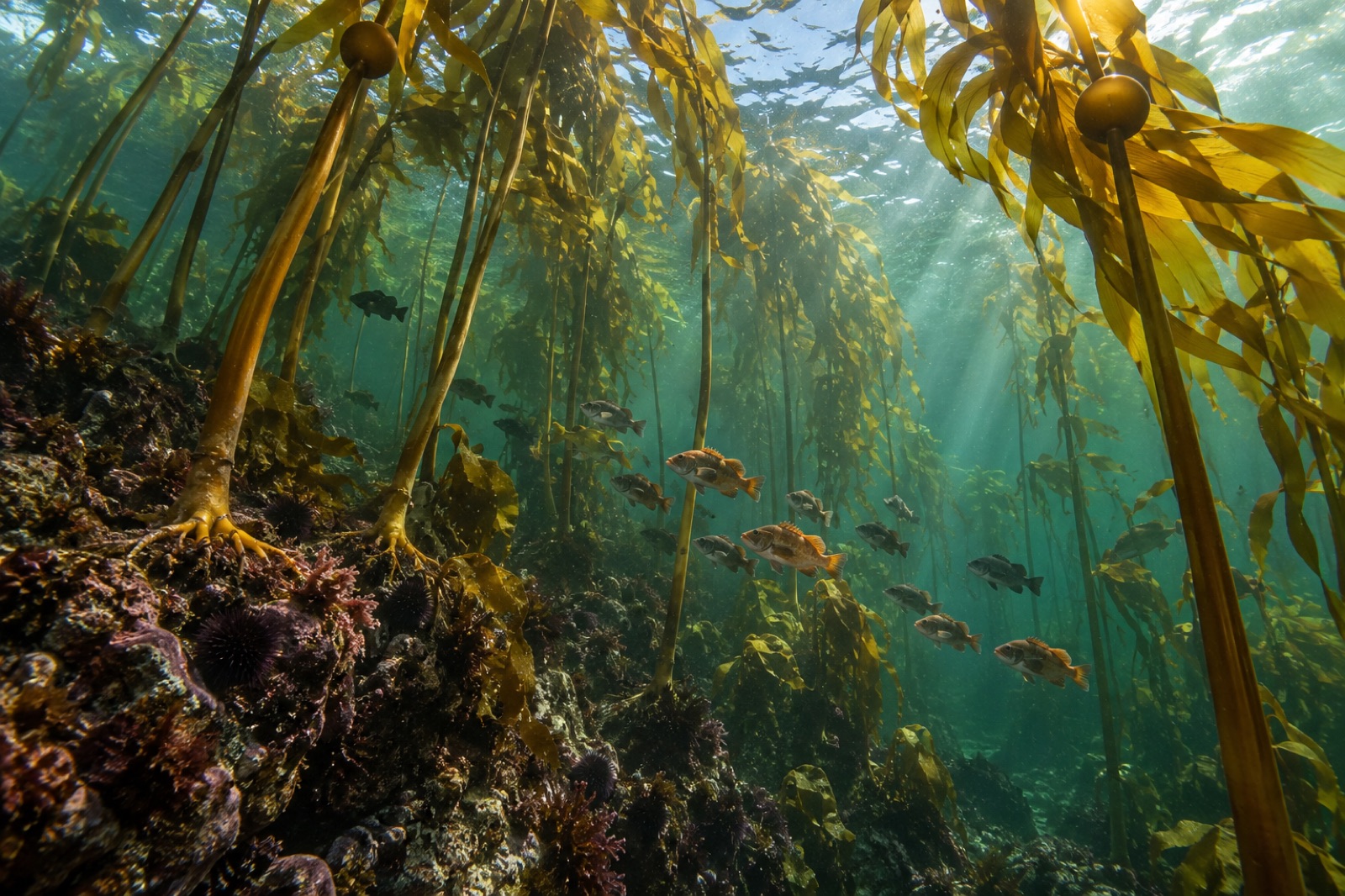
Meet bull kelp, the fast-growing annual giant of North America's Pacific coast — its biology, Indigenous heritage, dramatic decline and the race to restore it.
Dr. Mara Ellison ·