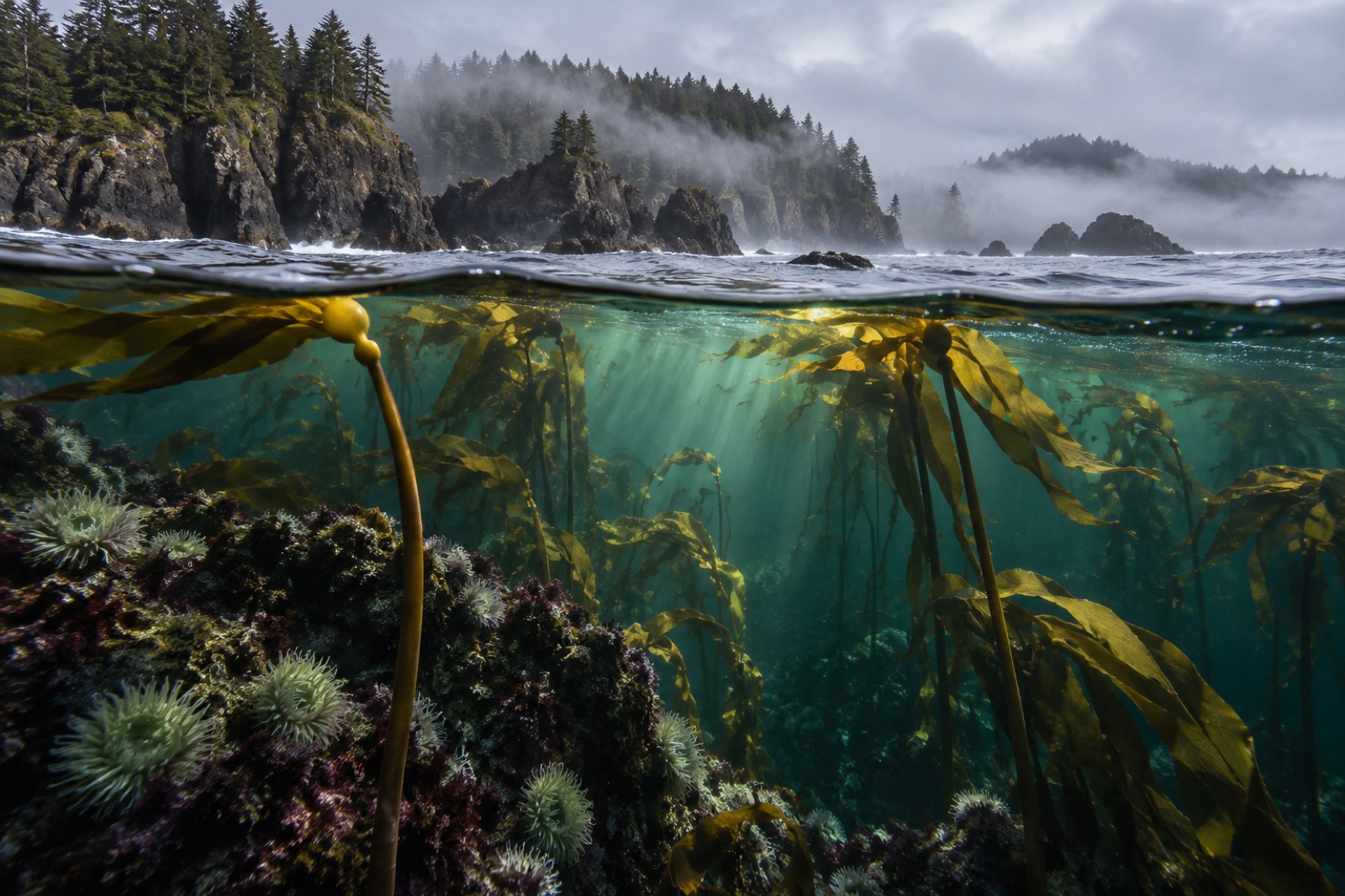
Fifteen kilometres from downtown Vancouver, at the mouth of Howe Sound, is a small rocky headland where a city keeps its wilderness within a bus ride of the office towers. Whytecliff Park — a small, protected bay, a scramble of granite points, and an offshore wall that drops beyond recreational depth — is British Columbia's most-loved shore dive, and for good reason: it is protected, accessible, and packed with cold Pacific life, on a coastline that has spent decades recovering from what industry did to it.
It is often cited as Canada's first marine protected area designation at the local level, established in the early 1990s, and the protection shows. This is a guide to diving it well.
The site at a glance
- Location: Whytecliff Park, West Vancouver, British Columbia, at the entrance to Howe Sound
- Access: Easy shore entry from the small bay; parking fills fast on summer weekends
- Depth: A gentle protected bay from the shallows; a steep wall at the outer headland descending well past 30 metres
- Conditions: Water 6–14°C by season; visibility typically 3–10 metres, best in winter and spring; mild current near the point, serious water further offshore
- Protection: The bay is a no-take area — nothing leaves the water with you except photographs
The neighbourhood: Howe Sound's slow recovery
Whytecliff is unthinkable without its setting. Howe Sound, the deep fjord on Vancouver's doorstep, endured a rough industrial century — pulp-mill effluent, copper-mine waste, spill after spill — and has spent the last few decades in an uneven, hopeful recovery. Rockfish closures, habitat restoration, and protective designations like Whytecliff's have coincided with the return of life that older divers say they never expected to see again: herring runs, dolphins, and the slow reoccupation of deep reefs by rockfish. The same recovery arc is told up the coast in our atlas entry for Vancouver Island's kelp forests, and it frames every dive here: this is a forest still growing back, and the protection around Whytecliff is part of the machinery doing it.
The three dives
The Bay
The inner bay is a classically easy Pacific Northwest shore dive: a beach entry, a sandy bottom giving way to boulders and kelp, and life that rewards slowness. Flounders hiding in the sand, crabs under kelp holdfasts, nudibranchs in the low growth. For newer divers, for check-out dives, for a first look at cold Pacific scenery, the bay is the warm-up — and often the whole dive, which is fine.
The Cut
Swim out past the day marker toward the point and the bottom simply falls away. The outer headland forms a steep, notched wall — locally called the Cut — where granite is drum-tight with giant plumose anemones, sea stars, sponges and urchins. The wall drops past recreational depth quickly, and the honest plan is an early multilevel turn: watch depth, stay shallow on the wall, and come back up the profile. It is one of the prettiest exposed-wall dives within driving distance of any Canadian city.
The islet and beyond
Whyte Islet, offshore from the bay, is connected at low tides by a rocky tombolo on land and extends underwater as structure, kelp and current. Divers who venture toward it on suitable days find more open water and more water movement — and should treat any drift toward the Queen Charlotte Channel as a signal to turn, not to follow.
The wildlife
The anemone wall is the set piece, but the residents give Whytecliff its character:
- Wolf eels in the wall's recesses — mated pairs, shy, long-suffering, and one of the great subjects of cold-water diving. Our wolf eel profile explains why they are not eels and why the pairs matter.
- Giant Pacific octopus, on lucky days, in the deeper boulders — arm span to fill a doorway, and profiled in our species encyclopedia.
- Lingcod the length of your leg wedged onto the wall, plus a supporting cast of greenlings, perch and painted greenlings.
- Bull kelp (Nereocystis luetkeana) streaming over the shoulders of the point from late spring into autumn, the seasonal roof over the whole system.
- Rockfish—quillback, copper, and on the best days an encounter that makes the recovery arc feel less theoretical.
Practical planning
- Go on a weekday if you can. Summer weekend parking at Whytecliff is a contact sport, and the calmest schedule beats the calmest water.
- Check the exchange. Whytecliff's bay is forgiving, but the point and the islet feel the tide; plan wall dives around the quieter water and treat any drift beyond the islet as a hard stop. Our guide to shore dive planning covers the framework.
- Dress for 6–10°C even in August. Below the summer thermocline the water is cold year-round; a drysuit is the default, a thick wetsuit the compromise, and our cold-water diving essentials lays out the honest gear logic.
- Mind the vis ledge. Like many inlet sites, Whytecliff's shallows can be brackish and milky after rain; a murky surface layer often clears below 5–8 metres. Descend before you judge.
- Respect the no-take rules. The bay's recovery is the reason the life is there to see.
When it's at its best
Winter and early spring bring the clearest water and the fewest people, at the price of genuinely cold air and a dark drive home. Summer offers canopy, daylight and company. The autumn in-between — kelp still up, crowds thinning, water in transition — is many locals' favourite. Whytecliff is not a destination to plan a trip around; it is a place to fold into a week in Vancouver, and to revisit season by season the way residents do.
Key takeaways
- Whytecliff Park puts a protected, no-take bay and a plumose-anemone wall within a twenty-minute shore dive of urban Vancouver — a powerful pairing of accessibility and wildness.
- The bay suits training and slow sightseeing; the Cut is the proper wall dive, to be turned early and respected at depth; the islet and channel are where current starts to matter.
- Wolf eels, giant Pacific octopus, lingcod and a recovering rockfish community are the point; the bay's protection is why they are there.
- Plan around tide, dress for real cold, and go on a weekday if you possibly can.
FAQ
Is Whytecliff really protected?
Yes — the bay is a no-take marine protected area, designated locally in the early 1990s and often described as Canada's first municipal marine protected area designation. The protection is why the anemone wall and fish life are as dense as they are.
Can a beginner dive here?
The bay is genuinely beginner-friendly under supervision, with an easy entry and benign depths. The point, the Cut and any current-exposed water beyond are for certified divers with cold-water experience.
What's the water temperature?
Roughly 6–10°C at depth for most of the year, warming a few degrees in the shallows in late summer. Divers wear drysuits for a reason; there is no warm month below the thermocline.
Is there an entry fee?
Whytecliff is a public park; diving is free, but parking is limited and intensely competitive in summer.
When is the kelp up?
Bull kelp builds through spring, sways at its fullest in summer and early autumn, and takes storm damage through winter. The anemones and fish are the year-round residents; the kelp is the canopy they live under while it lasts.