Encyclopedia9 min read
Lingcod (Ophiodon elongatus): Species Profile
The lingcod is not a cod at all — a big-headed, voracious ambush predator of Pacific kelp reefs, famous for blue-green flesh and fiercely guarded nests.
Dr. Mara Ellison ·
The wolf eel is not an eel and nothing to fear — a devoted, den-dwelling wolffish that crushes sea urchins for a living and guards its eggs for months.
Two grey heads in a boulder den, jaws like a vice, eyes that track you as you drift past: the wolf eel (Anarrhichthys ocellatus) is the face many cold-water divers remember longest. It is not, for the record, an eel — it is a wolffish, the elongated North Pacific member of a family built around crushing tools rather than chasing speed. And despite the gothic name and the dental hardware, it is one of the most docile big animals on the reef. What it is dangerous to is sea urchins — which makes the wolf eel one of the kelp forest's quiet allies. Meet the species properly.
| Scientific name | Anarrhichthys ocellatus |
| Family | Anarhichadidae (wolffishes) — not a true eel |
| Maximum size | To about 2.4 m; large adults commonly 1.2–1.8 m |
| Range | Eastern North Pacific, central California to the Aleutian Islands |
| Depth | Shallow subtidal to about 226 m; commonest in 10–70 m |
| Diet | Sea urchins, crabs, sand dollars and other hard-shelled invertebrates |
| Reproduction | Paired dens; eggs guarded by one or both parents for 3–4 months |
The name promises more menace than the animal delivers. Wolf eels belong to the Anarhichadidae, the wolffishes — a family of blunt-headed, powerful-jawed bottom fishes of cold northern seas. They are only distantly related to the true eels; the resemblance is convergence: an elongated, scaleless (or nearly scaleless) body with a long continuous dorsal fin running the length of the back, built for sliding in and out of crevices.
Adults are slate-grey, patterned with dark, pale-rimmed spots — the ocelli of the scientific name — running along the flanks. The head is blocky and expressive, the lips thick, the eyes set high. Young wolf eels look like a different species entirely: more orange-brown, pelagic, spending up to their first two years drifting in open water before settling to the reef and taking on adult grey.
A full-grown wolf eel can stretch towards 2.4 metres, which makes it among the longest resident fishes of the Pacific kelp reefs — longer than most lingcod you'll meet, though lighter and all head and muscle rather than bulk.
The wolf eel's head is a workshop. Up front, strong conical fangs grip; behind them, the jaws pave over into broad, molar-like crushing plates. The fish approaches a sea urchin or crab, takes it in, and simply crushes through the entire test or shell — spines and all — then winnows out the edible parts. There is little ceremony and no waste of effort.
That diet earns the wolf eel its ecological significance. Purple sea urchins and other grazing urchins are the inmates who can take over the asylum: when predator pressure fails and drift kelp runs short, they mobilise into grazing fronts that strip reef bare and hold it as an urchin barren. Wolf eels are among the fish predators that keep background urchin numbers in check on rocky reefs — not as powerfully as a sea otter, but steadily, den by den, reef by reef. They also take crabs, sand dollars, snails and clams, and will eat fish when the opportunity is easy.
A useful way to picture their role: wolf eels are part of the reef's standing army of hard-prey specialists, alongside sheephead, large crabs and sea stars. Remove enough of that guild — as heavy fishing pressure can — and the urchins face one less line of resistance.
If there is a single reason divers love wolf eels more than they fear them, it is the domestic life. Adult wolf eels pair up and share dens — cavity systems in rocky reef, often with a sandy floor and more than one entrance — and pairs appear to stay together for years, possibly for life. Dens are reused and defended, and a mated pair stacked side by side in the entrance is the classic wolf eel photograph.
Spawning happens in the den. The female produces a large mass of eggs — on the order of ten thousand — and winds it into a neat sphere. Then the long guard begins: one or both parents coil around or behind the egg mass, fanning and defending it for roughly three to four months. Divers frequently find a single adult (often the male) sitting sentinel while the eggs develop. The guard is attentive but rarely aggressive toward a respectful diver — the famous accounts of wolf eels biting people almost all trace back to hand-feeding, spearfished blood in the water, or a cornered animal.
When the eggs hatch, the larvae go pelagic. Juveniles ride the plankton and open water up to about two years, which is why wolf eel populations on separate reefs are demographically connected: your local den pair's offspring may settle a hundred kilometres down-current.
Wolf eels are temperate North Pacific fish: central California north through Oregon, Washington and British Columbia to the Gulf of Alaska and the Aleutian chain. They live on rocky reef from the shallow subtidal down past 200 metres, but the den-diving heartland is 10–70 metres, on reefs with good cavity structure and decent invertebrate forage — which is to say, the same terrain that holds kelp forest. The reefs off Vancouver Island and the fog-bound island chains of the Aleutians are classic wolf eel country.
They are largely sedentary as adults, holding a den and foraging its neighbourhood. Tagging and diver observation both report long-term use of the same dens, sometimes for many years.
Wolf eels are one of the great ambassador species of temperate diving: big, weird, calm and memorable. Habituated individuals at frequently dived sites will sometimes emerge from dens and approach divers — a habit built historically on hand-feeding, which is now widely discouraged. Feeding changes behaviour, teaches large predators to associate people with food, and ends badly for someone eventually. Watch, don't feed, give the den a respectful berth, never block an entrance, and the encounter will be on the animal's terms. New divers heading for cold kelp country should read our beginner's guide to kelp forest diving alongside this profile.
Threats to wolf eels are typical of long-lived reef fish: bycatch in commercial gears, occasional targeted take for the aquarium trade or meat, and the slow attrition of habitat quality. They mature late and hold small home ranges, so local populations can be thinned without obvious warning. Reef-scale protection and intact kelp forest serve them well — which is the same recipe as serves everything else in this guide.
Are wolf eels dangerous to humans? No, not in normal encounters. They are curious and placid. Bites are almost always linked to hand-feeding, spearing, or cornering the animal. Give the den space, keep your hands to yourself, and a wolf eel is a highlight, not a hazard.
Is a wolf eel actually an eel? No — it's a member of the wolffish family (Anarhichadidae). The long body and continuous dorsal fin are convergent with true eels; its nearest relatives are other blunt-headed northern bottom fish.
What do wolf eels eat? Hard-shelled prey, chiefly sea urchins, plus crabs, sand dollars, snails and clams, with occasional fish. They crush whole urchins with molar-like teeth at the back of the jaw — they are among the few fish that tackle big urchins directly.
Do wolf eels mate for life? Pairs occupy dens together for years and appear to maintain long-term, possibly lifelong bonds. Both parents may guard the egg mass; the female winds the eggs into a sphere, and the guarding period runs about three to four months until hatching.
Where can I see a wolf eel while diving? Rocky reefs and kelp country from northern California north — Puget Sound, Vancouver Island and coastal British Columbia are famous for habituated dens. Look for grey heads in large crevices with sandy floors in 10–30 metres of water.
The lingcod is not a cod at all — a big-headed, voracious ambush predator of Pacific kelp reefs, famous for blue-green flesh and fiercely guarded nests.
Dr. Mara Ellison ·
The purple sea urchin turned patches of California kelp forest into barrens. Learn its biology, its hidden hunger, and why it is both villain and victim.
Dr. Mara Ellison ·
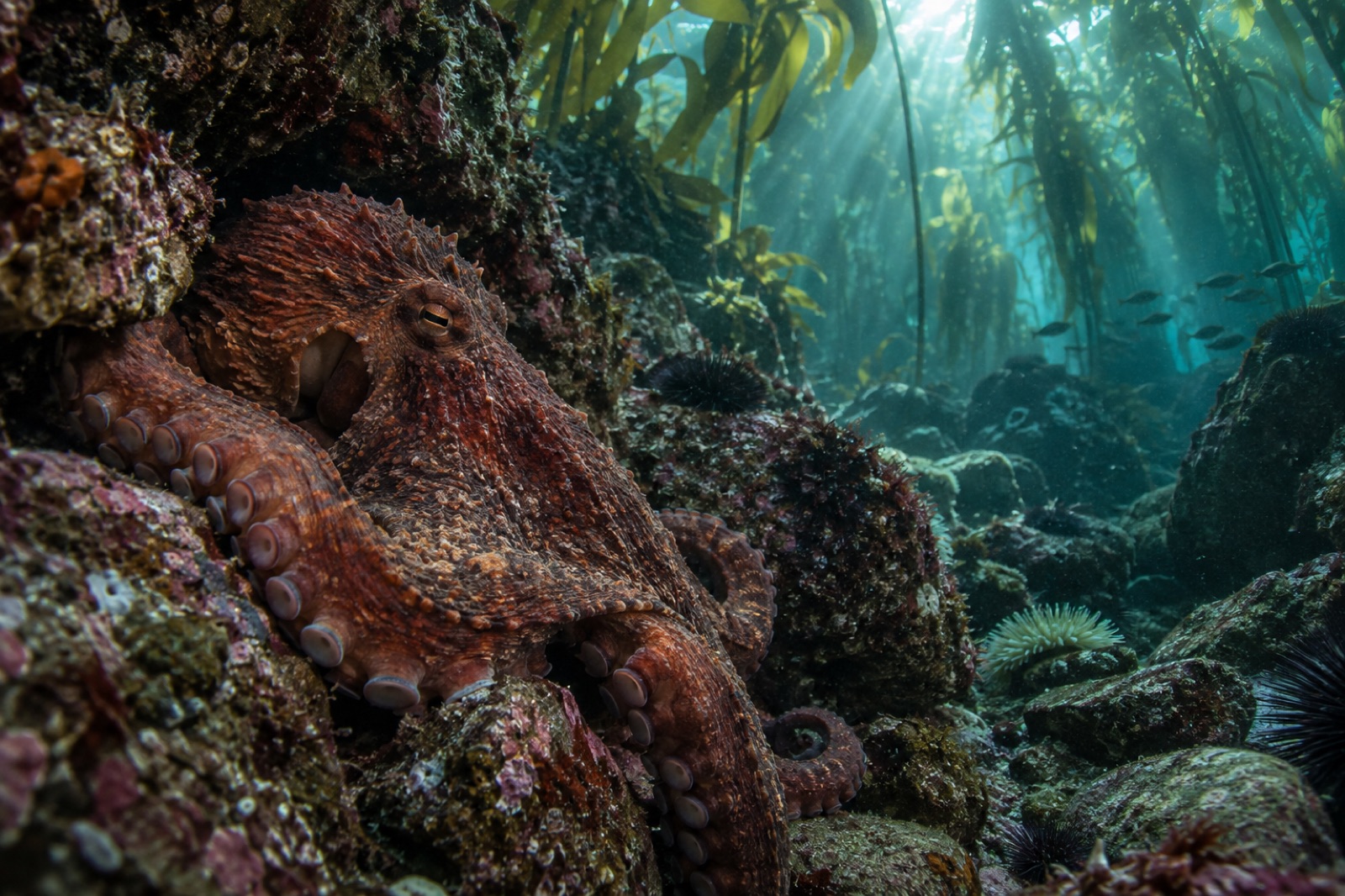
Meet the giant Pacific octopus: the world's largest octopus, a kelp-forest den-dweller with three hearts, blue blood and one shot at motherhood.
Dr. Theo Nakamura ·