Encyclopedia9 min read
Wolf Eel (Anarrhichthys ocellatus): Species Profile
The wolf eel is not an eel and nothing to fear — a devoted, den-dwelling wolffish that crushes sea urchins for a living and guards its eggs for months.
Dr. Mara Ellison ·
The lingcod is not a cod at all — a big-headed, voracious ambush predator of Pacific kelp reefs, famous for blue-green flesh and fiercely guarded nests.
Perch at the edge of a rocky reef off British Columbia or northern California and sooner or later you will notice a shape that wasn't there a moment ago resolving out of the rock: a metre of mottled, big-mouthed fish, resting on its fins like a dragon on a doorstep. That is a lingcod (Ophiodon elongatus) — despite the name, not a cod at all, but the largest member of the greenling family, and one of the most important mid-water predators of the northeast Pacific's kelp reefs. It is also a prized sport fish, a recovered conservation story, and — as any surprised cook will tell you — occasionally bright blue inside. Here is the species in full.
| Scientific name | Ophiodon elongatus |
| Family | Hexagrammidae (greenlings) — not a true cod |
| Maximum size | Females to about 1.5 m and 30+ kg; males much smaller |
| Range | Eastern North Pacific, Baja California to the Gulf of Alaska |
| Depth | Shallow subtidal to about 400 m; commonest above 100 m |
| Longevity | Commonly 15–20 years; females over 20 |
| Habitat | Rocky reefs, kelp edges and pinnacles; strong site fidelity |
| Status | Managed sport and commercial fisheries; US West Coast stock rebuilt after late-1990s overfishing |
The name is disinformation from early fishers who thought the long, tapering body looked like a ling crossed with a cod. Taxonomically the lingcod sits in the Hexagrammidae — the greenlings — a family of predatory bottom fish found only in the North Pacific. Its closest common relatives include kelp greenling and painted greenling, the small jewel-toned fish that perch on reef surfaces. The lingcod is the family scaled up to ambush-predator dimensions.
Everything behind the gills is subordinate to the head. A lingcod's head is enormous — approaching a quarter of total body length — and hinged around a cavernous mouth armed with rows of sharp, recurved teeth. The body is long, single-dorsal-finned, and mottled in brown, grey, green and rust that breaks up against rock, kelp shadow and sunlight dapple with uncanny precision.
Lingcod are classic sit-and-wait predators. Rather than cruise, they hold station on the bottom — often on a pinnacle edge or just outside a boulder — and erupt at anything edible that wanders within range. The diet reads like a roster of the rocky reef community: small rockfishes and greenlings, herring and sand lance, crabs, squid, and the occasional giant Pacific octopus — a fight that can go either way depending on size. Juveniles start on shrimp and small fish in eelgrass and sand flats before graduating to the reef.
They sit near the middle of the kelp forest food web as major consumers of forage fish, and near the bottom of someone else's menu as juveniles — marine mammals, large sharks and bigger fish all take them young. Sea lions have been observed handling adult lingcod, which says something about sea lions.
Two anatomical traits make them disproportionately effective:
A persistent share of lingcod — estimates vary by region, but commonly a fifth or more — have flesh tinted electric turquoise-blue, sometimes vivid enough to unsettle a first-time cook. The colour comes from biliverdin, a bile pigment circulating in the blood and staining the muscle. Why some fish carry elevated levels is unresolved; diet has been suspected but the evidence is inconclusive. What is settled: blue lingcod is harmless, normal-tasting, and cooks to ordinary white.
Lingcod reproduction turns the reef's usual script on its head. In winter — December to March in most of the range — mature fish move onto shallow rocky reef to spawn. Females arrive, deposit a large adhesive egg mass wedged into a current-swept crevice, and leave. The male stays. For the roughly two months until the eggs hatch, he guards the nest against a procession of egg-eating customers: rockfish, crabs, sea stars, and even his neighbours' roe-plundering cousins.
Nest-guarding males are aggressive, manageable, and — this is the fisheries problem — easy to catch. A guarding male strikes at lures to defend the nest, which is precisely when removal does the most damage: take the guardian and the nest is usually eaten within days. This is why several jurisdictions seasonally close shallow lingcod grounds during nesting, and why marine protected areas that hold big resident males punch above their area in recruitment terms. It is one of the cleaner cases for place-based fish conservation: a fish with high site fidelity, nesting in predictable spots, rewards protection that other species only marginally notice.
After hatching, the larvae ride the plankton for several months; juveniles settle into nearshore eelgrass and sand habitats, then work their way to rocky reef as they grow. Adult lingcod are homebodies — tagging studies show strong fidelity to quite small reef patches — which means a local population can be fished down reef by reef, and can likewise recover reef by reef.
Lingcod is premium table fish: firm, lean, white-fleshed, and versatile. It has supported recreational fisheries up and down the coast for over a century and has been taken commercially as both target and trawl bycatch.
The conservation history is instructive. By the late 1990s, US West Coast lingcod were declared overfished after decades of heavy trawl bycatch and sport pressure. Managers responded with a hard rebuild plan: reduced limits, depth restrictions, seasonal nesting closures and — crucially — the broad trawl-fleet rationalisation and area closures of the 2000s. The stock was declared rebuilt ahead of schedule in the mid-2000s, one of the faster turnarounds in the region. The lesson generalises: a long-lived, site-attached reef fish crashes quietly and recovers on decadal clocks, but it does recover if you ease the pressure and protect the nesters.
For divers, lingcod are one of the genuinely thrilling reef residents — big, calm and watchable if you move slowly. The kelp-fringed pinnacles off Vancouver Island and the wilderness reefs of Washington's Olympic Coast hold some of the most impressive fish in the range.
Why is some lingcod meat blue? A bile pigment called biliverdin stains the muscle of some individuals turquoise-blue. The cause of elevated levels isn't settled — diet is suspected but unproven. The colour is harmless, has no flavour of its own, and disappears when the fish is cooked.
Are lingcod good to eat? Excellent — firm, lean, mildly flavoured white flesh that suits everything from fish tacos to pan-roasting. Check local regulations first: seasons, size limits and nesting closures all apply, and in many areas you must not retain lingcod during the winter guard period.
Do lingcod really guard their nests? Yes — males, and they guard alone. After a female deposits her egg mass and departs, the male defends the nest for roughly two months until the eggs hatch, attacking intruding fish and even lures. Removing the guardian usually doom the nest, which is why seasonal closures exist.
How big do lingcod get? Females can reach around 1.5 metres and over 30 kilograms; exceptional old records run larger. Males top out much smaller, commonly under a metre. Most fish caught or seen diving are well under maximum size.
Where can divers reliably see lingcod? Cold-water rocky reefs and kelp pinnacles from northern California northward, with British Columbia and Washington especially dependable. Look for large fish resting on ledges and pinnacle edges in 10–30 metres of water, and move slowly — they'll watch you back.
The wolf eel is not an eel and nothing to fear — a devoted, den-dwelling wolffish that crushes sea urchins for a living and guards its eggs for months.
Dr. Mara Ellison ·
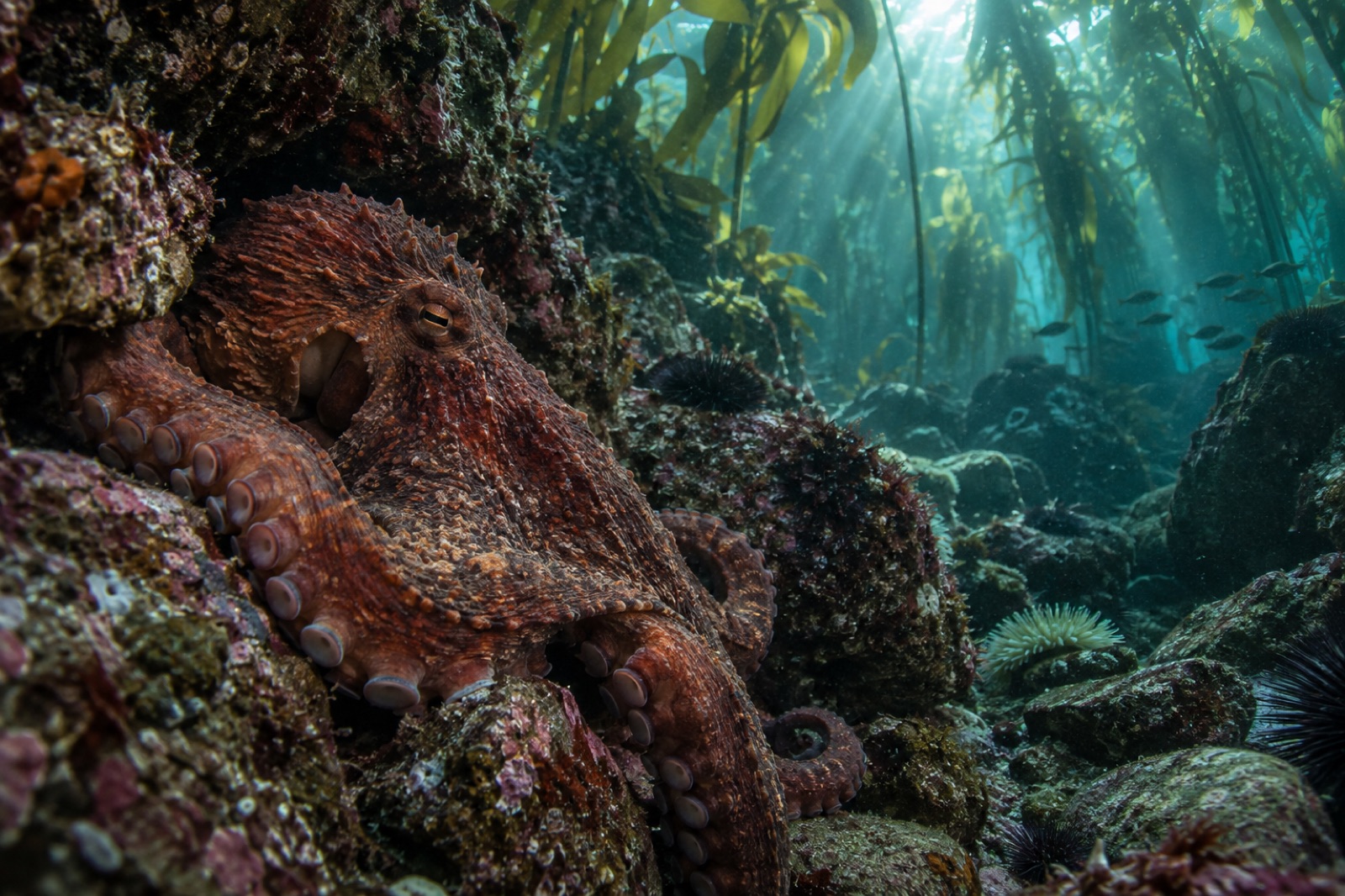
Meet the giant Pacific octopus: the world's largest octopus, a kelp-forest den-dweller with three hearts, blue blood and one shot at motherhood.
Dr. Theo Nakamura ·
The red sea urchin can live a century, grows to dinner-plate size, and feeds the uni trade. Meet the kelp forest's most venerable grazer — and its fishery.
Dr. Theo Nakamura ·