Drive US-101 as far west as it goes and the road simply gives up. West of Forks, Washington, the pavement bends inland and stays there, because ahead lies one of the longest roadless shorelines below Alaska: 135 miles (217 km) of sea stack, storm beach, tide-flat and reef running from the mouth of the Copalis River north to Cape Flattery, the northwesternmost tip of the contiguous United States. This is the Olympic Coast — most of it protected as the Olympic Coast National Marine Sanctuary at sea and Olympic National Park wilderness on land, all of it overlain by the treaty territories of four coastal Tribes. It is the least developed, and in many ways the healthiest, temperate coastline in the lower 48 states — and its kelp forests tell a story of both remarkable recovery and very recent loss.
A coast defined by what it lacks
Most American coasts are understood through their towns and roads. The Olympic Coast is understood through their absence. No continuous coastal highway ever happened here: the Olympic Mountains rise steeply just inland, snow-fed rivers run in short, violent courses to the sea, and the shoreline itself is a chaos of headlands, offshore rocks and pocket beaches that would have made road-building an engineering punishment. What development pressure never reached, wilderness survived.
The numbers speak with unusual force. The marine sanctuary — designated in 1994 — covers roughly 3,200 square miles (about 8,300 km²) of ocean from the shore out past the continental shelf. On land, some 73 miles of the coast are designated wilderness inside Olympic National Park, reachable only on foot over headland trails marked by cable-and-ladder bypasses and tide charts. Between the two jurisdictions, the entire ecotone — surf zone, kelp line, intertidal, forest — runs essentially continuous and protected. Add the tribal reservations at Neah Bay (Makah), La Push (Quileute), Hoh and Taholah (Quinault), and the governance of the coast is among the oldest continuous stewardship frameworks in the country: these Tribes hold reserved treaty rights to fishing and have co-managed sanctuary resources with the federal government from the sanctuary's beginning.
The upwelling engine
The oceanography here is the Northwest's classic pattern, running at full strength. From spring through summer, northwesterly winds drive surface water offshore and deep, cold, nutrient-charged water rises to replace it — the upwelling that makes the entire coast from Oregon to British Columbia a cold-water pantry. Here, the Juan de Fuca Eddy, a persistent counter-clockwise circulation off the strait's mouth, traps that nutrient-rich water at the coast's northern end, supercharging productivity around Cape Flattery and Tatoosh Island.
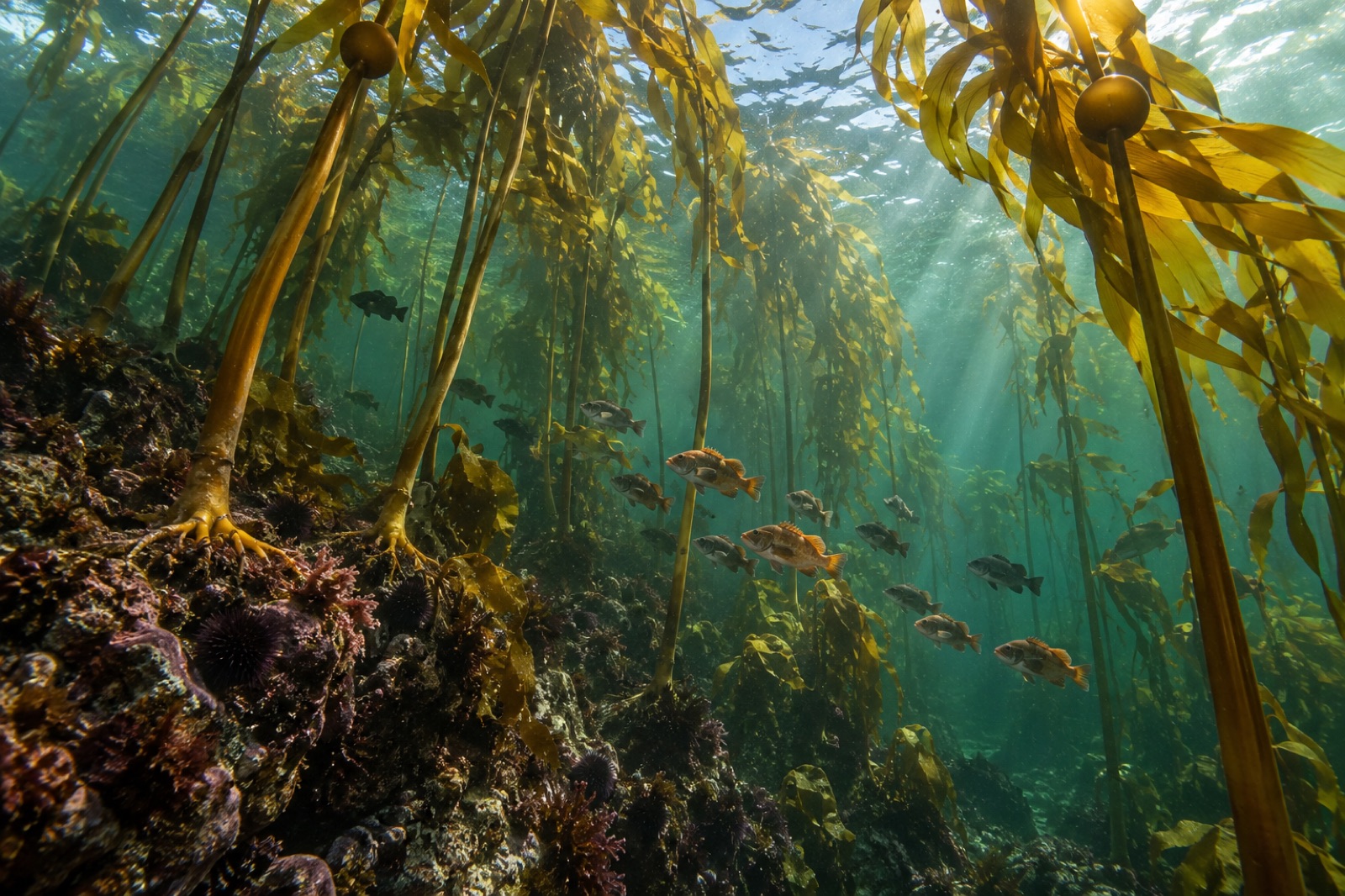
That productivity shows in the living inventory: twenty-nine species of marine mammal use the sanctuary, including grey whales on their 20,000-km migration and the seasonal return of humpbacks and orcas; offshore rocks hold some of the largest seabird colonies in the contiguous US; and the kelp beds themselves are engineered mostly by bull kelp (Nereocystis luetkeana) — the annual canopy-former whose bulb-topped stipes crown the outer reefs — over an understory of sugar kelp, sea cabbage and Laminaria species. Beneath the kelp: red and purple urchins, several rockfish species, wolf eels, giant Pacific octopus, and the near-mythical cold-water invertebrate abundance that makes this coast's intertidal zones famous among biologists.
Otters, again
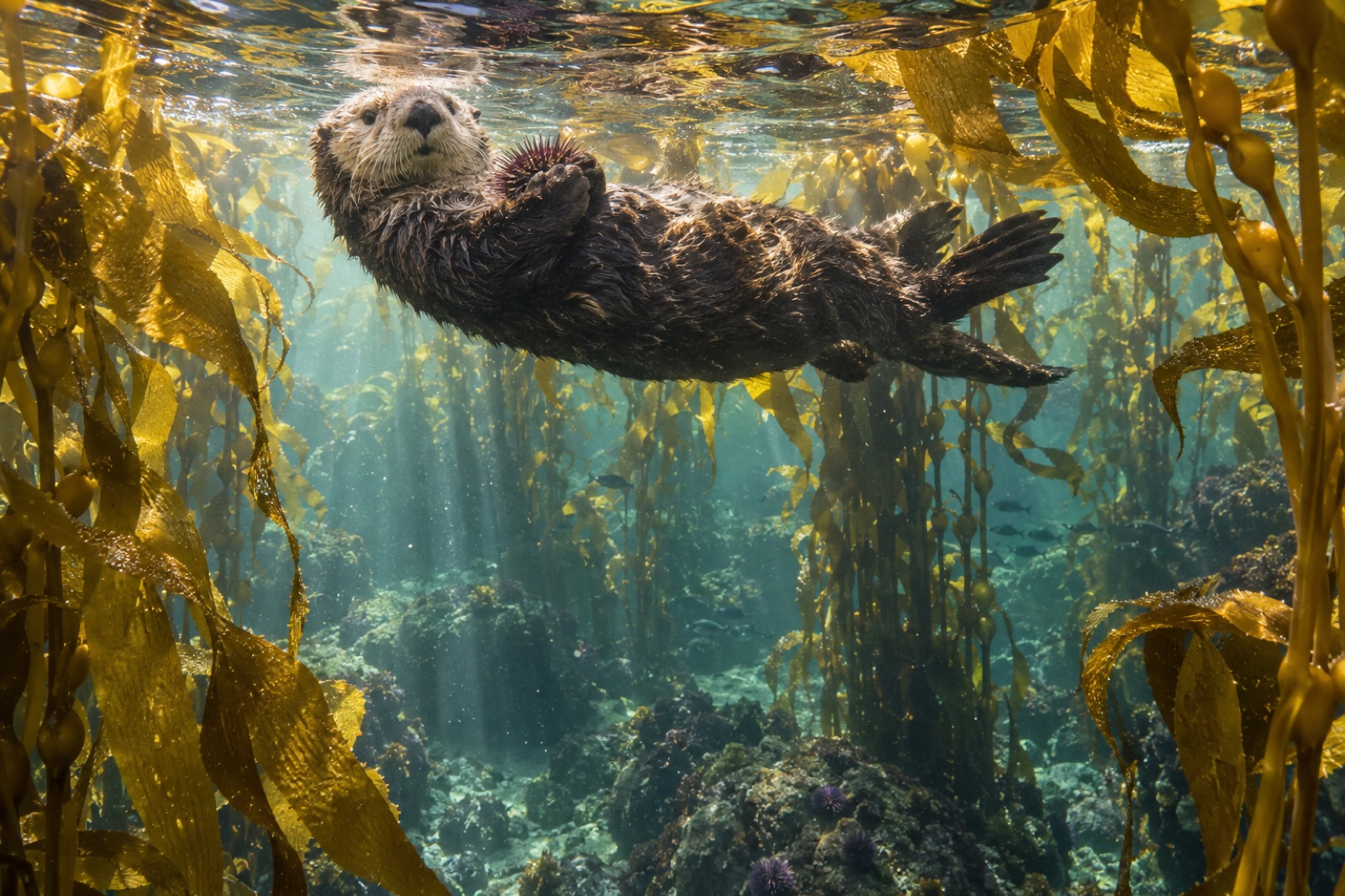
The region's signature recovery story is, once more, the sea otter. Washington's outer coast lost its otters to the fur trade in the nineteenth century; in 1969 and 1970, wildlife managers released fifty-nine Aleutian otters at La Push and Point Grenville. The population ignored its doubters, grew into the thousands and spread from the Columbia River mouth north to the strait — and everywhere it spread, the familiar cascade followed: urchin numbers suppressed, kelp canopy thickened.
The Washington case adds a scientific footnote the Aleutian story lacks. Unlike the Aleutians, where otter declines have been linked to killer whale predation, Washington's growing otter population has faced a subtler mix of limits — shark bites, disease, and the simple fact of living on a coast with more human traffic. The canopy gains are real but uneven: strong at La Push, strong around Cape Flattery, patchier between.
The starfish catastrophe
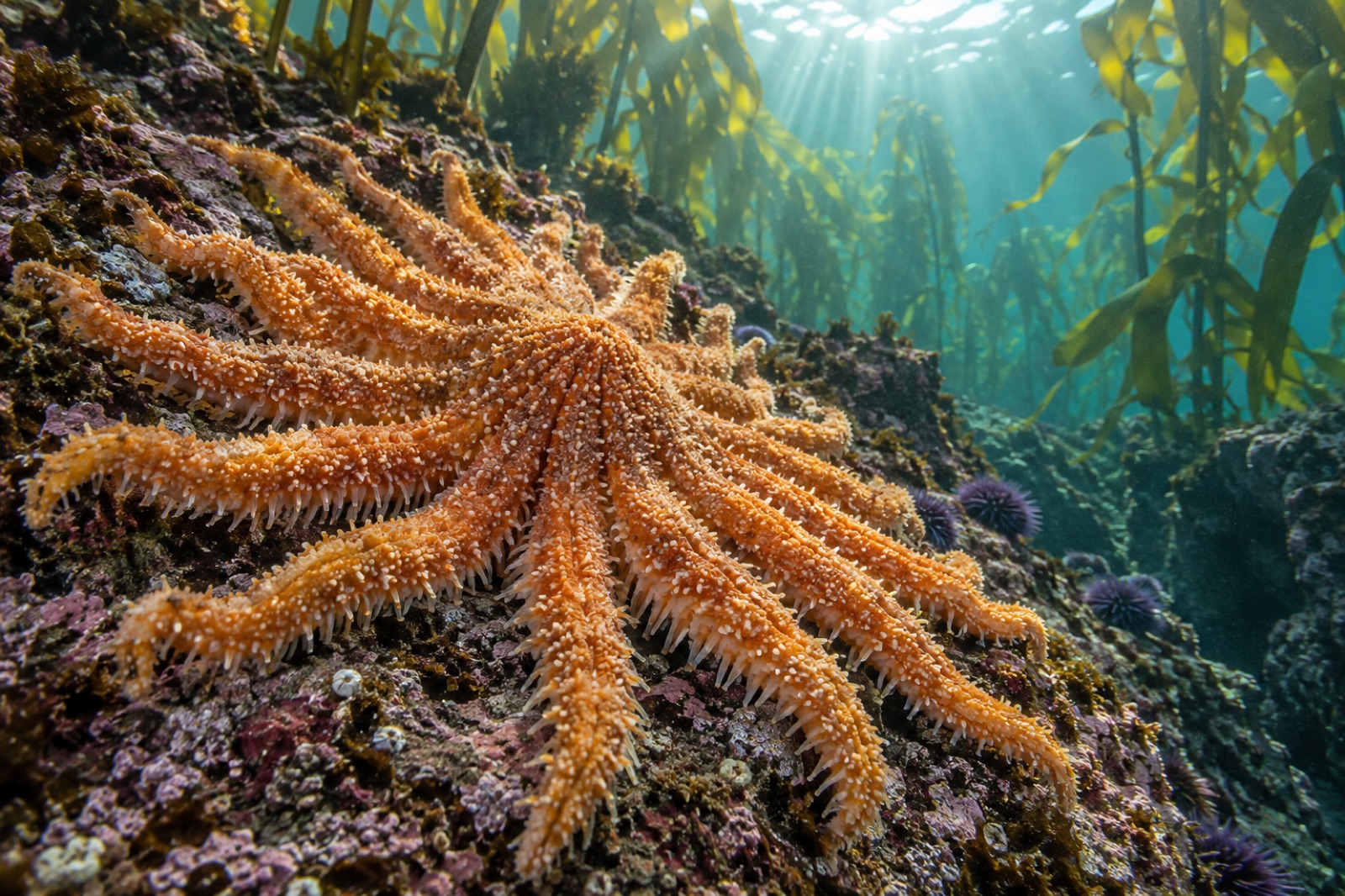
Since 2013, a second, darker story has overlain the otter recovery. Sea star wasting disease — the epidemic that killed billions of sea stars from Baja to Alaska — removed the sunflower sea star (Pycnopodia helianthoides), the coast's other great urchin predator, from nearly its entire range. On outer-coast reefs where otters are thin, the consequence is a new kind of herbivore pressure: urchin densities have risen at monitored sites, and some long-standing kelp beds on the open coast have thinned toward barren for the first time in decades.
Researchers on this coast now talk about a two-predator deficit: less otter coverage than the Aleutians model, no sunflower stars to fill the gap. It is an unusually clear demonstration that kelp forests depend on redundancy at the top of the food web — remove one predator and the other can compensate, remove both and the urchins inherit the reef. Warming water makes the problem sharper by expanding urchin activity and stressing the kelp, the same link our marine heatwave explainer walks through globally.
Visiting: the coast for walkers
The Olympic Coast's terrestrial side is the visiting experience, and it is world-class. Beach one to beach four, Shi Shi Beach and the Point of Arches, the Ozette Triangle with its Makah-carved whaling petroglyphs at Wedding Rocks, Rialto Beach's Hole-in-the-Wall arch: together these form about the finest accessible wilderness walking the country offers. Backpackers need wilderness permits, bear canisters, and tide-chart discipline — headland crossings that are pleasant walks at low tide are death traps at high.
Diving is a different matter. The outer coast is essentially undiveable in any ordinary sense: ferocious surge, cold water, no facilities, no easy entries. Realistically, the diveable margin lies around the strait-side communities — Neah Bay and Sekiu on the Makah and Clallam County coasts — where deeper lee sites hold giant plumose anemones, wolf eels, and yes, kelp, in slightly more forgiving water. This is advanced cold-water diving; read our beginner's guide and drysuit vs wetsuit notes first with honest eyes. Kayaking the wilderness coast is serious expedition paddling and equally worth planning months ahead.
Why this coast matters to restoration
For restoration practitioners, the Olympic Coast is the reference case for "protect what still works." Its comparative intactness — continuous land-sea protection, functioning tribal co-management, an otter population still expanding — is an asset that cannot be rebuilt on any budget. Its vulnerabilities — the sunflower star gap, urchin expansion, warming — are precisely the stress pattern most temperate coasts will face next decade.
Tidewright's planning for this coast follows the protect-first logic: no large reseeding programme where the forest is holding; monitoring-first partnership through Canopy Ledger; and urchin-response readiness co-designed with tribal natural-resources departments, in the same family of collaboration as our community partnerships work. The coast's lesson is one our science leads repeat often: restoration is not a substitute for keeping the forests you still have.
Key takeaways
- The Olympic Coast is the longest roadless temperate coastline below Alaska, protected end-to-end by a national marine sanctuary and national park wilderness.
- Co-management with the Makah, Quileute, Hoh and Quinault Tribes is not decoration but the operative governance — treaty rights structure every marine decision here.
- Sea otters returned from a 59-animal reintroduction in 1969–70 and now number in the thousands, thickening kelp wherever they reach.
- Sea star wasting disease removed the coast's second big urchin predator after 2013, leaving some otter-poor reefs to slip toward urchin barrens — a live demonstration that kelp needs redundant predators.
- Visitors walk, kayak and (carefully, on the strait side) dive; the outer coast itself remains a wilderness approach, not a tourist product.
FAQ
Is the Olympic Coast the same as the Olympic Coast National Marine Sanctuary?
Almost, but not exactly. "Olympic Coast" names the whole outer coast of the Olympic Peninsula from Cape Flattery south past La Push. The marine sanctuary specifically covers the ocean piece — about 8,300 km² of water from the mean high tide line seaward — while Olympic National Park's wilderness strip covers the land. Together, plus the tribal reservations, they blanket the coast.
Can you scuba dive the Olympic Coast?
Barely, on the open coast; conditionally, at the edges. The exposed shore has too much surge and too few access points for ordinary diving. Strait-adjacent sites around Neah Bay and Sekiu offer real diving in proper lee conditions — advanced cold-water terrain, requiring solid skills and local advice. Most visiting divers treat the Olympic Coast as a world-class walking and wildlife-watching coast that has some diving attached, not the other way around.
What is the status of sea otters there?
Growing but uneven. From fifty-nine animals reintroduced in 1969–70, the population has climbed into the low thousands and spread along most of the coast. Researchers track its southward progress closely; expansion toward Oregon is expected but slow. The key local question is which reef segments get otters soon enough to hold off expanding urchin fronts.
Why did sea star wasting matter so much here?
Because it removed the backup predator. The sunflower sea star was a ferocious urchin hunter; once wasting disease crashed it, the only remaining urchin control on many outer-coast reefs was the still-patchy otter population. Urchin numbers climbed where otters were absent, and several long-monitored kelp beds have thinned or paled toward barren. Monitoring continues, and conservation groups are now exploring captive-rearing and reintroduction for the sunflower star itself.
When is the best time to hike it?
Late spring through early autumn offers the most benign conditions, but summer fog, cold and rain are year-round possibilities — this is a coast that receives metres of precipitation annually. Shoulder seasons can be sublime if you accept weather risk. Any season demands tide charts, wilderness permits in summer, bear canisters and equipment for wet scrambling over headland trails.