The red sea urchin (Mesocentrotus franciscanus) is the heavyweight of the Pacific kelp forest floor: a deep-crimson urchin the size of a dinner plate, capable of living longer than almost any other animal you will meet on a reef. It feeds one of the most valuable dive fisheries on the west coast of North America, and it plays a complicated double role in kelp ecology — sometimes the forest's clean-up crew, sometimes its undoing. If the purple sea urchin is the story of a barren, the red urchin is the story of longevity, value and what careful management can look like.
Fast facts
|
|
| Scientific name |
Mesocentrotus franciscanus (formerly Strongylocentrotus franciscanus) |
| Group |
Echinoderm, class Echinoidea |
| Test diameter |
Commonly 10–15 cm; exceptional individuals approach 19 cm |
| Lifespan |
Routinely several decades; some individuals estimated at 100+ years |
| Depth range |
Intertidal shallows to about 90 m; densest in 15–60 m |
| Range |
Eastern Pacific, from Alaska to Baja California |
| Market |
Roe (gonad) sold as uni; among California's more valuable fisheries |
Built for the long haul
Everything about the red urchin suggests patience. Its spines, brick-red to burgundy, can reach seven centimetres — long enough that a resting urchin looks like a crimson pincushion. Growth is quick in youth and then slows to a crawl; a big red urchin may add barely a millimetre of test diameter a year. Age validation studies, using chemical markers and the growth rings laid down in the urchin's jaw plates, indicate that large animals can be many decades old, with some individuals plausibly exceeding a century. They appear to show negligible senescence: old urchins keep growing, keep reproducing, and do so at least as vigorously as young ones.
This longevity matters for the fishery and for the reef. A red urchin is not an annual crop; it is closer to old-growth bycatch than to a scallop. Removing a ten-centimetre urchin removes decades of accumulated life — and a large breeder.
The uni fishery
Red urchin roe — five tongues of golden-orange gonad arranged symmetrically inside the test — is one of the great delicacies of Japanese cuisine, and the north Pacific fishery grew up almost entirely to serve it. California's fishery expanded rapidly in the 1980s and 1990s as markets in Japan absorbed essentially everything divers could land.
The fishery works like this:
- Divers work from small boats, hand-collecting urchins one by one with a small rake into mesh bags. There is no dragging, no nets, almost no bycatch.
- Size limits set a minimum (and in some areas a maximum below which breeding-size animals are protected), and seasons run outside key spawning periods.
- Processors crack the tests, extract and grade the roe — colour, texture and sweetness determine price — and pack it for air freight.
The diver-harvest model makes this one of the lower-impact commercial fisheries anywhere. The pressure points are subtler: serial depletion of easy shallow reefs, the temptation to fish the largest, most fecund animals, and — above all — the ecological background. A fishery that cleans urchins off kelp forest margins can actively benefit the forest; a fishery that is the only thing controlling urchins is a fragile arrangement. Tidewright works with dive fleets in exactly this space through its Reef Partners programs, aligning harvest with reef management.
Forest floor ecology
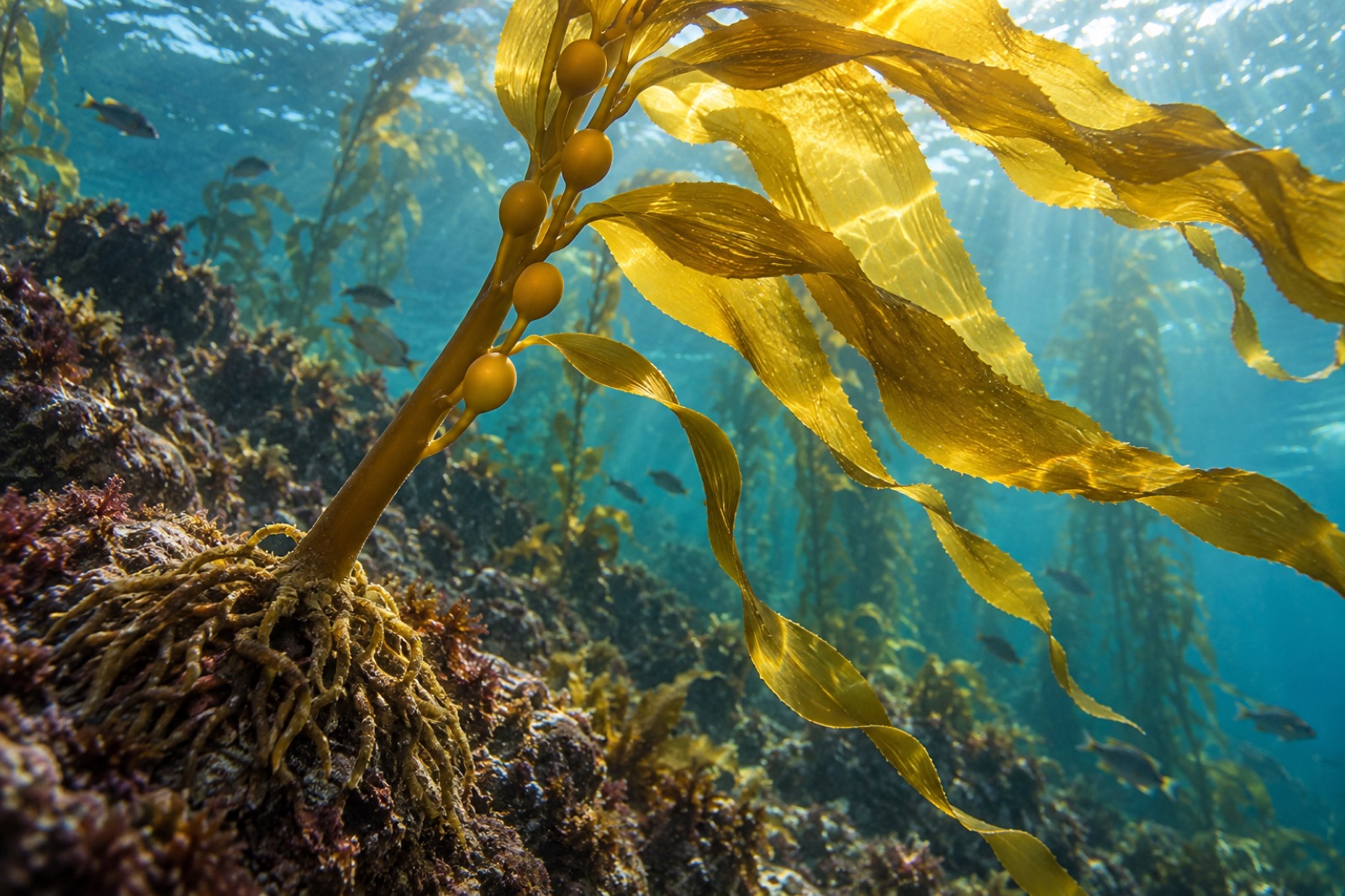
In a healthy forest, red urchins do what purple urchins do: park in crevices and catch drift kelp — the storm-torn blade litter that rains down from the canopy. Kelp-detritus feeding keeps them fat; their gonads swell with the seasons, and they are model citizens.
The problem comes when drift kelp runs out. Red urchins will then form grazing fronts just like purples, advancing across reef and consuming young kelp as it recruits. On the southern California coast in warmer decades, red urchin fronts contributed to kelp losses; in northern California's recent crisis, the smaller, faster-multiplying purple urchin did most of the barren-building while the reds — commercially worth pulling — were swept from accessible reef.
Two nuances are worth holding onto:
- Urchins can be a symptom, not just a cause. Heatwaves that disperse drift kelp also push urchins into grazing mode; the marine heatwave phenomenon is usually the deeper driver.
- Barren reds still have value. A red urchin in a barren keeps growing and can be worth collecting, where a starved purple is not — which makes red urchin harvest a genuinely useful management lever on some reefs.
Reproduction and the larvae lottery
Red urchins spawn in early spring. Females broadcast millions of eggs; fertilisation is external; the larvae — tiny, glassy plutei — drift in the plankton for one to three months before settling onto reef and metamorphosing. That long larval ride is both a strength and a lottery: it can connect reefs hundreds of kilometres apart, but recruitment is wildly variable year to year, pinned to currents, temperature and food in the plankton.
For restoration programs, this matters practically: a reef cleared of urchin fronts will often be re-seeded naturally by drifting kelp spores, but urchin recruitment returns too — which is why one-off removals rarely hold. Sustainable recovery pairs removal with monitoring, predator support and, where natural kelp spore supply is poor, active reseeding like Tidewright's Holdfast nursery lines.
Key takeaways
- The red sea urchin is the largest common urchin of the northeast Pacific and one of the longest-lived animals on the reef — over a century for some individuals.
- Its roe supports a valuable, low-impact dive fishery in which divers hand-collect urchins for the uni market.
- Red urchins are beneficial drift-feeders in healthy forests but can form grazing fronts that prevent kelp recovery when food runs short.
- Unlike the purple urchin, reds retain commercial value even on barrens, making harvest a practical management tool.
- Long life and late maturity mean sustainable management must protect large breeders and respect decades-long timescales.
FAQ
How long do red sea urchins live?
Growth studies and isotope dating indicate many decades is routine, with large individuals plausibly older than 100 years. Unlike most animals, they show few signs of ageing — reproduction continues late in life. Exact maximum age is debated, which is part of why conservative management matters.
Is the red urchin fishery sustainable?
It is one of the cleaner fisheries: hand-harvest by divers, essentially no bycatch, no seafloor damage. Sustainability depends on enforcement of size limits and restraint on serial fishing-down of shallow reefs. Several management areas in California and British Columbia use additional tools like limited entry and spatial closures.
Do red sea urchins destroy kelp forests?
Under food shortage they can — red urchin fronts have contributed to barrens in southern California. But in the recent northern California collapse the purple urchin was the dominant grazer. Red urchins more often sit at the forest margin, where their harvest can actually help keep balance.
What eats red sea urchins?
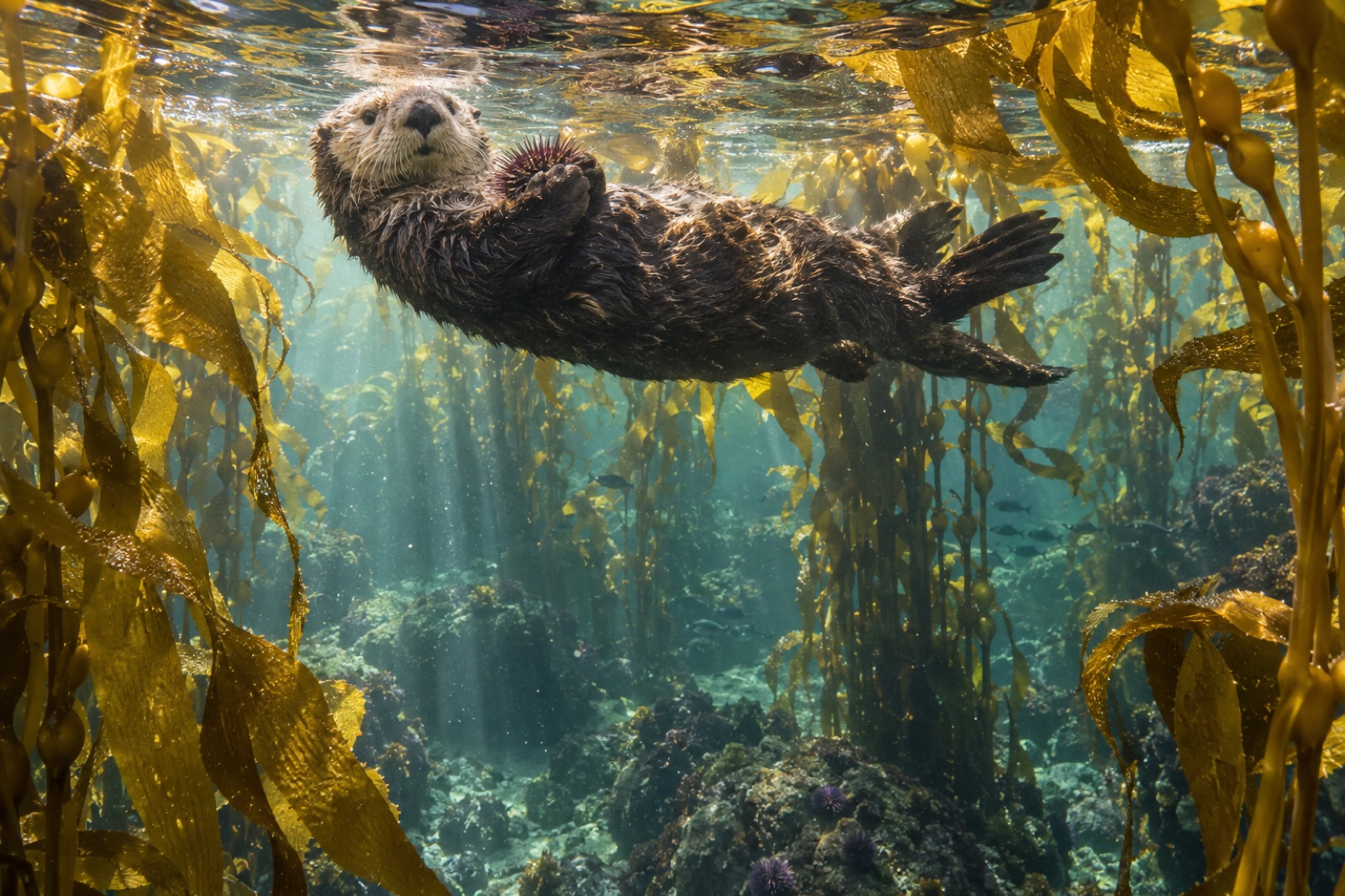
Sea otters take large numbers, and the (now endangered in places) sunflower sea star was once a major predator. Cabezon, California sheephead, and large rock lobster also prey on them. Protecting these predators is part of kelp forest restoration — see our sea otter profile.
Why is red urchin roe so expensive?
Supply is diver-limited and quality is graded ruthlessly: only bright, firm, sweet gonads make top uni prices. Air freight to Asia adds cost. Prices also rise when competing sources — Chile, Hokkaido, Russia — have weak seasons. Our kitchen cluster covers how to buy and eat uni well.