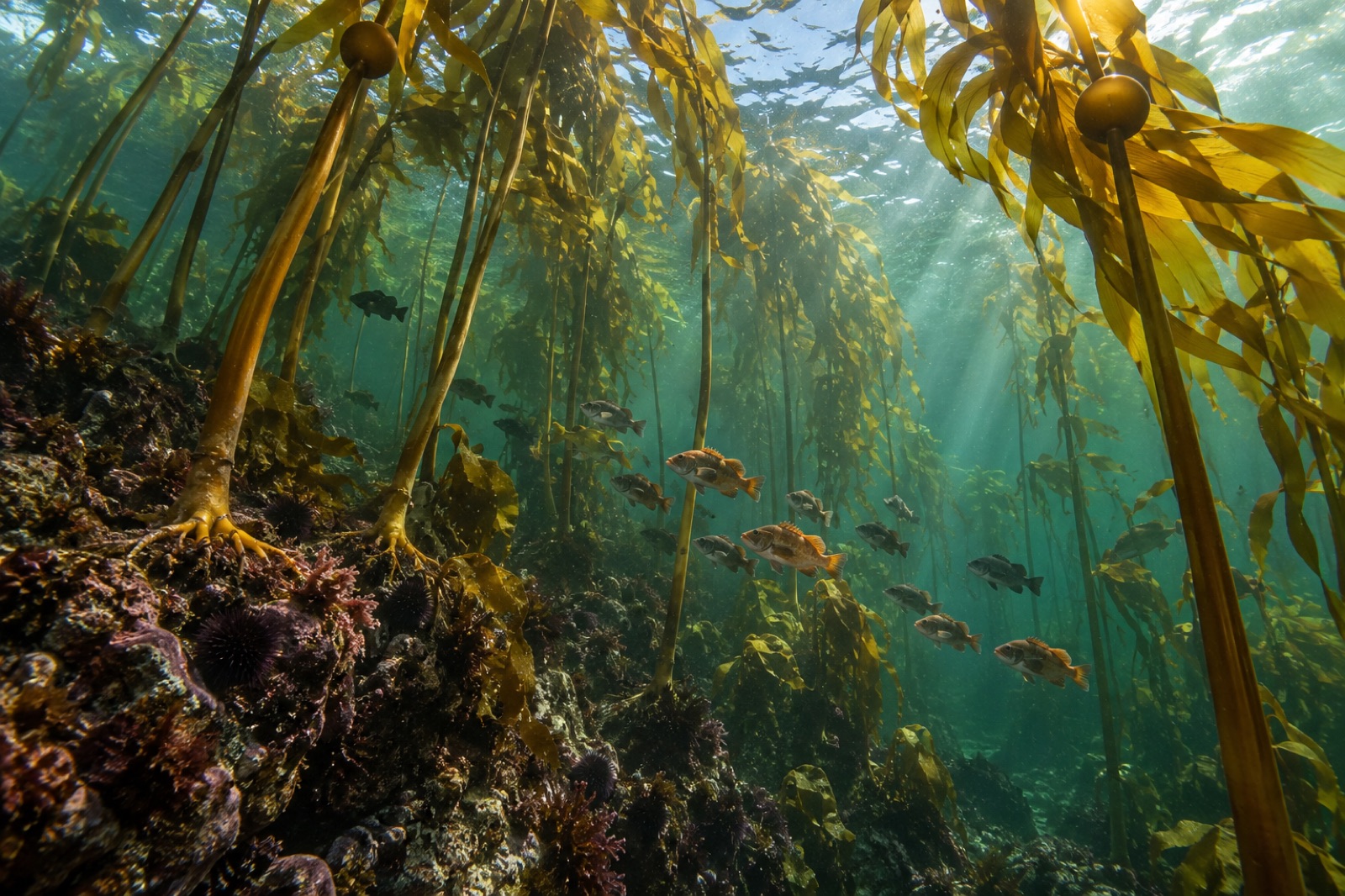
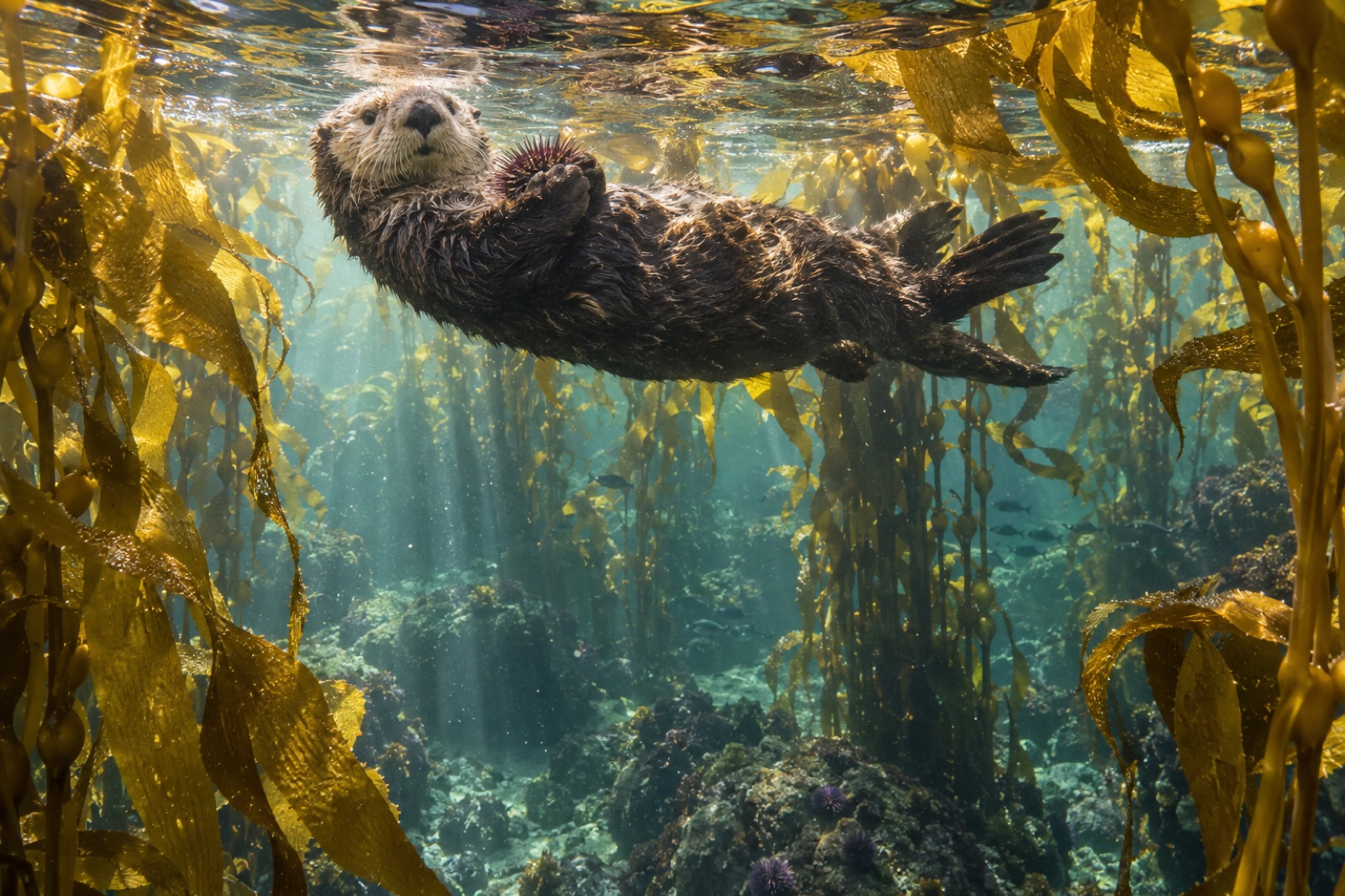
The west coast of Vancouver Island is where the North Pacific finally makes landfall. For thousands of kilometres of unobstructed fetch, swell builds and rolls east until it strikes this coast — a ragged margin of headlands, tomb-like beaches, carved sea caves and, offshore, reefs furred with kelp. Between the storm-battered outer shore and the calmer fjords of the island's protected east side lies one of the most studied, most recovered and most liveable kelp coastlines in North America. If you are going to learn one Pacific kelp coast in depth, learn this one.
The lay of the coast
Vancouver Island stretches roughly 460 kilometres, but its west coast is three times that long by the time you trace the convolutions. Two great indentations dominate the southern half: Barkley Sound, studded with the hundred-odd islets of the Broken Group, and Clayoquot Sound, a UNESCO Biosphere Reserve of fjords, old-growth islands and surf beaches. Between them, the Long Beach Unit of Pacific Rim National Park Reserve and the harbour towns of Ucluelet and Tofino give the coast its human anchors. Farther north, the settlement thins out into true wilderness: Nootka Sound, Kyuquot Sound, and ultimately the unsheltered reefs off Cape Scott at the island's northwest tip.
The oceanography is the signature. The island sits astride one of the classic upwelling systems of the Northeast Pacific: in summer, northwesterly winds drive surface water offshore and deep, cold, nutrient-loaded water wells up along the shelf break. That upwelled water is kelp fertiliser — and also fog. The west coast's famous marine layer is the sound of all that cold water meeting warm summer air. Water temperatures run a bracing 7–14°C through the year; visibility, when the plankton settles, can be superb.
The kelp: two species, two architectures
West-coast kelp comes in two structurally different packages:
- Bull kelp (Nereocystis luetkeana) — the exposed-coast champion. A single bulb-topped stipe up to twenty metres long, topped with blades like braided whips, bull kelp forms the classic surface-canopy beds that stitch the outer reefs. It is an annual, rebuilt from spores every spring, and its beds are the first thing a swell-driven diver notices: predatory currents threading gold-brown columns toward the light.
- Giant kelp (Macrocystis pyrifera) — in more sheltered pockets of Barkley and Clayoquot Sounds, the same species that builds California's forests persists at the northern edge of its range, laying perennial, many-layered canopies in water that almost never climbs above the mid-teens.
Between and beneath the large species spreads an understory of sugar kelp, sea cabbage, feather boa kelp and a dozen reds — the structural diversity that turns a kelp bed into a kelp forest. Juvenile rockfish, herring, salmon smolts, greenling and kelp crabs move through that architecture; harbour seals, river otters and the coast's famously resilient grey whales patrol its edges.
Bamfield: the science capital of a small coast
For a coast with only a few thousand permanent residents, the Westside has produced an outsized share of Canada's marine science. The reason is Bamfield, a boardwalk fishing village at the mouth of Barkley Sound, and the Bamfield Marine Sciences Centre sitting beside it. Since the early 1970s the station has trained generations of Canadian marine biologists and hosted long-running studies of kelp forest ecology, sea otter recovery, rockfish populations and the physical oceanography of the shelf.
That presence matters for a visitor too. The science community's presence means the kelp beds of Barkley Sound are among the best-documented anywhere; long-term monitoring diver-surveys mean that when a heatwave year like the Northeast Pacific's 2014–2016 warm "Blob" pulses through, the changes here are measured rather than guessed. Research from this coast — including work on how marine heatwaves thin kelp canopies and shift species — underpins the same understanding our science hub summarises in the marine heatwaves explainer.
The otters came back — and the coast changed
The signature ecological event of the modern west coast is the return of the sea otter. Hunted out of British Columbia in the nineteenth-century fur trade, otters were reintroduced to the island's northwest in 1969–1972 — eighty-nine animals moved from Amchitka in the Aleutians. From that seed the population has grown into the thousands and spread steadily down the coast.
What followed is the trophic cascade, live and measurable. As otters re-occupied reef after reef, sea urchin numbers fell, and kelp — suppressed for a century by urchin grazing — thickened back into canopy. Fish prospered in the rebuilt structure. The flip side of the story is equally real: otters eat the sea urchins, crabs and clams that Indigenous communities and commercial fishers harvest, and the "sea otter debate" on this coast is one of the most honest, difficult conversations in conservation. Nuu-chah-nulth Nations — Huu-ay-aht, Ucluelet, Tseshaht, Toquaht, Hesquiaht and their neighbours — hold constitutionally recognised rights to those fisheries, and coast management increasingly runs through co-governance that treats otters, shellfish and people as a single system to be negotiated rather than a winner to be picked.
For the wider world, the lesson is durable: recover a predator and you recover a forest, but you also inherit hard distributional questions. Trophic cascades are ecology, economics and diplomacy in one.
The coast as a working landscape
The west coast is not a postcard preserve; it works. Salmon and herring fisheries, shellfish aquaculture, a growing kelp-farming sector (sugar kelp and bull kelp aquaculture trials run in Barkley and Clayoquot waters), and one of Canada's highest-value surf-and-ecotourism economies all share this water. Forestry shaped the twentieth-century conflicts here — Clayoquot Sound's 1993 protests remain the largest act of civil disobedience in Canadian history — and that history left an unusually mature culture of negotiation between industry, First Nations and conservation.
That is precisely the soil restoration projects need: real stakeholders, real science, real governance. Tidewright's BC programme development looks closely at this coast as a reference for how community and Indigenous partnerships can structure restoration work — benefit-sharing, ranger-led monitoring, and Canopy Ledger verification that communities can audit themselves.
Diving and visiting
The west coast is genuinely diveable — one of the few wilderness kelp coasts in the world where you can drive in, gear up and drop into bull kelp off the rocks. Favoured sites sit around Ucluelet's headlands and the protected coves near Bamfield, where leopard-dappled sunlight falls through bull kelp columns onto plumose anemones, wolf eels and octopus dens. Conditions demand respect: cold water year-round, surge on any swell, and visibility that thrives in winter and dies in summer plankton blooms. New to cold water? Read our beginner's guide to kelp forest diving and drysuit vs wetsuit comparison before you commit.
Above water, the coast offers the West Coast Trail and Broken Group kayaking for the committed, storm-watching off-season for the contemplative, and some of the finest cold-water surfing in North America. Tofino has the accommodation; Ucluelet has the same reefs with fewer crowds; Bamfield has the rawest version of it all, reachable only by gravel logging road or by boat.
Key takeaways
- Vancouver Island's west coast is a textbook upwelling coast: cold, foggy, nutrient-rich, and therefore one of the most naturally productive kelp habitats on the continent.
- Bull kelp dominates the exposed outer reefs; giant kelp persists in sheltered sounds; the mix creates some of the widest structural diversity in Northeast Pacific kelp.
- Sea otter reintroduction since 1969 has restored the otter–urchin–kelp cascade here in real time — a conservation triumph entangled with legitimate shellfish-fishery conflicts that Nuu-chah-nulth co-governance is actively mediating.
- Bamfield's research station makes this one of the best-monitored kelp coasts on Earth, so change is measured, not argued about.
- It is both a working coast (fisheries, aquaculture, tourism) and a wilderness — and that combination is what makes it a template for restoration economies elsewhere.
FAQ
When is the best time to dive Vancouver Island's west coast?
For visibility, late autumn through early spring is the window: winter storms place a premium on flexibility, but between systems the water can clear to 20 metres or more, and the kelp beds look their most sculptural. Summer brings calmer seas, longer days and heavy plankton bloom — murkier water but a livelier surface skin. Cold is a constant; a drysuit or serious 7 mm wetsuit is not optional.
Can you surf and dive on the same trip?
Yes — the coast is unusual in offering both within minutes of each other. Surf beaches like Long Beach, Cox Bay and Chesterman's pick up swell year-round (it's Tofino's signature industry), while protected coves and leeward reefs shelter the diving. Many divers time a swell-window day for diving, a swell day for surfing, and let the Pacific's mood dictate the order.
How has the sea otter return affected the kelp here?
Profoundly. Since reintroduction in 1969–1972, otters have suppressed urchin grazing along more of the coast each decade, and kelp beds in otter-occupied areas are visibly denser and better established than in unoccupied ones. The trade-off is reduced harvestable shellfish in otter zones — a real cost to First Nations and commercial fishers — making this coast the world's most instructive real-world test of predator recovery's benefits and costs.
Is the west coast good for novice divers?
With modest preparation, yes. Entry-level sites exist around Ucluelet and in sheltered Barkley Sound coves, and the difference from warm-water diving is mostly thermal management and thicker gear rather than harder skills. Get a local orientation dive, respect the surge, and match the site to the forecast. A guided charter through Bamfield or Ucluelet is the easiest path to your first bull-kelp forest.
What is the kelp's biggest threat here?
Marine heatwaves and their knock-ons. The 2014–2016 Pacific "Blob" and subsequent warm years thinned canopies and stressed cold-dependent species; sea star wasting disease removed the sunflower sea star — a major urchin predator — after 2013, allowing urchin pressure to rise where otters are absent. The heatwave trajectory is the single number most worth watching on this coast, and the one the Aleutian comparison suggests we should not underestimate.