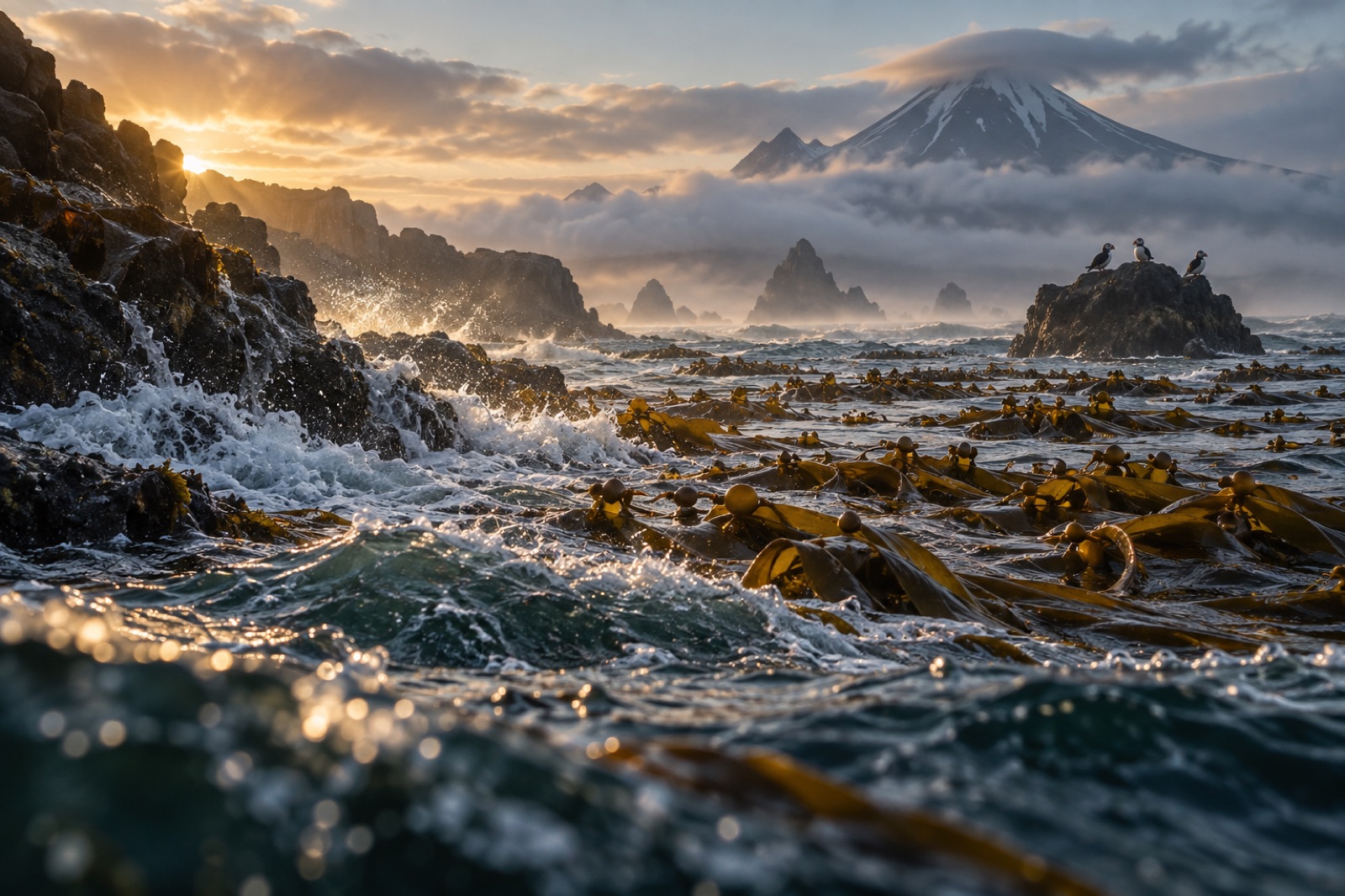
If you want to understand how kelp forests work — and how they break — there is no better classroom on Earth than the Aleutian Islands. The arc sweeps roughly 1,900 kilometres west from the Alaska Peninsula toward Siberia: more than 300 islands and islets, almost all of them volcanic, almost all ringed by kelp, almost none inhabited. This is where, across half a century of fieldwork, ecologists assembled the definitive proof that a single predator can hold an entire coastal ecosystem in place — and what happens when it is removed. Everything modern kelp restoration borrows from trophic theory was earned here, in cold green water, one dive at a time.
Reading this atlas entry
The Aleutians divide naturally into four island groups — the Fox, Four Mountains, Andreanof and Rat Islands, with the Near Islands at the far western end — separated by deep passes where immense tides pump Pacific water into the Bering Sea and back. Distances here are continental; weather is maritime in the extreme; underwater visibility swings from pea soup to cathedral clarity within a tide cycle. What unifies the arc is the reef itself: submarine bedrock shelves mantled in brown algae, from film-thin annuals up to thicket-forming perennials, occupying one of the strongest current regimes on the planet.
The geology: a burning rim, a cold sea
The Aleutians sit where the Pacific Plate grinds beneath North America, which is why the islands are really the tips of a submerged mountain chain — more than fifty historically active volcanoes rising straight out of the ocean. For a kelp forest, vulcanism is a gift. Fresh basalt and andesite erode into complex, pitted, boulder-strewn reef with endless attachment points, and the steep island slopes mean deep, cold, nutrient-dense water presses right up against the shore.
That water matters more than the rock. The passes between islands funnel some of the largest tidal exchanges on Earth; mixing keeps surface water fertilised far into summer, long after stratification would have starved kelp elsewhere. The result is a coastline that can grow kelp at extraordinary densities — historically, in places, among the most productive kelp habitat measured anywhere.
The otter–urchin–kelp story, where it was written
Every ecology student learns the trophic cascade as an abstract diagram. The Aleutians are where the diagram was measured.
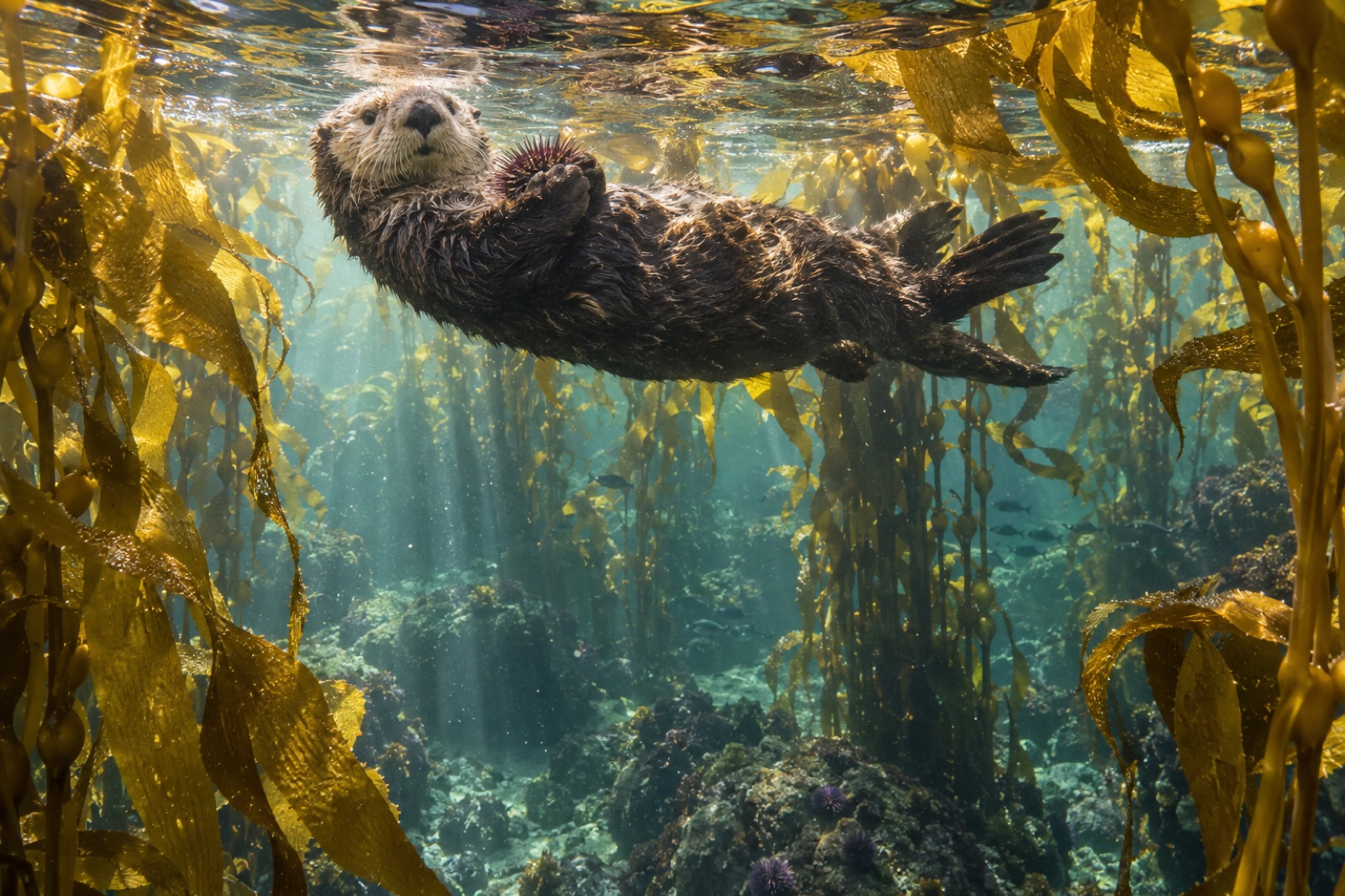
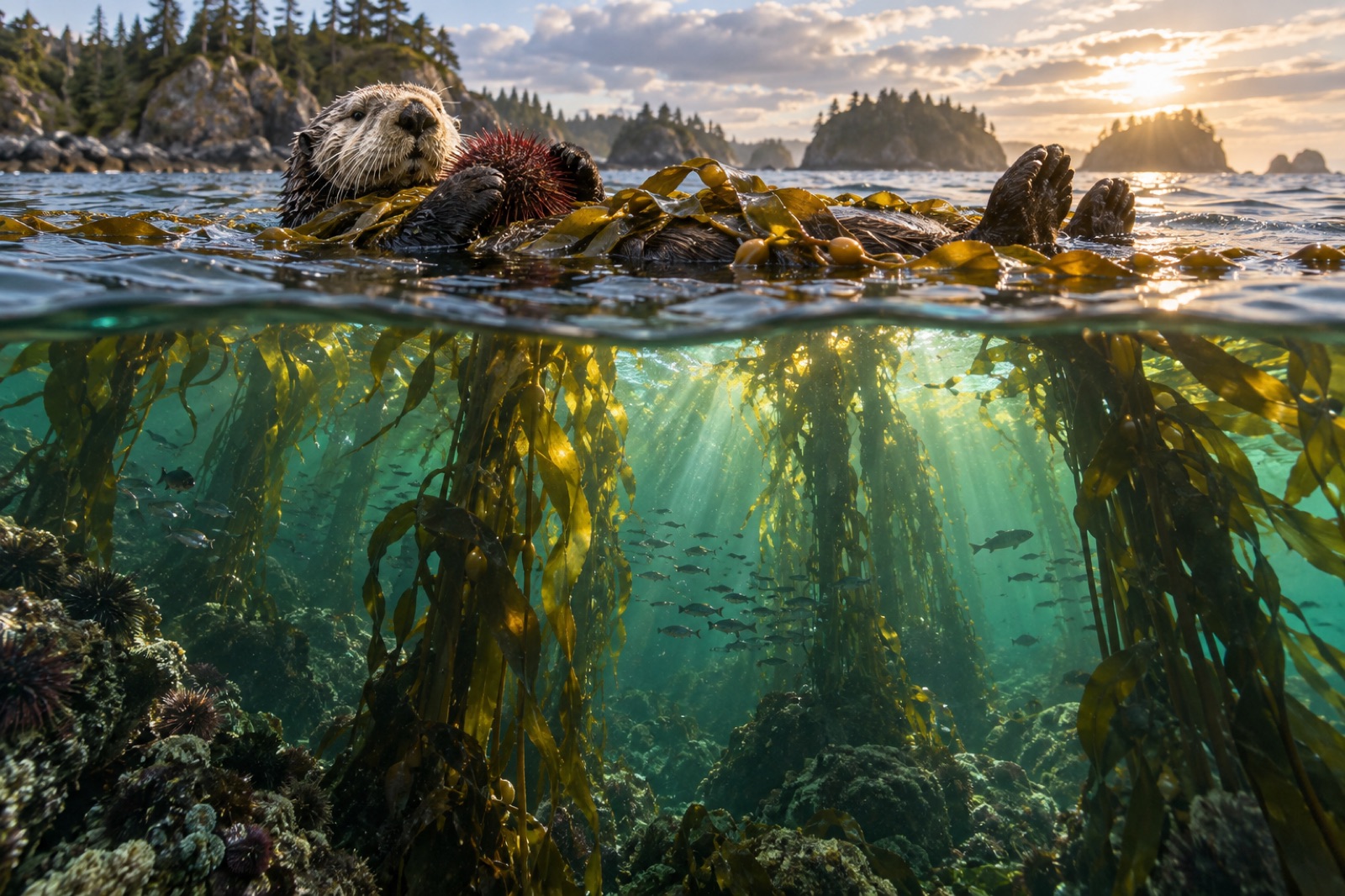
The chain has three links. Sea otters eat sea urchins. Urchins eat kelp. So otters, by eating urchins, protect kelp. Simple — but before the Aleutian work, nobody had shown it operating across whole archipelagos.
The natural experiment came from history. Beginning in the 1740s, Russian and later American fur traders hunted the Aleutian sea otter population to the edge of extinction; by the early twentieth century, only a handful of remnant colonies survived. Where the otters vanished, kelp forests collapsed into urchin barrens — seafloors paved with hungry urchins and fields of coralline algae, the forests' structural algae grazed to stubble. Where tiny otter refuges hung on, the forests hung on too.
In the 1970s, ecologist Jim Estes and colleague John Palmisano compared islands with otters against islands without — Shemya and Amchitka against otter-free Amchitka-era comparison sites like Alaid and Nizki — and published one of the most consequential comparisons in marine ecology. Otter islands: lush kelp, abundant fish. Otter-free islands: barrens. As legal protection allowed otters to re-colonise island after island through the century, each recovery flipped the local reef back from barren to forest, on schedule, in sequence. It was as close to a controlled experiment as an entire archipelago allows.
Then the Aleutians produced a second, darker lesson. Through the 1990s, otter numbers across the western arc crashed — in some surveys falling by well over half in a few years. Estes and colleagues attributed the decline to a new pressure: killer whales that had begun taking sea otters, possibly after their great-whale and pinniped prey in the Bering Sea dwindled. Where otters fell back, urchins rose and kelp thinned again — the whole cascade re-running in reverse, this time with a fourth link at the top. The "killer whale hypothesis" remains partly debated in its details, but the wider point stands: kelp forests sit at the bottom of a food web whose top can be rearranged far offshore, by forces no reef manager controls.
The kelp themselves
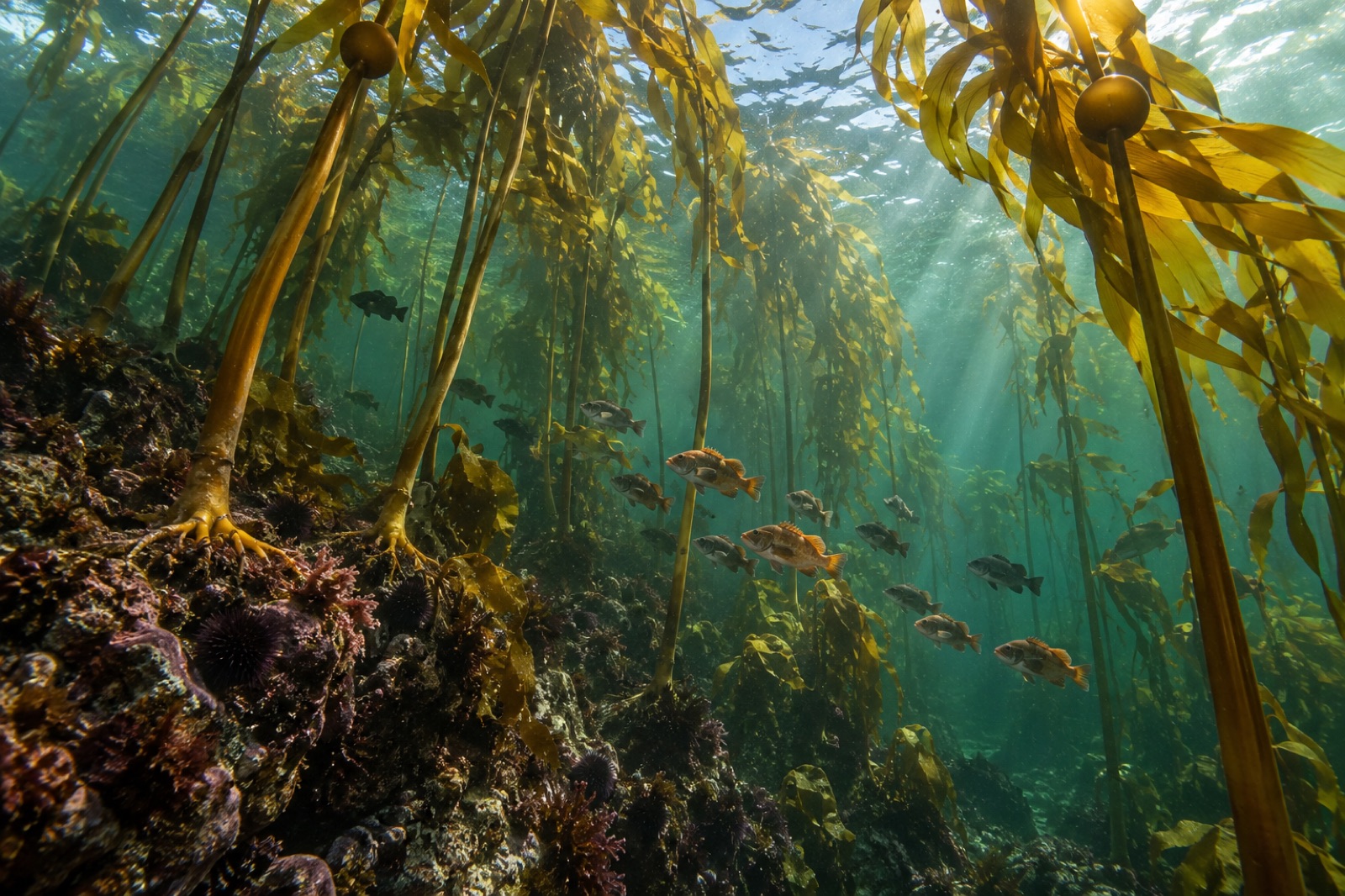
The Aleutian forest is a layered community, and the layering has shifted as the climate warms:
- Dragon kelp (Eualaria fistulosa) — the great canopy former of cold Alaska water, with fronds that can sprawl metres across the surface, forming the true "forest roof" of the shallow zone.
- Sieve kelp (Agarum and relatives) — fleshy, perforated understory species that tolerate dim light under canopy and acidifying conditions that stress calcifiers.
- Bull kelp relatives and annual browns — in more wave-sheltered pockets, fast-growing annuals (cousins of the bull kelp of more southerly coasts) colonise disturbed rock each spring.
- Coralline crusts — the pink, rock-hard paint that paves urchin-grazed zones and, ironically, serves as the settlement cue for young urchins themselves.
Fish life runs heavy to greenlings, rockfish, Atka mackerel and Pacific cod; harbour seals and Steller sea lions haul out on offshore rocks; and the islands hold seabird colonies — auklets, murres, fulmars, tufted puffins — counted in the millions. The kelp forest is this coast's pantry, nursery and climate buffer in one.
The Unangan: nine thousand years of kelp-country seamanship
No account of the Aleutians is complete without the people whose coast this is. The Unangan (Aleut) have lived along the arc for roughly 9,000 years — among the longest continuously occupied maritime cultures anywhere. They hunted seals, otters and whales from iqyax (the skin boats outsiders called "bidarkas"): split-cocked-deck kayaks so refined that every modern sea kayak is their descendant. Otter hunting was managed within social rules that, until the fur trade overwhelmed them, kept predator and forest in working relation for millennia.
The twentieth century was brutal here — forced evacuation of villages during the Second World War, internment in Southeast Alaska, military testing on Amchitka — yet Unangan communities endure on islands like Atka and Unalaska, and contemporary co-management increasingly puts their knowledge at the centre of fisheries and sanctuary decisions. Any restoration ethic working this coast starts from their stewardship, not around it.
State of the coast — and why it matters commercially
Today the Aleutians tell three stories at once. In parts of the eastern arc, otter-cleared urchin control keeps kelp robust. In the west, otter scarcity leaves broad urchin barrens that have persisted for decades — some of the oldest continuously barren seafloor documented anywhere. Overlaying both, warming water and ocean acidification are shifting which kelp species can dominate, favouring fleshy, stress-tolerant forms over calcifying habitat-builders.
For the restoration industry, the Aleutians are the reference case for both hope and humility. They prove a reef can flip from barren back to forest — and that the flip can take a decade even when conditions are favourable. They prove predator recovery is the single highest-leverage kelp intervention ever demonstrated. And they prove the leverage runs on a hair trigger: a change at the top of the food web, thousands of kilometres away, can unwind it all. Tidewright's northern-Pacific programme design — otter-aware urchin management, genetics-matched seedstock through our Holdfast nursery system, and multi-year verification through Canopy Ledger — draws directly on these lessons, applied to coasts south of the arc where interventions are logistically possible.
Visiting, in theory
Let us be honest: this is not a dive destination in any normal sense. There are no dive resorts, no liveaboards scheduled, no rental compressors. Access is by expedition vessel from Homer or Dutch Harbor, crossing open ocean in one of the world's least forgiving weather factories. A small number of scientific expeditions, charter expedition cruises and research teams make the journey each year; a very few commercial dive operators have run exploratory charters in calm eastern passes. For everyone else, the practical way to see Aleutian kelp is imagery — and the practical way to help is supporting the monitoring and Indigenous-led stewardship programmes that keep data flowing from the arc.
If cold-water kelp wilderness is your interest, start with our guides to kelp forest diving for beginners and snorkelling kelp country, then work up: the Aleutians are a lifetime-goal coast, not a next-trip coast.
Key takeaways
- The Aleutian arc is the natural laboratory that proved the otter–urchin–kelp trophic cascade — the intellectual foundation of modern kelp restoration.
- Historic fur-trade hunting flipped the entire chain once; a 1990s otter crash, plausibly linked to killer whale predation, flipped much of it back. Forests and barrens are alternative states, and switching between them takes years.
- The arc's volcano-built reefs and enormous tidal mixing make it, potentially, some of the most productive kelp habitat on Earth — when urchins are controlled.
- Unangan (Aleut) communities have stewarded this coast for about 9,000 years; their knowledge and co-management are central to its future.
- Warming and acidification are now reshuffling which kelp species win, adding a climate layer the classic cascade story never had to include.
FAQ
Are there kelp forests in Alaska, given how cold the water is?
Yes — some of the finest on Earth. Kelp are cold-water plants by design; they thrive where temperatures stay roughly below about 20°C and nutrients run high. Alaska's combination of cold, current-mixed, nutrient-rich water and rugged rocky substrate is close to ideal kelp habitat, which is why the Aleutian arc historically carried such dense growth.
Why did the fur trade wreck the kelp forests?
Fur traders removed nearly every sea otter along the arc between the 1740s and early 1900s. Without otters eating them, sea urchin populations exploded, and the urchins grazed kelp faster than it could regrow, converting forests to barrens. The damage was a side effect of the pelt trade — nobody yet understood that otters were structurally holding the coast together.
Did sea otters recover in the Aleutians?
Spectacularly, at first: twentieth-century protection let remnant colonies re-spread and drive reef recovery island by island. Then a severe decline hit the western and central arc in the 1990s — most researchers implicate increased killer whale predation — and those regions' otters remain scarce today, with urchin barrens widespread. Eastern Aleutian populations have fared better.
Can you dive the Aleutian Islands?
Only on expedition terms. There is no land-based dive infrastructure; access means a capable vessel, serious self-sufficiency and luck with weather. A handful of research teams and exploratory charters dive the eastern passes. For practical cold-water kelp diving, Southeast Alaska and British Columbia offer the same kelp-family wilderness with far more achievable logistics.
What does the Aleutian story mean for kelp restoration elsewhere?
Three things. First, urchin removal alone can trigger forest recovery — the strongest evidence that barrens are reversible. Second, recovery is slow and nonlinear, so restoration must budget in decades and verify continuously. Third, ecology can overturn engineering: any long-term kelp programme has to plan for predator dynamics, warming and acidification, not just planting.