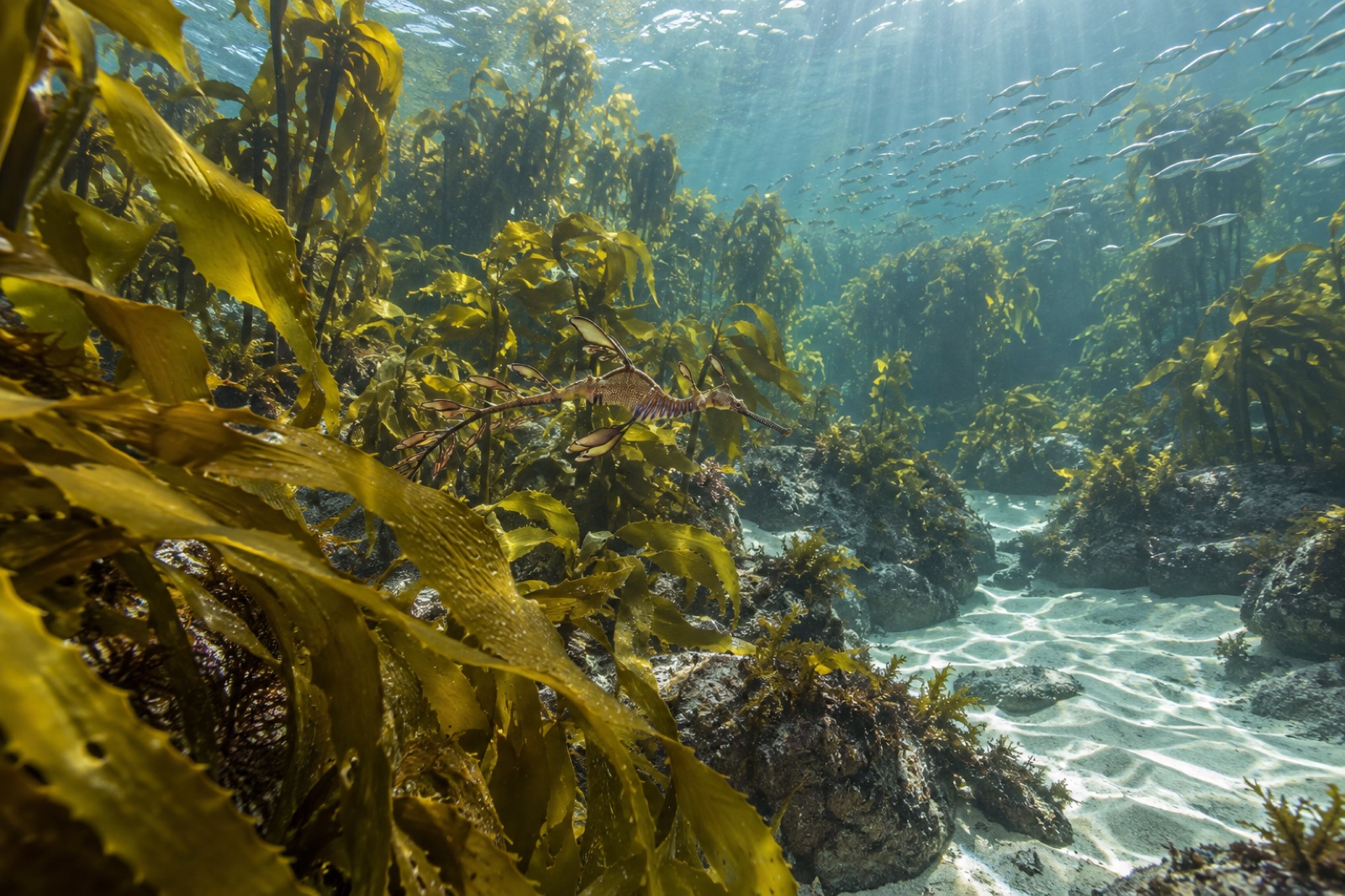
There is a corner of Victoria where the continent simply runs out of land. Wilsons Promontory — "the Prom" to every Melburnian who has ever queued for a campsite — is a granite peninsula that juts farther south than anywhere else on mainland Australia, into the cold, fast, nutrient-rich water where Bass Strait meets the open ocean. Above water it's famous for wombats and beaches that squeak. Below water, it's one of the strongest kelp coastlines on the Great Southern Reef: crayweed and common kelp forests wrapped around granite boulders, guarded by Australia's most southerly mainland fur seals. This guide covers what grows there, why it's special, and how to see it.
Where we are
The Prom sits about three hours southeast of Melbourne in Gippsland, a roughly 50,000-hectare national park peninsula joined to the mainland by a narrow, sandy isthmus at Yanakie. The rock itself tells the story: some of the oldest exposed granite in the state, ground smooth by ice-age winds and Bass Strait swells into the rounded tors and whaleback boulders that continue underwater as massive boulder reefs.
That position — a headland dividing two water masses — is the biological headline. The Prom sits in a convergence zone between the warmer waters of eastern Bass Strait and the cooler, productive flow rounding its southern shores. The result is a mixing bowl of marine life: temperate reef species at the eastern or western ends of their ranges overlap here, giving the peninsula a species richness that earlier biological surveys ranked among the highest measured anywhere on Australia's temperate coast.
The kelp communities
Three habitat-forming seaweeds do most of the architectural work:
- Crayweed (Phyllospora comosa) — the lacy, olive-brown seaweed that forms the shallow canopy on exposed reefs, named for the crayfish (southern rock lobsters) that shelter beneath it. It's the same species that makes Sydney's crayweed coast famous, and the Prom holds some of its healthiest Victorian stands.
- Common kelp (Ecklonia radiata) — the workhorse kelp of southern Australia, forming mid-depth forests on nearly every rocky reef around the peninsula, its golden-brown fronds flexible enough for this wave-battered coast.
- Giant kelp and bull kelp relatives — in deeper, more sheltered water around the offshore islands, larger forest-forming species add a third storey where conditions allow.
Under the canopy, the Prom's reefs carry the full supporting cast: weedy seadragons drifting over rubble, abalone in the crevices, southern rock lobster working the fringes at night, and dense stands of sponges and sea tulips on the deeper granite walls.
The seal capital of the south
An hour's boat ride around the southern shores brings you to the islands that complete the picture. Kanowna Island, off the Prom's southeast corner, holds one of the most important Australian fur seal breeding colonies in Bass Strait — thousands of animals in the summer breeding season, with the water below seething with juveniles. For divers and boaters, the etiquette standards from our seal encounter guide apply doubly here: these are working nurseries, and they run on their own rules.
Protection: the marine park system
The Prom's underwater estate is among Australia's earliest and strongest marine protection experiments — a mosaic of national-park no-take zones and managed park waters extending around the peninsula and its islands, first declared in the early 2000s after years of community campaigning. The no-take core areas cover exactly the habitats that matter: the kelp-forested granite reefs, the deep sponge gardens, the seagrass of the sheltered eastern bays and the seal islands. Nearly two decades of protection have made the Prom one of the reference sites where scientists measure what protected temperate reef looks like — which is why it keeps showing up in scientific papers about resilience.
How to visit
- On shore. Base yourself at Tidal River, the national park's visitor hub: campground, cabins, general store and the beach at Norman Bay. From here, shore-accessible snorkelling is best on calm days at sheltered corners of Norman Bay and around the rocky points of the western coves — easy entries, kelp fringes, wrasse and the occasional stingray in the sand channels.
- On the water. The serious kelp forest is boat-only. Local operators run snorkel and dive boats from Port Welshpool and the Prom's own launch points to the island reefs; expect granite swim-throughs, kelp canopy in 5–15 metres, seals in season and cold, clear winter water. Experienced sea kayakers paddle the western coves, but the exposed south and east coasts are expedition water.
- On the trails. Even non-divers can meet the kelp ecosystem: the low-tide rock ledges near Tidal River and the wrack lines on the surf beaches display everything the forest sheds — drift blades, holdfasts, sponges and the occasional crayweed raft.
Seasons and conditions
Water temperature swings from around 12 °C in late winter to the high teens in late summer. Visibility is famously seasonal: winter and early spring often bring gin-clear Bass Strait water (fifteen metres is not rare), while summer brings warmth, crowds and occasionally greener seas. Autumn — March through May — is the connoisseur's season: warmest water, lightest crowds, calmest mornings. Summer northerlies flatten the western bays; southerly swells make the southern shores entirely a look-from-shore proposition.
Reading the Prom as a kelp story
The Prom is the Great Southern Reef's eastern sentinel — far enough south, cold enough and protected enough to give scientists a benchmark when warmer coasts fail. Walk Squeaky Beach at dawn, snorkel the Norman Bay fringes at midday, and stand at the lighthouse track at dusk while the swell unloads on the granite below: you'll have traced, in one day, the whole arc from wild coast to sheltered kelp lagoon that makes this one of the essential temperate-marine places in Australia.
Key takeaways
- Wilsons Promontory is mainland Australia's southernmost point — a granite peninsula sitting in a Bass Strait convergence zone with exceptional temperate-reef biodiversity.
- Crayweed and common kelp build the shallow forests; deeper and offshore island reefs add larger kelps and sponge gardens.
- Kanowna Island hosts a major Australian fur seal breeding colony — treat it as a nursery and follow strict encounter etiquette.
- The Prom's marine national park system is one of Australia's best-known protected temperate reefs and a scientific reference site.
- Visit from Tidal River for shore snorkelling, or by boat for the island reefs; late autumn gives the best combination of warm water and quiet.
FAQ
Yes — the sheltered corners of Norman Bay near Tidal River offer easy shore snorkelling over kelp fringes and rocky points on calm days. The richest kelp forest, seal colonies and granite swim-throughs lie around the offshore islands and require a boat tour.
The peninsula's waters are covered by a mosaic of marine protected areas, including no-take national park zones around the key reefs and islands plus managed park water between them. Fishing and collecting are prohibited in the no-take zones; check the current zoning map before any harvest activity in managed areas.
What kelp species grow at the Prom?
The shallow exposed reefs are dominated by crayweed (Phyllospora comosa) and common kelp (Ecklonia radiata); deeper, sheltered reefs around the islands carry larger forest-forming kelps and dense understory seaweed communities.
Winter offers the clearest water (but the coldest, around 12 °C — bring a drysuit or thick wetsuit). Late summer to autumn offers the warmest water and often excellent vis. Regardless of season, conditions are swell-dependent; local operators won't run in heavy southerly weather, which is the honest answer.
Are there really seals at the Prom?
Yes — Kanowna Island, off the southeast coast, is one of Bass Strait's most significant Australian fur seal breeding colonies, and seals are regularly encountered around the island reefs by boat tours. Observe legal approach distances: this is habitat first and an attraction second.