Atlas9 min read
Sydney's Coast: The Crayweed Comeback Story
Sydney lost its crayweed forests to sewage in the 1980s — then brought them back. A guide to the city's kelp, golden kelp meadows and dive reefs.
Dr. Mara Ellison ·
From Palm Beach to Kurnell, a snorkel-and-dive trail along Sydney's replanted crayweed reefs: what to see, when to go, and how a city regrew a forest.
Sydney did something no other big city has quite managed: it lost a kelp forest to its own pollution, cleaned up its act, and then planted the forest back — by hand, reef by reef — within sight of some of the most famous beaches on Earth. If you are here to find out where to actually see the restored crayweed coast and how to swim it, this is the trail guide: a north-to-south itinerary of the reefs where the comeback is visible underwater today. For the full backstory of the disappearance and the science of the replanting, our companion piece Sydney's Coast: The Crayweed Comeback Story tells it in depth; this one gets you in the water.
Sydney's urban reef runs on sandstone ledges from Barrenjoey Head in the north to Kurnell in the south — roughly 70 kilometres of rock, beach and headland. Two seaweeds build the underwater architecture: the golden meadows of Ecklonia radiata, and the denser, bushier canopies of crayweed (Phyllospora comosa), the southeast Australian forest-former that vanished from the metropolitan shore in the 1980s and has been returning to transplanted patches since the early 2010s. Around both swim the civic celebrities of Sydney diving: eastern blue gropers, Port Jackson sharks, cuttlefish in their thousands each winter, and the weedy seadragons of the southern bays. Most of the sites below are reachable off the sand, for free, in an afternoon.
Start at the top. The reefs around Barrenjoey Head never fully lost their brown seaweed canopies, and the kelp here is what ecologists treat as the healthy reference condition — the ecological memory the rest of the coast is being steered toward. The snorkelling around the protected corner of the Pittwater side is mellow and pretty, with golden kelp on the shallow rock and luderick and drummer grazing the turf edges. On flat mornings the walk up to the lighthouse above gives you the whole coast's geography in one sweep.
Long Reef, that flat-topped headland running out between Collaroy and Dee Why, is where the restoration story is most legible underwater. It held some of the closest surviving crayweed stands to the lost urban shore, making it a donor site for transplantation, and its aquatic reserve protects the ledges where weedy seadragons drift through kelp fringes in plain sight of the surf club. It is one of the best easy shore dives in the city — enter on the western side, keep off the exposed eastern face in swell, and check the aquatic reserve rules before you take anything from anywhere.
Cabbage Tree Bay, along the Manly to Shelly Beach walkway, is Sydney's classroom reef: a fully no-take aquatic reserve where blue gropers — the big, inquisitive NSW state fish — cruise up to inspect snorkellers, bream hang in the shallows, and rays fold themselves into the sand gutters. The kelp sits mainly on the rock edges; the bay's real lesson is what protection does to fish behaviour. Nearby, the harbour-side reefs at North Harbour and around Little Manly pick up a softer, silt-tolerant seaweed community — a reminder that estuarine edges are their own habitat, not failed ocean reefs.
This is the stretch the phrase "crayweed coast" now belongs to. Around Bondi's northern rocks, Mackenzies Point and further south, researchers and community divers bolted down mats of fertile crayweed transplanted from donor reefs — and those patches survived, spread and began establishing their own juveniles. Snorkel the shallow ledges on a calm day and you can find dense brown canopy where none existed a generation ago, holding leatherjackets, sweep and the occasional passing kingfish. It is modest next to the wilderness coast of the Great Southern Reef, and that is exactly the point: this is what restoration looks like when it happens between apartment blocks.
Maroubra's northern headland carries more of the transplanted patches, and offshore at Magic Point one of the east coast's more reliable grey nurse shark aggregations circles a cave system in 15 to 20 metres — a boat dive, but one every qualified Sydney diver should bank. Just south, Malabar holds some of the best surviving and recovering brown seaweed beds close to the city core, an easy boat or confident shore dive with big sponge gardens under the kelp fringe.
End at the bottom of the map. Kurnell's kelp-edge meadows over sand — especially the famous boat channel site known simply as The Steps — are Sydney's weedy seadragon nursery, the most dependable place in the state to spend a dive watching a male dragon carry his egg tail through the weed. The water here is influenced by Botany Bay's exchange, so pick high tide and a slack for clarity, and move slowly: dragons reward the patient. Our macro photography in kelp guide has the settings if you are carrying a camera.
Sydney is a four-season kelp coast, which is rarer than it sounds:
The short version, for the shoreline signpost: crayweed disappeared from roughly 70 kilometres of metropolitan coast in the 1970s and 80s as shoreline sewage outfalls degraded the water; deep ocean outfalls commissioned in the early 1990s fixed the cause; and when the forest did not return on its own, scientists and volunteers transplanted fertile adults onto bare reefs — starting around 2011 — and watched them take root and reproduce. It remains one of the world's clearest proofs that brown seaweed forest restoration can work once the original pressure is removed, and it is the working template behind restoration efforts from Tasmania's east coast to Tidewright's own (fictional) programs. The full account — including the years nobody replanted anything — is in Sydney's Coast: The Crayweed Comeback Story.
The shallow ledges between Bondi and Coogee hold some of the earliest and best-established transplanted patches, and Mackenzies Bay is a good starting point on a calm day. For the healthiest natural stands, head north to Long Reef aquatic reserve.
Most of the trail is ideal snorkelling territory — the kelp and canopies sit in two to eight metres of water, and Cabbage Tree Bay, Long Reef and the northern Bondi rocks are all beach entries. Boat dives like Magic Point and deep Kurnell sites are for qualified divers.
March to May, when the water is still warm and the swell most settled. Winter is colder (about 15 °C) but rewards hardy swimmers with giant cuttlefish spawning aggregations and grey nurse sharks at the gutters.
No — and no one involved pretends it is. Transplanted patches have survived, reproduced and spread beyond their mats, but the forest is decades from its historic extent. Current effort is shifting toward planting heat-tolerant stock as the coast warms, the same tolerance question we cover in kelp thermal tolerance.
Yes. Eastern blue gropers are curious, calm and fully protected in NSW. In no-take reserves like Cabbage Tree Bay they approach swimmers on their own terms — float, stay still, and never try to touch or feed them.
Sydney lost its crayweed forests to sewage in the 1980s — then brought them back. A guide to the city's kelp, golden kelp meadows and dive reefs.
Dr. Mara Ellison ·
Golden kelp forms the backbone of Australia's Great Southern Reef. Learn to identify Ecklonia radiata and why this habitat-maker is on the move as oceans warm.
Dr. Mara Ellison ·
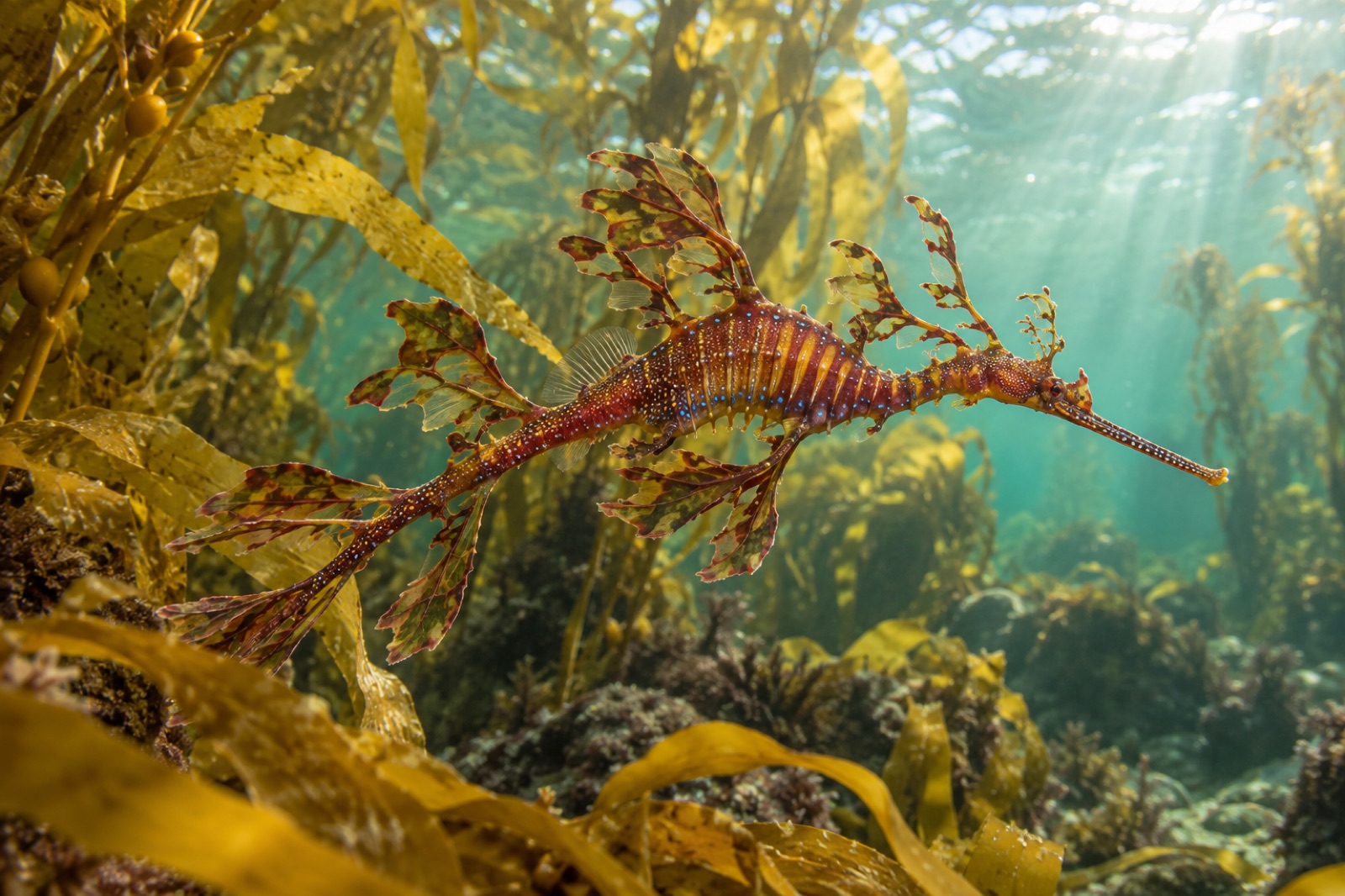
Australia's weedy seadragon drifts through kelp like fallen seaweed come alive. Discover its camouflage, male egg-brooding, range and conservation.
Dr. Theo Nakamura ·