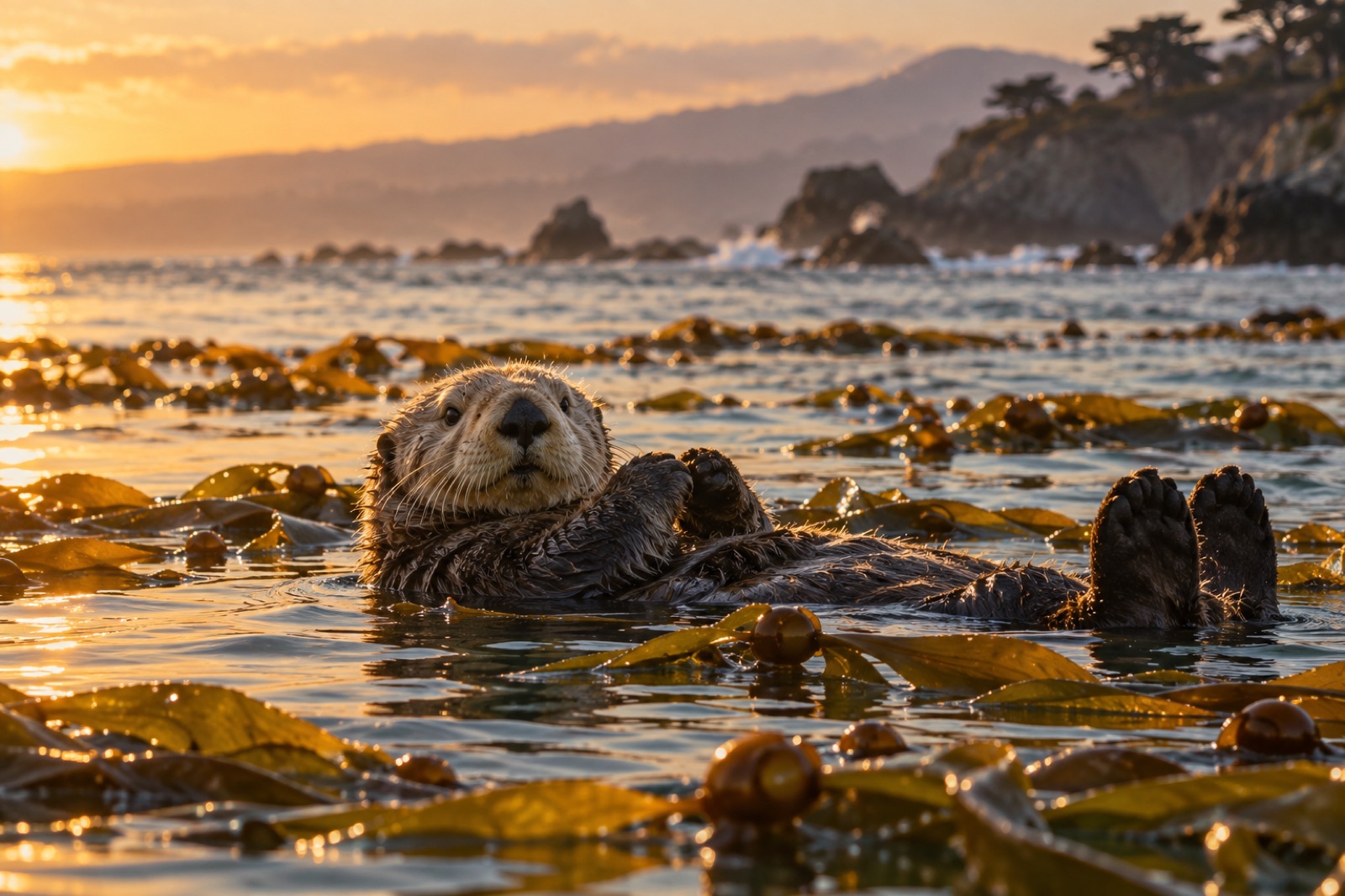
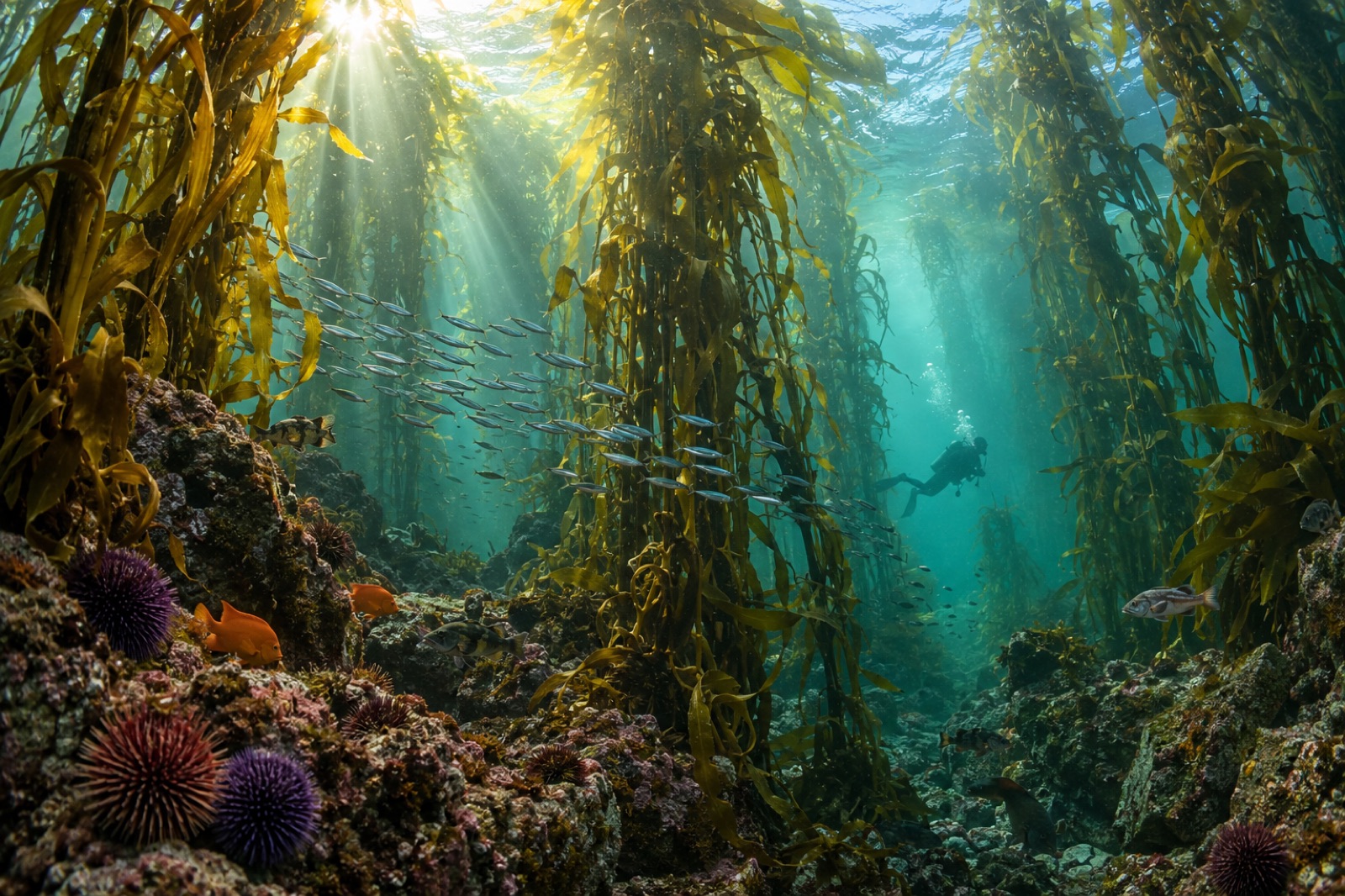
Kelp forests feel generous. Seals barrel-roll past your shoulder, garibaldi hover inside territorial circles, sea otters crunch urchins on their chests within finning distance. It is easy to experience that closeness as permission. It often isn't. A marine animal that lets you near is not necessarily calm — it may be habituated, cornered, protecting a pup or a patrol zone, or deciding whether you are worth the metabolic cost of moving away. This guide gives kelp-country divers and snorkellers a practical ethics: the distances that protect animals, the body language that tells you you've gone too far, and the habits that make wildlife encounters something both sides keep.
The core principle: let the animal set the distance
The most robust rule in wildlife watching is also the simplest: the animal chooses proximity, not you. If a harbour seal wants to stop three metres from your mask and stare, wonderful — you stay motionless and let it happen. If a garibaldi swells, arches its back and scrapes at the substrate two metres from your face, that is not an invitation; it is a homeowner asking you to back off their garden.
Every distance recommendation in this article is a default for your choice of position. If an animal closes that distance on its own initiative, relax, stay vertical and quiet, and don't exploit the trust by reaching out.
Legal minimums and sane minimums
Marine wildlife laws vary by country, and they are almost always minimums — the floor below which you are breaking the law, not the target for a good encounter. In the United States, approaching marine mammals closer than 45 metres in a boat or paddling a kayak within about 23 metres of a hauled-out seal can violate the Marine Mammal Protection Act; Australia, New Zealand and South Africa have similar approach limits to seals, dolphins, and whales. Swimming itself is often legal at closer ranges, but legal is not the same as ethical. The practical dive distances below sit well above the legal minimum and well below what spooks most animals:
- Seals and sea lions (in water): stay five metres or more; if an animal approaches closer, hold position, don't chase.
- Sea otters: ten metres minimum when they are resting or with pups; read our fuller note in watching sea otters without bothering them.
- Hauled-out seals and sea lions on rocks or beaches: stay at least 30 metres away on the surface; enter the water where you'll pop up no fewer than 50 metres from the haul-out if you can manage it.
- Nesting or foraging birds overhead (cormorants, oystercatchers): don't dive or snorkel directly under an active nesting ledge; disturbance flushes birds and exposes eggs.
- Sharks and large rays: give ten metres, stay well clear of any resting place, and never corner an animal against rock or reef.
Reading body language: four distress tells
Ocean animals don't have a word for "get lost." They have a set of behaviours. Learn these four:
- Repeated directed looking. A seal otter that keeps re-fixing a slow stare at you, rather than scanning or dozing, is tracking you. That is concern, not cuteness.
- Hesitation to transit. Any animal that is swimming a clear route and slows, hesitates, or changes course because you are in the middle of the path has moved from tolerance to decision-making. Move off the path; don't make the animal route around you.
- Startle or flush. Wings slapped, urchin dropped, pup grunted, one sudden flipper scoop — any abrupt repositioning caused by your arrival is a cost you have imposed. You've gone too close; retreat gently.
- Mobbing or aggressive posture. Garibaldi swells, garibaldi that won't stop approaching your mask despite lateral distance, a sheephead making a head-on approach and stopping — these are fish with boundary enforcement. Acknowledge it with a slow fin back.
The ethics of approach: a few habits
Don't corner. Any animal between you and solid rock — a crevice, a wall, a pile of boulders — has lost an exit. Back away diagonally so the animal sees you open the lane, then stay put.
Don't feed. Feeding wildlife teaches animals to associate humans with calories, which reliably ends in bites, begging habits, relocations and sometimes euthanasia. It is also illegal in most jurisdictions. This includes the casual "well, it ate a scrap once" stories — don't start that tradition.
Don't touch. A slimy kelp blade you can touch all day. An animal's skin carries mucus and surface microbes that don't survive human contact well; fingernails cut the skin of a garibaldi as surely as they cut your own. Hands out is the default; hands on the animal is for veterinary and research work, not recreation.
Slow down around the canopy edge. Surface kelp canopy is a nursery and a hide. Finning fast over the canopy startles juveniles, dislodges grazing snails, and flushes birds; the canopy also conceals surfaces. Kick slowly, keep your body low and horizontal, and give any canopy overhang a few metres of respect.
The special case of otters and pups
Sea otters carry some of the most famous ethic problems in kelp country because they rest at the surface, they look like they are napping, and pups are dependent on mothers near the surface. A resting otter that changes from dozing to eye-fixed staring, or that slips under water and resurfaces at a new distance, has paid metabolic cost to adjust to your presence. Multiply that across dozens of passing kayakers, divers and snorkellers each day, and the cost adds up. For otters:
- Ten metres is a kindness, not a legal floor.
- If you see a mother and pup, treat both as moving targets: close no more than the mother-line allows, exit on a tangent away from the pair.
- Don't tangle a kayak paddle or fin in the canopy between you and an otter; canopy edges are otter habitat, not photo frames.
A fuller otter-specific protocol is in our article on watching sea otters responsibly — highly recommended before a kelp trip that includes otter habitat. For general kelp entry skills first, start with the beginner's guide to kelp forest diving.
Photography ethics: the image is not worth the cost
A wildlife photograph that looks like intimacy is often a photograph of stress. A garibaldi filling the frame usually means a garibaldi asking you to leave its patch. A seal ten centimetres from your dome port usually means you are already too close. Fieldcraft beats proximity: dive slowly, practise buoyancy and stillness, and let interest happen on the animal's schedule. If your autofocus whistle, safety sausage, or bright torch startles an animal, the photograph is testimony to your disturbance, not your closeness.
Why this matters beyond your dive
Disturbance is cumulative. A kelp forest that sees ten ethical divers a day barely notices; one that hosts ten runners-through-the-canopy sees its seals haul out less, its otters burn calories to avoid people, its garibaldi wastes energy chasing shadow-divers. Multiply by a hundred dive days a year, and diver behaviour becomes a real ecological pressure on small coastal reefs — the same reefs that organisations like ourselves at Tidewright work to restore. Individual ethics at the individual kelp forest level is part of making restoration actually recover.
Key takeaways
- The animal chooses your distance; your job is to hold position and let it.
- Legal approach minimums are floors; kind defaults are much further out.
- Four tells — directed staring, hesitating transit, startle/flush, posturing — tell you to ease off.
- Don't feed, don't touch, don't corner, slow down at the canopy.
- Otters, mothers with pups and nesting birds deserve the widest berth of all.
- Cumulative diver behaviour is an ecological pressure; individual restraint is habitat protection.
FAQ
How close can I legally get to a sea lion or seal in the water?
Laws vary by country, but as a general rule many jurisdictions prohibit intentional approach to marine mammals within ~45 metres from boats and specify approach distances (often 10 to 30 metres) in the water. In practice, stay five metres or more from a swimming seal or sea lion, and well over 30 metres from a hauled-out animal. Where an animal voluntarily closes the distance, stay motionless and quiet.
Is it okay to pet a curious sea lion?
No. Wild marine mammals should never be touched, even if they initiate contact. Bites happen regularly to divers who treat a curious mouth as friendly; more importantly, habituation to humans erodes their natural behaviour and endangers the animal. A soft fin-push away and a slow vertical position is the right response.
How can I tell if I've disturbed an animal while snorkelling?
Look for startle responses: dropped food, sudden transit, a hauled-out seal lifting its head, a bird that flushes. If your arrival changes what an animal is doing, you've disturbed it. Back off the distance on the next pass.
Should I ever enter water where seals are hauled out?
Don't enter or surface within about 50 metres of a haul-out; if you do pop up nearby, back away horizontally and keep low. Haul-out is a low-energy, vulnerable behaviour for seals and sea lions — disturbing it costs rest they need.