Explore10 min read
Planning a Shore Dive: Reading the Beach Before You Get In
How to assess a shore dive site step by step: wind, swell, entry and exit points, surge and kelp layout — plus the bailout plan every beach dive needs.
Tom Okafor ·
Kelp forests make navigation both easier (vertical landmarks) and harder (featureless canopy walls). Learn compass discipline plus natural navigation by light and surge.
Part of a learning path
This article is stop 6 of 9 on Into the Canopy — A cold-water diver’s route from first kelp dive to night forest.
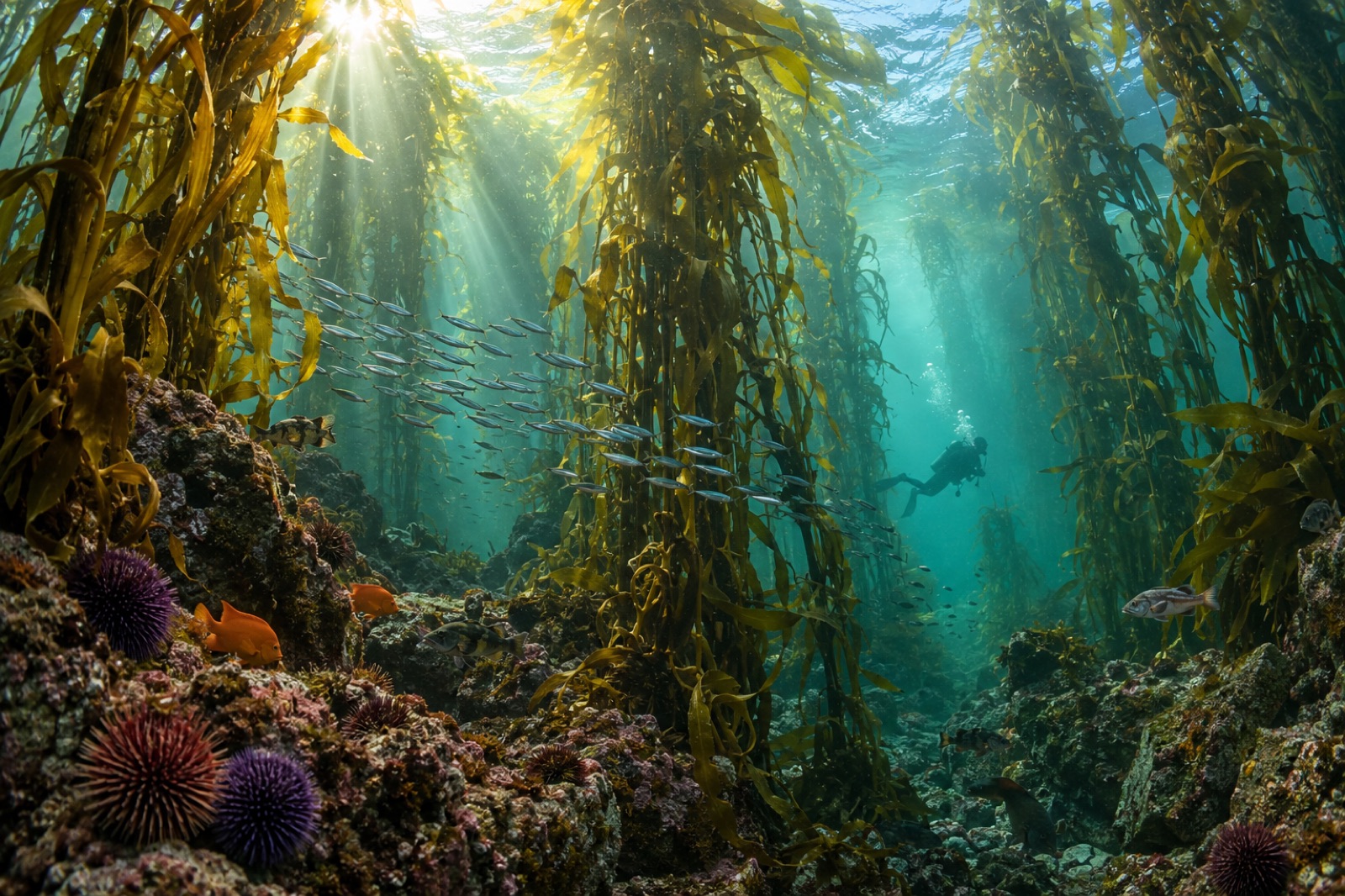
Getting lost in a kelp forest is a strange, gentle experience. There's no panic of open blue water — the shore is never far, and the surface is right there above the canopy. What's lost instead is certainty: which way the entry was, where the reef edge runs, why every lane between the stipes suddenly looks identical. Kelp navigation is a distinctive skill because kelp gives you both more landmarks than any other diving and more visual confusion than any other diving. The divers who handle it best combine two systems — compass discipline and natural navigation — and use each to check the other. This guide teaches both, plus the route patterns that make kelp dives nearly un-losable, and what to do on the rare dive when both systems fail you.
Understand the failure modes first:
A compass in kelp country isn't a backup; it's half the navigation system. Used properly:
This is the satisfying half — reading the living landscape. Kelp offers more natural cues than almost any other underwater terrain:
The "sunball" is your southerly-tending sky glow: in the Northern Hemisphere's temperate coasts the sun tracks the southern sky, and its underwater glow marks roughly that bearing through the day. Caustic patterns on rock and sand lean with sun angle too. None of this is precise to degrees; it's a hemisphere-level sanity check that catches gross compass errors (like swimming your out-heading on the way home).
Swell surge runs along the axis of the incoming waves — on most open coasts, roughly shoreward and seaward. Feel it on your body in the first minutes of the dive, when you still know where you are. Surge is a breathing arrow pointing home-and-away along one axis. If you know you're somewhere east or west of your exit, surge will not tell you which — but it hands you the shoreward direction for free, forever.
Depth contours are the most reliable natural lines in all of shore diving. "Swim out at nine metres, return at seven" is a plan the topography enforces for you: drift deeper than contour and the reef wall reminds you. On multi-level reefs, the ledge between steps is a nearly unbreakable rail. Combine one contour with one compass bearing and you are, for practical purposes, navigationally complete.
Traffic noise can mark a harbour arm; surf noise grows shoreward; at very shallow depths some divers can literally catch the smell of the shore. These bonus channels matter most when you've been disoriented: stop, go quiet, and listen.
Structure the dive so the navigation is done by the route itself:
Every kelp diver will, eventually, surface-look at an unfamiliar coastline. The protocol:
Navigation is a perishable skill; treat it like one:
When you've truly got it, kelp forests stop being mazes and become what they actually are: the most legible terrain in diving — a forest with signposts on every stipe, for the diver who knows the language.
Yes, because the compass isn't only about getting back to a boat — it's about ending the dive where you planned. Surfacing in the wrong place on a shore dive can mean a long surface swim against current or a dangerous exit on rock. And guides get disoriented too; the buddy who independently tracks the route has rescued many a dive plan.
Absolutely — and most divers find wrist-mounted digital compasses easier to sight than analogue. The technique is identical; just make sure you know how to keep it level and calibrated, and that you know the compass display exists before you're peering for it in green water.
The rushed turn. The outbound leg feels effortless because landmarks accumulate; the turn gets taken casually, and the diver swims home 30 degrees off the reciprocal, arriving at an endless stretch of identical coastline. Stop, breathe, confirm with your buddy, then turn.
The light cues flip (sun overhead to the north rather than the south), but surge, depth contours, canopy lean and reef-edge logic are universal. Recalibrate your sun expectations for each hemisphere and the rest travels with you.
Yes — because natural navigation is what catches compass errors and makes diving feel like travel rather than treadmill. Also, compasses fail, flood and get demagnetised; the sun, the surge and the contour never do. The beginner's kelp diving guide starts this habit from dive one.
How to assess a shore dive site step by step: wind, swell, entry and exit points, surge and kelp layout — plus the bailout plan every beach dive needs.
Tom Okafor ·

Kelp forests transform after dark. A night diving guide: lights and light discipline, night planning, the nocturnal shift change, and calming the mind in the dark.
Tom Okafor ·
Your first kelp forest dive is easier — and more magical — than you think. Gear, skills, marine life and etiquette for new divers entering the green cathedral.
Tom Okafor ·